Reproductive System
 Call Kai
 Learn
Learn Practice Test
 Spaced Repetition
 Match
Match Flashcards
 Knowt Play
1/161

There's no tags or description
Looks like no tags are added yet.
Name | Mastery | Learn | Test | Matching | Spaced | Call with Kai |
|---|
No analytics yet
Send a link to your students to track their progress
162 Terms
What does HPG stand for?
Hypothalamic-Pituitary-Gonadal Axis
What happens in Hypothalamic-Pituitary-Gonadal Axis
Hypothalamus releases GnRH
Anterior pituitary releases FSH and LH
Gonads (ovaries/testes) release sex hormones
What hormone is released by the hypothalamus to start reproductive hormone secretion?
Gonadotropin-Releasing Hormone (GnRH)
What does GnRH stimulate?
Release of FSH and LH from the anterior pituitary gland.
What are the gonadotropins?
FSH and LH
What role does leptin play in puberty?
signals the hypothalamus that sufficient energy stores exist to begin puberty.
Why do children not enter puberty immediately after birth?
Small amounts of estrogen/testosterone inhibit GnRH release.
How long after menarche do cycles typically become consistently ovulatory?
3 years
What is usually the first sign of puberty in males?
Enlargement of the testes and scrotum.
At what age does male puberty generally begin?
Between ages 8–14.
Which hormone initiates pubic, axillary, and facial hair growth before the testosterone surge?
DHEA (dehydroepiandrosterone) from the adrenal glands.
What indicates sexual maturity in males?
Presence of mature sperm in semen.
What are nocturnal emissions?
"Wet dreams" caused by rising testosterone levels during puberty.
What is usually the first sign of puberty in females?
Breast budding (thelarche).
At what age does breast budding typically occur?
Ages 8–13.
What develops after breast budding?
Pubic and axillary hair.
When does menarche usually occur?
Approximately 2 years after breast development begins.
Is fertility immediately established after menarche?
No.
Regular ovulation and fertility often require another 2 years.
When is genetic sex determined?
At fertilization.
How many sex chromosomes are present in humans?
Two sex chromosomes.
What are autosomes?
The 44 non-sex chromosomes.
What sex chromosomes do females possess?
XX
What sex chromosomes do males possess?
XY
Which parent determines the genetic sex of the offspring?
The father.
What happens if an X-bearing sperm fertilizes the egg?
XX female offspring.
What happens if a Y-bearing sperm fertilizes the egg?
XY male offspring.
What does SRY stand for?
Sex-determining Region of the Y chromosome.
What is the function of the SRY gene?
Initiates testis development.
Why is the SRY gene important?
It triggers male sexual differentiation.
What is the sexually indifferent stage?
Early embryonic stage when reproductive structures can become male or female.
What are gonadal ridges?
Embryonic structures that develop into testes or ovaries.
During what week do gonadal ridges first appear?
Week 5
What are primordial germ cells?
Cells that migrate from the yolk sac and become sperm- or egg-producing cells.
Where do primordial germ cells originate?
Yolk sac.
What are mesonephric ducts also called?
Wolffian ducts.
What do Wolffian ducts become?
Male reproductive ducts.
What are paramesonephric ducts also called?
Müllerian ducts.
What do Müllerian ducts become?
Female reproductive ducts.
When does testis formation begin?
7 weeks
What three events occur during male gonad development?
Seminiferous tubules form.
Wolffian ducts develop.
Müllerian ducts degenerate.
What hormone causes development of male reproductive ducts?
Testosterone.
When does ovarian development begin?
About one week after testis development begins.
What three events occur during female gonad development?
Follicles form.
Müllerian ducts develop.
Wolffian ducts degenerate.
What common embryonic structure gives rise to external genitalia in both sexes?
Genital tubercle.
What other embryonic structures contribute to external genitalia?
Urethral groove
Urethral folds
Labioscrotal swellings
What determines whether male or female external genitalia develop?
Presence or absence of testosterone.
What structure guides gonadal descent?
Gubernaculum.
When do testes descend into the scrotum?
About two months before birth.
Through what structure do the testes descend?
Inguinal canal.
What stimulates testicular descent?
Testosterone.
What is the spermatic cord?
A structure containing vessels, nerves, and connective tissue supporting the testes.
Do ovaries descend?
Yes, but only to the pelvic brim.
What does the female gubernaculum become?
Ovarian ligament and round ligament.
What is menopause?
Permanent cessation of menstruation.
When is menopause officially diagnosed?
After one full year without menstruation.
At what age does menopause typically occur?
Ages 46–54.
What causes menopause?
Depletion of ovarian follicles and declining estrogen production.
What is perimenopause?
Transitional period before menopause with irregular cycles.
What are common symptoms of menopause?
Hot flashes
Vaginal dryness
Bone loss
Thinning skin
Mood changes
Why are postmenopausal women at greater risk for osteoporosis?
Estrogen normally helps maintain bone density.
Why does cardiovascular disease risk increase after menopause?
Estrogen declines, causing cholesterol changes.
What is hormone replacement therapy (HRT)?
Administration of estrogen (sometimes progesterone) to reduce menopausal symptoms.
Benefits of HRT?
Reduces hot flashes
Reduces bone loss
Improves quality of life
Risks of HRT?
Increased breast cancer risk
Increased heart disease risk
Pampiniform venous plexus
Cools arterial blood to keep the testes below core temperature
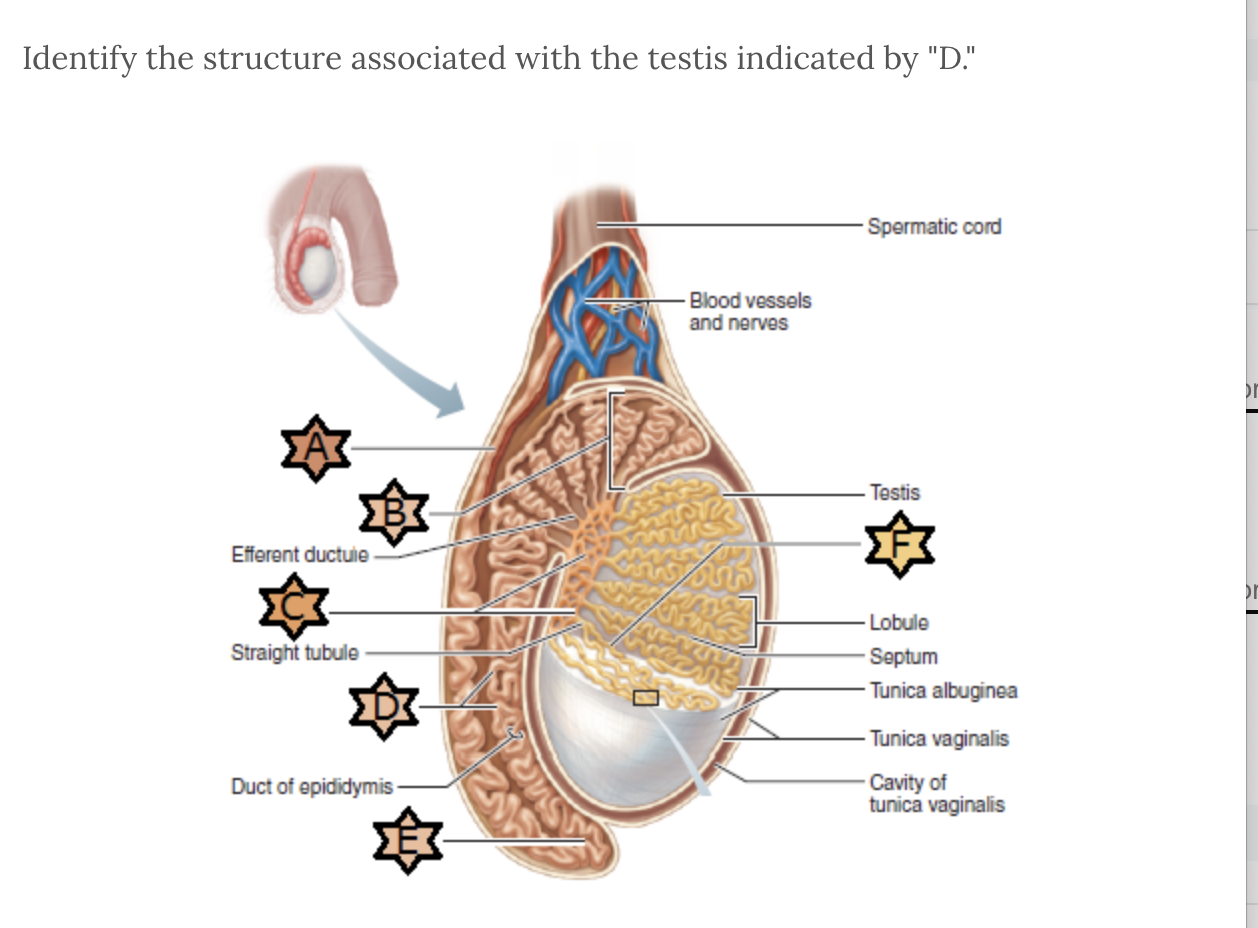
Identify structure D
Body of epidermis
Which of the following absorb(s) heat from the testes?
The pampiniform plexus
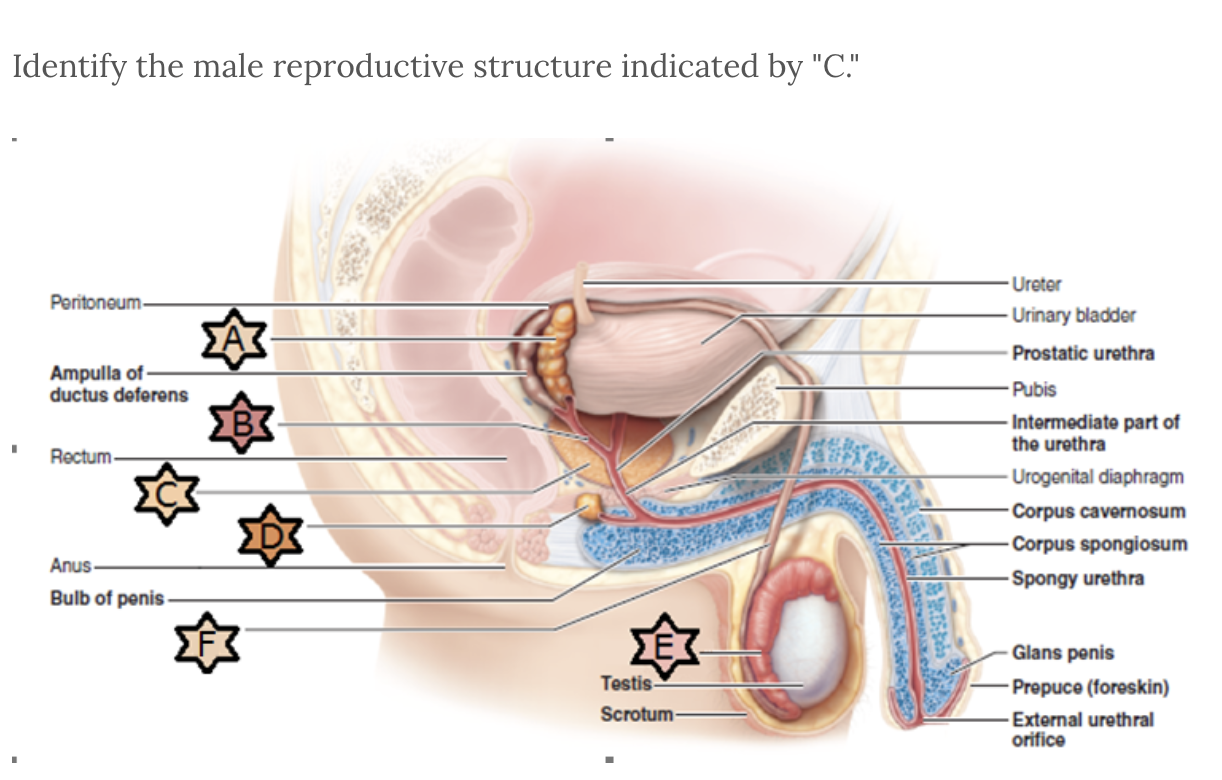
Identify structure C
Prostate
Which structure surrounds the male urethra?
Corpus spongiosum
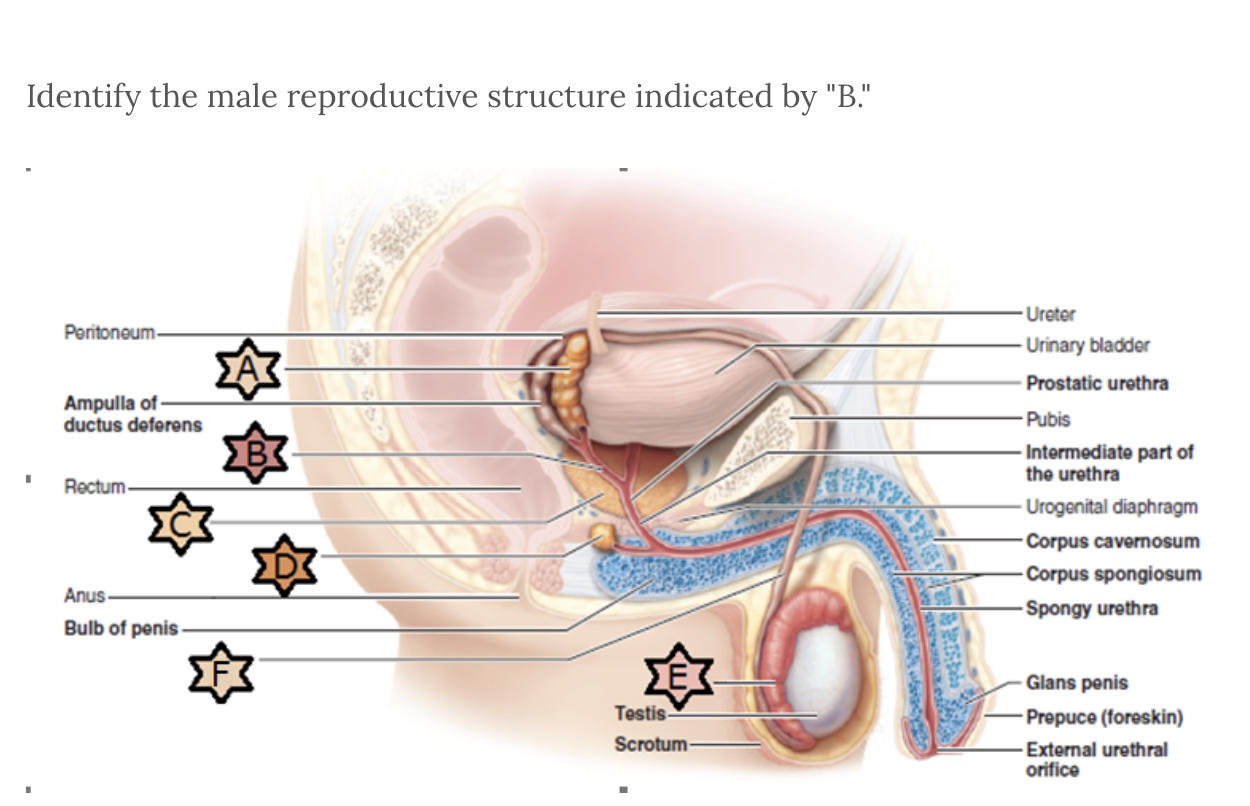
Identify structure B
Ejactulatory duct
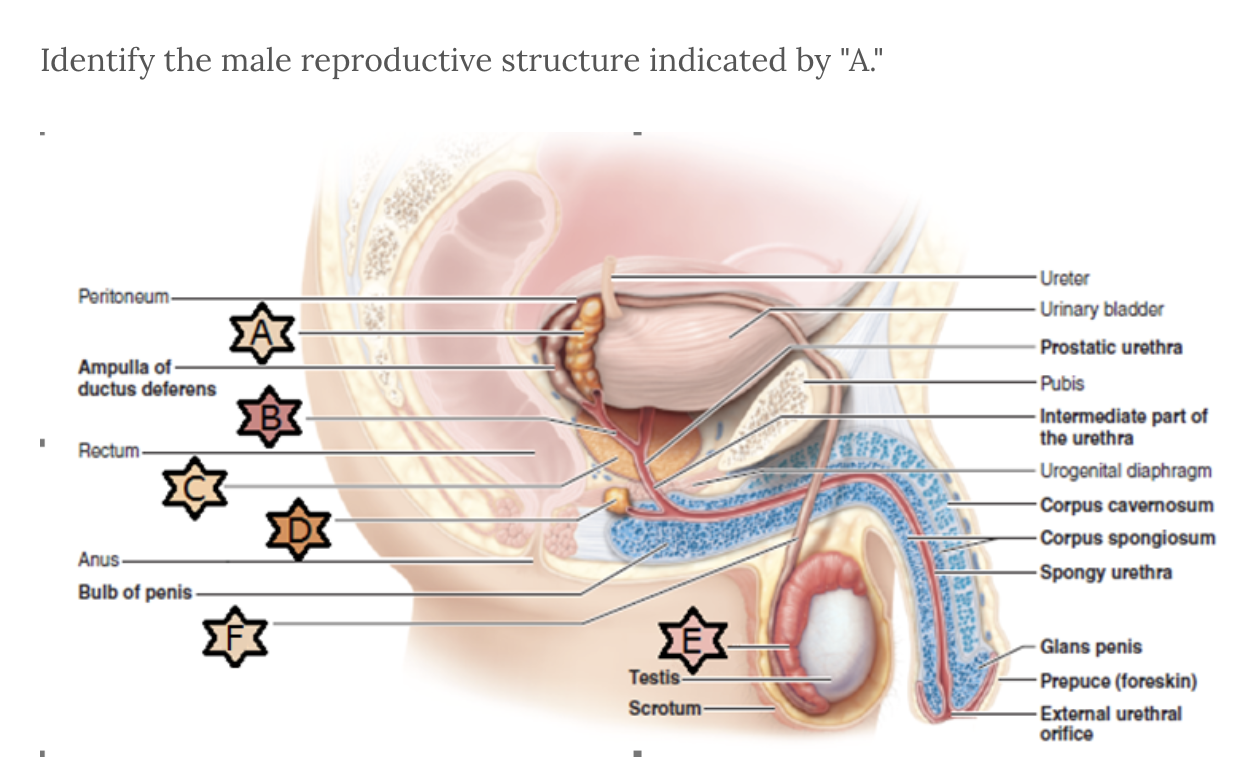
Identify structure A
Seminal gland
Which structure(s) make up most of the penis?
Corpora cavernosa
In a vasectomy, which part of the male duct system is cut?
Ductus deferens
Which of the following statements about myoid cells is true?
They surround the seminiferous tubules and contract rhythmically to squeeze sperm and testicular fluid through the tubules out of the testes.
Which of the following structures makes up most of the male urethral length?
Spongy urethra
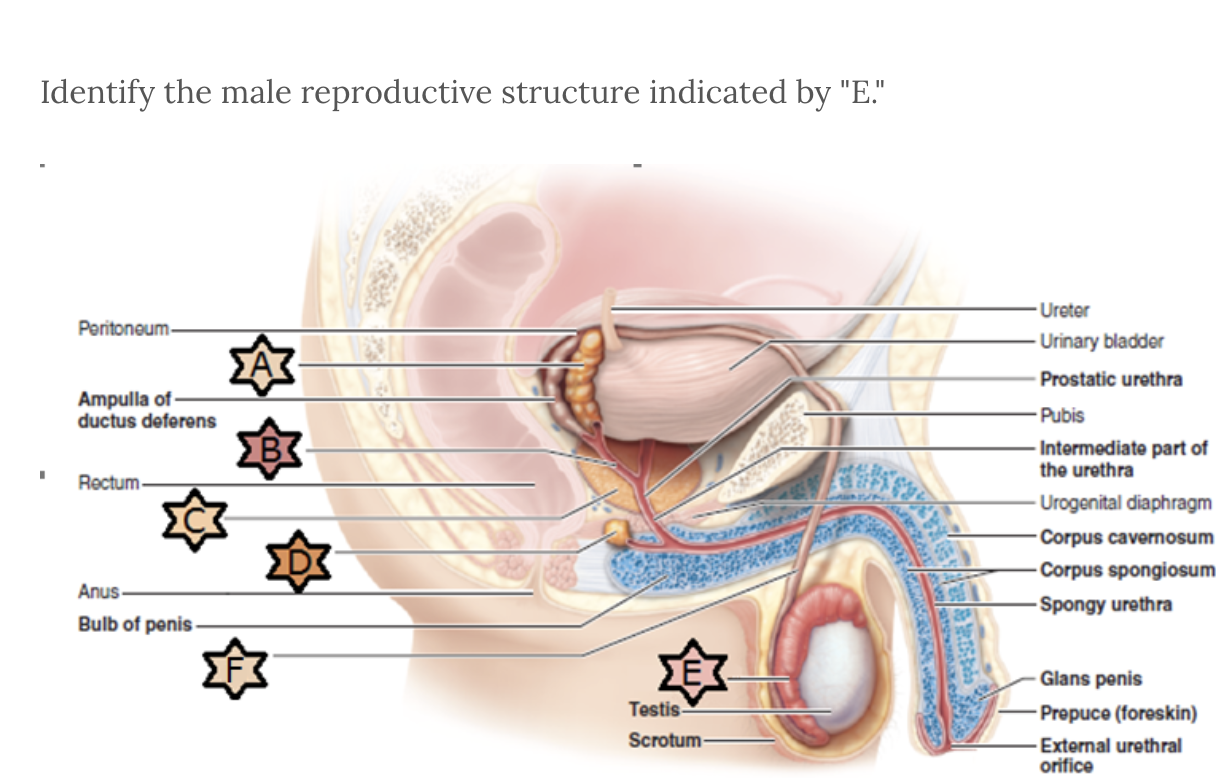
Identify E
epididymis
Epididymis
Site of sperm storage
Select the correct order of accessory ducts from proximal to distal.
epididymis, ductus deferens, ejaculatory duct, urethra
The reason why the testes are suspended in the scrotum is __________
Cryptorchidism
Undescended testes
Which of the following absorb(s) heat from the testes?
The pampiniform plexus
Which of the following structures passes through the inguinal canal?
The spermatic cord
Tunica albuginea.
Fibrous capsule of the testes
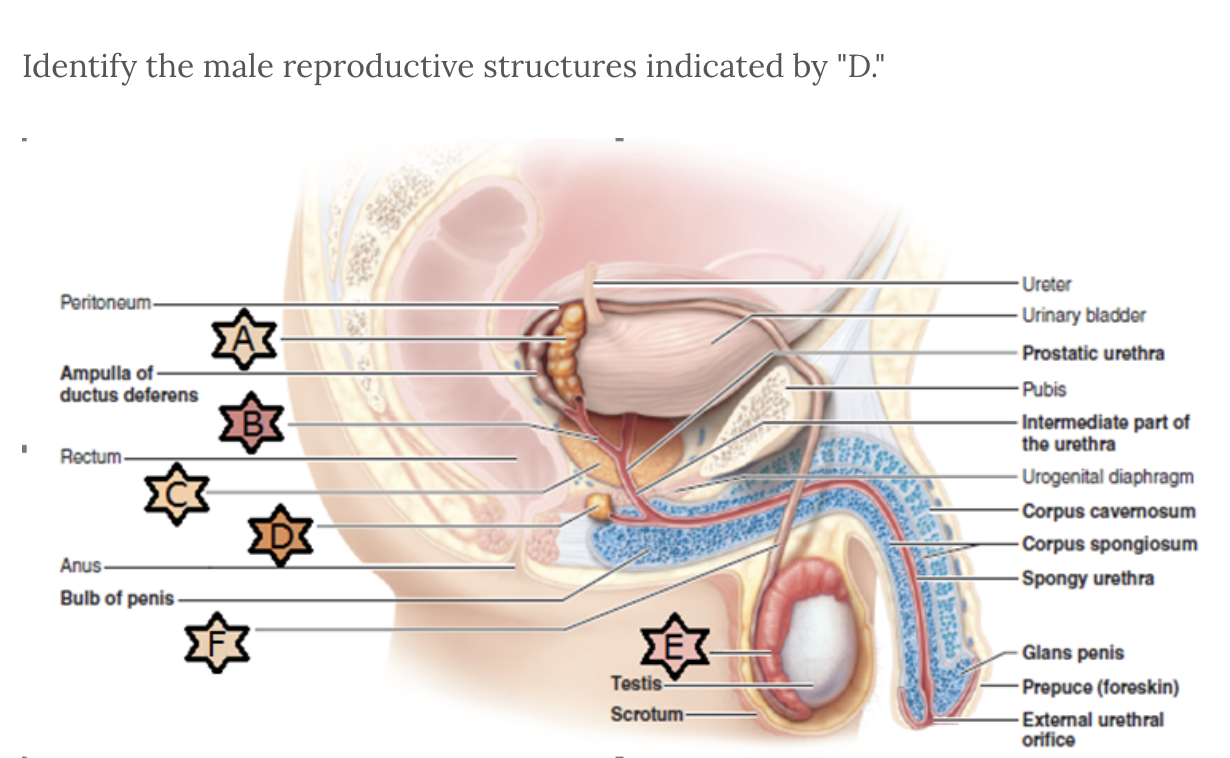
Identify D
Bulbo-urethral gland
In response to warmth, the scrotum __________.
Increases surface area
Which structure surrounds the male urethra?
Corpus spongiosum
Which structure(s) make up most of the penis?
Corpora cavernosa
Which of the following structures passes through the inguinal canal?
The spermatic cord
Conversion of haploid spermatids to spermatozoa is specifically called __________.
The area of the sperm cell that contains many mitochondria is the __________.
midpiece
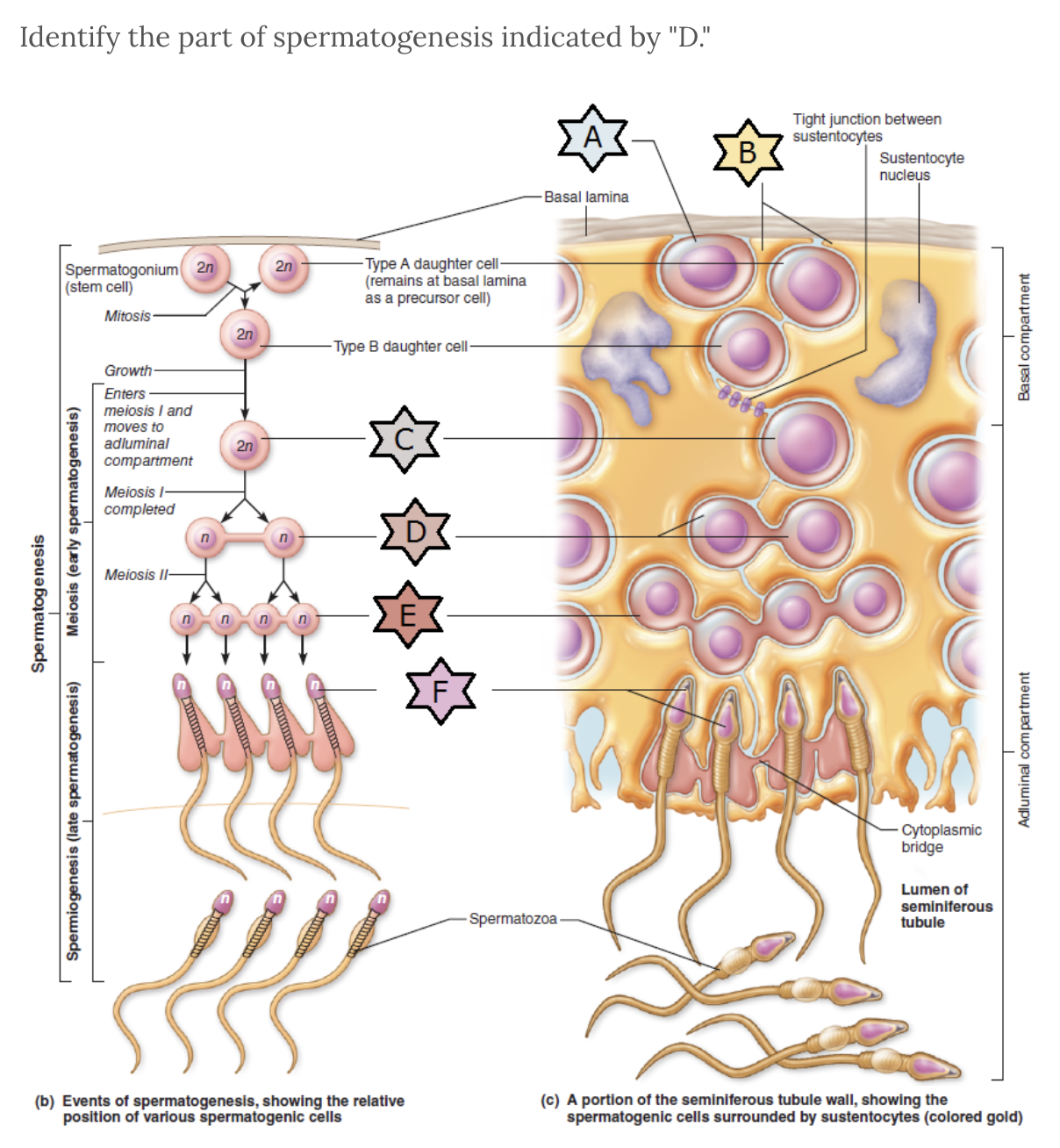
Identify D
secondary spermatocyte
Match the phase of meiosis to the event that occurs in the phase: Telophase II
Four genetically unique haploid cells are formed
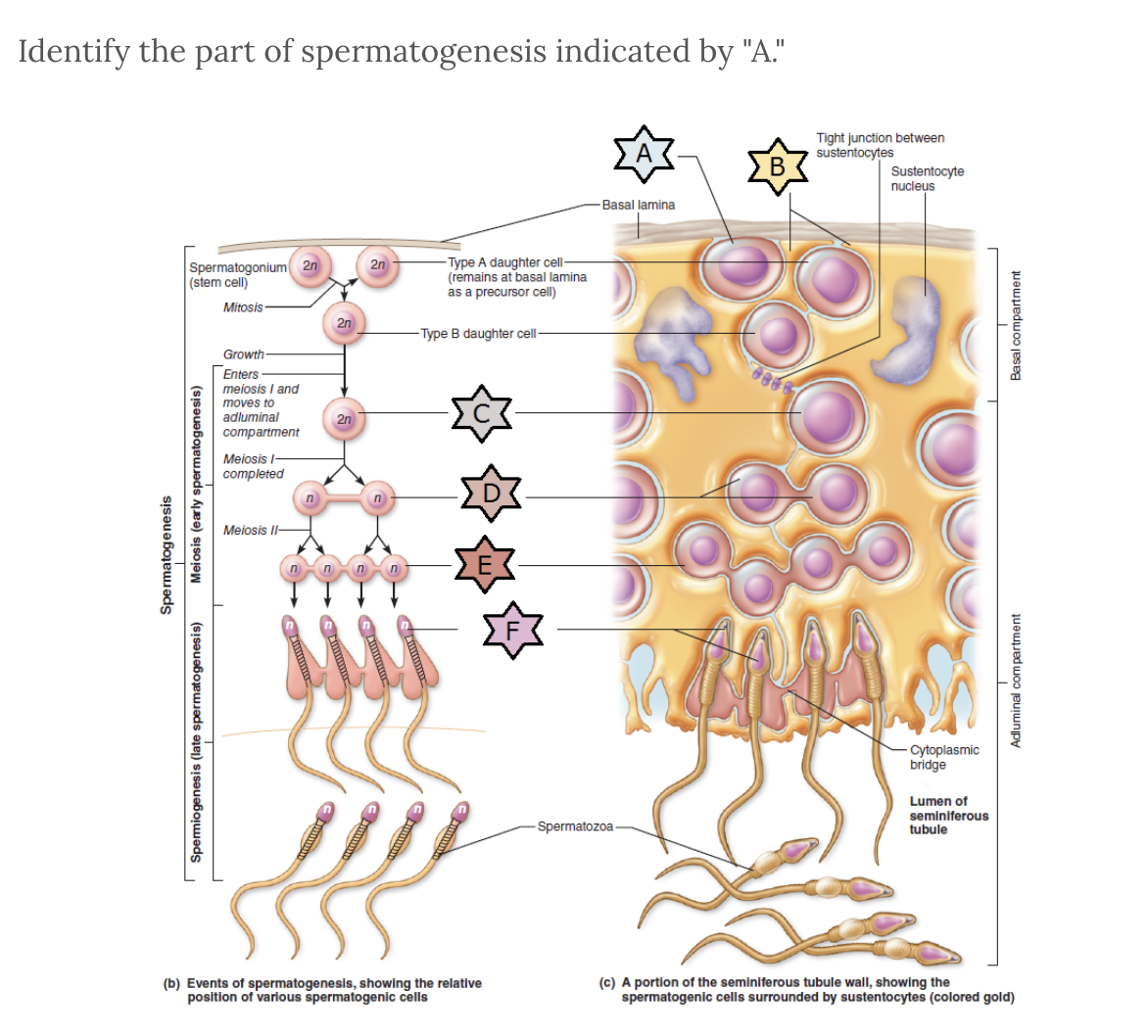
Identify A
Spermatogonium
The sperm's acrosome __________.
contains enzymes
Conversion of haploid spermatids to spermatozoa is specifically called __________
spermiogenesis
Which of the following is true about meiosis?
Meiosis produces cells that have a haploid chromosome number
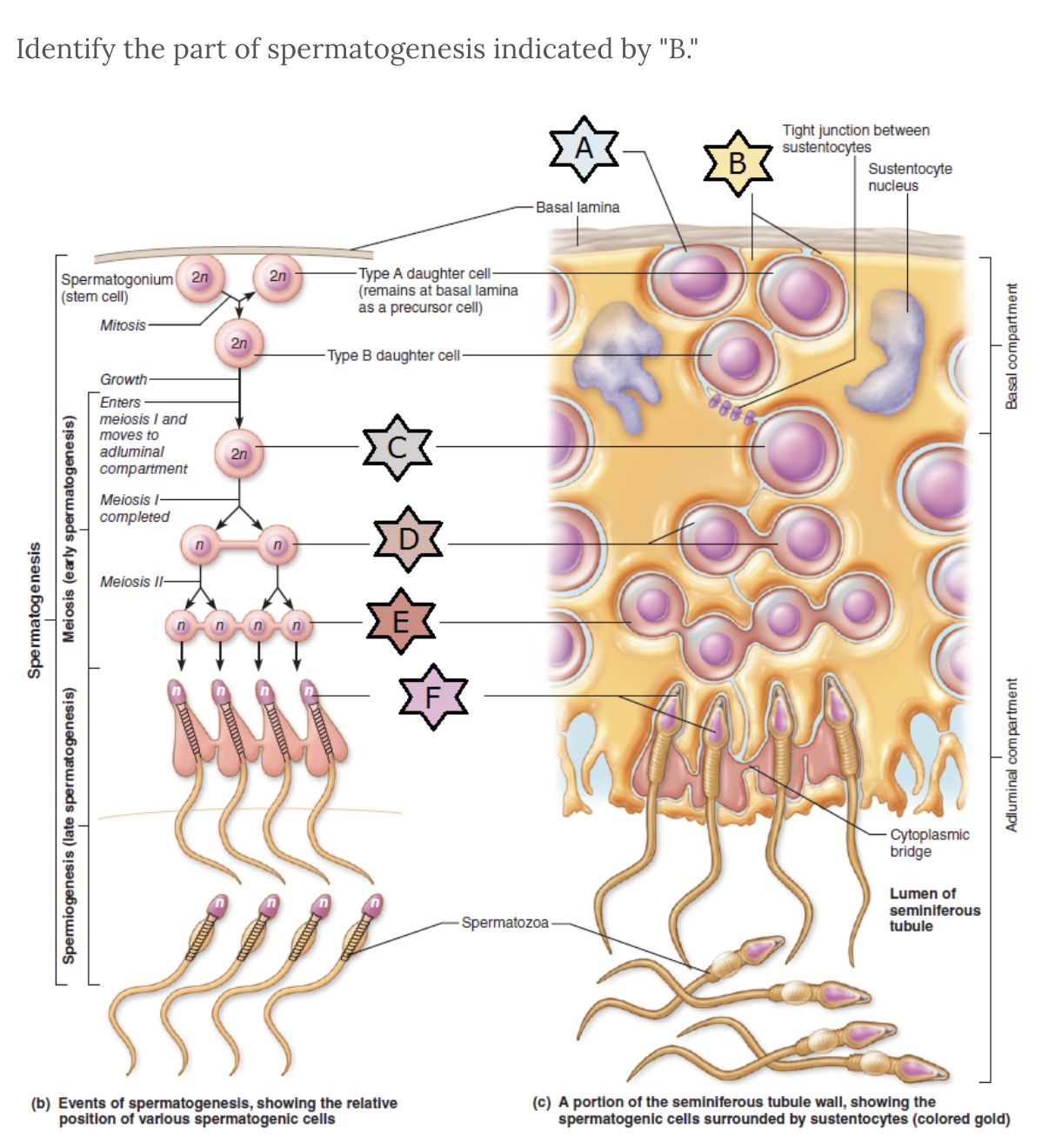
Identify B
Cytoplasm of adjacent sustentocytes
Which of the following statements is TRUE about the testicular interstitial endocrine cells?
Produce testosterone
Which male accessory gland produces a thick, clear mucus that lubricates the glans penis during sexual excitement?
Bulbo-urethral gland
Match the phase of meiosis to the event that occurs in the phase: Anaphase I.
Homologous chromosomes separate from one another.