EXSS 385 NEW SLIDES FINAL
 Call Kai
 Learn
Learn Practice Test
 Spaced Repetition
 Match
Match Flashcards
 Knowt Play
1/196

There's no tags or description
Looks like no tags are added yet.
Name | Mastery | Learn | Test | Matching | Spaced | Call with Kai |
|---|
No analytics yet
Send a link to your students to track their progress
197 Terms
functions of bone biomechanics
protect vital organs
support soft tissue
produce RBCs
reservoir for minerals
provide attachment sites for skeletal muscles
acts as system of machines to recieve muscle torques and make movement possible
factors of bone biomechanics influencing mechanical properties
structure
geometry
mode of loading
rate of loading
frequency of loading
muscle activity
age
bone biomechanics → structure composition
collagen (25-30% dry weight)
mineral (60-70% dry weight)
ground substances (5% dry weight)
water (20-25%)
structure → collagen
tensile strength
provides flexability (relatively little)
structure → mineral
calcium & phosphate
gives compressive strength
structure → ground substance
gel like substance surrounding collegen fibers
gives compressive strength
bone biomechanics → geometry
cross sectional area proportional to ultimate failure point
increased area = increased ultimate failure point
polar moment of inertia
quantity used to predict an objects ability to resist torsion
increased polar moment of inertia meaning
the mass is distributed away from neutral axis
decreased polar moment of inertia meaning
the mass is distributed close to neutral axis
anisotropic mode of loading
stiffness & strength depend upon mode of loading
what mode of loading is failure point HIGHEST
during compression
193 MPa
what mode of loading is failure point SECOND HIGHEST
during tension
133 MPa
what mode of loading is failure point LOWEST
during shear
68 MPa
viscoelasticity
mateirals may behave in both elastic and viscous manners with different rates of loading
rate-sensitive loading
viscoelastic
stiffness & strength depend upon speed of applied load
what does loading rate influence
influences fracture patterns and soft tissue damage
energy release
what components make a high loading rate
increased stiffness
ncreased ultimate failure point
increased energy storage prior to failure point
viscous fluid
time-dependent deformation
elastic solid
returns to original shape
stiffness if there’s higher loading rate
increased stiffness
stiffness if there’s lower loading rate
decreased stiffness
physical effects of decreased loading rate
cracking (no fragments)
little to no soft tissue damage
physical effects of increased loading rate
comminuted (fragments displaced)
extensive soft tissue damage
frequency of loading
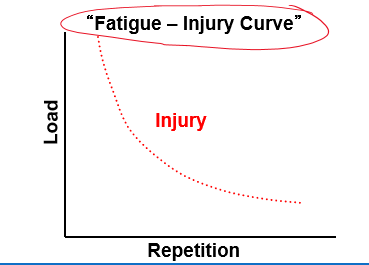
interplay of load, repetition, & injury
effects of frequency of loading
bone fatigue
fatigue fracture
bone fatigue
weakening of bone during repeated loading
factors of bone fatigue
magnitude of load
number of load applications (+ in a given time)
high number of load applications in a given time
fatigue process outpaces the repair-remodeling process
fatigue fracture (stress fracture)
high load, few repetitions
low load, many repetitions
fatigue-injury curve
as repetition increases, the load tolerance of tissues decreases, leading to higher injury risk
what do muscles produce
may produce tensile or compressive stresses on bone
offsets mechanical stresses in opposite directions
bone density with age
there is progressive decrease in bone density as age increases
collagen and mineral content with age
collagen and mineral content decrease as age increases
bone mass and size with age
bone mass and size decrease as age increases
stiffness and strength with age
stiffness and strength decrease as age increases
bone remodeling
alters size, shape, & structure based on the imposed mechanical demands
Wolff’s Law
bone tissue is gained or lost depending upon the level of stress sustained
Wolffs Law → mechanical stress
high mechanical stress causes high bone tissue production
low mechanical stress causes low bone tissue production
what is Wolff’s law affected by
affected by activity level and implants
stress shielding
reduction in bone density (osteopenia) by removing typical stress from the bone by an implant
factors influencing active muscle force production
neural factors
fiber type
mechanical factors
muscle architecture
muscle stiffness
neural factors
how strongly and frequently the nervous system signals the muscle
how neural factors affect active muscle force
muscle fiber activation & discharge rate
motor unit recruitment
muscle fiber activation & discharge rate TYPES
twitch
summation
tetanus
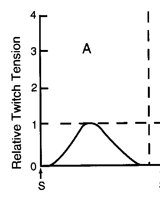
TWITCH muscle fiber activation
response of muscle to single stimulus
one single activation hump
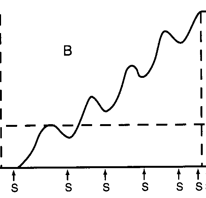
SUMMATION muscle fiber activation
the overall effect of added stimuli
multiple activation humps that add off eachother
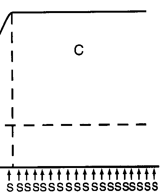
TETANUS muscle fiber activation
sustaied maximal tension due to high frequency stimulation
straigh line thats very high due to continuous activation
fiber type
fast twistch fibers (type IIa & IIb)
slow twitch fibers (type I)
type I slow twitch fiber → shortening speed
slow
type I slow twitch fiber → size
small
type I slow twitch fiber → force production
low
type IIa fast twitch fiber → shortening system
fast
type IIa fast twitch fiber → size
large
type IIa fast twitch fiber → force production
high
type IIb fast twitch fiber → shortening system
fast
type IIb fast twitch fiber → size
large
type IIb fast twitch fiber → force production
high
fast twitch vs slow twitch → peak force
fast twitch fibers have a higher peak force, but lasts shorter
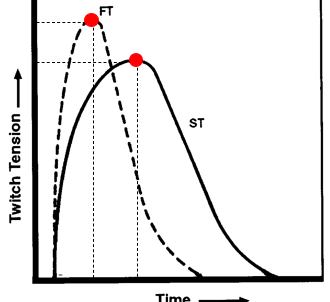
fast twitch vs slow twitch → rate of force production
fast twitch fibers have higher rate of force production
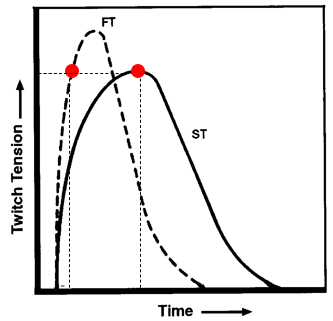
all fibers within a motor unit
all fibers within a motor unit are the same time
all fibers within a muscle
all fibers within a muscle have a mixture of fiber types
what does motor recruitment increase
muscle stiffness
ordered recruitment → Hennemans size principal
type I recruitment first (lowest threshold)
type IIa recruited second
type IIb recruited last (highest threshold)
Hennemans size principal allow for
allows for controlled, smooth gradation of force
reduction in tension
can fiber types change
fiber types can change with training
type distribution is largely genetic
muscle architecture
arragement of contractile components that affects force production, excursion, & velocity
ex: pennation angle
muscle arrangement types
parallel
series
muscle arrangement → parallel
side to side arrangement
parallel fiber architecture
represent muscle fibers as parallel springs
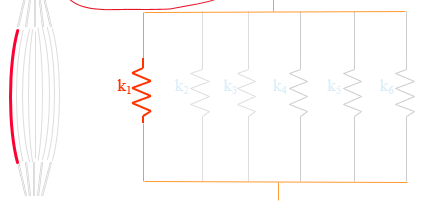
addition of parallel springs
K total = K1+ K2 + K3…..
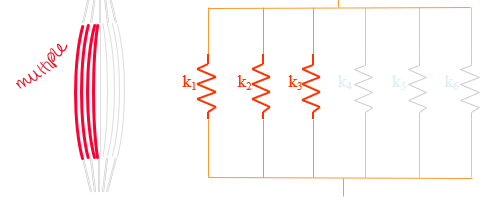
muscle arrangement → series
end to end arrangement
types of muscle fiber architecture
longitudinal
unipennate
bipennate
fusiform
muscle fiber architecture → longitudinal
fibers run straight along the length of the muscle
ex: esophagus
whats the “plus” of longtiduinal architecture
good for long excursions
muscle fiber architecture → unipennate
fibers insert at an angle on one side of a tendon
ex: lumbicals
whats the “plus” of a unipennate architecture
more fibers can pack into a given area to increase force capactity
muscle fiber architecture → bipennate
fibers attack on both sides of a central tendon
ex: gastrocnemus
whats the “plus” of a bipennate architecture
allows even MORE fibers to fit in to generate high force
muscle fiber architecture → fusiform
fibers are wider in the middle and narrower at the ends
ex: biceps brachii
whats the “plus” of a fusiform artchitecture
can move a lot and shorten quickly
muscle stiffness
passive elastic properties of the muscle
motor unit recruitment
how many motor units the nervous system activates
what is a motor unit?
a single motor neuron and all the muscle fibers it innervates
3 to 2,000 fibers innervated (innervation ratio)
“all or none” principal
motor unit importance
functional unit of muscle
smallest unit of muscle contraction
all muscle fibers respond as one
muscle force proportional to
proportional to the # of motor units recruited
proportional to stimulation/firing rate
what does synchronization of firing impulses increase
may increase muscle force
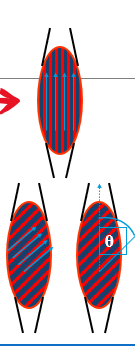
angle of pennation (θ)
alignment of muscle fibers relative to line of pull
if pennation angle (θ) = 0 degrees meaning
the fibers are aligned with the line of pull
resultant force in less pennated fiber arrangements
increase in resultant force directed along the line of pull
2 ways force can be directed relative to the muscle
directed parallel to the longitudinal axis
directed at an angle (of pennation) to longitudinal axis
F long =
Fcos(θ)
F = x Newtons
for the same muscle volume, longitudinal arragements produce…
less force than pennate arrangements
why do longitudinal arragements produce less than pennate arragements
there are more crossbridge formations available
because more fibers outweighs less resultant force
stiffness
force response to a mechanical stress
stiffness equation
stiffness (k) = (ΔF)/(ΔL)
what do muscle fibers possess
stiffness
in what ways can stiffness be controlled
intrinsic stiffness
reflex mediated stiffness
joint stiffness
intrinsic stiffness
prepatory muscle activation
reflex mediated stiffness
reflex activation