Biomechanics Final (Slideshows)
 Call Kai
 Learn
Learn Practice Test
 Spaced Repetition
 Match
Match Flashcards
 Knowt Play
1/96

There's no tags or description
Looks like no tags are added yet.
Name | Mastery | Learn | Test | Matching | Spaced | Call with Kai |
|---|
No analytics yet
Send a link to your students to track their progress
97 Terms
Where is an object’s mass distributed?
An object’s mass is distributed throughout the object
What is the centre of mass?
The centre of masses a hypothetical point where an object’s entire mass can be assumed to be concentrated
It is the point at which an object’s mass is equally distributed
What does an objects centre of mass depend on?
The location of an objects centre of mass depends on the shape and density of the object
Where is the centre of mass located in a symmetrical object with uniform density?
For object’s that are symmetrical and of uniform density like a wooden ruler, the object centre of mass will be at the geometric centre of the object
Where is the centre of mass located in an asymmetrical object will uniform density?
For objects that have an asymmetrical shape but that have uniform density like a baseball bat, the centre of mass will be located towards or within the larger end
Where is the centre of mass located for the human body?
For objects that are asymmetrical and have non-uniform density, like the human body, the centre of mass changes depending on the posture it is in… it can even be located outside of the body
What are the centre of mass and centre of gravity both referring to?
The centre of mass and centre of gravity are both referring to the same hypothetical point where an object’s mass can be considered to be concentrated
When is the term centre of gravity specifically used?
The term centre of gravity is specifically used when dealing with the vertical direction because that is the direction of gravity
What is inertia?
Inertia is the term we use to describe an object’s resistance to a change in motion… more specifically, a resistance to acceleration
What happens when an object’s inertia is larger?
The larger an objects inertia, the harder it is to make it accelerate
What is the biggest determinant of inertia or an object at rest?
The biggest determinant of inertia for an object at rest is mass because the larger the object’s mass, the more inertia it has
What is angular inertia?
Angular inertia is the resistance to change in angular motion (objects that are rotating)… more specifically, a resistance to angular acceleration
What is the biggest determinant of angular inertia for object’s at rest?
For object’s at rest, the biggest determinant of angular inertia is the moment of inertia
What are the biggest determinants of inertia for object’s in linear motion?
For object’s in linear motion, the biggest determinants of inertia are mass and velocity (momentum)
What are the biggest determinants of angular inertia for object’s in angular motion?
For object’s in angular motion, the biggest determinants of angular inertia are the moment of inertia and angular velocity (angular momentum)
What type of quantity is moment of inertia?
Moment of inertia is a scalar quantity
What is the moment of inertia?
The moment of inertia is the measure of the ability of an object’s to resist changes in angular velocity… it is a measure of angular inertia
What does the moment of inertia give us an indication of?
The moment of inertia gives us an indication of how hard it will be to route the object
Mass tells us how much matter or stuff is in the object
Moment of inertia not only tells us how much stuff is in an object, but how that stuff is distributed about in relation to the axis about which the object is rotating
FOr rotating object’s, what contributes to their resistance to rotation?
For rotating object’s, both the object’s mass and how that mass is distributed contributes to the object’s resistance to rotation
How is moment of inertia calculated?
The moment of inertia is calculated as the product of an object’s mass (m) and a value known as its radius of gyration (k)
What is the radius of gyration?
The radius of gyration is a measure of the distribution of the object’s mass relative to the axis of rotation
What is the radius of gyration expressed in?
The radius of gyration is expressed in length and uses metres
How is moment of inertia calculated?
The moment of inertia is calculated by multiplying the object’s mass by the squared radius of gyration
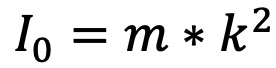
What are the units for moment of inertia?
The units for moment of inertia are kgm2
Do mass and radius of gyration have the same effects on the magnitude of the moment of inertia?
Mass and radius of gyration do not have equal effects on the magnitude of inertia… the mass has a smaller effect than the radius of gyration
If you double an object’s mass, what will happen to the moment of inertia?
If you double an object’s mass, its moment of inertia will also double
If you double an object’s radius of gyration, what will happen to the moment of inertia?
If you double an object’s radius of gyration, the moment of inertia will quadruple
What is linear momentum?
Linear momentum is the measure of an object’s resistance to an object changing its velocity
What is momentum mathematically?
Mathematically, momentum is the product of an object’s mass and linear velocity
L= m * v
What do changes in linear momentum depend on?
Changes in linear momentum depend only on changes in the object’s linear velocity
What happens when an object’s velocity is lager?
The larger the velocity of an object, the larger the momentum, meaning the harder it is to change the object’s velocity
What is angular momentum?
Angular momentum describes an object’s resistance to changing its angular velocity
What type of quantities are momentum and angular momentum?
They are vector quantities
What is the direction of angular momentum?
The direction of angular momentum is always in the same direction of the object’s angular velocity
How is angular momentum calculated?
Angular momentum is calculated as the product of an object’s moment of inertia and its angular velocity
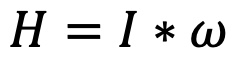
How do you change an object’s linear momentum?
To change an object’s linear momentum, you would have to apply a net external force to the object
How do you change an object’s angular momentum?
To change an object’s angular momentum, you have to apply a net external momentum of force to the object
What is a moment of force?
A moment of force is the tendency of a force to cause rotation about a specific axis… aka torque or moment
What do moments cause and control?
Moments cause and control all movements of the limbs and entire body
What type of quantity are moments?
Moments are vector quantities
What type of rotation does a positive moment cause?
A positive moment causes rotation in the counterclockwise direction
What type of rotation does a negative moment cause?
A negative moment causes rotation in the clockwise direction
Mathematically, what is a moment?
Mathematically, a moment is the product of an applied force and the perpendicular distance from the line of action of the force to the axis of rotation
What is the perpendicular distance in a moment called?
The perpendicular distance is called the moment arm
What are the units of moment of force?
The units of moment of force are Nm
When can a fore cause a moment?
A force can only cause a moment if it is applied to an object at some distance away from the axis of rotation
What happens is a force is applied through the axis of rotation?
If the force is applied through the axis of rotation, the length of the moment arm is equal to zero, so there will be no moment
If the force applied to a rigid body is not perpendicular, what happens?
If a force is applied to a rigid body at an angle other than perpendicular, the amount of moment it produces decreases… The farther away the angle from perpendicular, the less moment the force will produce
What happens when forces are applied parallel to the rigid body?
Forces that are parallel to the rigid body will not reduce any moment because at that point, the line of action of the applied force is through the axis of rotation, meaning the moment arm is zero
What is the magnitude of the moment proportional to?
The magnitude of the moment is proportional to the magnitudes of the perpendicular component of the applied for at the moment arm
What is stability?
Stability is the capacity of an object to return to equilibrium or its original position after it has been displaced
When is more stability important in sports?
More stability is important when the goal is to maintain position like in wrestling or football linemen
When is less stability important in sports?
Less stability is important when the goal is to move out of position quickly like being a soccer goalie or volleyball defence
What are the factors that affect stability?
The factors that affect stability are the height of the centre of mass, the weight of the object, and the size of the base of support
What happens when a toppling force is applied to an object?
When a toppling force is applied to an object, it creates a moment around an axis of rotation at the opposite edge of the base of support
What is the moment arm for a toppling force?
The moment arm for the toppling force is the height of the object
When is it harder for a toppling force to knock an objet over?
It is harder for a toppling force to knock an object over when its height/moment arm is reduced
What does lowering an object’s centre of mass do in terms of stability?
Lowering an object’s centre of mass increases its stability
Does the weight of an object generate a moment? If yes, what does this do?
Yes, the weight of an object generates a moment, and this moment opposes the toppling force to keep the object upright
What happens if you increase the magnitude of the weight vector?
If you increase the magnitude of the weight vector, you increase the moment keeping the object upright, making it harder to topple
What does the weight of an object do in terms of stability?
Increasing an object’s weight increases its stability
What does increasing the distance from the weight vector to the edge of the base of support do in terms of stability?
Increasing the distance from the weight vector to the edge of the base of support increases stability because it increases the moment arm, making it harder to rotate the object
What is the sprint start position of sprinters doing?
The sprint start decreases stability in order for the athletes to have a quick start
What does the direction of the moment depend on?
The direction of the moment depends on both the direction of the applied force and where the force is applied relative to the axis of rotation
What is the right had rule?
The right hand rule is used to determine the direction of a moment…
If your thumb points toward you, the rotation is positive which means counterclockwise
If you thumb points away from you, the rotation is negative which means clockwise
If the force of a moment arm in on an angle, what is its perpendicular component called?
The perpendicular component is called the rotational component and this is the component of the force that causes rotation
What is statics (static equilibrium)?
Statics is the branch of rigid body mechanics that deals with object at rest or moving at a constant velocity
What do all the forces add up to when an object is at rest? What does this mean?
When an object is at rest, all the external forces acting on it are in equilibrium and they add up to zero, meaning that the object is not in linear motion, but doesn’t necessarily mean that it isn’t rotating
When can an object be said to be in a state of static equilibrium?
An object can be said to be in static equilibrium when the object is at rest and both the net forces and net moments acting on it are both equal to zero