PUBHLT 2015 Lesson 1: Pathogens, Infectious Diseases, and the Microbiome
 Call Kai
 Learn
Learn Practice Test
 Spaced Repetition
 Match
Match Flashcards
 Knowt Play
1/69

There's no tags or description
Looks like no tags are added yet.
Name | Mastery | Learn | Test | Matching | Spaced | Call with Kai |
|---|
No analytics yet
Send a link to your students to track their progress
70 Terms
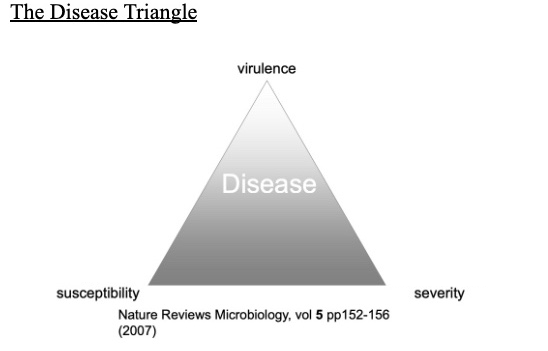
Fill in the blanks in the disease triangle.
1. Pathogen
Host
Environment
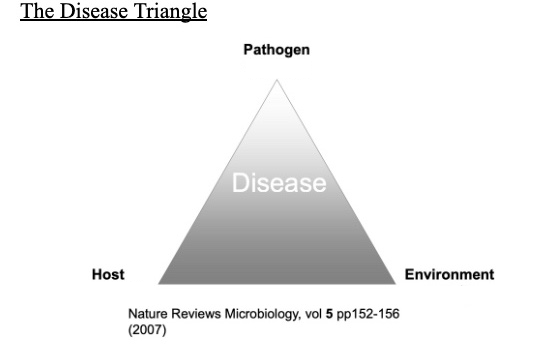
Fill in the blanks in the disease triangle.
1. Virulence
Susceptibility
Severity
What disease do prions cause in sheep?
Scrapie
What disease do prions cause in cattle?
Mad Cow Disease
What disease do prions cause in humans?
New-Variant Creutzfeld-Jakob Disease (nvCJD)
How do prions cause neurodegenerative diseases?
Improper folding
Through what methods are individual proteins transmitted?
Ingestion, transfusion
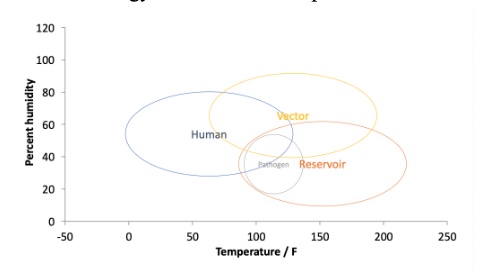
What does the blue oval represent?
The conditions where humans live comfortably (between 0oF - 130oF, and 30%-80% humidity)
What does the yellow oval represent?
The region where vectors (such as mosquitos or ticks) transmit diseasesW
What does the orange oval represent?
Where the host of a virus or bacteria lives and multiplies when it is not infecting humans
What does the grey circle represent?
Where the actual germ can survive, without the host
What types of changes in disease patterns can occur?
1. Changes in pathogen
Changes in the environment
Changes in the reservoir or vector range
What types of changes in pathogens can occur?
Adaptation, genetic change
What types of changes in the environment can occur?
Altering niche overlap, through seasonal, climatic, and anthropogenic means
What types of changes in reservoir or vector range can occur?
Emerging infections
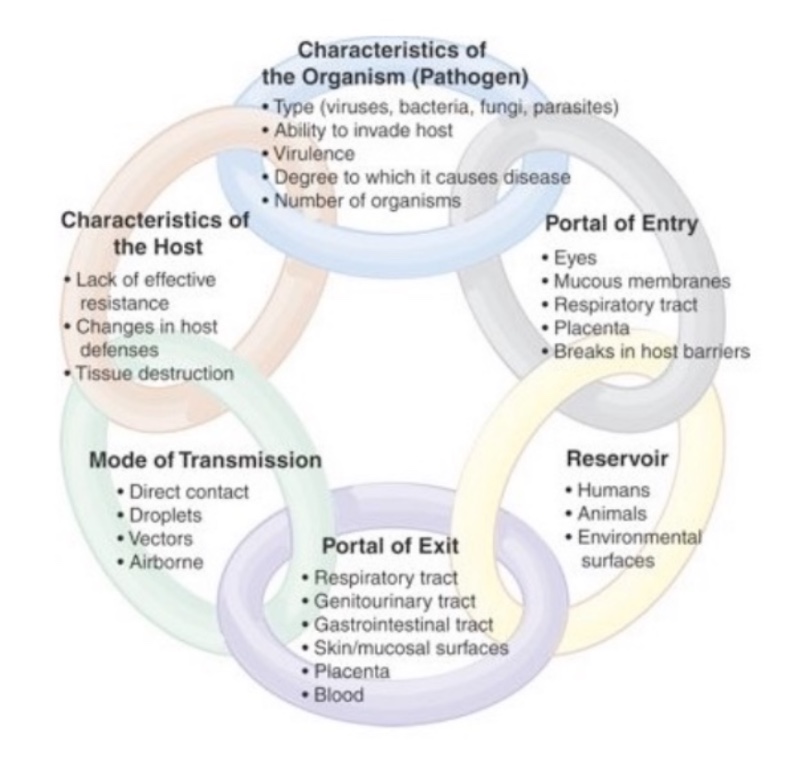
What is the Chain of Infection?
An epidemiological model showing how infectious diseases spread; breaking any single link stops transmission
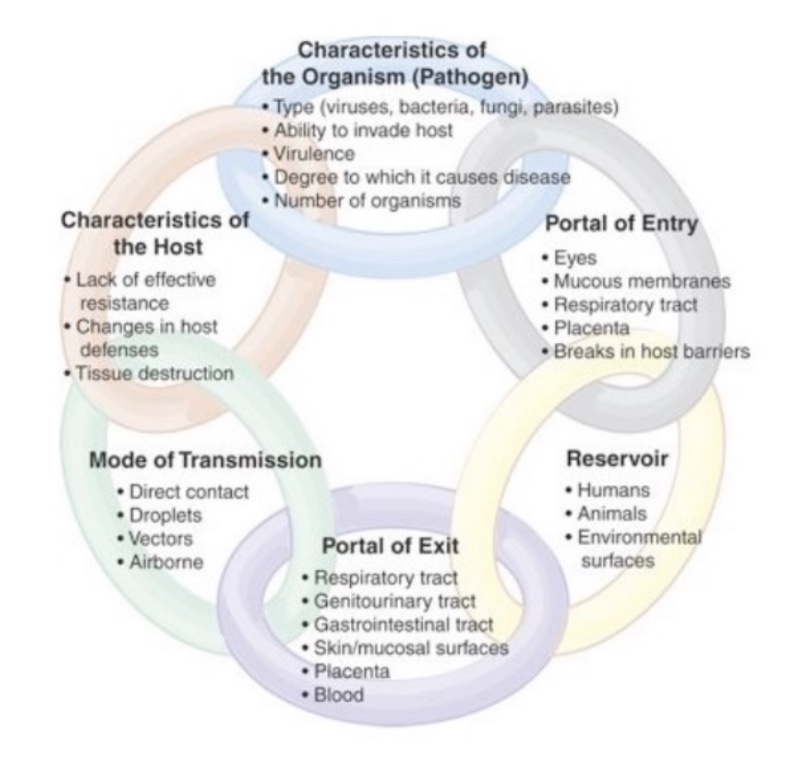
What is the pathogen in this context?
The germ causing diseases
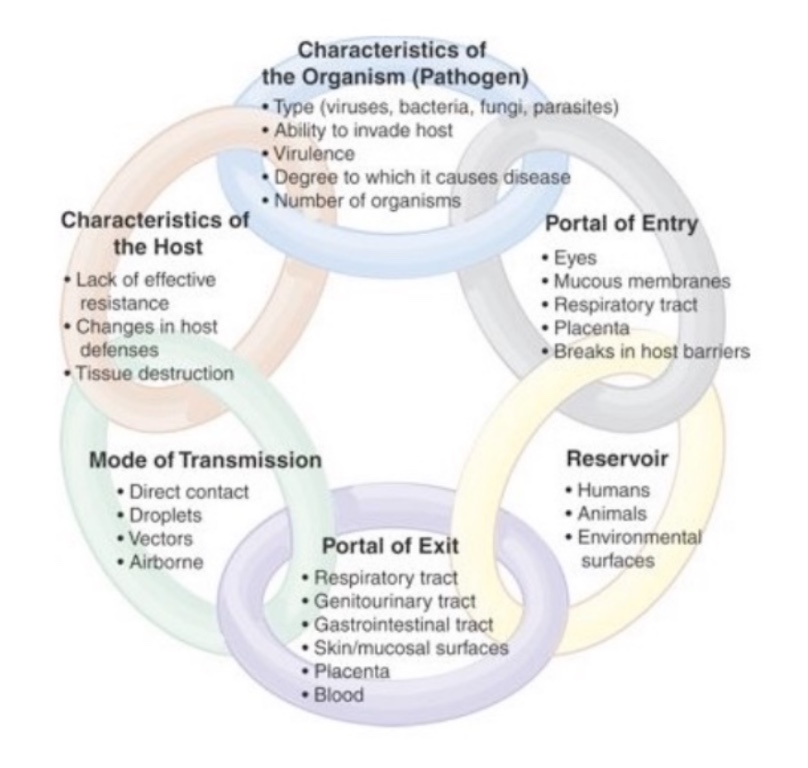
What is the reservoir in this context?
Where the germ lives and multiplies
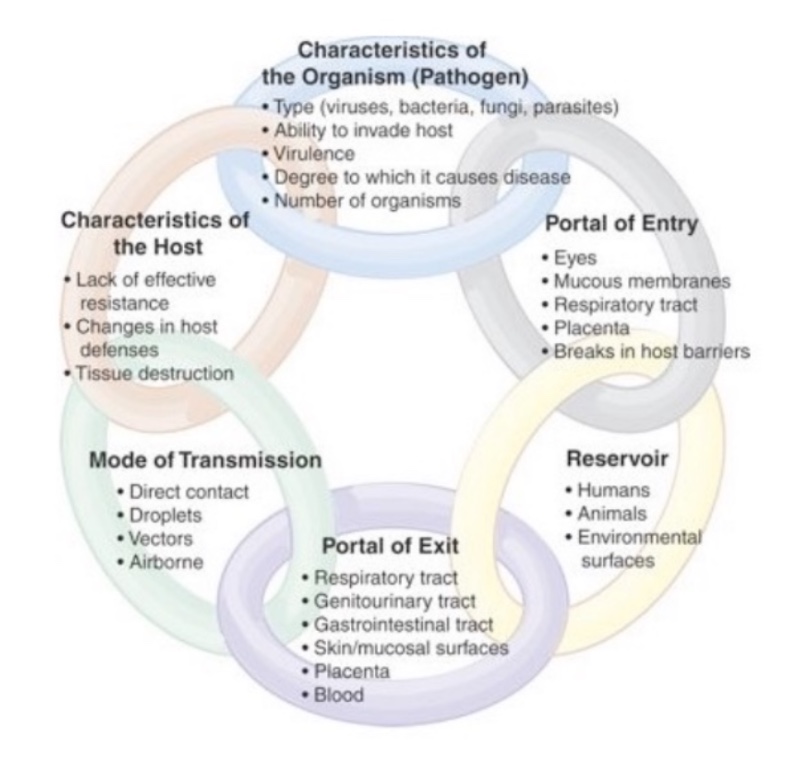
What is the portal of exit in this context?
How the germ leaves the reservoir
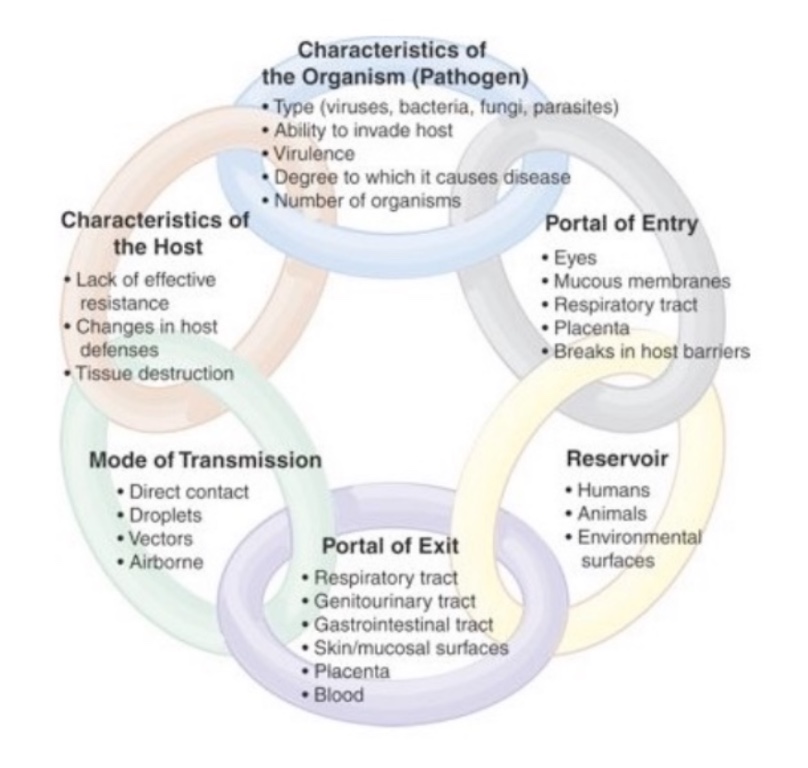
What is the mode of transmission in this context?
How the germ travels
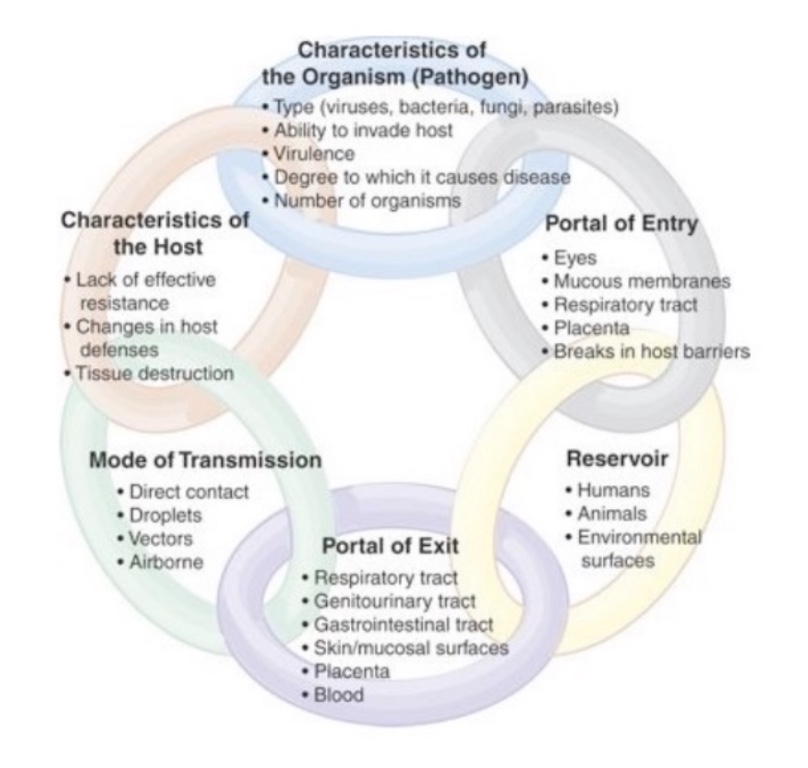
What is the portal of entry in this context?
How the germ enters the new host
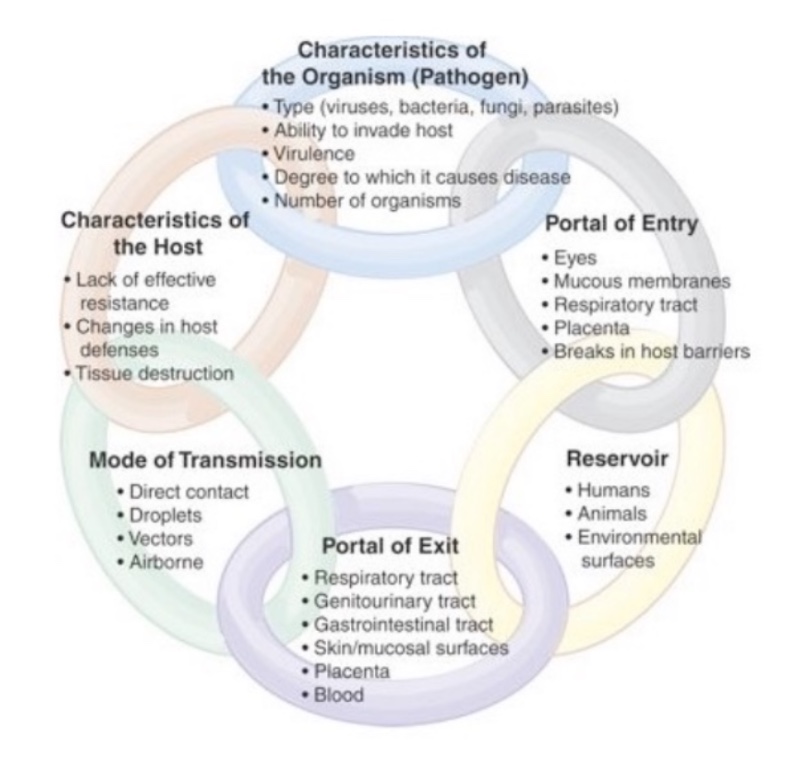
What is the susceptible host in this context?
The vulnerable person who gets sick
What are some ways to break the chain of infection?
Washing hands, vaccines
Give examples of pathogens.
Viruses, bacteria, parasites
Give examples of reservoirs.
Humans, animals, and the environment
Give examples of the portal of exit.
Coughing, feces, blood
Give examples of modes of transmission.
Direct contact, airborne droplets, vectors
Give examples of portals of entry.
Inhalation, ingestion, broken skin
Give examples of why a host may be susceptible.
Low immunity, lack of vaccines
Which method does Tanzania use to forecast malaria outbreaks?
Predictive climatology
What methods does Tanzania use to prevent wide-spread malaria outbreaks?
Community-based interventions, reducing pesticide use by increasing natural predators
Endogenous
Microbes inhabit our bodies
Exogenous
Microbes exist outside our bodies
What are the types of interactions?
Parasitic, symbiotic, and commensal
Parasitic
One organism benefits at the expense of another
What are some examples of parasitic organisms?
TB, HIV, measles
Symbiotic
Both organisms benefit
What are some examples of symbiotic relationships?
Some gut bacteria produce micronutrients
Commensal
Only one organism benefits, but the other does not suffer
What bacteria is an example of a commensal relationship?
Propionibacterium acnes
What are the stages of infection?
Contamination, colonization, infection, disease
Contamination
Organisms are present, but are not actively growing
Colonization
Microbes are growing on the body’s surface, gut mucosa, etc
Infection
Microbes have entered the body and are actively replicating and beginning to stimulate the immune system
Disease
The infection is starting to cause signs and symptoms
What are some examples of infections which always cause disease symptoms?
Measles, chickenpox, rabies
What are some examples of infections that are usually asymptomatic or inapparent?
90% of polio cases
Give some examples of infections which cause a spectrum of severity, ranging from mild to severe
Measles only rarely causes encephalitis, polio rarely causes paralysis
Plague of Athens (430 B.C.E.)
70,000 people killed probably by typhus
Antonine Plague (166 C.E.)
Up to 7,000,000 people killed throughout the Roman Empire, may have been smallpox
Barbarian Boils (160 C.E. China)
Bubonic plague lead to the collapse of the Eastern Han empire
Black Death (1346-1350 Europe)
1/3 of the population was killed
New World Epidemics (1492 - 1567)
Within 75 years, the indigenous population of Mexico fell by 95%
Louis Pasteur (1822-1895)
Disproved the old theory of spontaneous generation and established germ theory of disease transmission
Robert Koch (1943 - 1910)
Introduced several postulates to establish causal relationships for infectious agents
Golden Age
When the etiology of many diseases was discovered
What are Koch’s Postulates?
The organism can be regularly isolated from cases of the disease
The organism can be isolated in pure culture on artificial media
Inoculation of the cultured organism produces a similar disease in experimental animals
The organism can be recovered from the diseased animal and will cause the same disease when introduced into another animal
What are some 20th century advances?
The discovery of viruses in plants and animals
Koch’s postulates often are hard to prove for viruses
The ability to isolate and grow viruses in cell culture (1950s) gave rise to the Golden Age of virolgy
The development of antibiotics
Impact of biotechnology in the past 30 years
The eradication of smallpox
What is the mircobiome?
The bacteria, viruses, and eukaryotic organisms that inhabit each of us
How many cells vs bacteria are there in the human body?
Human body - 1013 cells
Bacteria - 1014
How many genes are in the human genome vs the microbiome?
Human genome - 23,000 genes
Microbiome - 3,000,000
How much does each person’s microbiome weigh?
2 lbs
Do all pathogens benefit at the extent of the host?
Yes
Extracellular Pathogens
Living inside the host, but outside the host cells, the pathogen is free to move and colonize the entire body, but is constantly exposed to the host immune system
What is an example of an extracellular pathogen?
Cholera
Intracellular Pathogens
Invades the host cells, better proteching from immune response, but must leave one cell in order to infect another
What are some examples of intracellular pathogens?
Viruses and and some small bacteria
What are the symptoms of cholera?
Severe diarrhea, massive fluid loss, death within 2-3 days
Cholera
Waterborne pathogen often found in brackish coastal waters
Infection is usually by drinking water contaminated by other cholera sufferers
Can sometimes be directly acquired
How does cholera infection occur?
Most ingested V. cholerae are killed by stomach acids
Infectious dose is approximately 100,000,000 bacteria
Surviving bacteria enter small intestine and swim into the mucus layer
Detach the flagellum, losing ability to swim
Being secreting the toxins that cause the disease