PROTEIN & ENZYMES - PART 2
 Call Kai
 Learn
Learn Practice Test
 Spaced Repetition
 Match
Match Flashcards
 Knowt Play
1/143

There's no tags or description
Looks like no tags are added yet.
Name | Mastery | Learn | Test | Matching | Spaced | Call with Kai |
|---|
No analytics yet
Send a link to your students to track their progress
144 Terms
Structural / Contractile
Transport
Storage
Defense
Messenger / Regulatory
Catalytic
Serves as precursors to many important compounds of varying purposes
Uses of Protein [7]
Collagen and elastin, wool, silk, etc
Actin and myosin
[USES OF PROTEINS]
Examples of structural/contractile proteins
a. Albumins and casein
b. Hemoglobin and myoglobin
c. Collagen and elastin, wool, silk, etc.
d. Immunoglobulins and interferons
d. Actin and myosin
[USES OF PROTEINS]
Added function of contraction
a. Collagen and elastin
b. Immunoglobulins and interferons
c. Hemoglobin and myoglobin
d. Actin and myosin
Hemoglobin
Membrane channels
Membrane pumps
[USES OF PROTEINS]
Examples of Transport protein
a. Albumins, casein, most plant seed proteins
b. Hemoglobin, membrane channels and pumps
c. Immunoglobulins and interferons
d. Collagen and elastin, wool, silk
c. Hemoglobin
[USES OF PROTEINS]
Transport protein with nonstop action
a. Albumin
b. Myoglobin
c. Hemoglobin
d. Casein
Myoglobin
Albumins
Casein
Most plant seed proteins
[USES OF PROTEINS]
Examples of Storage protein [3]
d. Myoglobin
[USES OF PROTEINS]
Storage protein with nonstop stagnation
a. Albumin
b. Hemoglobin
c. Casein
d. Myoglobin
Immunoglobulins
Interferons
[USES OF PROTEINS]
Examples of defense protein [2]
Amino acid neurotransmitters
Peptide hormones
[USES OF PROTEINS]
Examples of messenger / regulatory proteins [2]
Enzymes
[USES OF PROTEINS]
Example of Catalytic protein [1]
a. True
[USES OF PROTEINS]
Amino acids serves as precursors to many important compounds of varying purposes.
a. True
b. False
a. True
[ANALYTICAL PROCEDURES]
A biologic sample is expected to have many different proteins, so separation is done first to isolate a protein(s) of interest/
a. True
b. False
Isoelectric precipitation
Salting out
Liquid chromatography
[ANALYTICAL PREOCEDURES -SEPARATION]
Separation methods by polarity [3]
Electrophoresis
Ion exchange chromatography
[ANALYTICAL PREOCEDURES -SEPARATION]
Separation methods by charge [2]
Dialysis
Size exclusion chromatography
SDS-Polyacrylamide Gel Electrophoresis (PAGE)
[ANALYTICAL PREOCEDURES -SEPARATION]
Separation methods by size [3]
a. True
An isolated protein can be known of its sequence using reagents
a. True
b. False
a. General sequencing
[ANALYTICAL PREOCEDURES - SEQUENCING]
Targets terminal amino acids
a. General sequencing
b. Specific amino acid sequencing
Edman reagent
Sanger reagent
Aminopeptidase
[ANALYTICAL PREOCEDURES - SEQUENCING]
General sequencing reagents that target the N-terminal [3]
b. Carboxypeptidase
[ANALYTICAL PREOCEDURES - SEQUENCING]
General sequencing reagent that targets the C-terminal
a. Edman reagent
b. Carboxypeptidase
c. Aminopeptidase
d. Sanger reagent
b. Specific amino acid sequencing
[ANALYTICAL PREOCEDURES - SEQUENCING]
Targets bond at the C-terminal (right side)
a. General sequencing
b. Specific amino acid sequencing
d. Cyanogen bromide
[ANALYTICAL PREOCEDURES - SEQUENCING]
Specific amino acid sequencing reagent that targets methionine only
a. Trypsin
b. Chymotrypsin
c. Carboxypeptidase
d. Cyanogen bromide
b. Trypsin
[ANALYTICAL PREOCEDURES - SEQUENCING]
Specific amino acid sequencing reagent that targets basic amino acids
a. Chymotrypsin
b. Trypsin
c. Cyanogen bromide
d. Aminopeptidase
c. Chymotrypsin
[ANALYTICAL PREOCEDURES - SEQUENCING]
Specific amino acid sequencing reagent that targets aromatic amino acids
a. Trypsin
b. Cyanogen bromide
c. Chymotrypsin
d. Carboxypeptidase
a. Mass spectrometry
[ANALYTICAL PREOCEDURES - SEQUENCING]
Today, faster methods like this are used instead for sequencing
a. Mass spectrometry
b. Gel electrophoresis
c. Liquid chromatography
d. Dialysis
c. Ninhydrin
[QUALITATIVE TEST FOR PROTEINS]
Main reagent for Ninhydrin test (for free amino acids)
a. Cupric sulfate
b. Nitric acid
c. Ninhydrin
d. Sodium nitroprusside
b. Cupric sulfate
[QUALITATIVE TEST FOR PROTEINS]
Main reagent for Biuret test (for peptide bonds)
a. Mercury in nitric acid
b. Cupric sulfate
c. Glyoxylic acid
d. Lead II acetate
[QUALITATIVE TEST FOR PROTEINS]
b. Nitric acid
[QUALITATIVE TEST FOR PROTEINS]
Main reagent for Xanthoproteic test (for aromatics)
a. Alpha-naphthol
b. Nitric acid
c. Ninhydrin
d. Diazotized sulfanilic acid
c. Mercury in nitric acid
[QUALITATIVE TEST FOR PROTEINS]
Main reagent for Millon's test (for phenolic compounds)
a. Sodium nitroprusside
b. Lead II acetate
c. Mercury in nitric acid
d. Cupric sulfate
a. Glyoxylic acid
[QUALITATIVE TEST FOR PROTEINS]
Main reagent for Hopkin's Cole test (for indole)
a. Glyoxylic acid
b. Alpha-naphthol
c. Nitric acid
d. Ninhydrin
c. Alpha-naphthol
[QUALITATIVE TEST FOR PROTEINS]
Main reagent for Sakaguchi test (for guanidine group)
a. Glyoxylic acid
b. Diazotized sulfanilic acid
c. Alpha-naphthol
d. Sodium nitroprusside
a. Sodium nitroprusside
[QUALITATIVE TEST FOR PROTEINS]
Main reagent for Nitroprusside test (for thiol group)
a. Sodium nitroprusside
b. Lead II acetate
c. Cupric sulfate
d. Mercury in nitric acid
c. Lead II acetate
Main reagent for Fohl's test (for S-containing compounds)
a. Sodium nitroprusside
b. Diazotized sulfanilic acid
c. Lead II acetate
d. Glyoxylic acid
b. Diazotized sulfanilic acid
[QUALITATIVE TEST FOR PROTEINS]
Main reagent for Pauly's test (for specific rings: tyr, his)
a. Alpha-naphthol
b. Diazotized sulfanilic acid
c. Mercury in nitric acid
d. Sodium nitroprusside
c. Violet
[QUALITATIVE TEST FOR PROTEINS]
Positive result for Ninhydrin test (for free amino acids)
a. Yellow
b. Red
c. Violet
d. Rose/salmon
b. Violet
[QUALITATIVE TEST FOR PROTEINS]
Positive result for Biuret test (for peptide bonds)
a. Reddish/wine
b. Violet
c. Brown or black ppt
d. Violet ring
c. Yellow
[QUALITATIVE TEST FOR PROTEINS]
Positive result for Xanthoproteic test (for aromatics)
a. Red
b. Rose/salmon
c. Yellow
d. Violet
b. Rose/salmon
[QUALITATIVE TEST FOR PROTEINS]
Positive result for Millon's test (for phenolic compounds)
a. Violet
b. Rose/salmon
c. Yellow
d. Reddish/wine
c. Violet ring
[QUALITATIVE TEST FOR PROTEINS]
Positive result for Hopkin's Cole test (for indole)
a. Red
b. Brown or black ppt
c. Violet ring
d. Yellow
b. Reddish/wine
[QUALITATIVE TEST FOR PROTEINS]
Positive result for Sakaguchi test (for guanidine group)
a. Violet
b. Reddish/wine
c. Rose/salmon
d. Red
c. Red
[QUALITATIVE TEST FOR PROTEINS]
Positive result for Nitroprusside test (for thiol group)
a. Violet ring
b. Yellow
c. Red
d. Brown or black ppt
a. Brown or black ppt
[QUALITATIVE TEST FOR PROTEINS]
Positive result for Fohl's test (for S-containing compounds)
a. Brown or black ppt
b. Red
c. Violet
d. Reddish/wine
c. Red
[QUALITATIVE TEST FOR PROTEINS]
Positive result for Pauly's test (for specific rings: tyr, his)
a. Violet ring
b. Rose/salmon
c. Red
d. Yellow
c. Ninhydrin test
[QUALITATIVE TEST FOR PROTEINS]
Test for free amino acids
a. Biuret test
b. Xanthoproteic test
c. Ninhydrin test
d. Millon's test
d. Biuret test
[QUALITATIVE TEST FOR PROTEINS]
Test for peptide bonds
a. Ninhydrin test
b. Sakaguchi test
c. Hopkin's Cole test
d. Biuret test
b. Xanthoproteic test
[QUALITATIVE TEST FOR PROTEINS]
Test for aromatics
a. Millon's test
b. Xanthoproteic test
c. Nitroprusside test
d. Pauly's test
c. Millon's test
[QUALITATIVE TEST FOR PROTEINS]
Test for phenolic compounds
a. Pauly's test
b. Sakaguchi test
c. Millon's test
d. Fohl's test
b. Hopkin's Cole test
[QUALITATIVE TEST FOR PROTEINS]
Test for indole
a. Fohl's test
b. Hopkin's Cole test
c. Nitroprusside test
d. Sakaguchi test
d. Sakaguchi test
[QUALITATIVE TEST FOR PROTEINS]
Test for guanidine group
a. Pauly's test
b. Hopkin's Cole test
c. Fohl's test
d. Sakaguchi test
b. Nitroprusside test
[QUALITATIVE TEST FOR PROTEINS]
Test for thiol group
a. Fohl's test
b. Nitroprusside test
c. Pauly's test
d. Millon's test
b. Fohl's test
[QUALITATIVE TEST FOR PROTEINS]
Test for S-containing compounds
a. Nitroprusside test
b. Fohl's test
c. Biuret test
d. Xanthoproteic test
c. Pauly's test
[QUALITATIVE TEST FOR PROTEINS]
Test for specific rings (tyr, his)
a. Hopkin's Cole test
b. Sakaguchi test
c. Pauly's test
d. Nitroprusside test
a. True
Enzymes are mostly proteins, but not all
a. True
b. False
a. True
Enzymes have certain degrees of specificity
a. True
b. False
c. Enzymes
Biologic catalyst
a. Hormones
b. Coenzymes
c. Enzymes
d. Cofactors
b. Substrate
[ENZYMES]
Synonym for "reactant"
a. Product
b. Substrate
c. Cofactor
d. Ligand
b. Products
[ENZYMES]
Enzymes help convert substrates into this
a. Cofactors
b. Products
c. Zymogens
d. Coenzymes
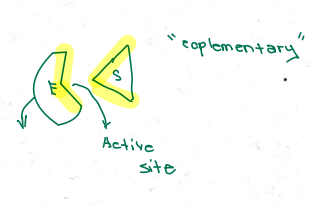
c. Active site
[ENZYMES]
To work, the substrate must bind to the _______ , forming an enzyme-substrate (ES) complex and then separating again to become product.

a. Allosteric site
b. Binding pocket
c. Active site
d. Catalytic domain
b. Complementary
[ENZYMES]
The active site and substrate have shapes described as
a. Identical
b. Complementary
c. Symmetrical
d. Reciprocal
![<p>[ENZYMES]<br>The active site and substrate have shapes described as</p><p class="font-claude-response-body break-words whitespace-normal">a. Identical<br>b. Complementary<br>c. Symmetrical<br>d. Reciprocal</p>](https://assets.knowt.com/user-attachments/743ebc06-f695-471e-845c-0d2b34d3eeae.png)
Lock-and-key
Induced fit
[ENZYMES]
Theories Governing Enzyme Binding [2]
a. Induced fit
[THEORY GOVERNING ENZYME BINDING]
Theory of enzyme binding with assumption of rigidity
a. Induced fit
b. Lock-and-key
c. Allosteric model
d. Cooperative binding
c. Induced fit
[THEORY GOVERNING ENZYME BINDING]
Theory of enzyme binding with assumption of flexibility
a. Lock-and-key
b. Sequential model
c. Induced fit
d. Symmetry model
a. Conformational changes
[ENZYMES]
Enzyme can perform this to fit, as described under the Induced Fit theory
a. Conformational changes
b. Allosteric inhibition
c. Covalent modification
d. Phosphorylation
c. Zymogens
[ENZYMES]
Most enzymes are active; some are inactive by default and have to be activated by specific enzymes or conditions
a. Coenzymes
b. Apoenzymes
c. Zymogens
d. Holoenzymes
a. Pepsinogen (inactive) → Pepsin (active)
[ENZYMES]
Example of a zymogen (inactive) that converts to its active form
a. Pepsinogen (inactive) → Pepsin (active)
b. Apoenzyme (inactive) → Holoenzyme (active)
c. Trypsinogen (inactive) → Chymotrypsin (active)
d. Proinsulin (inactive) → Glucagon (active)
c. Pepsin
[ENZYMES]
Enzyme that hydrolyzes peptides
a. Trypsin
b. Pepsinogen
c. Pepsin
d. Chymotrypsin
d. Holoenzyme
[ENZYMES]
Only functional when complete (apoenzyme + cofactor)
a. Zymogen
b. Coenzyme
c. Apoenzyme
d. Holoenzyme
b. Apoenzyme
[ENZYMES]
The protein portion of a holoenzyme
a. Cofactor
b. Apoenzyme
c. Coenzyme
d. Zymogen
d. Cofactor
[ENZYMES]
The nonprotein portion of a holoenzyme, which can be inorganic or organic
a. Apoenzyme
b. Zymogen
c. Substrate
d. Cofactor
b. Metal like Na, Zn
[ENZYMES]
Example of an inorganic cofactor
a. Vitamin B12
b. Metal like Na, Zn
c. Coenzyme A
d. NAD+
b. Vitamins
[ENZYMES]
Organic cofactors (coenzymes) are derived from
a. Metals
b. Vitamins
c. Carbohydrates
d. Lipids
a. Apoenzymes
[ENZYMES]
Organic cofactors from vitamins
a. Apoenzymes
b. Coenzymes
c. Zymogens
d. Holoenzymes
b. Water-soluble vitamins
[ENZYMES]
Most cofactors come from this type of vitamin, but the role of fat-soluble vitamins is equally important
a. Fat-soluble vitamins
b. Water-soluble vitamins
c. Minerals
d. Trace elements
b. Ascorbic acid
[STANDARD LIST OF VITAMINS]
Vitamin C is also known as
a. Retinol
b. Ascorbic acid
c. Tocopherol
d. Cobalamin
c. Thiamine/Aneurine
[STANDARD LIST OF VITAMINS]
Vitamin B1 is also known as
a. Riboflavin
b. Pyridoxine
c. Thiamine/Aneurine
d. Biotin
b. Riboflavin
[STANDARD LIST OF VITAMINS]
Vitamin B2 is also known as
a. Niacin/Nicotinic acid
b. Riboflavin
c. Pantothenic acid
d. Folic acid
a. Niacin/Nicotinic acid
[STANDARD LIST OF VITAMINS]
Vitamin B3 is also known as
a. Niacin/Nicotinic acid
b. Pyridoxine
c. Cobalamin
d. Biotin
b. Pantothenic acid
[STANDARD LIST OF VITAMINS]
Vitamin B5 is also known as
a. Pyridoxine
b. Pantothenic acid
c. Riboflavin
d. Folic acid
a. Pyridoxine
[STANDARD LIST OF VITAMINS]
Vitamin B6 is also known as
a. Pyridoxine
b. Biotin
c. Niacin
d. Cobalamin
b. Biotin
[STANDARD LIST OF VITAMINS]
Vitamin B7/H is also known as
a. Pyridoxine
b. Biotin
c. Pantothenic acid
d. Folic acid
c. Folic acid/Pteroylglutamic acid
[STANDARD LIST OF VITAMINS]
Vitamin B9 is also known as
a. Cobalamin
b. Biotin
c. Folic acid/Pteroylglutamic acid
d. Pyridoxine
b. Cobalamin
[STANDARD LIST OF VITAMINS]
Vitamin B12 is also known as
a. Folic acid
b. Cobalamin
c. Pyridoxine
d. Riboflavin
c. Retinoids
[STANDARD LIST OF VITAMINS]
Vitamin A consists of
a. Tocopherols
b. Phylloquinone
c. Retinoids
d. Calciferol
b. Cholecalciferol
[STANDARD LIST OF VITAMINS]
Vitamin D3 is also known as
a. Tocopherols
b. Cholecalciferol
c. Phytomenadione
d. Retinoids
b. Tocopherols
[STANDARD LIST OF VITAMINS]
Vitamin E consists of
a. Retinoids
b. Tocopherols
c. Phylloquinone
d. Cholecalciferol
c. Phytomenadione/Phylloquinone
[STANDARD LIST OF VITAMINS]
Vitamin K1 is also known as
a. Tocopherols
b. Cholecalciferol
c. Phytomenadione/Phylloquinone
d. Retinoids
b. Ascorbic acid (itself)
[STANDARD LIST OF VITAMINS]
Coenzyme form of Vitamin C
a. Coenzyme A (CoA)
b. Ascorbic acid (itself)
c. Thiamine pyrophosphate (TPP)
d. Tetrahydrofolate (THF)
c. Thiamine pyrophosphate (TPP)
[STANDARD LIST OF VITAMINS]
Coenzyme form of Vitamin B1 (Thiamine)
a. Pyridoxal phosphate (PLP)
b. Flavin mononucleotide (FMN)
c. Thiamine pyrophosphate (TPP)
d. Nicotinamide adenine dinucleotide (NAD)
a. Flavin mononucleotide (FMN) and Flavin adenine dinucleotide (FAD)
[STANDARD LIST OF VITAMINS]
Coenzyme forms of Vitamin B2 (Riboflavin)
a. Flavin mononucleotide (FMN) and Flavin adenine dinucleotide (FAD)
b. Thiamine pyrophosphate (TPP)
c. Coenzyme A (CoA)
d. Nicotinamide adenine dinucleotide (NAD)
c. Nicotinamide adenine dinucleotide (NAD)
[STANDARD LIST OF VITAMINS]
Coenzyme form of Vitamin B3 (Niacin)
a. Tetrahydrofolate (THF)
b. Pyridoxal phosphate (PLP)
c. Nicotinamide adenine dinucleotide (NAD)
d. Biotin (itself)
a. Coenzyme A (CoA)
[STANDARD LIST OF VITAMINS]
Coenzyme form of Vitamin B5 (Pantothenic acid)
a. Coenzyme A (CoA)
b. Flavin adenine dinucleotide (FAD)
c. Pyridoxal phosphate (PLP)
d. Deoxyadenosylcobalamin (DAC)
b. Pyridoxal phosphate (PLP)
[STANDARD LIST OF VITAMINS]
Coenzyme form of Vitamin B6 (Pyridoxine)
a. Thiamine pyrophosphate (TPP)
b. Pyridoxal phosphate (PLP)
c. Tetrahydrofolate (THF)
d. Nicotinamide adenine dinucleotide (NAD)
a. Biotin (itself)
[STANDARD LIST OF VITAMINS]
Coenzyme form of Vitamin B7/H (Biotin)
a. Biotin (itself)
b. Coenzyme A (CoA)
c. Pyridoxal phosphate (PLP)
d. Ascorbic acid
c. Tetrahydrofolate (THF)
[STANDARD LIST OF VITAMINS]
Coenzyme form of Vitamin B9 (Folic acid)
a. Deoxyadenosylcobalamin (DAC)
b. Coenzyme A (CoA)
c. Tetrahydrofolate (THF)
d. Nicotinamide adenine dinucleotide (NAD)
d. Deoxyadenosylcobalamin (DAC)
[STANDARD LIST OF VITAMINS]
Coenzyme form of Vitamin B12 (Cobalamin)
a. Tetrahydrofolate (THF)
b. Pyridoxal phosphate (PLP)
c. Coenzyme A (CoA)
d. Deoxyadenosylcobalamin (DAC)
b. Retinol, Retinal, Retinoic acid
[STANDARD LIST OF VITAMINS]
Coenzyme forms of Vitamin A (Retinoids) used for transport, vision, and cell growth
a. Tocopherols, Calciferol, Phylloquinone
b. Retinol, Retinal, Retinoic acid
c. Ascorbic acid, Biotin, Folate
d. TPP, FAD, NAD
c. 1,25-dihydroxycalciferol (calcitriol)
[STANDARD LIST OF VITAMINS]
Coenzyme form of Vitamin D3 (Cholecalciferol)
a. Retinoic acid
b. Coenzyme A
c. 1,25-dihydroxycalciferol (calcitriol)
d. Reduced vitamin K (KH2)
a. Tocopherols
[STANDARD LIST OF VITAMINS]
Coenzyme form of Vitamin E (Tocopherols)
a. Tocopherols
b. Retinal
c. Calcitriol
d. KH2
d. Reduced vitamin K (KH2)
[STANDARD LIST OF VITAMINS]
Coenzyme form of Vitamin K1
a. Retinoic acid
b. Calcitriol
c. Tocopherols
d. Reduced vitamin K (KH2)
a. Collagen synthesis
[STANDARD LIST OF VITAMINS]
Primary function of Vitamin C (pro/lys hydroxylation)
a. Collagen synthesis
b. Coagulation
c. Antioxidant
d. Carboxylation