Integral Calc Integration & Volumes
 Call Kai
 Learn
Learn Practice Test
 Spaced Repetition
 Match
Match Flashcards
 Knowt Play
1/38

There's no tags or description
Looks like no tags are added yet.
Name | Mastery | Learn | Test | Matching | Spaced | Call with Kai |
|---|
No analytics yet
Send a link to your students to track their progress
39 Terms
Find the derivatives for the following:
1) f(x) = sin (x)
2) f(x) = cos (x)
cos (x)
-sin(x)
Find the derivatives for the following:
1) f(x) = tan (x)
2) f(x) = cot (x)
sec² (x)
-csc² (x)
Find the derivatives for the following:
1) f(x) = cos (x)
2) f(x) = csc (x)
3) f(x) = cot (x)
-sin (x)
-csc(x) cot (x)
-csc² (x)
Find the derivatives for the following:
1) f(x) = sec (x)
2) f(x) = csc (x)
sec (x) tan (x)
- csc (x) cot (x)
Find the derivatives for the following:
1) f(x) = loga(x)
2) f(x) = ln (x)
1/[x*ln (a)]
1/x
Find the derivatives for the following:
1) f(x) = arcsin(x)
2) f(x) = arcos(x)
3) f(x) = arctan(x)
1/(√1-x²)
-1/(√1-x²)
1/1+x²
a(t) =
v’(t) = s’’(t)
What is the antiderivative of the following?
xn
1/(n+1) * xn+1
Find the antiderivatives for the following:
1) f(x) = sin (kx)
2) f(x) = cos (kx)
-1/(k) cos (kx)
1/(k) sin (kx)
What is the antiderivative of the following?
1/x
ln |x|
What is the antiderivative of the following?
ekx
1/(k) ekx
What is the antiderivative of the following?
1/√(1-k²x²)
1/k arcsin (kx)
What is the antiderivative of the following?
akx
1/(k ln (a)) * akx
What is the antiderivative of the following?
sec²(kx)
1/k tan (kx)
What is the integral of the following?
tan (u) du
ln |sec (u)| +C
What is the integral of the following?
sec (u) du
ln |sec (u) + tan (u)| +C
What is the integral of the following?
cot (u) du
ln |sin (u)| +C
What is the integral of the following?
csc (u)du
-ln |csc (u) + cot (u)| + C
Finish these Pythagorean Trig Identities
sin2(x) + cos2(x) =
sec2(x) =
csc2(x) =
= 1
= tan2(x) + 1
= cot2(x) + 1
Finish these Power Reduction Formulas
sin2(x) =
cos2(x) =
= ½ (1 - cos (2x))
= ½ (1+cos(2x))
Finish the Double Angle formula
sin (2x) =
= 2 sin(x) cos(x)
What trig substitution do you use for each form:
a2 - x2
a2 + x2
x2 - a2
x = a sin θ
x = a tan θ
x = a sec θ
In ∫sinm(x) cosn(x) dx
How do you proceed if m & n are both even? What if m is odd? What if n is odd?
if both even, use power reduction
if m is odd, break off a sin and use sin2(x) = 1 - cos2(x)
if n is odd, break off a cos and use cos2(x) = 1 - sin2(x)
cot (Θ)
adj/opp
OR
cos (Θ)/sin (Θ)
csc (Θ)
hyp/opp
OR
1/sin(x)
sec (Θ)
hyp/adj
OR
1/cos(Θ)
Volumes - Disk Method
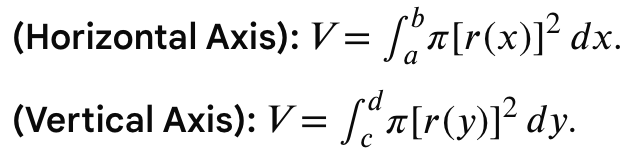
Volumes - Washer Method

Volumes - Shell Method

How do you integrate something that has functions as bounds?
Use extension of 2nd FTC

Average value RoC formula
integral/interval OR
area
———
b - a
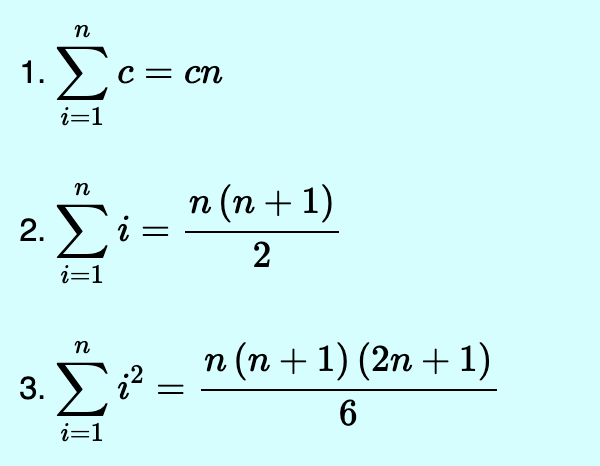
Summation Formulas
Riemann Sum Form
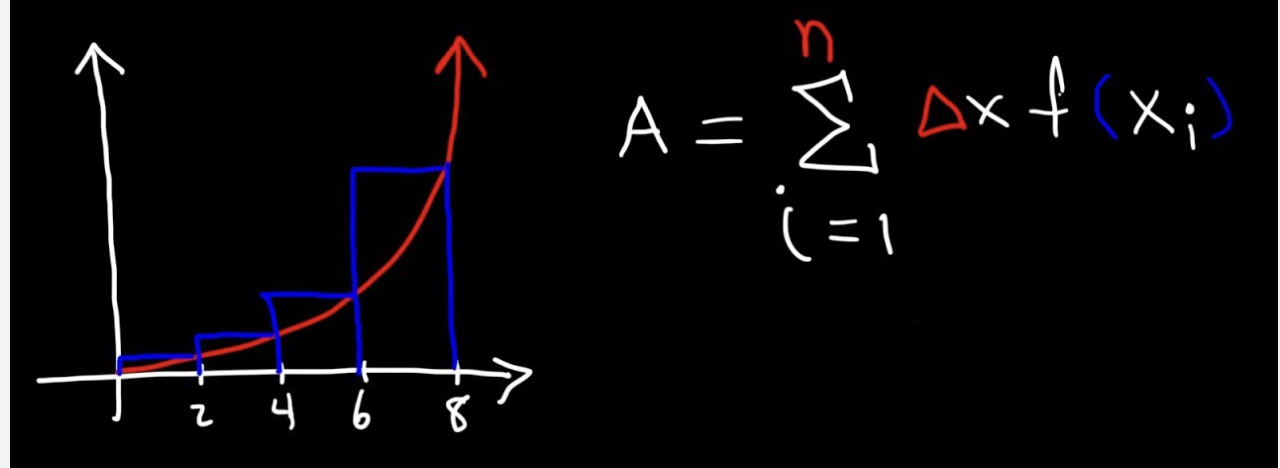
Define all the variables in Riemann Sum formula.
Δx = (b-a)/n
xi* = any number in the interval, usually will be told to use upper or lower
= Xo + iΔX (for righthand endpoints, bc [Xi-1, Xi] )
True or False. If taking the integral of a function f(x), from -a to a, the answer will be 0.
False, not always.
If odd function (like sin), it equals 0.
If even function (like cos), it equal 2*the integral from 0 to a.
Mean Value Theorum for Integration
IF func. is continuous on interval [a,b] THEN you can find a number c (the x value) that gives the avg value (the y-value; integral / interval)
Order of integration techniques from easiest to hardest
U-sub
IBP (ILATE)
Trig IDs
Trig sub
Partial Fractions
Whats the process for finding the area between curves?
draw graph, if possible
Find intersection(s)
If multiple, break up the integral and bounds
Integrate the difference between the bottom function and the top function for each integral term
(bottom and top func might switch - its ok)
True or False. If you’re using IBP on a composite function, set u to be the inside function.
False. You can’t separate a composite function. Set u to be the whole composite func, and set dv=dx