Test Two Dev. Countries
 Call Kai
 Learn
Learn Practice Test
 Spaced Repetition
 Match
Match Flashcards
 Knowt Play
1/97

Earn XP
Description and Tags
We ALL are getting a 100
Name | Mastery | Learn | Test | Matching | Spaced | Call with Kai |
|---|
No analytics yet
Send a link to your students to track their progress
98 Terms
A&R: Extractive Institutions
Extractive institutions can generate growth, but they rarely sustain
development.
• “Catch-up” growth is different from innovation-led growth.
• Catch-up growth = reallocation of labor and capital toward higher
productivity uses.
• Sustained development = recurrent innovation via creative destruction.
• Centralization can mobilize resources, but extraction tends to block creative
destruction and invite elite conflict.
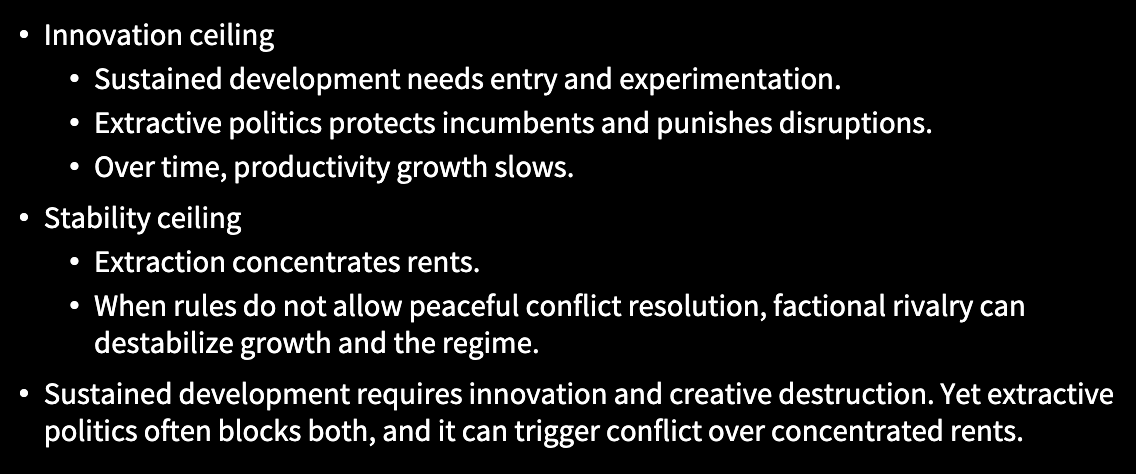
Growth is possible under extraction, but it is typically bounded.
• Extractive institutions can produce rapid growth by mobilizing labor and capital, especially during catch-up.
• They struggle to sustain development because they weaken innovation incentives, distort information, and block creative destruction.
Authoritarian & Extractive Mid-Week Case Studies
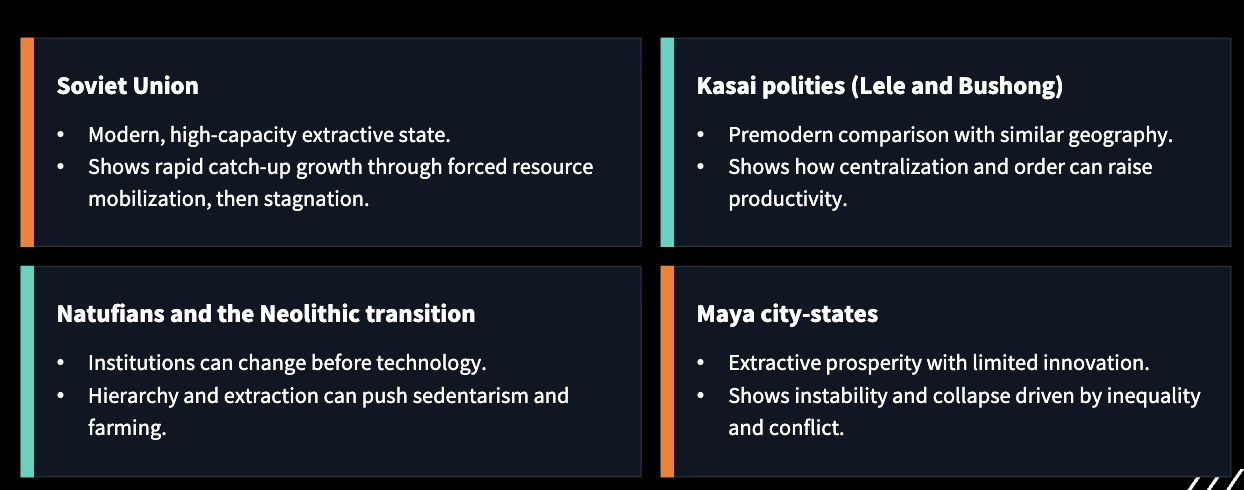
A&R Why is extractive growth rarely sustainable?
(Gandhi 2008) Why do dictatorships show wide variations in economic growth?
• Institutions can help dictators trade concessions for cooperation in a more
structured way.
• That structure can support growth through stability, predictability, and
information.
• Institutionalization is linked to coalition breadth, not only to coercion.
Broadened Incorporation of groups within a dictatorship instead of narrow exclusivity generates more economic growth.
If institutionalized authoritarianism can improve performance and stabilize coalitions, when does that strength create confidence that elections are survivable for the autocrats?
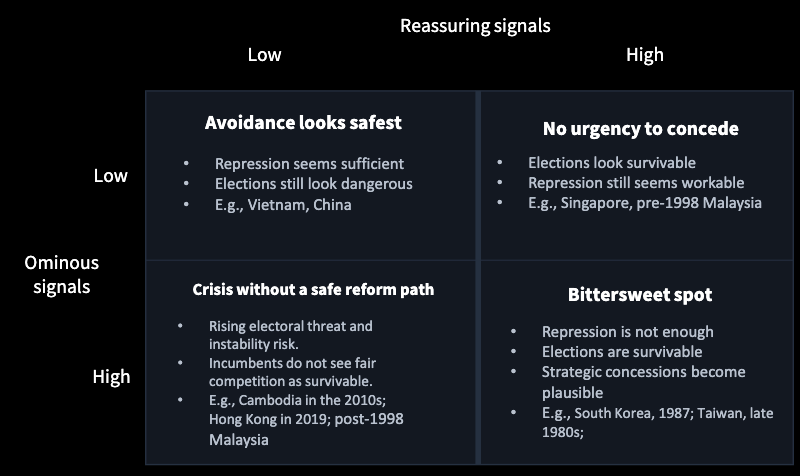
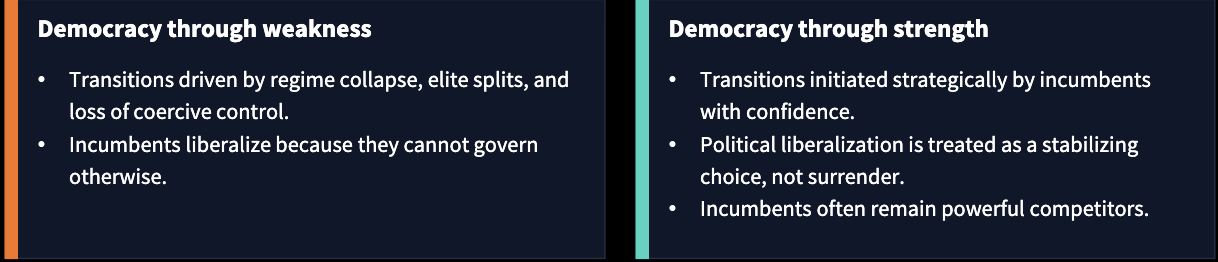
S&W: Differences of democratizations through weakness & strength
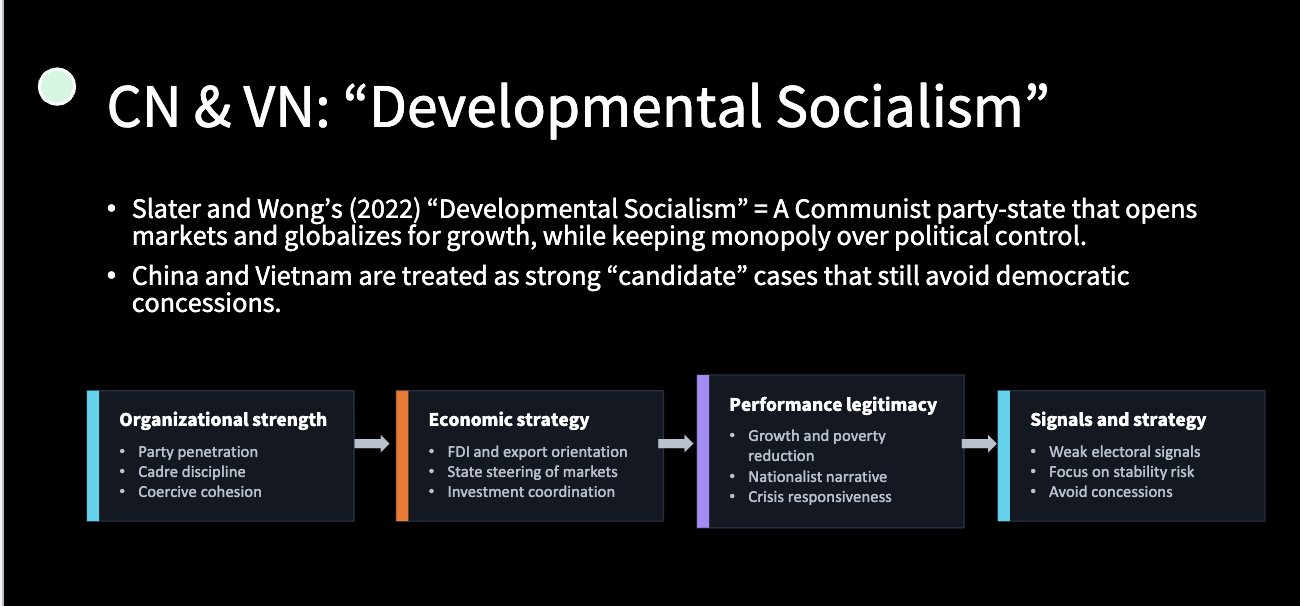
Developmental Socialism shared features CN & VN
• Communist ruling party with monopoly over political
authority.
• Party-state retains authority over labor, media,
and political association.
• Market opening and global integration under party
supervision.
• Growth used as performance legitimacy.
• Co-optation of new economic elites into party-state
channels.
• Global integration increases resources for co-
optation and repression
• Selective repression combined with controlled
responsiveness.
Developmental Socialism Differences CN & VN
• China: stronger re-centralization and
personalized leadership in the 2010s.
• Vietnam: more collective leadership and more
visible legislative and local deliberation.
• China: superpower rivalry elevates nationalist
and security incentives against opening.
External threat narratives strengthen
nationalist legitimation.
• Vietnam: security concern is China’s influence,
which shapes external alignment incentives.
Developmental Socialism
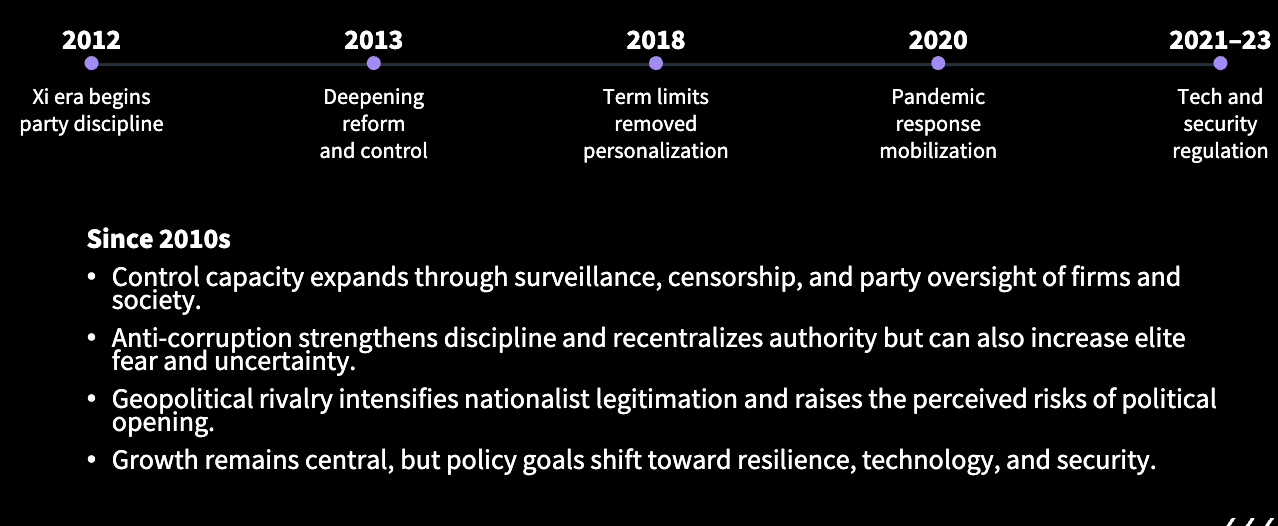
China’s Pol. Dev Timeline, 1949-1989
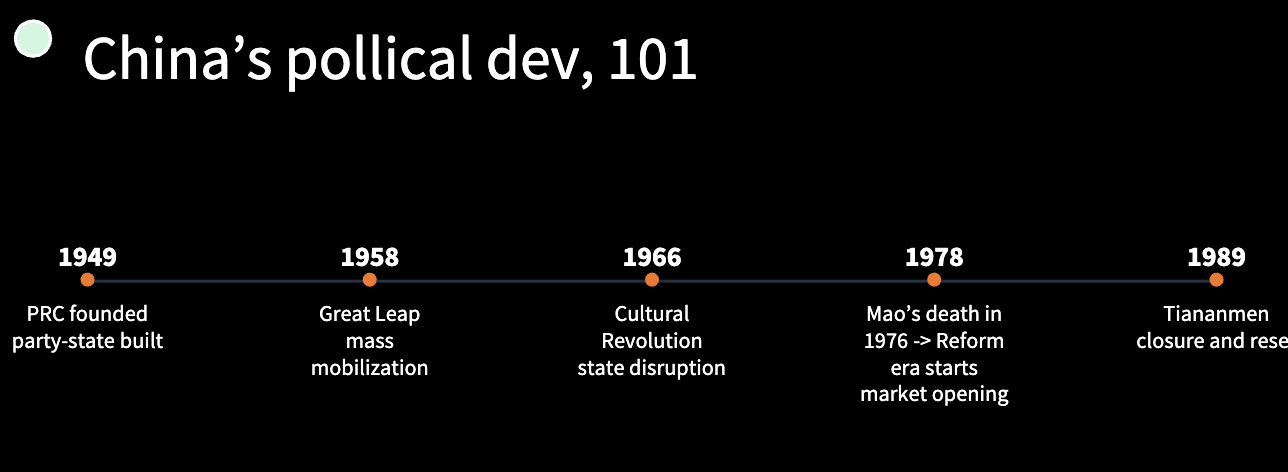
China Pol Dev, 1992-2012

China Pol Dev, 2013-2023
Where does China’s institutional strength come from? (Party-bureaucratic)
Party-bureaucratic strength
• Party cadre management and evaluation.
• Capacity to mobilize resources across levels
of government.
• Ability to implement major reforms, then
adjust after shocks.
• Policy experimentation with central
oversight and learning.
• Revenue capacity strengthened by fiscal
reforms.
Where does China’s institutional strength come from? (Coercive-Informational)
Coercive and informational strength
• Cohesive security apparatus and party
control of coercion.
• Censorship and surveillance that reduce
collective action capacity.
• Consultative and grievance channels that
gather information.
• Co-optation of entrepreneurs and
professionals into party networks.
• High ability to prevent independent national
opposition organization.
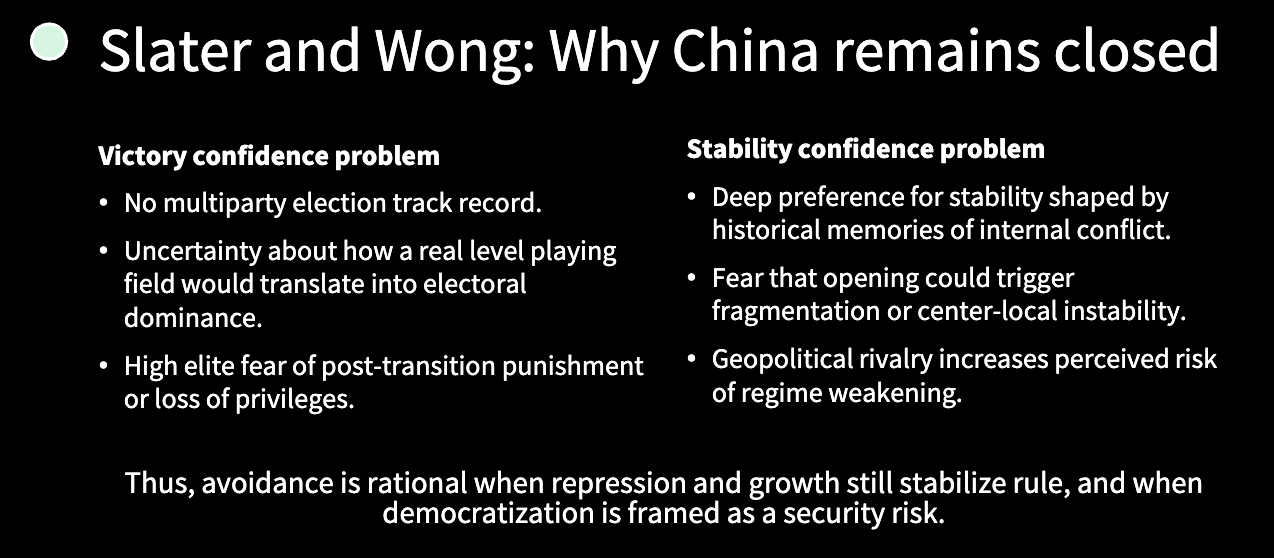
Why does China remain closed?
Vietnam Political Dev, 1945-2007
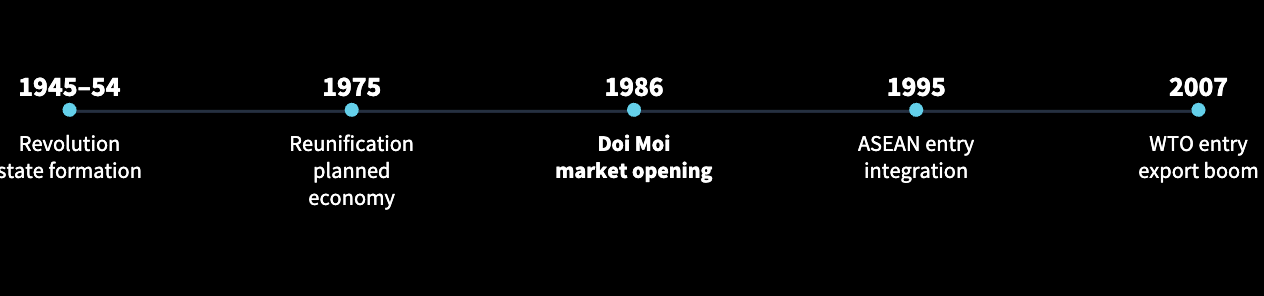
Vietnam Political Dev, 2007-Now

Where does Vietnam’s institutional strength come from? (Coercive-Informational)
Security apparatus capable of
preventing national opposition
organization.
• Censorship and controlled media
environment, especially online.
• Selective tolerance of criticism and
protest to gather information.
• Anti-corruption campaigns that
strengthen discipline and deter elite
defection.
Where does Vietnam’s institutional strength come from? (Party-Bureaucratic)
Collective leadership norms and
regularized succession cycles.
• Policy implementation through
provinces with real authority.
• Legislative deliberation that can surface
problems and improve information.
• Ability to balance growth, distribution,
and stability goals.
Why does Vietnam remain closed?
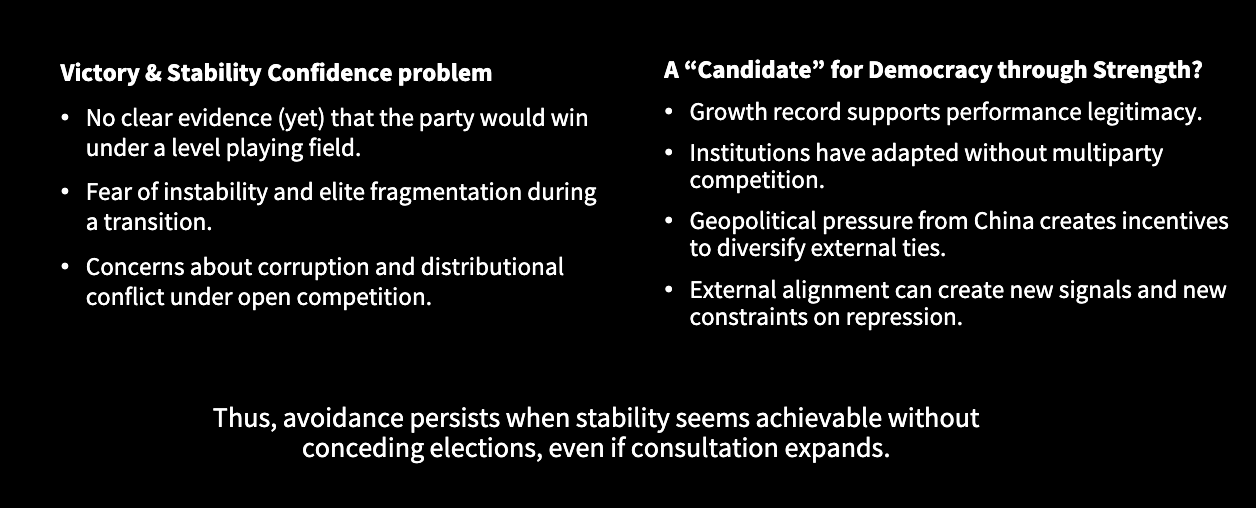
Summary of week 8
• Authoritarian politics is structured by institutions and organizations, like in democracies.
• Growth and stability depend on how rulers manage coalitions, not only on coercion.
• Strength can stabilize dictatorship and, in some contexts, make democratization strategically
plausible.
• Gandhi (2008):
• Institutions inside dictatorships can improve performance by structuring bargaining.
• Institutionalization can broaden support and increase durability.
• Growth patterns differ systematically across the level of institutionalization.
• Slater & Wong (2022):
• Economic development can generate organizational strength that produces regime confidence.
• Signals and timing shape whether or not rulers concede.
**A&R: The Vicious Circle

Vicious Circle in Sierra Leone: Railway to Bo
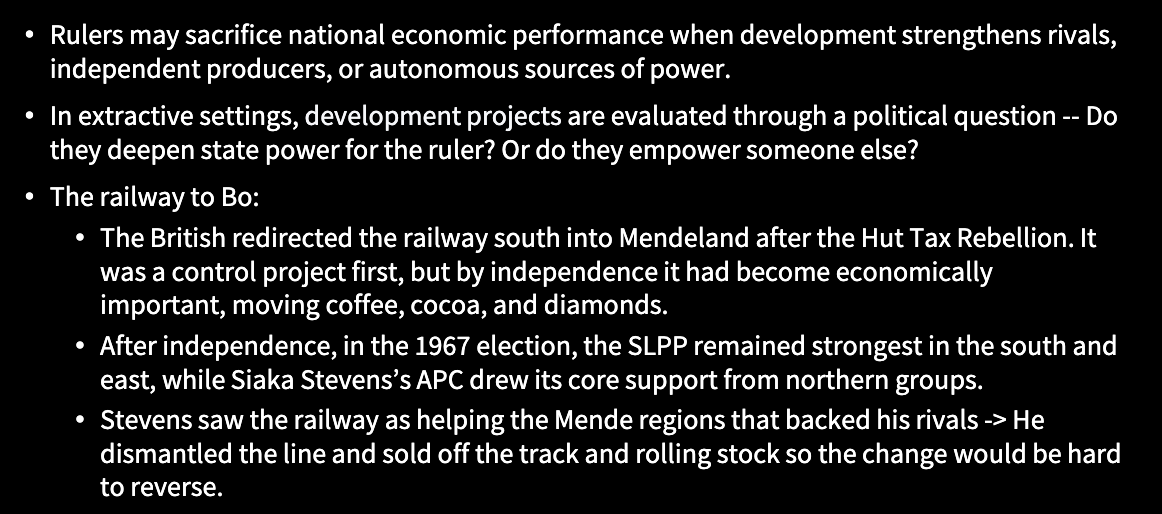
Vicious Circle in Sierra Leone: Marketing Boards
taxation without broad development
• The colonial state claimed the marketing board would
stabilize farmers’ income by smoothing price swings.
• In practice, the board became a tax machine: it
systematically paid farmers well below the world price.
• Extraction intensified after independence. By the mid-
1960s, farmers received only about half the world price;
under Stevens the share sometimes fell to roughly one-
tenth.
• The money did not return as broad public goods ->
enrichment of rulers and cronies, plus the financing of
political support.
Vicious Circle in Sierra Leone: Chiefs, land, and investment
• Indirect rule survived independence. Paramount
chiefs still collected taxes and remained tied to
recognized “ruling houses.”
• Because chiefs were custodians of land, farmers’
rights were insecure unless they were politically
connected or rooted in the local ruling structure.
• Land could not easily be sold or used as
collateral. Outsiders could not safely plant
perennial crops because doing so might trigger
disputes over rights.
• The result was weak incentives to invest, adopt
new methods, or protect the soil.
Vicious Circle in Sierra Leone: Diamonds in Sierra Leone
• Because the diamonds were alluvial, many
people could potentially have participated in
mining. In principle, that could have
broadened opportunity.
• Colonial authorities did the opposite: they
granted a monopoly to the Sierra Leone
Selection Trust under De Beers and even
allowed a private Diamond Protection Force.
• After independence, Stevens nationalized the
arrangement into the National Diamond Mining
Company and turned diamond control into a
political resource.
Vicious Circle in Sierra Leone: Violence and state capacity under Stevens
• Stevens did not trust a strong national army; a
powerful military could become a threat to his
own rule.
• He therefore weakened the regular army and
relied instead on loyal paramilitary forces such
as the Internal Security Unit and the Special
Security Division.
• This move protected the ruler in the short run
but accelerated the erosion of state authority.
Personalized coercive institutions helped make
future disorder more likely.
Extractive Institutions: Guatemalan Example
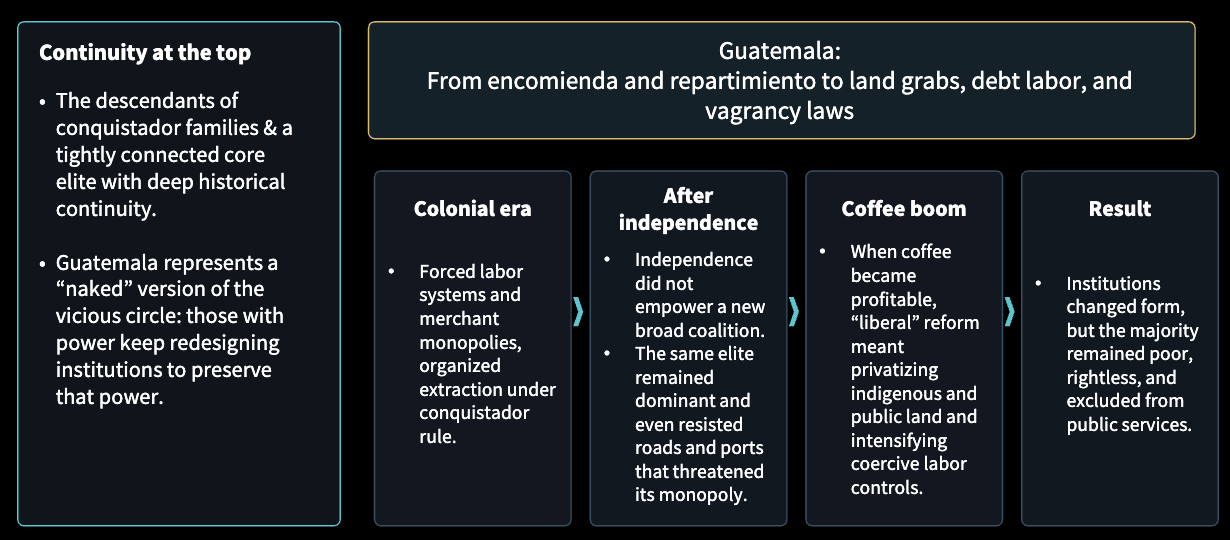
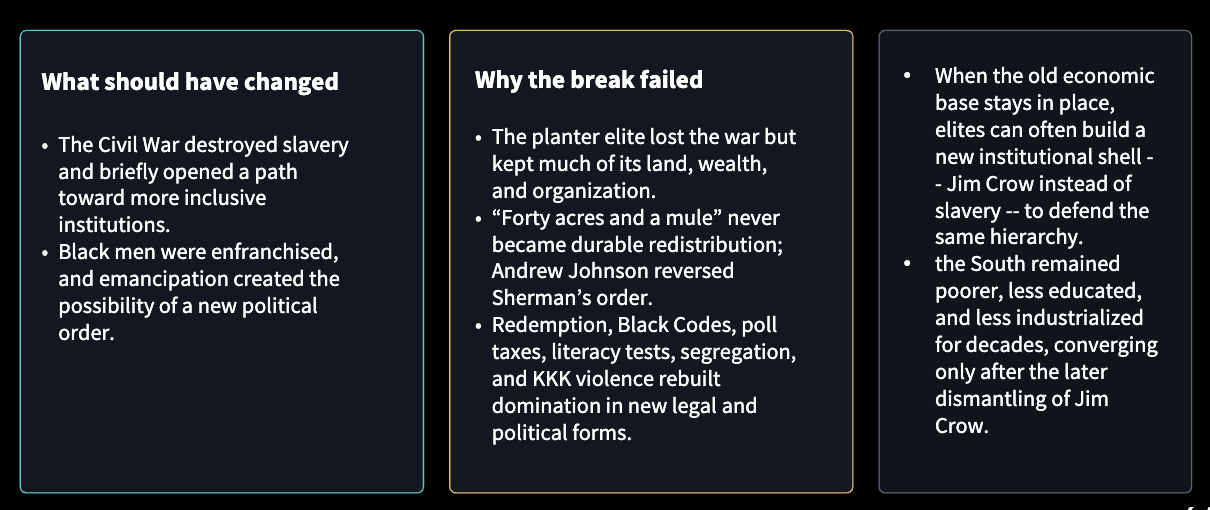
Extractive Institutions: The US South Example
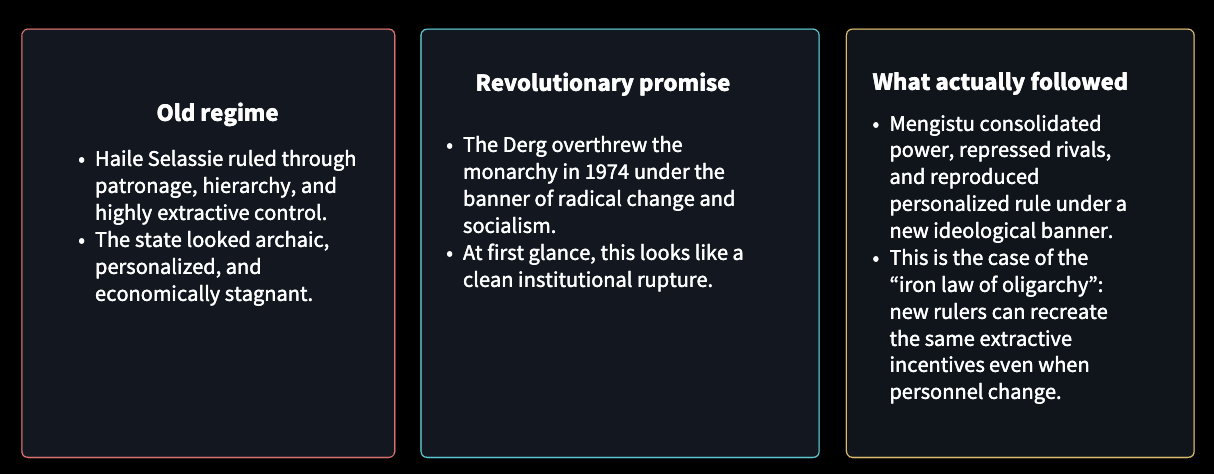
Extractive Institutions: The Ethiopia Example
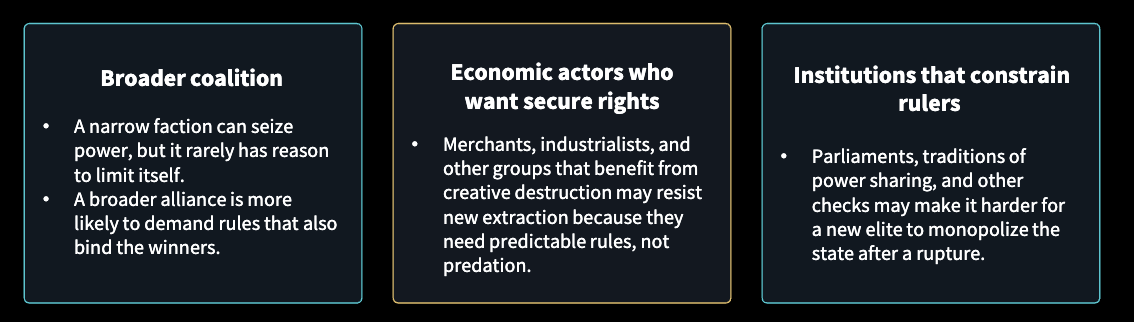
What can break the vicious circle?
What is clientelism?
distribution (or promises) of resources by political office holders or candidates in exchange for political support, primarily (not exclusively) the vote. Typically selective, particularistic, and tied to informal but binding understandings.
What is patronage?
allocation of jobs, contracts, and public resources through political connections. Often supplies the material base and organizational glue for clientelist exchange.
What is machine politics?
organized systems that routinize targeted distribution and mobilization. Machines solve delivery (who gets what) and enforcement (how compliance is signaled when vote choice is private).
What are brokers?
intermediaries who translate need into requests and translate access into participation. Broker power rests on gatekeeping, information advantages, and scarcity management.
What is programmatic politics?
distribution by rules to categories rather than personal ties. Reduces broker
monopoly and weakens contingent exchange.
What is turnout buying?
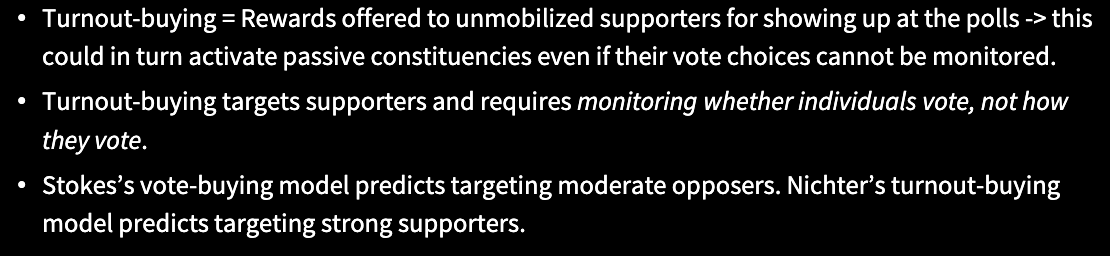
What are the different ways to combine voter preference and clientelism?
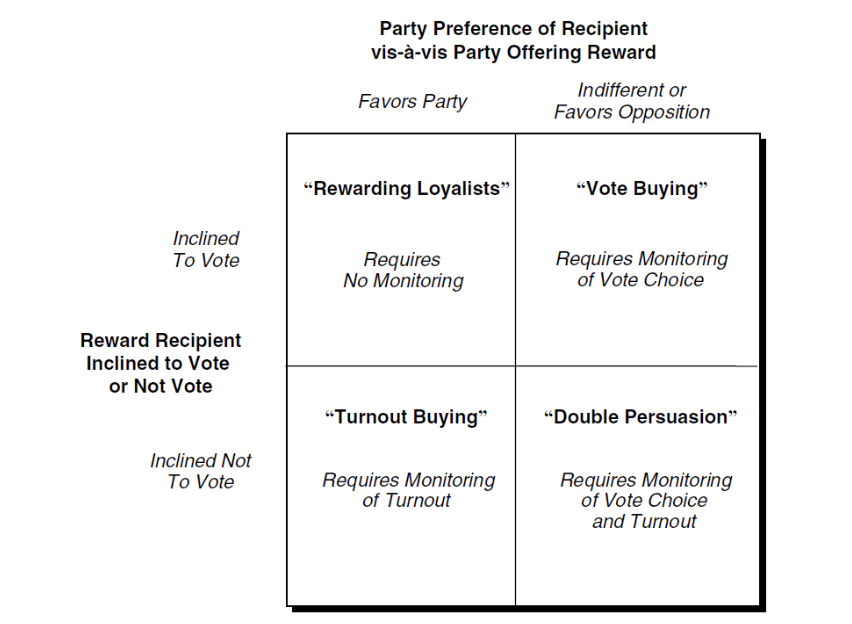
Turnout-Buying, Argentina
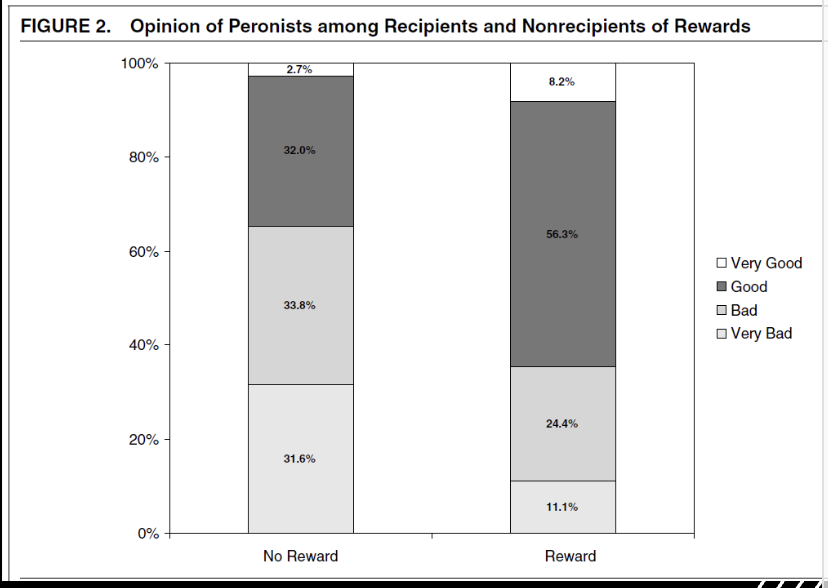
Auyero: Where is clientelism most prominent? How does Clientelism work?
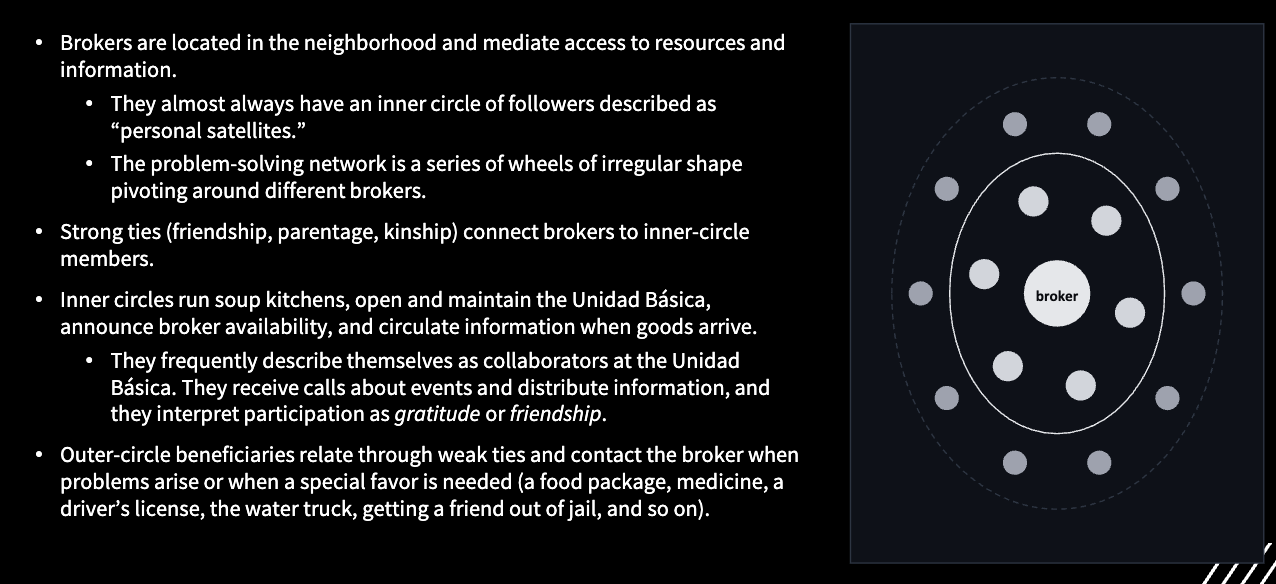
Latin America; Clientelism works through relationships, not only through explicit exchanges at election time.
Auyero: Clientelism as problem-solving network
Clientelism in the Philippines: Dynastism
Dominant parties are heavily dynastic.
• 57% of legislators from the dominant party
belong to political clans.
• Around 160 political clans have had two or more
members serve in Congress.
• They account for more than 400 of the 2,407
individuals elected to the national legislature
since 1907.
Historic aid precedents
Apolitical, palliative rather than transformational
Politicization of aid: Post-Cold War Geopolitics
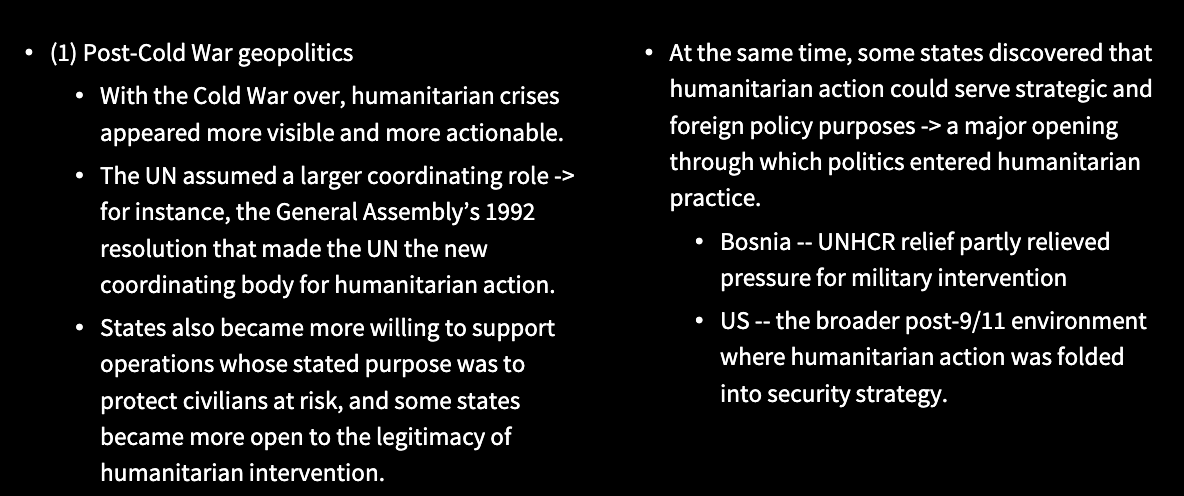
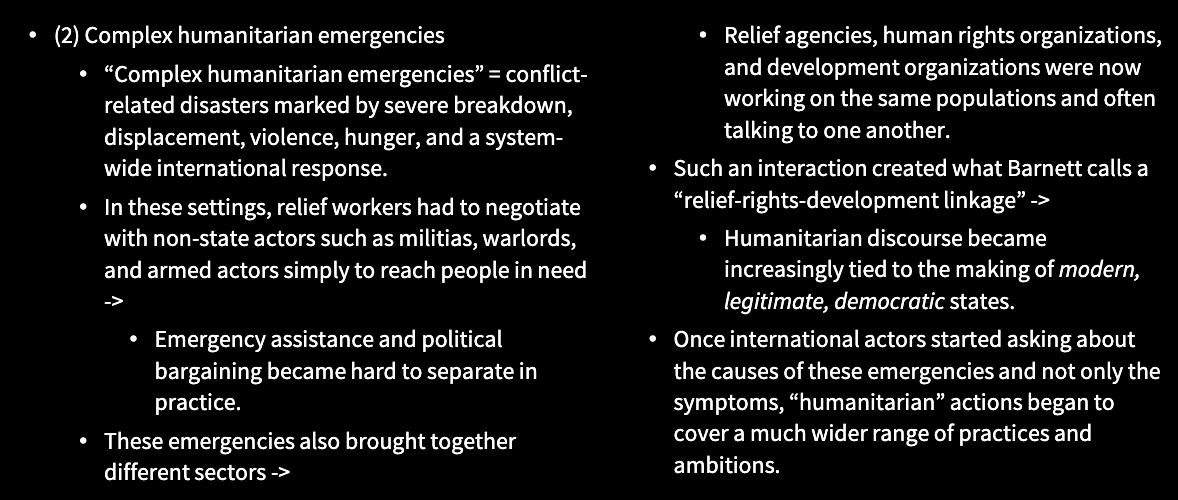
Politicization of aid: Complex Humanitarian Emergencies
Politicization of aid: Political Economy of Funding
Humanitarian funding rose sharply throughout the 1990s.
• Official assistance increased from about $2.1 billion in
1990 to $5.9 billion in 2000, and humanitarian aid
grew as a share of official development assistance.
• A small donor oligopoly mattered greatly -- The US
dominated, followed by the European Community
Humanitarian Organization (ECHO), the UK, several
European states, Canada, and Japan.
• More money = more leverage, more expectations, and
more monitoring.
Politicization of aid: Change in normative/legal environment
Sovereignty was becoming more “conditional” ->
• State legitimacy was increasingly tied to rule of law,
markets, democracy, and what later became familiar
as a “responsibility-to-protect” logic.
• Human rights discourse also pulled humanitarianism
toward the center of the international agenda ->
• Many agencies adopted the language of rights, even
though rights-based approaches could make relief
conditional in ways classical relief workers found
troubling.
• A broader “cosmopolitan” ethos reinforced all of this by
insisting that distant suffering generates moral obligations
across borders.
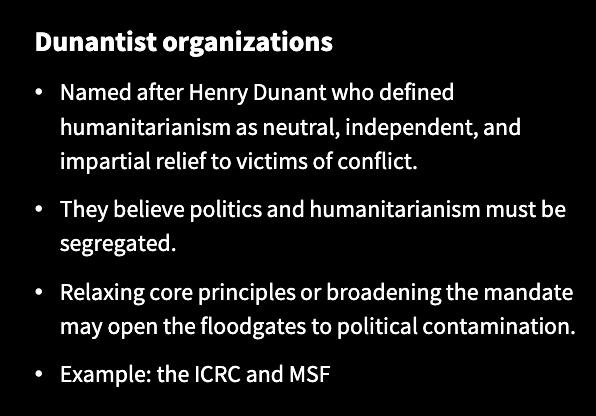
Differences in organizations: Dunantist aid
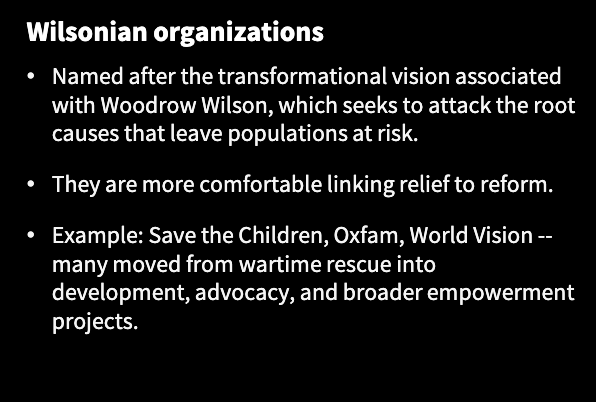
Differences in organizations: Wilsonian aid
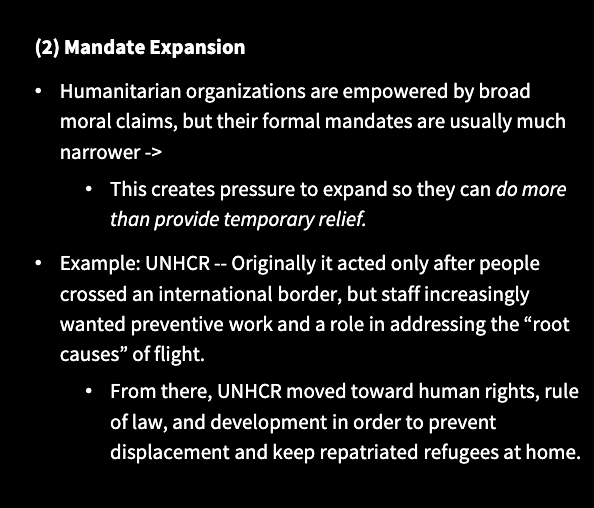
Differences in organizations: Mandate Expansion
Differences in organizations: Resource Dependence
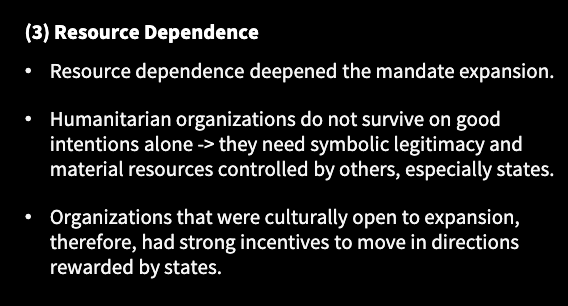
Institutionalization of Humanitarianism
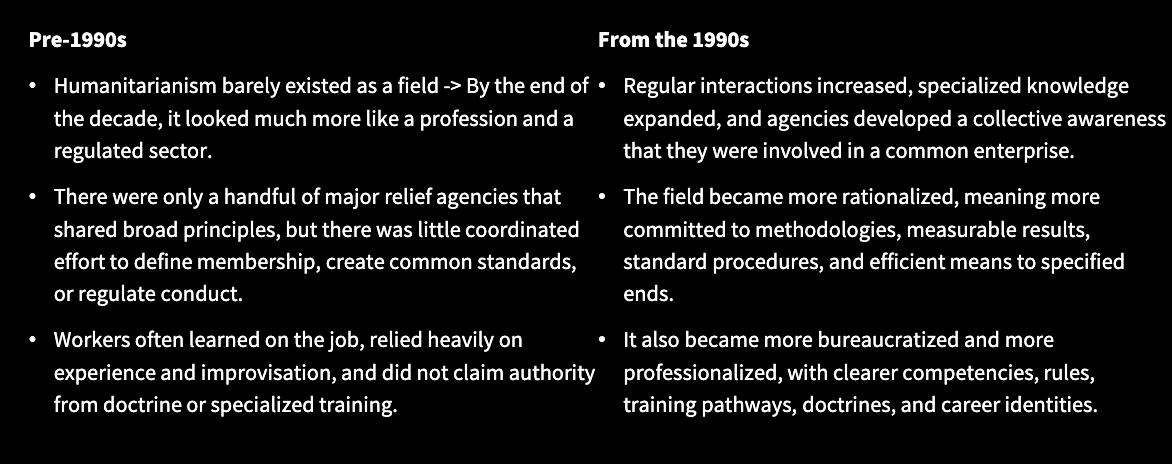
Why did aid organizations become institutionalized?
(1) An influx of agencies created coordination problems: different groups arrived with different standards,
different practices, and different levels of competence.
• (2) Donors were paying much more and therefore demanded proof that agencies were effective and accountable.
Three mechanisms of institutional isomorphism
Coercive isomorphism occurs when powerful actors such as states impose rules and standards.
• Mimetic isomorphism occurs when organizations copy forms viewed as successful under uncertainty.
• Normative isomorphism occurs when professional communities define proper methods of work, control training and entry into the field, and establish expert authority over what counts as legitimate practice.
Official Development Assistance (ODA)
Comes from the official sector.
• Has the promotion of economic development
and welfare as its main objective.
• Is concessional (that is, with low, fixed interest
rate) in character.
• E.g., classic OECD-DAC rule required at least a
25% grant element and excluded ordinary
export credits, military aid, and subsidies for
donor-country firms.
Other Official Flows (OOF)
• A residual category for official money that does
not meet ODA criteria.
• These flows can still be developmental, but
they are not ODA.
• Includes loans that are not concessional
enough, or whose primary purpose is export
promotion rather than development and
welfare.
Chinese aid, ODA-style
• China’s external assistance includes grants,
zero-interest loans, and concessional
foreign-aid loans.
• Activities associated with the aid program
such as turn-key projects, technical
cooperation, material goods, general
humanitarian aid, training programs, and
some concessional loan projects.
Chinese official finance beyond ODA-style aid
• The larger universe includes preferential
export credits, non-concessional state loans,
policy-bank lending, and mixed packages
that combine infrastructure finance, trade
promotion, and support for Chinese firms.
• These may serve development, but they
should not automatically be counted as
ODA-style aid.
Why is Chinese aid misclassified
(1) Transparency is limited:
• Chinese official finance is often reported in ways that make it hard to separate grants,
concessional loans, export credits, and commercial instruments.
• (2) China’s way of doing things:
• Beijing frequently bundles several types of finance together in one package, so outside
observers see one large developmental deal and call the entire package “aid.”
• (3) Negligence over OECD-DAC rules:
• Many analysts are not careful about DAC rules. If they compare all Chinese official finance (incl.
OOF) with OECD’s definition of ODA, they are comparing apples with oranges.
• (4) The misleading PR:
• Some Chinese instruments are genuinely developmental in effect, which makes them easy to
mistake for aid even when they do not meet the formal ODA criteria.
Chinese aid in Angola
China Eximbank financed post-war reconstruction
through an oil-backed line of credit that funded
roads, schools, electricity, water systems, hospitals,
and related infrastructure.
• It looked like development assistance, but it was not
– at least by the definition of ODA.
• The loans were secured with oil exports and
operated more like special state loans or export-
credit style finance.
• The money largely stayed in China, as payments
went to Chinese contractors and suppliers.
Chinese aid in Nigeria
The huge Sino-Nigerian railway deal often cited as
“aid” was actually a mix of construction contracts
and credit negotiations, including a separate $2
billion package linked to oil and a $500 million
preferential export credit.
• Once the deal is unpacked, most of it does not
clearly qualify as ODA.
Regilme and Hodzi benchmarks for systematic aid comparison
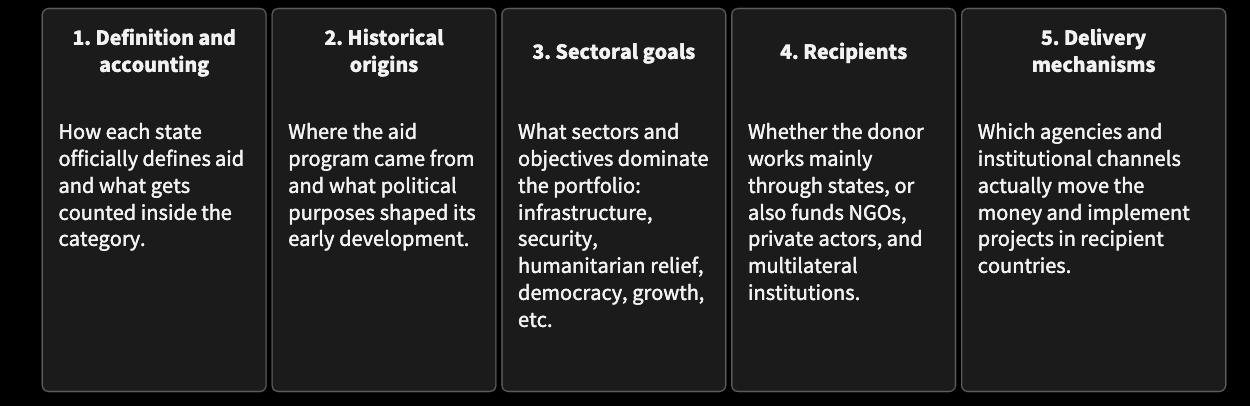
US aid vs. China: USA (Official Definition and Accounting)
US aid is clearly defined, publicly reported, and
institutionalized.
• US foreign assistance = a broad portfolio that
includes economic aid, military aid, and
contributions through multilateral
organizations.
• Because the US system is older and more
bureaucratized, its accounting categories are
comparatively transparent.
US aid vs. China: China (Official Definition and Accounting)
China officially highlights grants, interest-free
loans, and concessional loans
• Chinese aid is much harder to decipher
because official statistics were long treated as
sensitive or even classified.
• Aid is often bundled with trade, investment,
concessional loans, and other state-backed
finance.
• Beijing also dislikes “donor-recipient”
language for political and diplomatic reasons
and prefers terms such as “cooperation,”
“mutual benefit,” and “South-South
exchange.”
US aid vs. China: China (Historical Foundations)
Chinese aid began in the 1950s with support for
North Korea, Vietnam, and other anti-imperial
or anti-colonial struggles.
• In the 1960s and 1970s, aid supported Third
World leadership claims and diplomatic
competition with Taiwan.
• From the late 1970s onward, China's aid
became less ideological and more pragmatic
and economy-driven.
• As China's global economic footprint grew, aid
merged more closely with trade, infrastructure,
debt relief, and resource access.
US aid vs. China: US (Historical Foundations)
The modern US aid tradition is rooted in the
Marshall Plan and post-1945 reconstruction.
• During the Cold War, aid served anti-
communist containment and alliance-building.
• After the Cold War, it was recalibrated toward
market-oriented liberal democracy.
• After 9/11, military assistance and
counterterror priorities became central again.
US aid vs. China: US (Goals and Priorities)
US aid combines economic development,
humanitarian programming, governance
reform, and large military assistance.
• Washington often links aid to democratic
governance, market-led development,
human rights, and civil-society
empowerment.
• Military and security aid remain especially
important in strategic regions and conflict
settings.
US aid vs. China: China (Goals and Priorities)
Chinese assistance is concentrated more
heavily in infrastructure, agriculture,
technical cooperation, education, training,
and state capacity.
• The Chinese model does not center political
liberalization or civil society empowerment.
• Its language is developmental and state-
centric: strengthen growth, build
infrastructure, expand markets, and sustain
mutually beneficial cooperation.
US aid vs. China: US (who recieves aid, and how is it delivered?)
Recipients include states, militaries, multilateral
organizations, private corporations, philanthropic
institutions, and civil society actors.
• Delivery is spread across a large bureaucratic
apparatus, especially USAID, the Department of
State, the Department of Defense, and now the US
International Development Finance Corporation
(DFC).
• That breadth reflects the US view that development
is a multi-stakeholder project rather than an
exclusively state-to-state undertaking.
US aid vs. China: China (who recieves aid, and how is it delivered?)
Recipient governments are the central counterpart.
Chinese aid is far less oriented toward NGOs and civil
society organizations.
• Historically, Chinese aid management was
fragmented across many agencies, with policy banks
playing a major role.
• The creation of China International Development
Cooperation Agency (CIDCA) in 2018 was meant to
centralize planning, improve coordination, and align
aid more closely with foreign policy and the BRI.
Chinese aid and legitimacy building
Chinese aid is tied to core interests defined by the party-state CCP: sovereignty,
national security, territorial integrity, social stability, and long-term economic
development.
• Aid and official finance help secure markets, commodities, and safer
environments for Chinese investments and citizens abroad.
• Through peacekeeping, regional security support, and BRI-linked finance,
Beijing also tries to present itself as a responsible major power that provides
public goods neglected by traditional powers.
• Its rhetoric of South-South cooperation, non-interference, and mutual benefit
is therefore part of China’s broader claim to legitimacy in the Global South.
US aid as leverage
US aid has long served perceived geostrategic and economic interests, from the
Marshall Plan, to Cold War alliance-building, to the global war on terror.
• Its official discourse highlights democracy, human rights, markets, and
multilateralism, but in fact aid often supports recipient elites whose survival aligns
with US interests.
• Because the US funds governments, NGOs, multilaterals, and private actors, its aid
regime reflects a more plural and market-oriented vision of development than China’s
state-centered model.
• Aid also underwrites US claim to international legitimacy as a provider of global public
goods, although that legitimacy can erode when US policy turns unilateral or openly
transactional.
Cambodian timeline 1953-1989
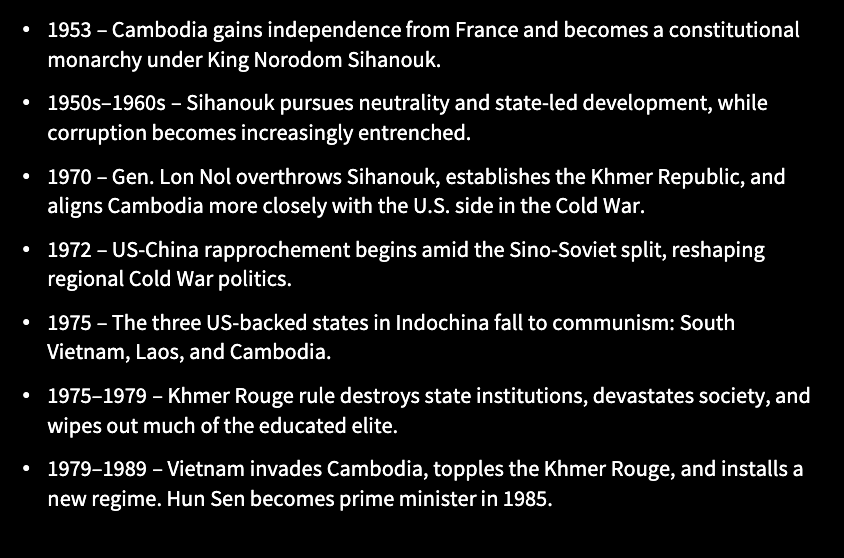
Cambodia 1989-2018
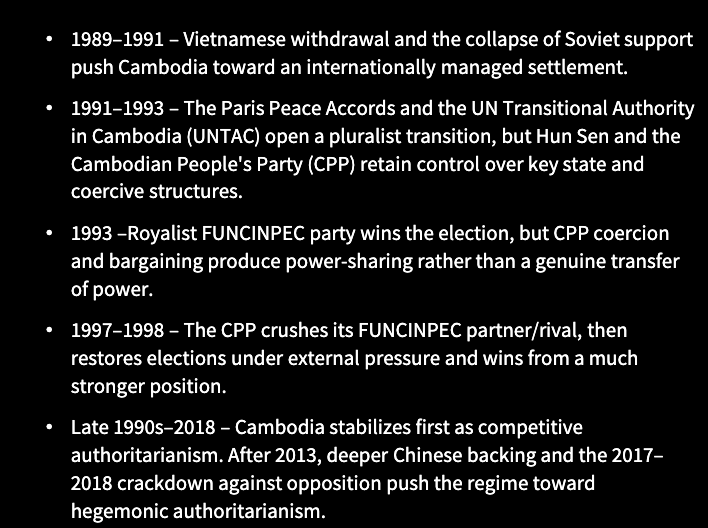
UNTAC, Cambodia, 1993 election & forced coalition
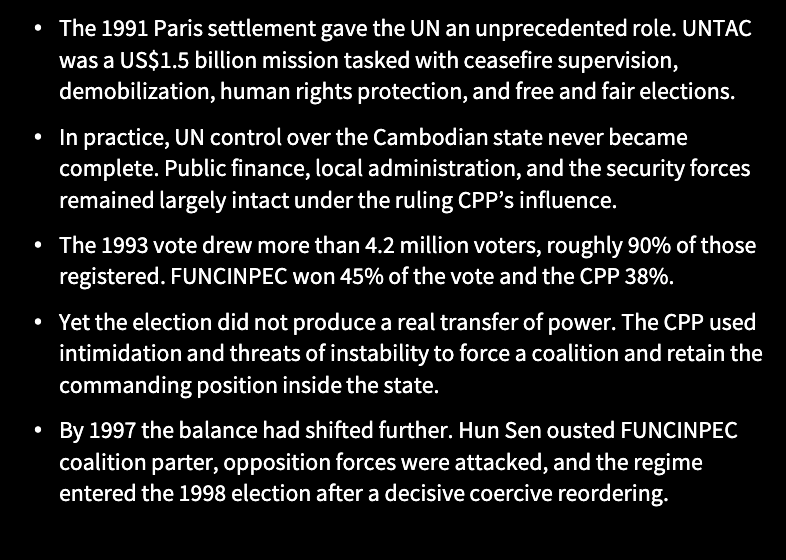
Cambodian aid dependence and governance after 1993
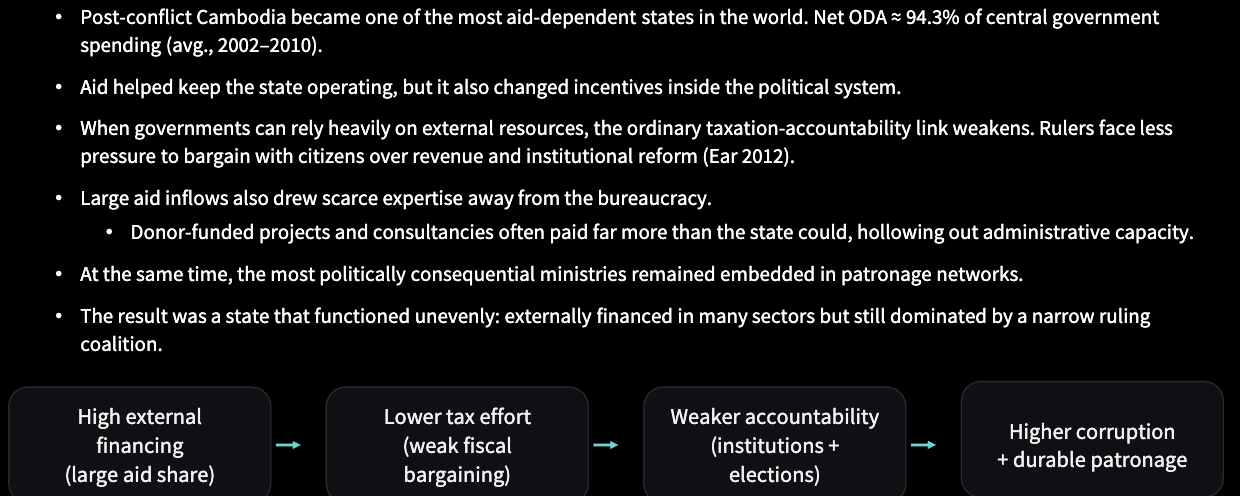
Cambodia’s political regime, 1993-2010s
Cambodia’s political regime, 1993-the 2010s
• Hun Sen’s 1997 self-coup briefly renewed
foreign pressure.
• Aid suspensions, delayed ASEAN admission,
and the empty UN seat pushed the regime to
restore a formally competitive arena in 1998.
• However, by then, the balance of power had
already shifted.
• The 1998 election took place after a
decisive coercive reset.
• FUNCINPEC had been purged from the
state, its rural networks were destroyed,
and its organization splintered.
• The Hun Sen/CPP regime packed the
electoral commission, restricted opposition
media access, used state resources freely,
and ran the thumbprint campaign to
monitor and intimidate rural voters.
• After 1998 external pressure fell again.
• Assistance was restored, business
financing for the opposition became
dangerous, and the ruling CPP
consolidated control over television,
radio, courts, and patronage resources.
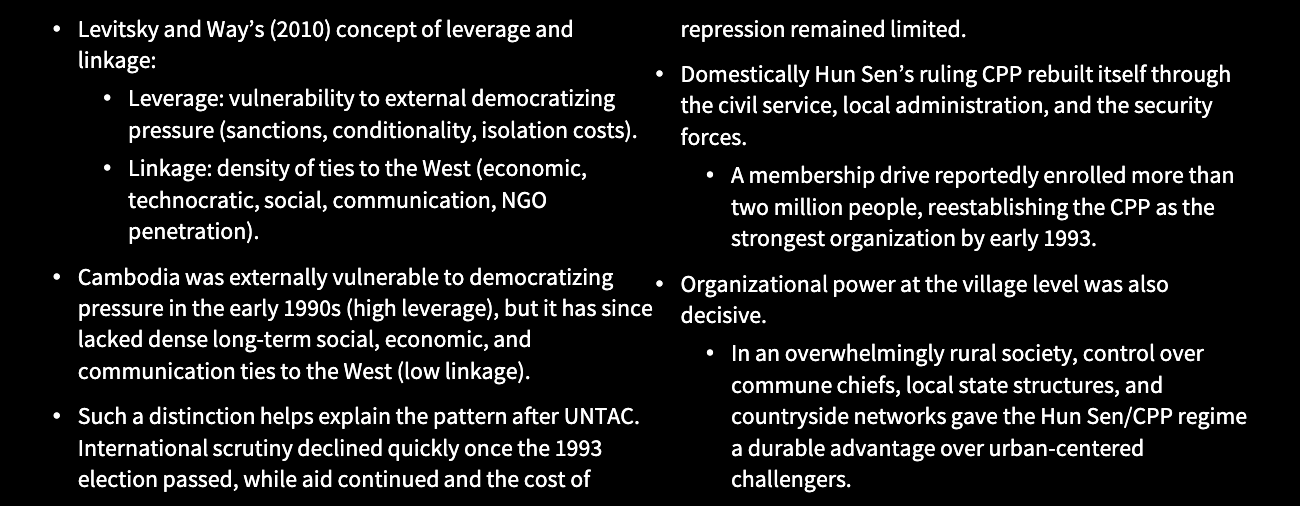
Cambodia’s political regime, 2012-onwards
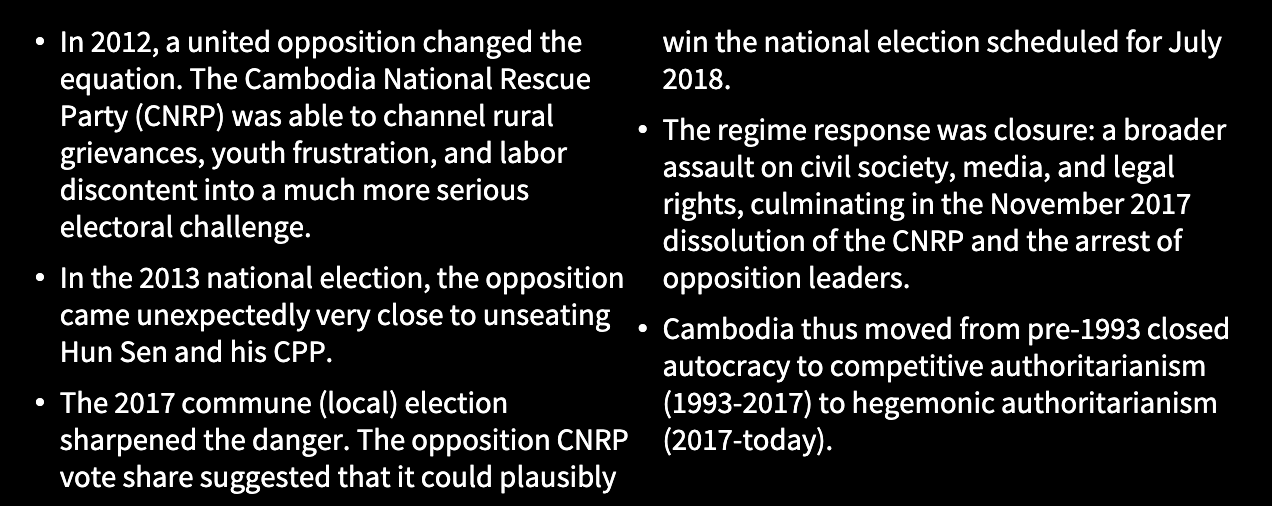
Cambodia-Chinese linkage: capital, tycoons, & the ccp
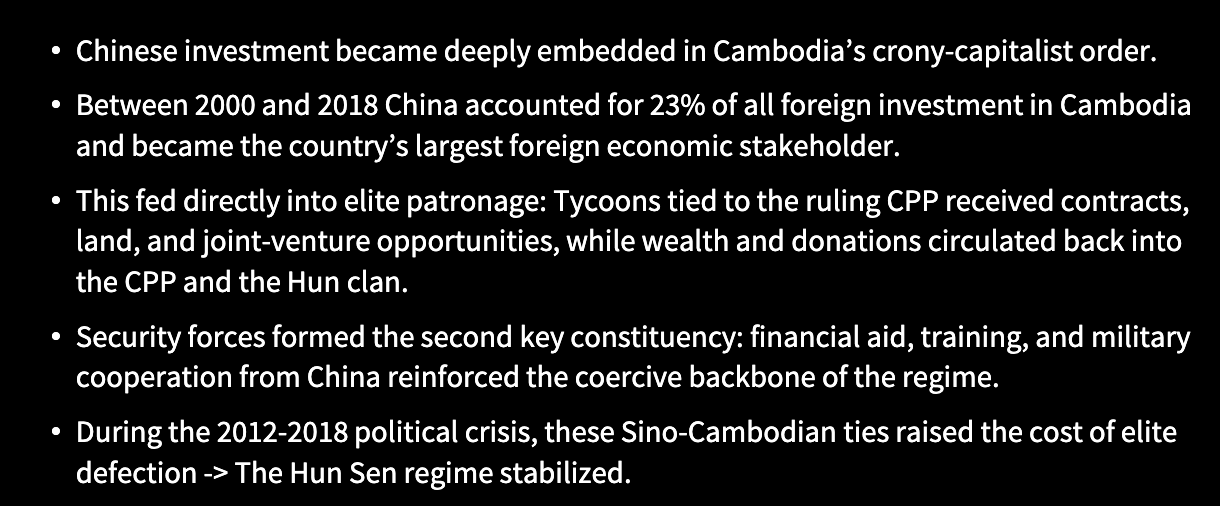
Cambodia-Chinese linkage: sanctions, trade, and diplomatic cover
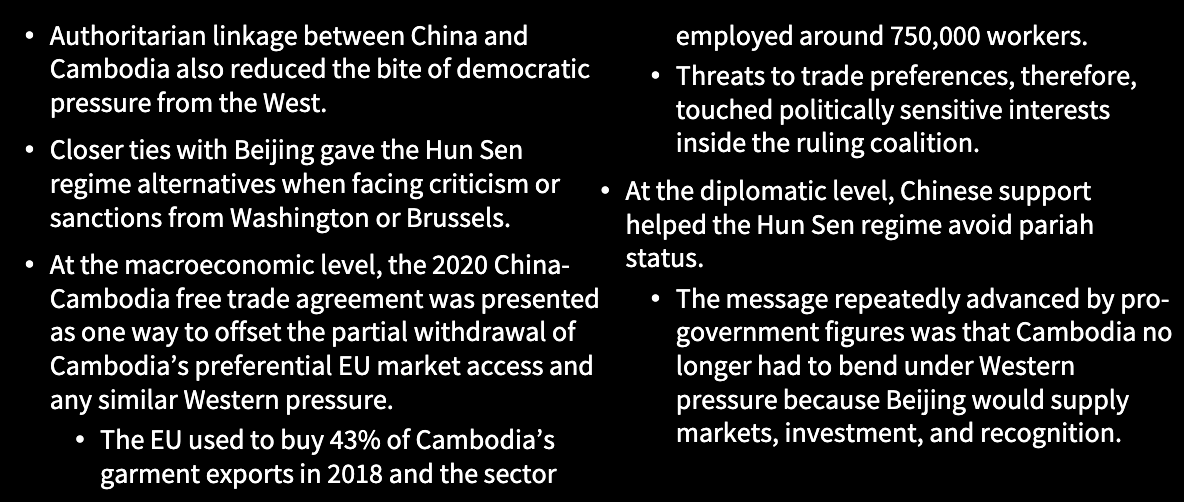
Cambodia-Chinese linkage: discourse, repression, and military cooperation
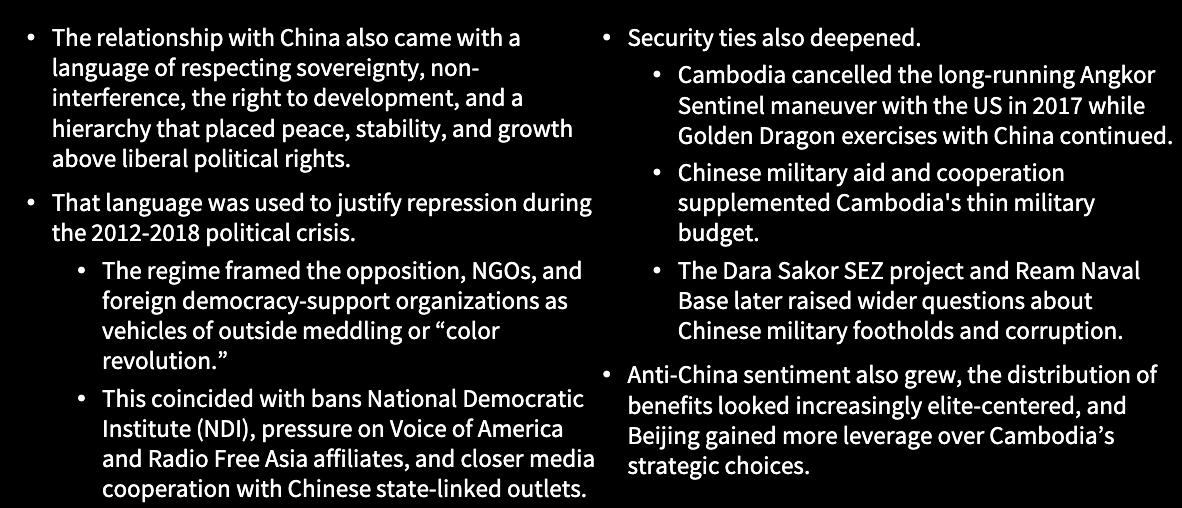
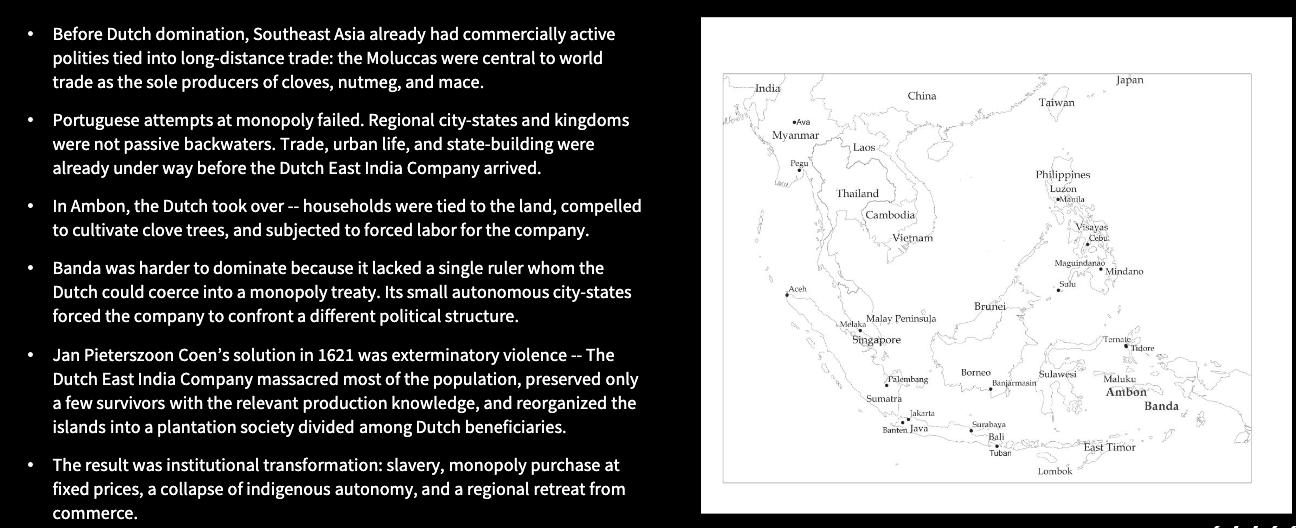
Spice Trade & the Coercive Monopoly
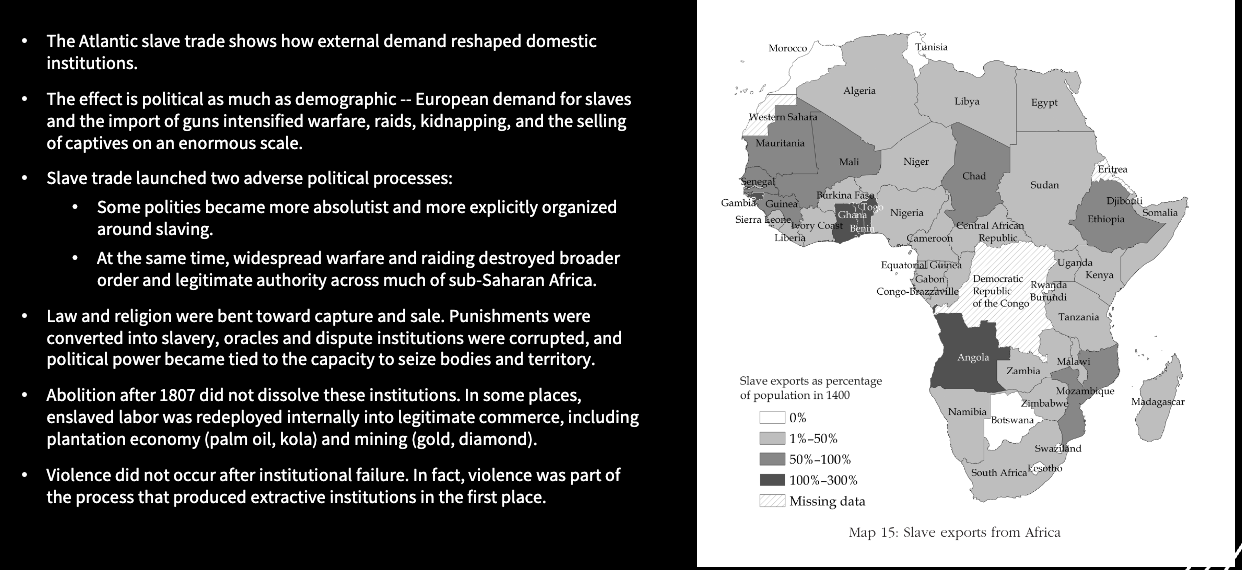
Slave Trade & the Coercive Monopoly
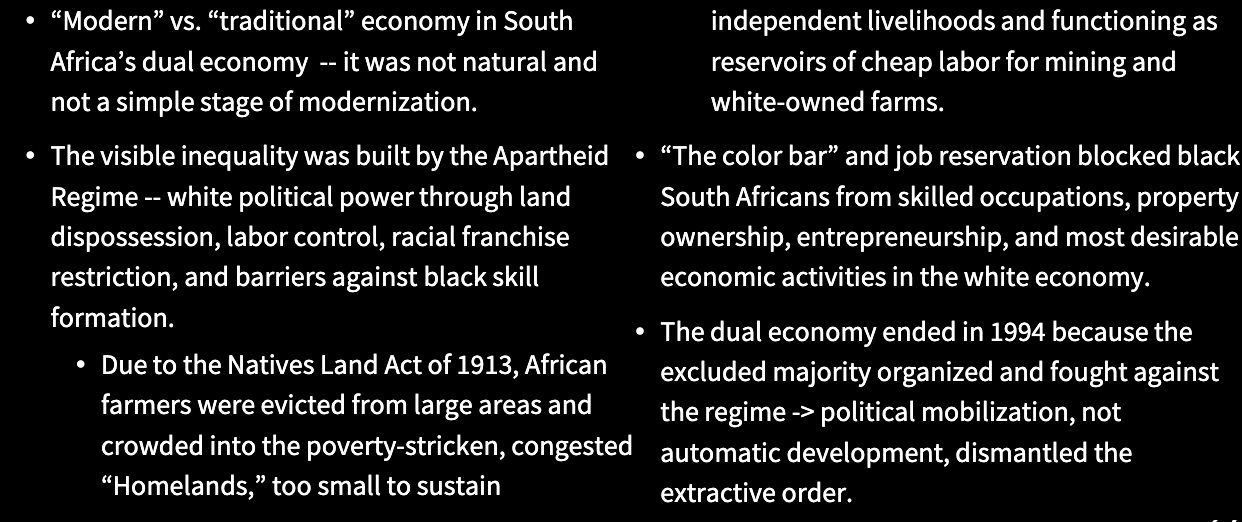
South Africa’s dual economy
Cederman: Civil-War debate; grievance-centered
Davies (1962) and Gurr (1970) linked conflict to relative
deprivation: various forms of collective violence arise
from frustrations caused by a widening gap between
one’s aspirations and actual economic status, usually
tied to material well-being.
• Structural arguments (e.g., Acemoglu and Robinson
2005) associated uneven land or wealth distributions
with revolt, rebellion, and redistributive struggle.
• Horowitz (1985) and Gurr (1993) extended grievance
arguments to ethnic conflict, where status inequality
and exclusion can supply group-based motives for
mobilization.
Cederman: Civil-War debate; opportunity/feasibility
Snyder and Tilly (1972) argued that hardship is too
widespread to explain variation in conflict. Hence, they
argued that opportunity-based mobilization, rather
than grievances, causes internal conflict and
revolutions.
• Collier and Hoeffler (2004) treated grievance individual-
level indicators such as the Gini coefficient as weak
predictors and rejected grievances and inequality as
causes of civil war.
• Fearon and Laitin (2003) found little support for
grievance proxies and stressed low income, weak
institutions, insurgency-friendly terrain, and state
weakness as causes of civil war.
Cederman: Economic, Political, Vertical versus Horizontal Inequality
Vertical inequality = differences among
individuals/households within a country (e.g., Gini).
• Horizontal inequality = differences between politically
relevant ethnic groups and the state. Two dimensions
are highlighted :
• Economic horizontal inequality = a group’s wealth
relative to the national average.
• Political horizontal inequality = a group’s access to
central executive power.
Cederman: Civil Conflict Findings
This pattern holds in both directions: groups that are poorer than
average and groups that are richer than average are both more
conflict-prone (Model 5; also Model 4/Figure 5 and 6).
• Groups that are excluded from executive power face higher conflict
risk than groups that are included (Model 3).
• Economic inequality and political exclusion appear together in the
results -> both group wealth differences and exclusion from central
power raise the likelihood of conflict (Model 3).
• Older literature likely missed part of the inequality-conflict
relationship because it focused too much on country-level
inequality and not enough on inequality between politically
relevant groups.
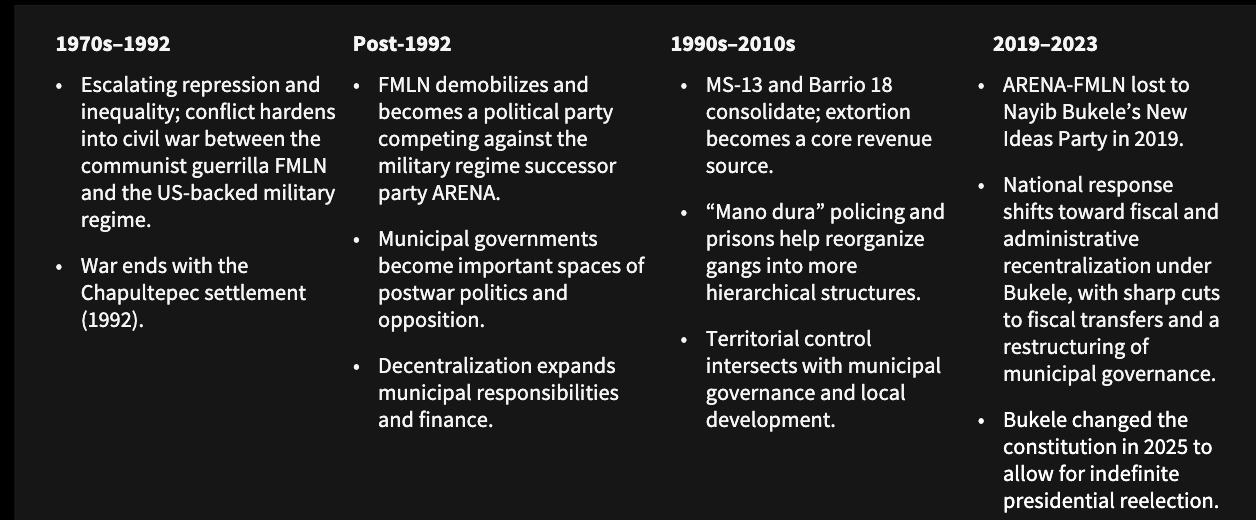
El Salvador: 1970s-2023
El Salvador: Decentralization and armed actors
• Decentralization can absorb grievances, tailor
policy to local conditions, and reduce conflict
(e.g., Bland 2006; Brinkerhoff 2011).
• Others argue that decentralization can
strengthen secessionism, empower regionally
organized challengers, or fragment the state
security apparatus (e.g., Brancati 2006).
El Salvador: Criminal governance and the state
• An emerging line of literature treats gangs as
“shadow states,” “parallel states,” or providers of
criminal governance (e.g., Chipkin & Swilling
2018; Van Klinken 2003).
• Some work stresses complementarity (a
symbiotic relationship of sort) between gang rule
and state rule, especially where gangs protect
lucrative drug markets (e.g., Lessing 2021).
• Eaton et al. (2024) argue that El Salvador fits a
different pattern because Salvadoran gangs relied
heavily on extortion rather than retail drug rents.
As such, their relation to municipal government
was more “parasitic” than complementary.
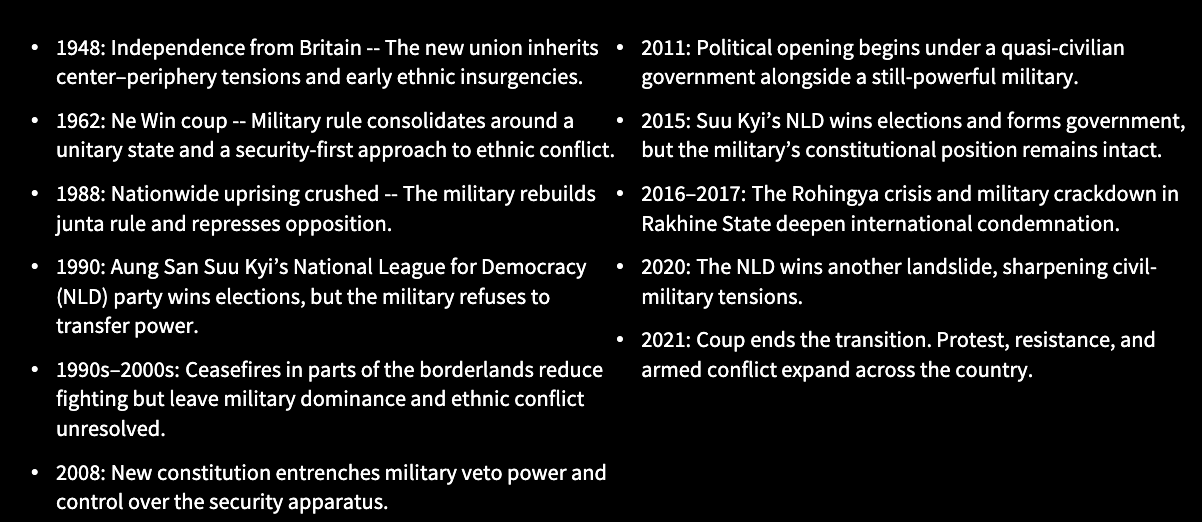
Myanmar: Timeline
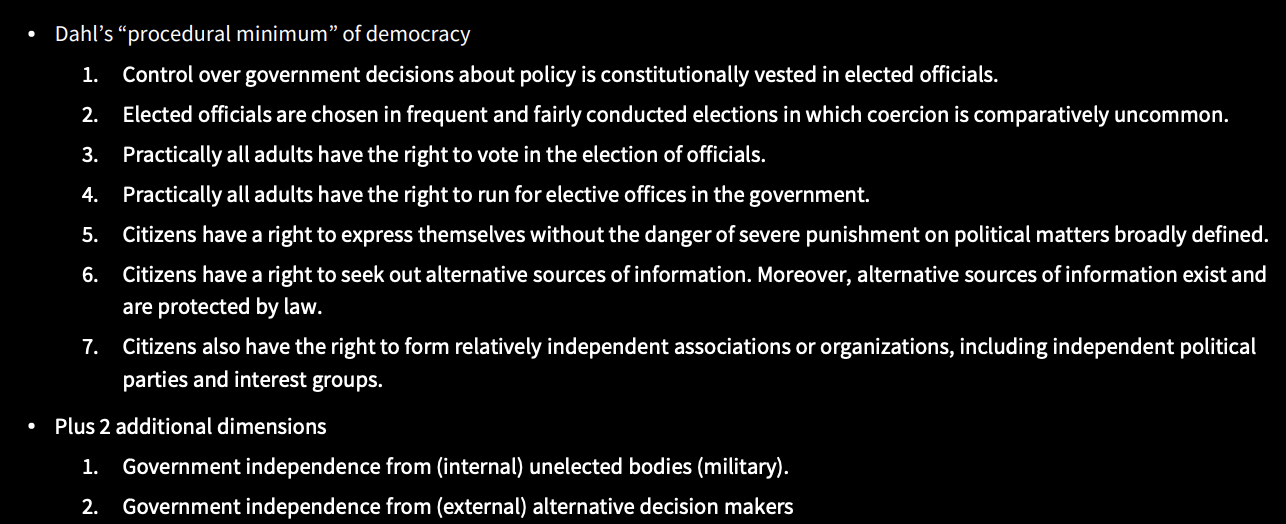
What is democracy?
Contingent Consent
In democracy, Winners do not use temporary advantage to permanently lock out losers; losers keep playing because future access is possible
Bounded uncertainty
Outcomes are uncertain, but procedures are stable enough that people accept results and comply.