Final Exam: Plant Tax Lecture
 Call Kai
 Learn
Learn Practice Test
 Spaced Repetition
 Match
Match Flashcards
 Knowt Play
1/116

Earn XP
Description and Tags
ALL of Plant tax exam 1 + Tracheophytes, seed plants / gymnosperms, Angiosperms, Reinforcement & Reproductive character displacement and role in speciation, Plant Groups & Key traits of each
Name | Mastery | Learn | Test | Matching | Spaced | Call with Kai |
|---|
No analytics yet
Send a link to your students to track their progress
117 Terms
Draw the heterosporous lifecycle
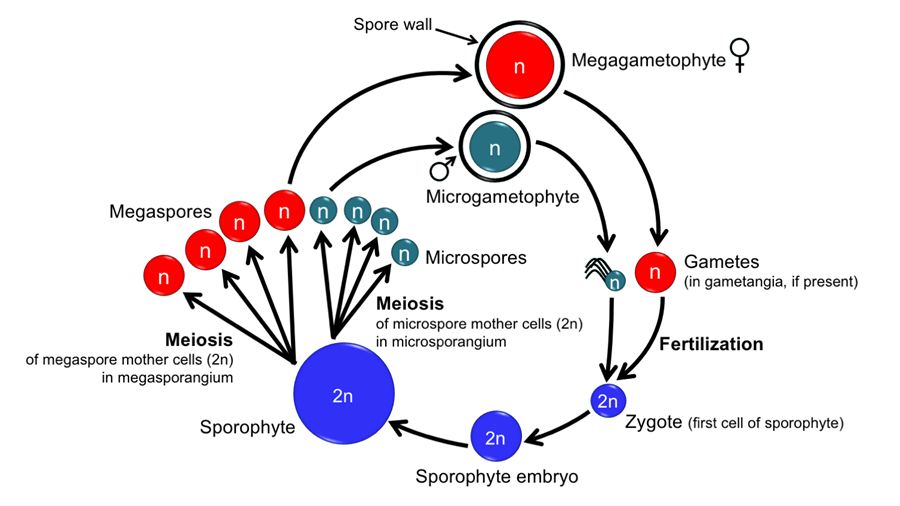
what is the difference between homospory & Heterospory?
Homospory: produces ONE type of spore → develops into a bisexual gametophyte
Heterospory: produces TWO types of spores (microspores + megaspores) → develop into male & female gametophytes separately
what are the differences in gametophyte development between homosporous and heterosporous?
homo: develops bisexual gametophyte
hetero: develops into separate male and female gametophytes
define endospory
Endospory: gametophyte develops inside the spore wall (protected & dependent)
define megasporophyll
Megasporophyll: leaf/structure that bears megasporangia
define megasporangium.
Megasporangium: structure that produces megaspores
define megasporocyte
Megasporocyte: diploid cell (2n) that undergoes meiosis to form megaspores
define megaspore
Megaspore: haploid (n) spore → develops into female gametophyte
define megagametophyte
Megagametophyte: female gametophyte (produces eggs)
define microsporophyll
Microsporophyll: leaf/structure that bears microsporangia
define microsporangium
Microsporangium: structure that produces microspores
define microsporocyte
Microsporocyte: diploid cell (2n) that undergoes meiosis to form microspores
define microspore
Microspore: haploid (n) spore → develops into male gametophyte
define microgametophyte
Microgametophyte: male gametophyte (produces sperm; e.g., pollen grain)
What is the adaptive significance of endosporic development?
Gametophyte develops inside the spore wall, which protects it from desiccation and environmental stress, reduces exposure to hazards, and allows retention on the parent sporophyte for added protection and nutrient support. This also promotes reduced, dependent gametophytes and is an important evolutionary step toward the seed habit (especially in heterosporous plants).
What are synapomorphies of euphyllophytes?
Megaphylls (true leaves) + highly branched vascular systems (leaf gaps present)
What are typical unifying traits of monilophytes (ferns & relatives)?
Sporophyte dominant, megaphylls (fronds), sporangia on leaves, often sori, circinate vernation (fiddleheads)
(exceptions exist, e.g., some lack typical fronds or sori)
what is a seed?
A mature ovule containing an embryo (young sporophyte), stored nutrients, and a protective seed coat → allows dormancy, protection, and dispersal
what are the 5 steps in the evolution of a seed?
1. Heterospory (micro + megaspores)
2. Reduction to one functional megaspore (others degenerate)
3. Retention of megaspore in megasporangium (on parent)
4. Endospory (female gametophyte develops inside)
5. Integument formation (protective layer → ovule/seed)
what is an integument?
Protective tissue layer surrounding the ovule → becomes the seed coat
What is pollen?
Male gametophyte that delivers sperm to the ovule (no water needed)
what is exospory?
Gametophyte develops outside the spore wall (free-living)
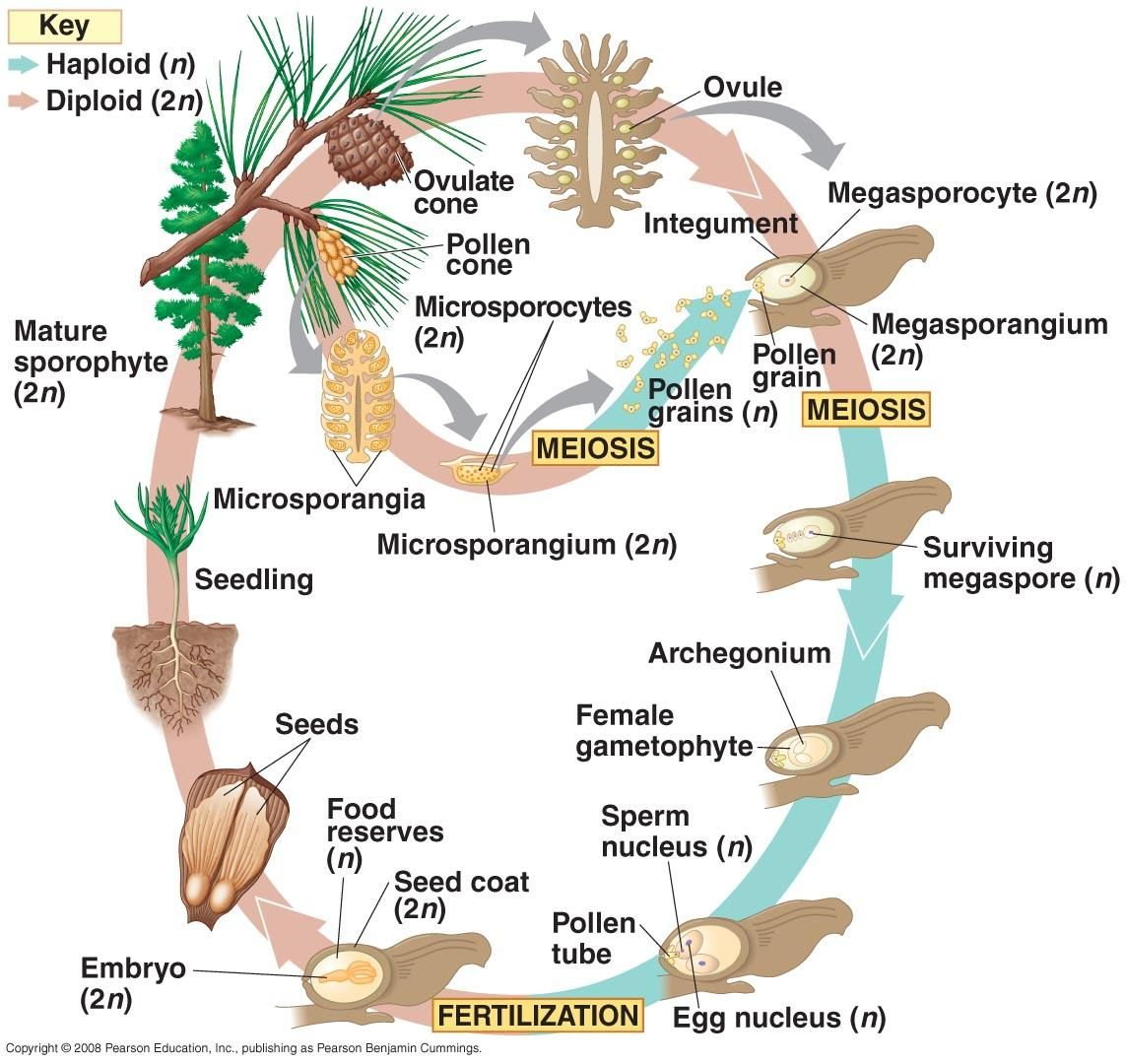
Gymnosperm (Pinus) life cycle — male function?
Pollen (microgametophyte) produced in microsporangia of pollen cones → dispersed by wind → lands on ovule → forms pollen tube to deliver sperm
Gymnosperm (Pinus) life cycle — female function?
Megaspore forms in ovule → develops into megagametophyte (with eggs) → fertilization occurs → zygote → embryo → seed develops on cone scale
draw the Gymnosperm (Pinus) life cycle with male and female parts included.
What are the functions of seeds?
Protection of embryo, nutrient storage, dormancy, dispersal, and increased survival in harsh environments
what are the 4 groups of gymnosperms?
Cycads, Ginkgos, Conifers, Gnetophytes
Characteristics of Cycads?
Palm-like, large compound leaves, dioecious, motile sperm, tropical/subtropical, often symbiotic N-fixing roots
Characteristics of ginkgos?
Single species (Ginkgo biloba), fan-shaped leaves, deciduous, dioecious, motile sperm, very pollution tolerant
Characteristics of conifers?
Woody trees/shrubs, needle or scale leaves, usually evergreen, non-motile sperm, wind pollination, dominant in cold/dry climates
Pinaceae vs. Cupressaceae — leaf shape?
Pinaceae: needle-like (often in bundles/fascicles)
Cupressaceae: scale-like or small needles
Pinaceae vs. Cupressaceae — pollen morphology?
Pinaceae: winged pollen (air sacs)
Cupressaceae: non-winged pollen
Pinaceae vs. Cupressaceae — ovulate cone shape?
Pinaceae: woody, elongated cones
Cupressaceae: smaller, often round/berry-like cones
Pinaceae vs. Cupressaceae — mycorrhizal status?
Pinaceae: ectomycorrhizal
Cupressaceae: typically arbuscular (or variable)
Role of vascular cambium in woody plants?
Produces secondary xylem (wood) inward and phloem outward → increases girth
Role of cork cambium in woody plants?
Produces cork (protective outer layer) → reduces water loss and protects from damage
What are the 6 unique characteristics of angiosperms?
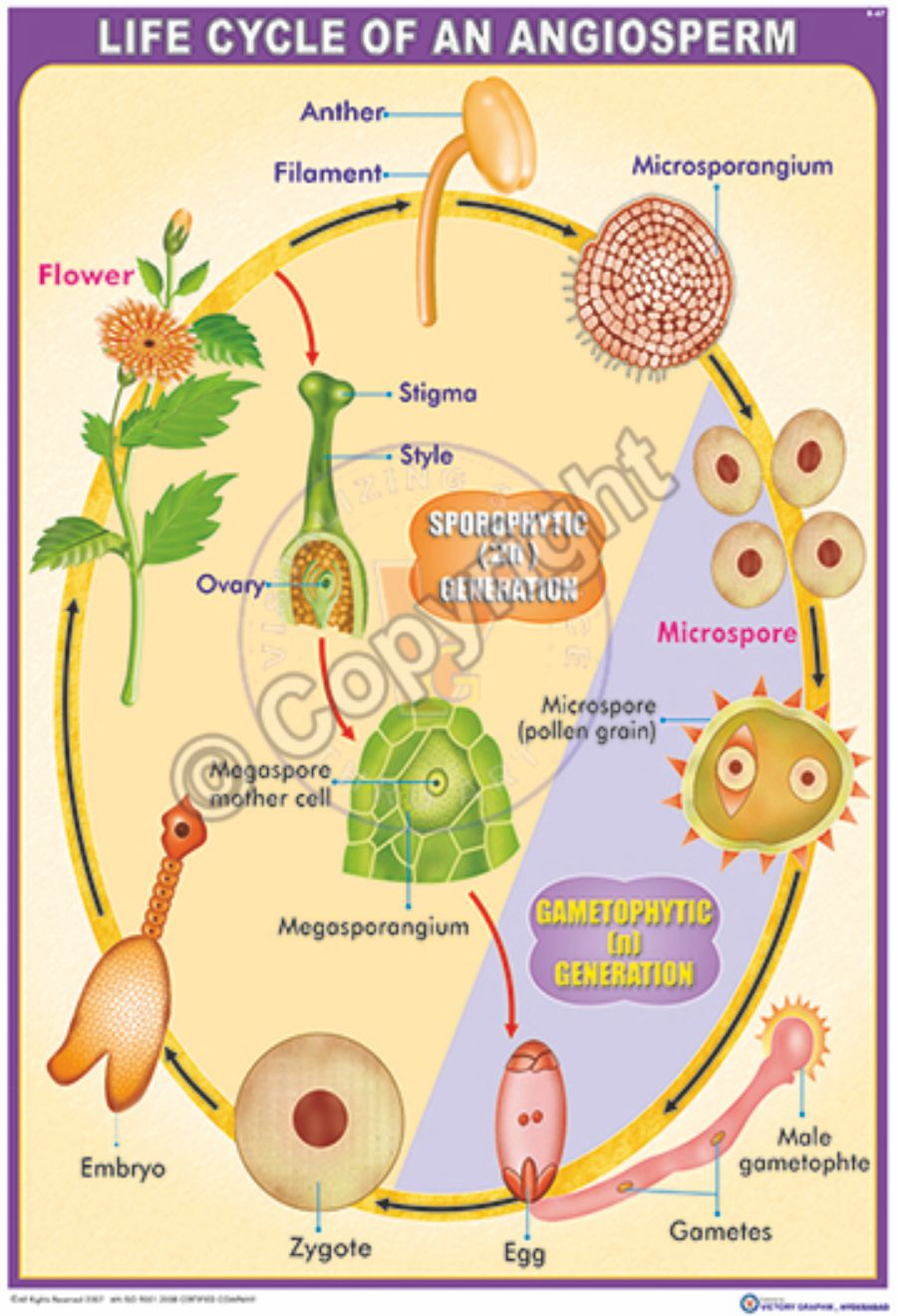
Flowers, fruits (enclosed seeds), double fertilization, endosperm formation, vessel elements in xylem, reduced gametophytes
draw out the angiosperm (flowering plants) lifecycle.
What is an ovule and how does it relate to megagametophytes in other groups?
Ovule = megasporangium + integuments; contains the megagametophyte (embryo sac). Unlike other groups, it is fully enclosed in the ovary and highly reduced
What is double fertilization? What cells are fertilized and what forms?
Double fertilization is a process unique to angiosperms where two sperm cells are involved in fertilization. After pollination, the pollen tube delivers two sperm into the ovule. One sperm fertilizes the egg cell, forming a diploid (2n) zygote, which develops into the embryo. The second sperm fuses with two polar nuclei in the central cell, forming a triploid (3n) endosperm, which serves as nutritive tissue that supports the developing embryo.
What are the evolutionary origins of anthers and pistils?
Anthers = modified microsporophylls (male structures)
Pistils (carpels) = modified megasporophylls that enclose ovules
What is the androecium?
Male reproductive whorl (all stamens)
What is an anther?
Pollen-producing structure
What is a filament?
Stalk that supports the anther
What is the gynoecium?
Female reproductive whorl (carpels/pistils)
what is a pistil?
female structure = stigma + style + ovary
what is the stigma?
sticky surface that recieves pollen
what is a style?
tube connecting stigma to ovary
what is the ovary?
encloses ovules; develops into fruit
what is an ovule?
structure containing egg; becomes seed after fertilization.
what is the calyx?
all sepals (outer whorl)
what are sepals?
protect flower bud
what is the corolla?
all petals
what are petals?
often colorful; attract pollinators
what is the perianth?
calyx + corolla (non-reproductive parts)
what is a stamen?
male structure = anther + filament
what is a pedicel?
flower stalk
what is a complete flower?
has sepals, petals, stamens, and pistil
what is an incomplete flower?
Missing one or more of these: sepals, petals, stamens, and pistil.
what is difference between perfect & imperfect flower?
perfect = both male and female parts are present
imperfect = has only male or female parts. not both.
difference between actinomorphic and zygomorphic?
actinomorphic = radial symmetry (multiple planes of symmetry present)
zygomorphic = bilateral symmetry (one plane of symmetry present)
what are the 3 fruit types, and explain the definition of each. give examples of each as well.
simple = from one ovary of one flower ex) tomato, peach, cherry, apples, legumes
aggregate = from multiple ovaries of one flower ex) strawberry, raspberry, blackberry
multiple = from many flowers fused together ex) pineapple, fig, mulberry
what are the common fruit dispersal strategies?
Wind (light/winged), animals (fleshy or hooked), water (buoyant), explosive/mechanical (bursting)
Monocots vs. eudicots — key differences?
Monocots: 1 cotyledon, parallel veins, fibrous roots, flower parts in 3s, scattered vascular bundles
Eudicots: 2 cotyledons, netted veins, taproot, flower parts in 4s/5s, vascular bundles in ring
What traits do basal angiosperms share with monocots & eudicots?
Flowers, enclosed ovules, double fertilization, but often have less specialized traits (e.g., many floral parts, spiral arrangement)
What is reproductive character displacement? Why is it important?
Traits related to reproduction (flower shape, timing, pollinators) diverge more in areas where similar species coexist to prevent hybridization → reinforces reproductive isolation and promotes speciation
Key traits of: Apiaceae (umbelliferae)
Umbel/compound umbel inflorescence, hollow stems, aromatic, schizocarp fruit, inferior ovary
Key traits of: Apocynaceae
Milky latex, opposite/whorled leaves, 5 fused petals, often toxic (dogbane), epipetalous stamens
Key traits of: Araceae
Spadix + spathe, often large tropical leaves
Key traits of: Arecaceae
large palmate / pinnate leaves (palms), unbranched trunks, large compound leaves
Key traits of: Aspleniaceae
Ferns, sori elongated / linear along veins
Key traits of: Asteraceae
Composite heads (disc + ray florets), “flower = many flowers”, involucral bracts, achene fruit
Key traits of: Berberidaceae
bulbous pistil, simple leaves, basal angiosperm, spiny shrubs
Key traits of: Betulaceae
Monoecious trees, toothed leaves, dense male catkins, nut or samara fruit
Key traits of: Boraginaceae
Rough/hairy plants, scorpioid cyme, 5 fused petals, 4 nutlets
Key traits of: Brassicaceae
4 petals in cross shape, 6 stamens (4 long, 2 short), silique fruit
Key traits of: Calycanthaceae
Aromatic shrub, many tepals, basal angiosperm-like flower structure
Key traits of: Caryophyllaceae
Opposite leaves, swollen nodes, 5 petals, capsule fruit, petals are pinked to various severities
Key traits of: Cornaceae
Opposite leaves with arcuate venation, cyme/head inflorescence, drupe fruit,
Key traits of: Cupressaceae
Scale-like leaves, woody cones (sometimes berry-like), conifer
Key traits of: Cyperaceae (sedges)
Triangular solid stems, 3-ranked leaves, reduced flowers in spikelets
Key traits of Dryopteridaceae
Fern with round sori and indusia, “wood ferns”
Key traits of: Equisetaceae
Jointed stems, silica, whorled leaves, strobili (horsetails)
Key traits of: Ericaceae
Acidic soils, evergreen shrubs, urn-shaped flowers, poricidal anthers
Key traits of: Euphorbiaceae
Milky latex, cyathium inflorescence, often highly reduced flowers
Key traits of: Fabaceae
Legume fruit, compound leaves, nitrogen-fixing roots, 10 stamens
Key traits of: fagaceae
Acorns/nuts, monoecious trees, loose male catkins, lobed leaves
Key traits of: Geraniaceae
Beak-like fruit, 5 carpels, 10 stamens (2 whorls)
Key traits of: Iridaceae
Sword-like leaves, 3-merous flowers, inferior ovary, 3 stamens
Key traits of: Juncaceae (rushes)
Grass-like, round solid stems, 6 tepals, capsule fruit
Key traits of: Lamiaceae
Square stems, opposite leaves, aromatic, zygomorphic flowers, 4 nutlets, gynobasic style
Key traits of: Lauraceae
Aromatic trees, simple leaves, 2 whorls of 3 tepals, drupe fruit
Key traits of: Liliaceae
Monocot with 6 tepals, 6 stamens, bulbs common
Key traits of: Malvaceae
Mucilage, hibiscus-type flowers, stamens fused into column
Key traits of: Magnoliaceae
Large flowers, many spiraled parts, basal angiosperm traits, cone-shaped receptacle
Key traits of: Nymphaceae
Aquatic plant, floating peltate leaves, many petals/stamens, berry fruit
Key traits of: Onagraceae
4 petals, inferior ovary, hypanthium tube, evening primrose type, chicken-foot stigma
Key traits of: Ophioglossaceae
Simple leaf + fertile spike (adder’s tongue fern)
Key traits of: Orchidaceae
Zygomorphic flowers, labellum, pollinia, column (gynostemium), epiphytes
Key traits of: Osmundaceae
Fern with distinct fertile fronds (royal ferns)