D1 Spring Prev Exam 3
 Call Kai
 Learn
Learn Practice Test
 Spaced Repetition
 Match
Match Flashcards
 Knowt Play
1/41

There's no tags or description
Looks like no tags are added yet.
Name | Mastery | Learn | Test | Matching | Spaced | Call with Kai |
|---|
No analytics yet
Send a link to your students to track their progress
42 Terms
mouth mirror, explorers, probes
3 assessment instruments
manual/powered scalers, curettes (manual), periodontal files
Removal instruments (removal of calculus, stains, plaque)
1/2 gracey curette
For all surfaces of anterior teeth. Double-ended & area-specific.
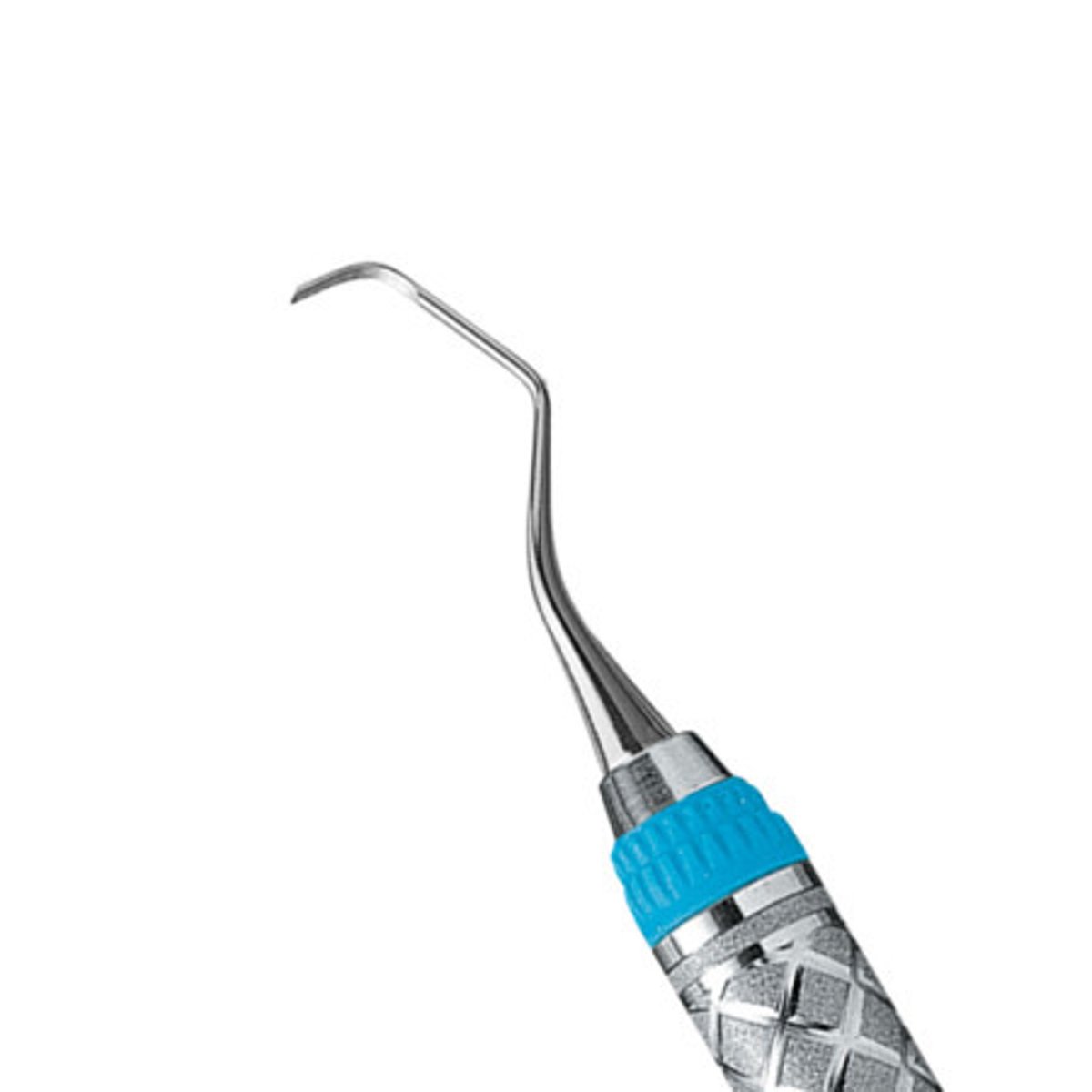
11/12 gracey curette
Primarily for mesial of posteriors (also buccal/lingual). Double-ended, area specific
Instrument should not wrap around tooth - terminal shank should be parallel with long axis of tooth.
Insert with toe 1/3
13/14 gracey curette
Only for distal surfaces of posterior teeth.
Instrument should not wrap around tooth - terminal shank should be parallel with long axis of tooth.
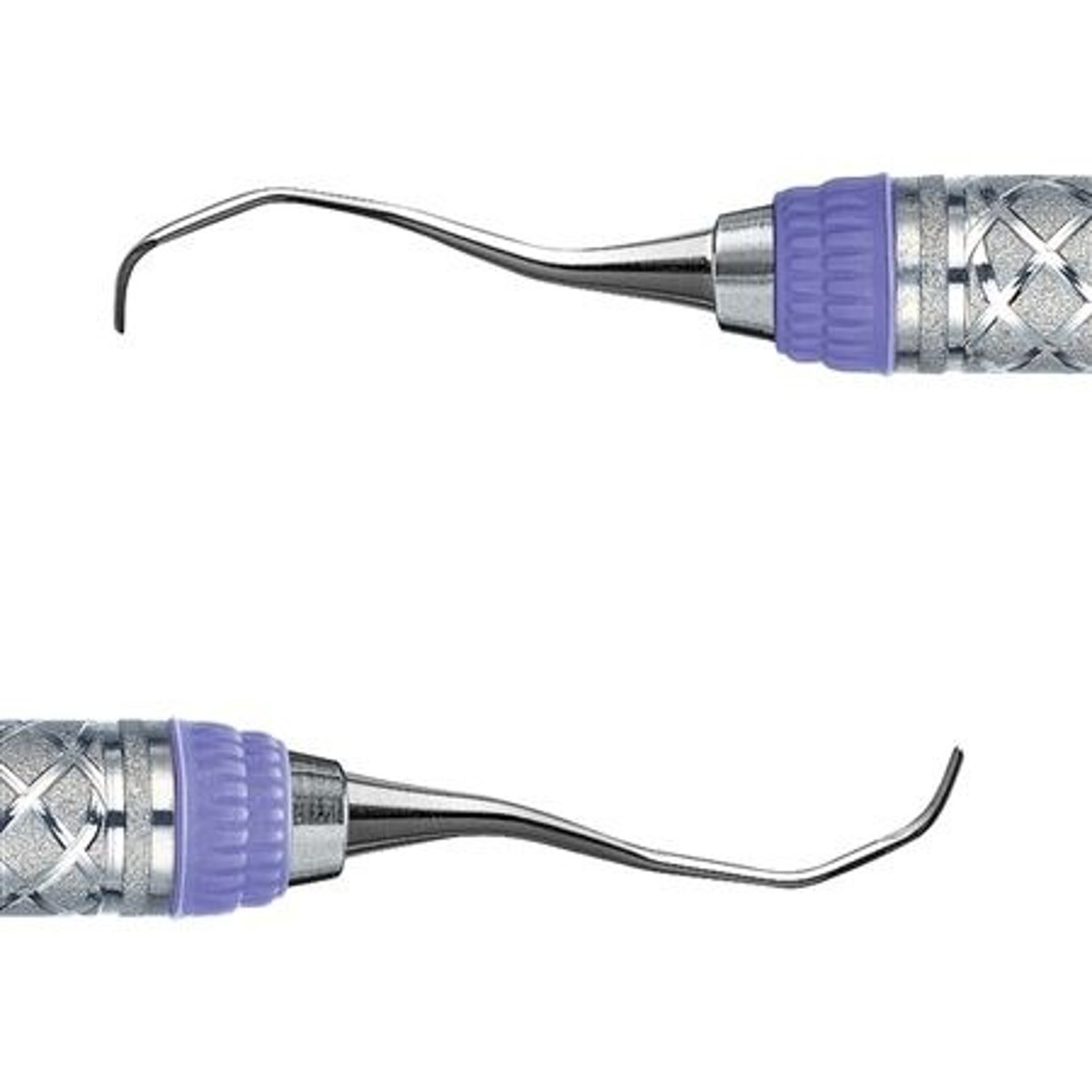
handle
hold this part of the instrument
terminal shank
Last bend of the shank prior to working end
Should be parallel to long axis of tooth.
shank
connects working end with handle
working end
The tip or blade of the instrumnet
straight/simple shank
Shank with few or no bends (flat design) - for anterior teeth
angled/complex shank
Shank with multiple bends for better adaptation (proximals of posterior teeth).
Harder to reach --> more, deeper bends in the shank
Longer shanks can help reach deeper periodontal pockets.
blade
the working end of a scaler or curet
double-ended (unpaired)
Instruments with 2 ends that differ in design & function
double-ended (paired)
Instruments with 2 ends that are mirror images of each other. On side is for facial/buccal; the other for lingual
face
the part of the working end facing the tooth; opposite of the back of the working end
cutting edges
sharp edges of the working end
toe, face, curet
the 3 parts of the working end of a curette
tip, face, sickle
the 3 parts of the working end of a scaler
1) toe pointed in direction of movement
2) Terminal shank parallel w/long axis of tooth
3) Can only see part of the face of the blade.
3 rules for orientation of working end of instrument
Thumb, index, 3rd finger
3 fingers in contact with instrument in modified pen grasp
neutral wrist
proper wrist positioning to avoid carpal tunnel
fulcrum
Support/point of rest for instrument stability and precision.
Should be on the same arch & quadrant
insertion
placing instrument below gingival margin into the sulcus w/o traumatizing tissue.
0-40 degree angle
0-40 degrees
Angle range for instrument insertion (closed angle) - face is positioned against tooth surface
just past midline
insertion location for anteriors.
Make sure to overlap insertion sites
just past distal line angle
Insertion location for posterior teeth. Overlap insertion sites to avoid missing spots.
>90 degrees
scaling angle that may burnish calculus
45-90 degrees
ideal angle for carving calculus
adaptation
keeping the toe third of the working end instrument on the tooth in correct orientation (only terminal 1-2mm for line angles).
Need to keep the lower 1/3 of the instrument on working site (NOT middle or direct tip)
angulation
angle between working end of instrument & tooth surface.
Probe: Side of tip on tooth
Scalers/curets: Angle between blade face/tooth surface
70 degrees
Open angulation for effective calculus removal
activation (stroke)
Unbroken movement made by instrument - should be coordinated between arm, wrist, and fingers
walking strokes
Use with probe
exploratory strokes
Strokes with explorers/removal instruments for tactile sensitivity
scaling strokes (calculus removal)
Strokes with firm pressure for removal of calculus
lateral pressure
Pressure applied to tooth by instrument. Should be balanced with pressure on fulcrum.
If too high, may result in loss of control, soft tissue damage, & fatigue.
curettes
3 instruments used for supra-and sub-gingival calculus, biofilm, and stain removal.
Rounded tip (toe), face & lateral surface bordered by cutting edges.
2 cutting edges on curved blade.
universal curettes
Curettes adapted for supra-and subgingival instrumentation on any tooth surface.
Face is perpendicular to the lower shank; cutting edges are parallel & level with each other.
scalers
Instruments with curved blade for removal of supra-gingival calculus, biofilm, and stain.
Double-bladed, so it is not used below the gumline (otherwise use it like gracey 1/2)
Straight (unpaired w/flat shank) vs. modified/contra-angle (paired, mirrored instrument).
70 degree angulation.
Adaptation: Maintain tip-1/3 or terminal 3rd of cutting edge on tooth at all times.
tip wraps around tooth (wrap method)
How to find correct working end for 11/12 explorer
move diamond card (instrument is stationary)
How to sharpen an instrument. Finish on down stroke.
Always clean instrument before use.
110 degree (3 min. past 12)
Angle between handle and diamond card when sharpening.
Adapt the diamond card to the instrument to preserve rounded toe