CHEM 1060: UNIT 4 EXAM
 Call Kai
 Learn
Learn Practice Test
 Spaced Repetition
 Match
Match Flashcards
 Knowt Play
1/74

There's no tags or description
Looks like no tags are added yet.
Name | Mastery | Learn | Test | Matching | Spaced | Call with Kai |
|---|
No analytics yet
Send a link to your students to track their progress
75 Terms
Where do enzymes get their prefixes from?
their substrates or the type of reaction
What is another word for substrates?
Reactants
What are the 6 major classes of enzymes?
Oxidoreductase
Transferase
Hydrolase
Isomerase
Ligase
Lyase
What is a simple enzyme?
Enzymes that work on it’s own (without a cofactor)
What is a Conjugated enzyme?
An enzyme that cannot work on it’s own (needs a cofactor)
What is an apoenzyme?
A conjugated enzyme that does not have a cofactor (but needs one. therefore they don’t work)
What are some examples of inorganic cofactors?
metal ions, Magnesium and Zinc
What is another word for organic cofactors?
coenzymes
What are the coenzymes (organic cofactors) we need to know?
NAD
FAD
CoA (Coenzyme A)
PLP
TPP
What Vitamin do coenzymes come from?
Vitamin B
What vitamin does FAD come from?
Vitamin B2 (Riboflavin)
What vitamin does NAD come from?
Vitamin B3 (Niacin)
What vitamin does CoA come from?
Vitamin B5 (panthothenic acid)
What vitamin does PLP come from?
Vitamin B6 (Pyridoxine)
What vitamin does TPP come from?
Vitamin B1 (Thiamin)
Why do you put the enzyme above the arrow when showing a reaction?
Because Enzymes are not consumed by a reaction
What part of an enzyme do substrates bind to?
The active site
What is the lock and key fit theory?
the enzyme is very rigid and will not move to accomodate for the substrate (which has to be the exact same original copy)
What is the Induced fit theory?
The enzyme is not rigid, and will move to accomodate the substrate
What are some factors that affect enzyme activity?
temperature
pH
[S] (substrates concentration)
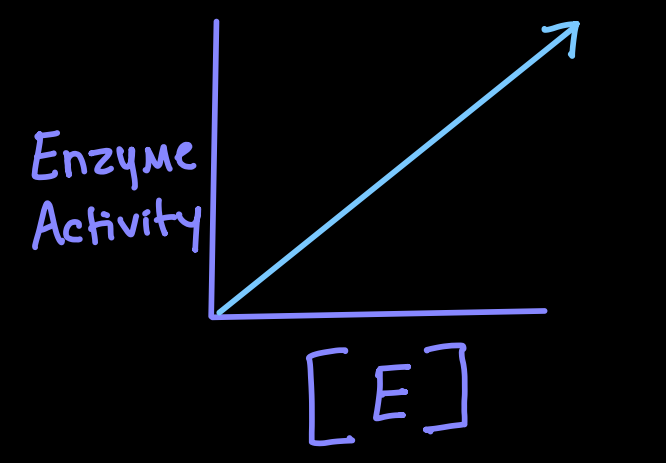
[E] (enzyme concentration)
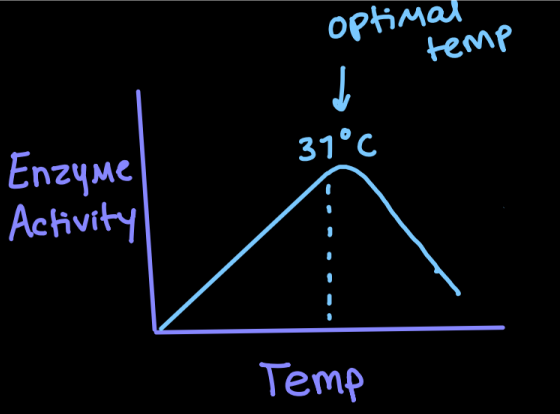
What is the graph that shows the relationship between enzyme activity and temperature?
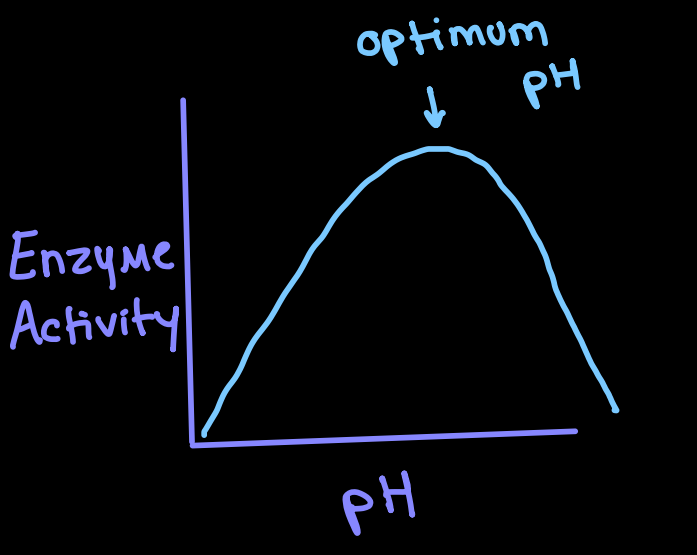
What is the graph that shows the relationship between enzyme activity and pH?
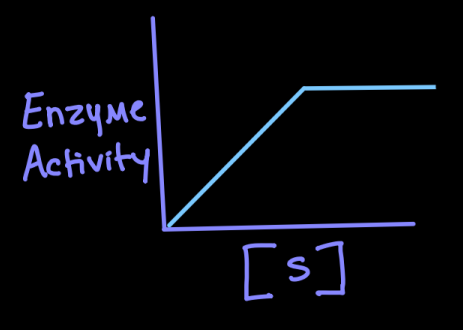
What is the graph that shows the relationship between enzyme activity and substrate concentration?
What is the graph that shows the relationship between enzyme activity and enzyme concentration?
why does the graph that shows the relationship between enzyme activity and temp start to go down after hitting optimal temp?
After optimal temp, the temp is too high and causes the enzymes to denature
What does optimum pH depend on when showing the relationship between enzyme activity and pH?
location of the body the enzyme is
Why does the graph start to “flat line” when showing the relationship between enzyme activity and [S]
because you can only add so many substrates to an enzyme until all the active sites are filled up
What are the 2 types of inhibition?
Competitive Inhibition
Noncompetitive Inhibition
What is competitive inhibition?
When the inhibitor molecule competes with the substrate for the active site
What is noncompetitive inhibition?
The inhibitor molecule does not bind to the active site because it does not resemble the substrate. It binds to the Alosteric site instead. (which changes the shape of the enzyme
What are the 2 different nucleic acids?
DNA and RNA
where is DNA located in the cell?
the nucleus
where is RNA located in the cell?
the cytoplasm OR nucleus
What is a nucleotide made up of?
cyclical amine base, pentose sugar, and a phosphate group
What are the 2 categories of cyclical amine bases?
purines and pyrimidines
What bases are known as purines?
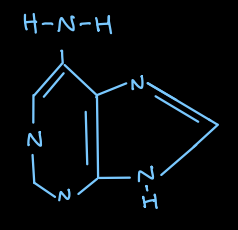
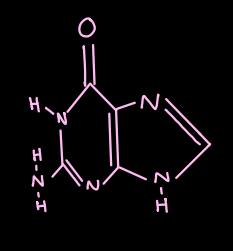
Adenine and Guanine
What bases are known as pyrimidines?
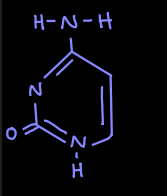
Cytosine, Thymine and Uracil
What is a purine?
2 cyclical structures attached with nitrogens
What is a pyrimidine?
A single ring with nitrogens attached
What is the structure for adenine?
What is the structure for guanine?
What is the structure for cytosine?
What is the structure for thymine?
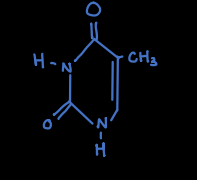
What is the structure for uracil?
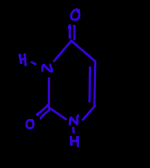
What is it called when you add a cyclical base to a pentose sugar but no phosphate?
Nucleosides
What is the suffix for purine nucleosides?
-sine
What is the suffix for pyrimidine nucleosides?
-dine
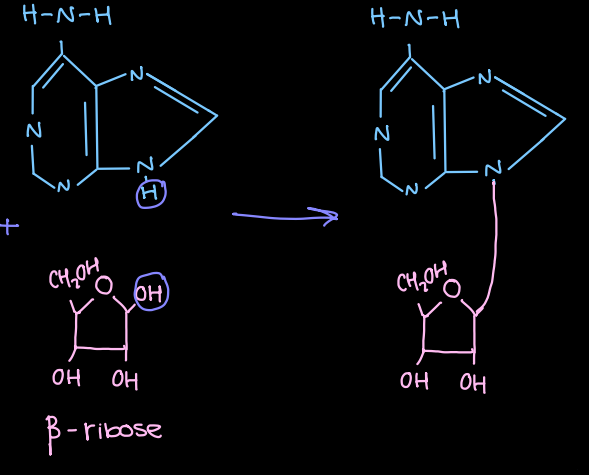
Where do we attach a pentose sugar to a cyclical base?
on the bottom Nitrogen (replace the H)
What do you call a nucleoside that has a deoxyribose and not a ribose?
d- (… nucleoside name)
What carbon is the phosphorus group attached to when making a nucleotide?
carbon 5 of the pentose
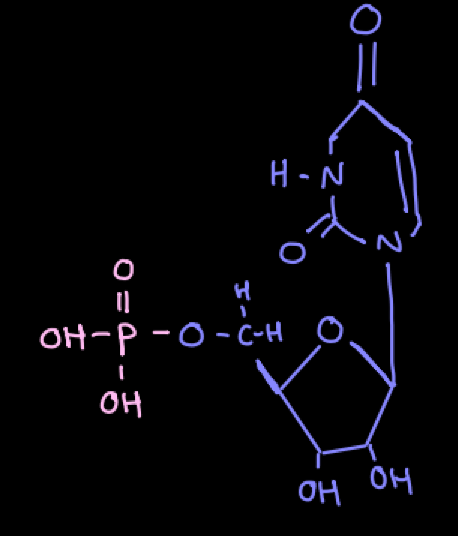
How do you name a nucleotide?
nucleoside name + mono + phosphate
eg:
uridinemonophosphate
or
d-guanisinemonophosphate
When making a dinucleotide, what does the phosphate group attach to?
the sugar
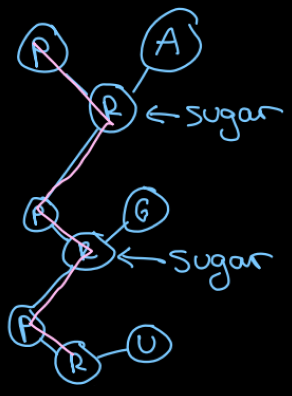
What does 5’ and 3’ ends mean?
5’ means the fifth carbon is not attached to a nucleotide
3’ means the third carbon is not attached to a nucleotide
What enzyme unzips the 2 strands of DNA to replicate each one and make 2 daughter cells?
Helicase
What is a gene?
strech of DNA that codes for a specific polypeptide.
Where does translation happen?
the ribosomes
Where does transcription happen?
the nucleus
Where does replication happen?
the nucleus
what is replication?
replicating DNA into more DNA
(DNA→DNA)
what is transcription?
Turning the DNA strand into a RNA strand
(DNA → RNA)
what is translation?
Turning the mRNA into the proper polypeptide with the codon chart
(RNA → Protein)
what are all of the different types of RNA?
mRNA
tRNA
snRNA
hnRNA
rRNA
What is mRNA?
messenger RNA. It is the result of transcription after the introns are spliced out and it delivers the RNA from transcription in the nucleus to the ribosomes to build instructions for tRNA during translation.
What is tRNA’s job?
transfer RNA. It transfers the proper amino acid to the mRNA.
What is snRNA?
the RNA that splices out the introns.
What is hnRNA?
Heteronuclear RNA. It is the first transcript that includes both introns and extrons.
What are exons?
Parts of DNA that code for proteins
what side of tRNA carries the amino acid?
the 3’ end
What are the 3 types of mutations?
point mutation
deletion
translocation
What are some examples of mutagens?
steroids
UV light
cigarettes
toxic chemicals
How does UV light act as a mutagen?
Makes 2 thymines bond together instead of it’s complementary pair
What is DNA recombinant technology? What is another word for it?
When you put 2 DNA’s from different sources together. Cloning
What 3 things can scientists make with DNA recombinant technology?
insulin
human growth hormone
TPA (clot buster)
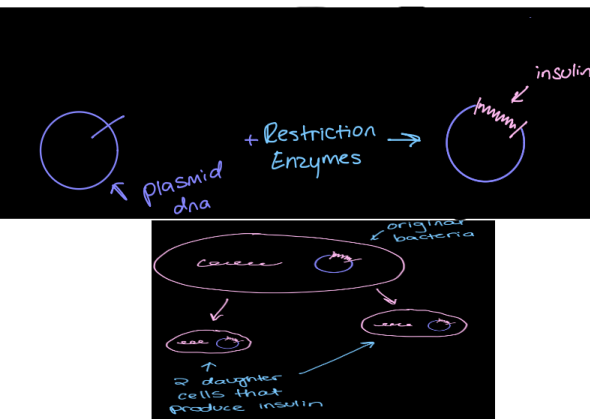
How does DNA recombinant technology work?
Take plasmid DNA from a bacteria cell
Restriction enzymes cat the Plasmid DNA
Add whatever you want more of to the spot that the restriction enzymes cut
place the new plasmid DNA back into the original bacteria