Anatomy & Physiology Terms; Nervous System
 Call Kai
 Learn
Learn Practice Test
 Spaced Repetition
 Match
Match Flashcards
 Knowt Play
1/135

There's no tags or description
Looks like no tags are added yet.
Name | Mastery | Learn | Test | Matching | Spaced | Call with Kai |
|---|
No analytics yet
Send a link to your students to track their progress
136 Terms
What is the Nervous System?
Allows communication between the brain and our body so that we can interact with the environment
What are the broad divisions of the Nervous System?
Anatomical and Physiological
What are the sub-divisions of the Anatomic Division?
Central Nervous System & Peripheral Nervous System
What is included in the Central Nervous System?
The brain and spinal cord
What system includes all the structures housed within the bones of the skull and vertebral column?
The Central Nervous System
What is considered the brain?
Everything above the foramen magnum (the circular opening at the base of the skull)
How many hemispheres does the brain have?
Two, left and right
What are the structures of the brain?
two hemispheres, brain stem, cerebellum, basal ganglia, diencephalon, thalamus
What does the spinal cord do?
connects the brain with the rest of the body
What is included in the Peripheral Nervous System?
12 cranial nerves, 31 spinal nerves, and sensory receptors
What is the purpose of the Peripheral Nervous System?
Links the body to the outside world through motor and sensory pathways
What nerves are within the brain?
The first two cranial nerves
- 1 Olfactory Nerve
- 2 Optic Nerve
What nerves are on the brain stem?
The 3rd-12th
Where do the pairs of spinal nerves go along?
31 pairs of spinal nerves go along the vertebrae
How many cervical vertebrae are there?
8 pairs
How many thoracic vertebrae are there?
12 pairs
How many lumbar vertebrae are there?
5 pairs
How many sacral vertebrae are there?
5 pairs
How many coccygeal vertebrae are there?
1
What are sensory receptors?
nerve endings that respond to sensory information and send information back up to the brain
What are the sub-divisions of the Physiological Division?
Autonomic Nervous System and Somatic Nervous System
What are other names for the Autonomic Nervous System?
Visceral or Involuntary Nervous System
What type of muscles are associated with the Autonomic Nervous System?
Smooth Muscle (non-striated) like the heart and respiratory
What systems are associated with the Autonomic Nervous System?
the systems that happen automatically (pupil dilation, breathing, increase heart rate)
What are the the additional divisions of the Autonomic Nervous System?
Sympathetic and Parasympathetic
What is the sympathetic nervous system?
"Fight or flight" (increase energy)
What is the parasympathetic nervous system?
"Rest and digest" (conserves energy)
Why are the sympathetic and parasympathetic nervous systems important?
Yen and Yang allow balance and harmony within our bodies
What is the Somatic Nervous System?
system that controls the body's skeletal muscles dealing with the body, limbs, and skin but not the organs
Is the somatic nervous system voluntary or involuntary?
Controls conscious and voluntary functions
Motor pathways are a part of which nervous system division?
the somatic nervous system
How does the Somatic Nervous System function?
Functions through the cranial nerves and spinal nerves
What are the additional sub-divisions of the Somatic Nervous System?
Pyramidal and Extrapyramidal Systems
What are the Pyramidal and Extrapyramidal systems within?
Are within the anatomical parts of the CNS and help control our skeletal movements and muscles
Where does the Pyramidal System originate?
Arises from the motor area of the cerebral cortex
What is the Pyramidal system associated with?
Motor Tracts
Why is the Pyramidal System called Pyramidal?
Because it is associated with pyramids of the Medulla and associated with Pyramid Cells which are within the layers of the brain (cerebral cortex)
What is the Extrapyramidal System also known as?
the indirect system
Why is the Extrapyramidal system indirect?
It does not pass through the pyramids of the medulla
What is the the Extrapyramidal system associated with?
Associated with the brain stem, cerebellum, basal ganglia, and thalamus
What does the Extrapyramidal system do?
helps regulate, coordinate, modulate our movements (perfect them)
How much does the adult brain weigh?
3 pounds
What is the brain enclosed within?
The cranium/skull
What is the most organized structure in our body?
The brain
What is the largest structure of the nervous system?
The brain
How many cells are in the brain?
more than 100 billion cells
What are nerve cells called?
Neurons
What are non-nervous cells called?
Glial Cells
What does the brain do?
initiates, monitors, and regulates the bodies actions and reactions by sending out motor commands, receiving sensory information, analyzing it and responding
What is the brain made of?
grey and white matter
Where is the grey matter located?
Outer portion of the brain in the cerebral cortex
What is the majority of the brain composed of?
white matter
What is grey matter associated with?
with a nerve's soma (body) and dendrite
What is white matter associated with?
with a nerve's axon
What is deep grey matter?
Diencephalon, thalamus, and basal ganglia
Diencephalon which includes the thalamus
What is #2
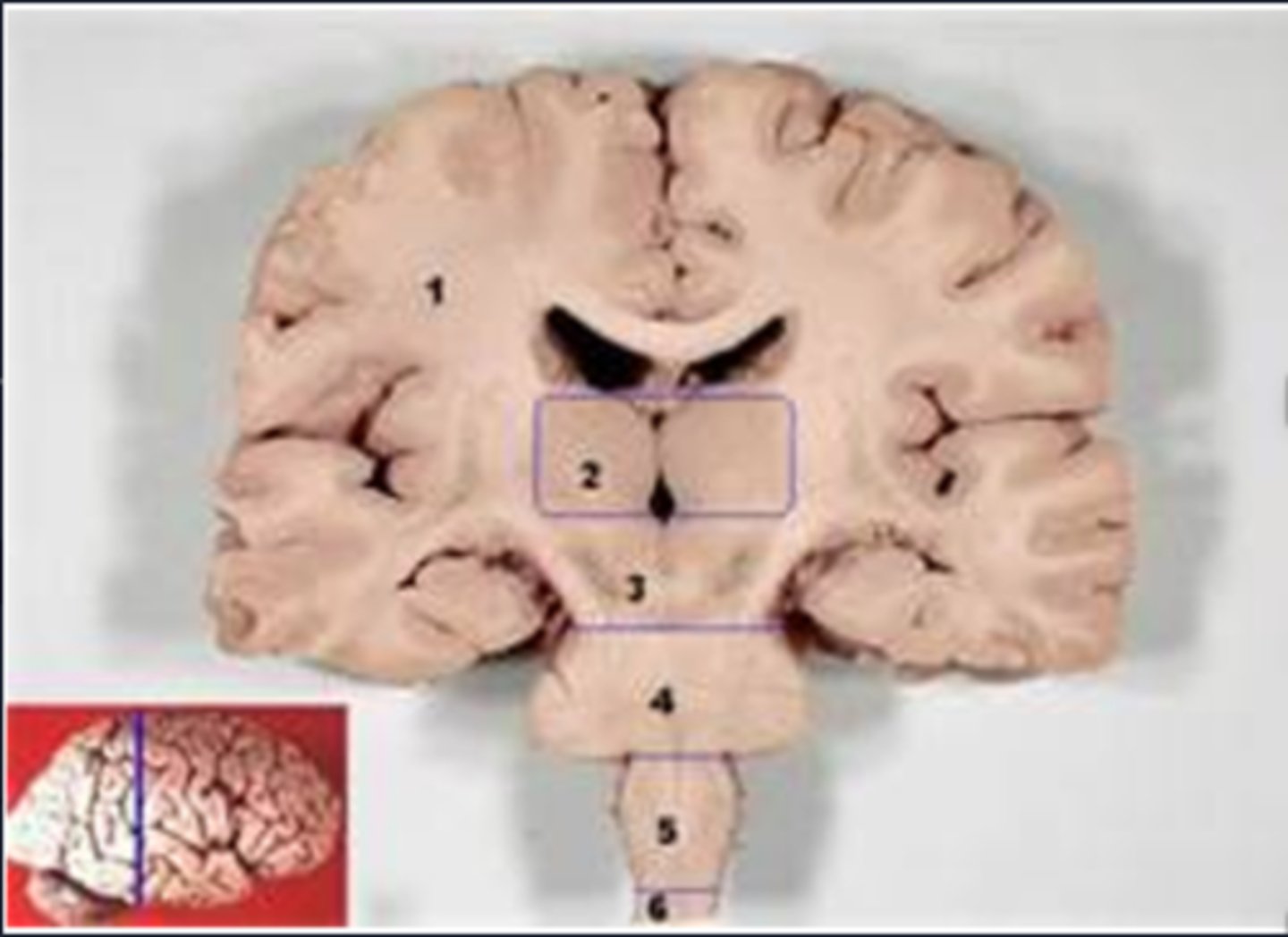
The Basal Ganglia
What is #3
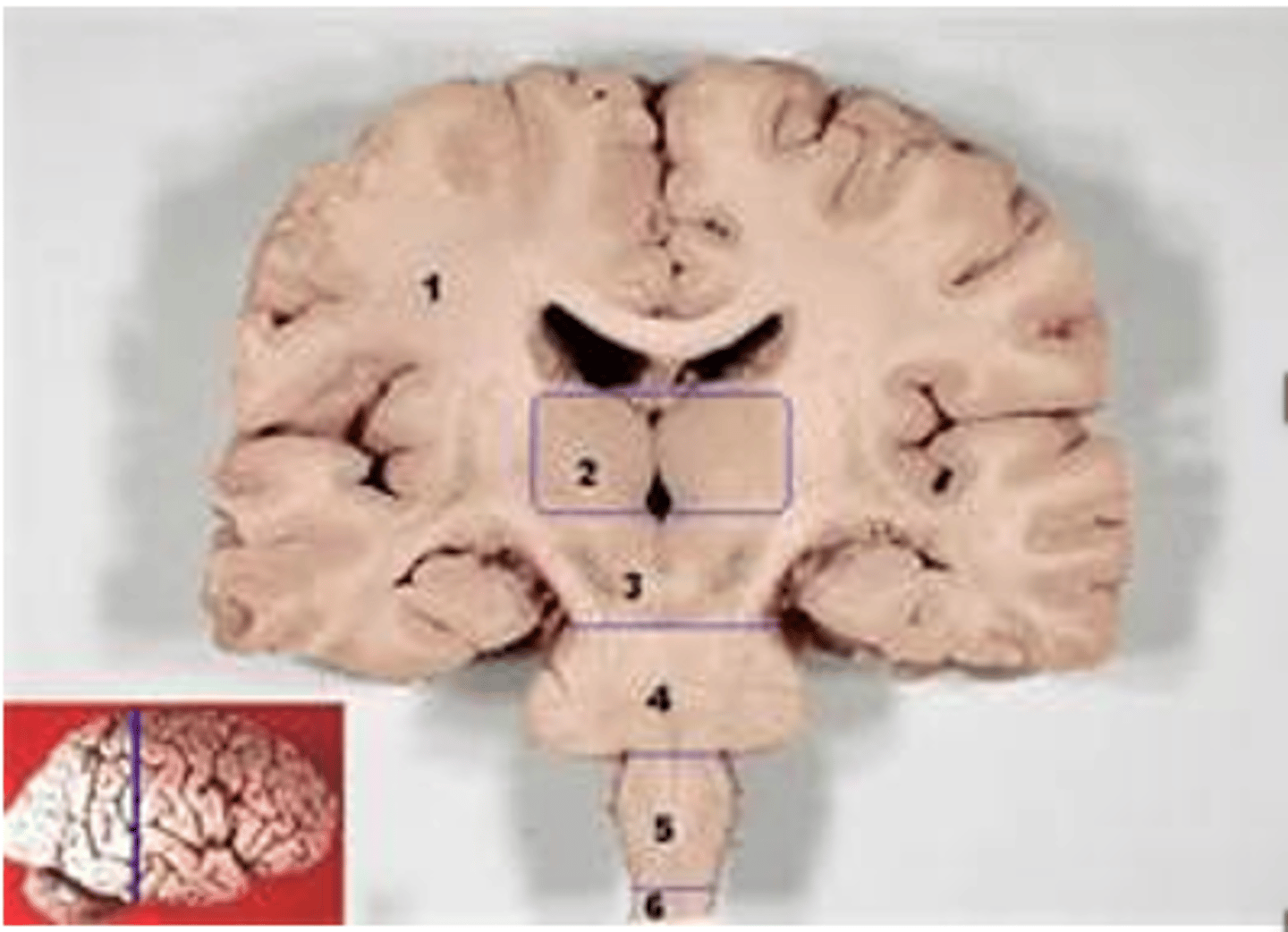
The Brain Stem
What is #4-6
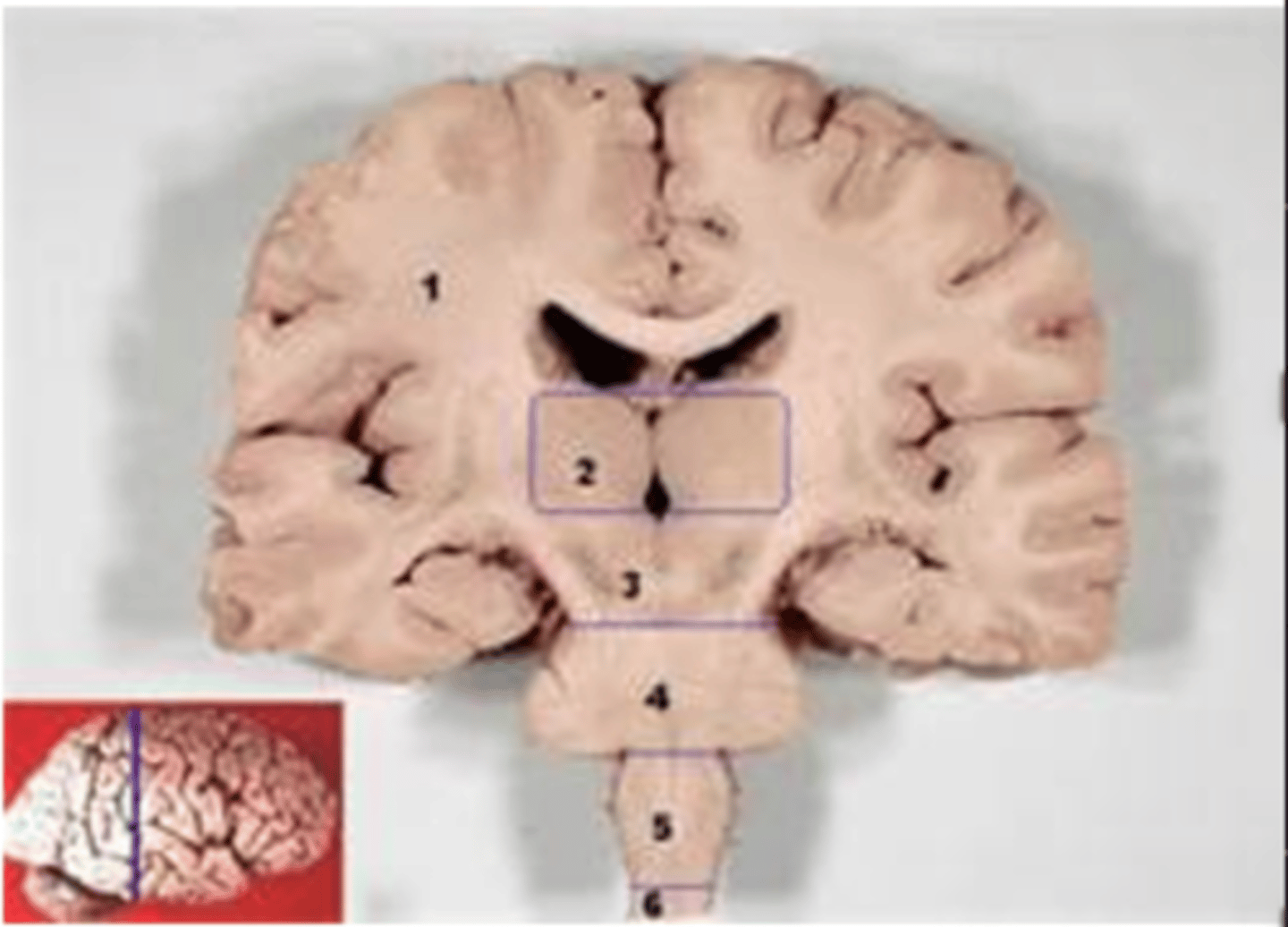
What are Broadman's areas?
Regions of the brain that have been numbered based on structure and organization of the cells
Anatomy
the study of the structure of the organism
Physiology
the study of the function of the organism and its parts
Applied or Clinical Anatomy
the applying of anatomical study for diagnosis and treatment of disease
Descriptive or Systemic anatomy
the description of individual parts without reference to disease conditions. Sees the body as a composite of systems that function together
Gross Anatomy
studies structures that are visible to the eye
Microscopic Anatomy
studies structures not seen without a microscope
Developmental Anatomy
describes the development of the organism from conception to adulthood
Pathological Anatomy
when the view is from a disease standpoint
Thorax
Chest
Abdomen
Stomach
Trunk or Torso
The thorax and abdomen
Dorsal Trunk
Back
Pelvis
Hip bone
Cranium
The skull and it houses the brain
Upper Extremity
the arm, forearm, wrist, and hand
Lower Extremity
thigh, leg, ankle, and foot
Anatomical Position
a body standing erect with palms, arms, and hands face forward
Frontal or Coronal Plane
front view of a body divided into front and back section
Midsagittal Section
dividing the body in left and right halves
Transverse Section
Divide the body into upper and lower halves
Anterior or Ventral
Front surface of body
Posterior or Dorsal
Back surface of the body
Rostral
toward the head
Caudal
away from the head
Superficial
confined to the surface
Deep
means it is closer to the axis than another structure or away from the surface
Distal
away from the midline or abduction (legs)
Medial
toward the midline or adduction (arms)
Superior
above or farther from the ground
Inferior
below or closer to the ground
Lateral
related to the side
Flexion
bending at a joint usually toward the ventral surface or surfaces come together, such as a sit-up
Extension
pulling apart, completing a sit-up (laying back down)
Hyperextension or Dorsiflexion
Arching of the back
Plantar
Sole of the foot
Plantar grasp reflex
when the sole of the foot is stimulated and the toes "grasp"
Palmar
the palm of the hand or ventral surface (dorsal back of hand)
Palmar Grasp
flexing of the fingers to grasp when palm is stimulated
Cells that form the structures involved in speech and hearing
muscle cells, nerve cells, and bone cells
Tissues combine to form larger structures; the tissued that makeup the structures of the body are?
epithelial, connective, muscular, and nervous tissue
Epithelial
superficial outer layer, these constitute the skin. This tissue lacks material between cells or little intercellular matter. This absence allows these cells to form a tightly packed sheet of protective quality.