M22 - The Ultimate Fate of the Universe
 Call Kai
 Learn
Learn Practice Test
 Spaced Repetition
 Match
Match Flashcards
 Knowt Play
1/41

There's no tags or description
Looks like no tags are added yet.
Name | Mastery | Learn | Test | Matching | Spaced | Call with Kai |
|---|
No analytics yet
Send a link to your students to track their progress
42 Terms
Hubble’s Law
Tells us the universe is expanding
Redshift indicates distant galaxies are moving away from us
Spacetime is expanding
Big Bang Model Interpretation of Hubble’s Law
This model tells us the universe began in a hot, dense state about 14 billion years ago
Cosmic Microwave Background
Cosmic Microwave Background
Provides extremely strong evidence for the Big Bang
Leftover radiation from the universe’s extremely hot and dense state
Hubble’s Law Deviation
There’s a deviation in actual observations from Hubble’s Law
Distant galaxies are farther than expected
Expansion of the universe is accelerating
Dark Energy
Responsible for the acceleration of the universe
Makes up 68.3% of the universe
Contents of the Universe
Ordinary Matter - 4.9%
Dark Matter - 26.8%
Dark Energy - 68.3%
Observational Limit
The further away we look in the universe, the further back in time we are looking
Observational Limit and the Sun
We see the Sun as it was 8 minutes ago because it takes light from the Sun 8 minutes to reach us
Observational Limit and CMB
Farthest visible thing we will ever see is the CMB
13.8 billion years ago
Observable Universe
The portion of the universe we can see from Earth
Earth at the center
Limited by how far light has had time to travel since the Big Bang (13.8 billion years ago)
Other Observable Universes
Each observer has their own observable universe
Only contains objects whose light has had time to reach them
Expansion of the Universe
The expansion of the universe means the radius of the observable universe has been stretched to about 46.5 billion ly
Whole Universe
The whole universe is likely much bigger than the observable universe
Other regions physically exist but light has not reached us yet
Geometry of the Universe
We can measure the size of the universe (including the parts impossible to see) using the curvature of the universe
Curvature of the Earth
To measure the curvature of the Earth, we can use triangles
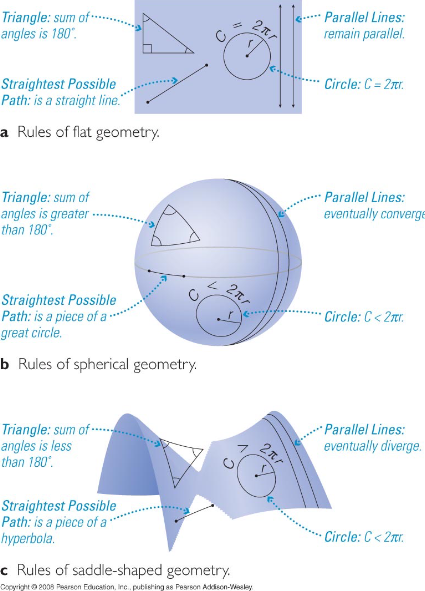
On a flat surface, angles inside a triangle always add to 180°
Positively Curved Surface
On a positively curved surface (e.g. a sphere) the angles add up to more than 180°
The corners “open up” a bit
Measuring the Curvature of the Earth
Triangles made in a relatively small area (e.g. a city) will have interior angles adding up to roughly 180°
The surface would seem flat
Triangles made in a relatively large area would add up to more than 180°
Measuring the Curvature of the Universe
We can use the CMB to measure the curvature of the universe
Types of curves:
Closed (positive curvature)
Open (negative curvature)
Flat (no curvature)
CMB temperature variations
We can use the CMB’s temperature variations to measure the universe’s curvature
This is the equivalent of measuring the angles inside a very large cosmic triangle
Closed Universe
Positive curvature. Has a finite size but is unbounded (there’s no edge)
i.e. you can start at one point and moving in the same direction causes you to loop back to your starting point
Open Universe
Negative curvature. Can be infinite in extent with no edges
i.e. you can start at one point and move in the same direction but never return to your starting point
Flat Universe
No curvature. Can be infinite in extent with no edges
i.e. you can start at one point and move in the same direction but never return to your starting point
3D volume
The 3D volume of the universe can be curved around a fourth, mathematical dimension
Measured Geometry
As precisely as we can measure, the geometry of the universe is flat
“Flat” means no intrinsic curvature; lines are straight, drawing triangles at any orientation results in angles that sum up to 180°
Flat Misconception
When we say the universe is flat we don’t mean that’s like a piece of paper
It means the parallel lines never converge, and the sum of the angles inside large triangles is 180°
Infinite Size
The most obvious way to interpret a geometrically flat universe is that it has infinite size
You could head off in any direction and never encounter an edge or return to your starting point
Geometry and Ultimate Fate of the Universe
Geometry of the universe is determined by how much “stuff” (matter and energy) there is in the universe
This determines how the universe evolves over time
Geometry and Density
The geometry of the universe is related to its overall density
Quantified by the density parameter (omega ‘Ω’)
Total Density of the Universe
Ω = Ωm + ΩΛ + Ωrad
total density = density of matter and dark matter + density of dark energy + density of radiation (all the light in the universe)
Negligible Radiation
In our universe, the total amount of radiation contributes a negligible amount to the overall density
Instead we could use:
Ω = Ωm + ΩΛ
Density Parameter Definitions
The density parameter is defined so that
Ω = 1 (universe is flat)
Ω < 1 (universe is open)
Ω > 1 (universe is closed)
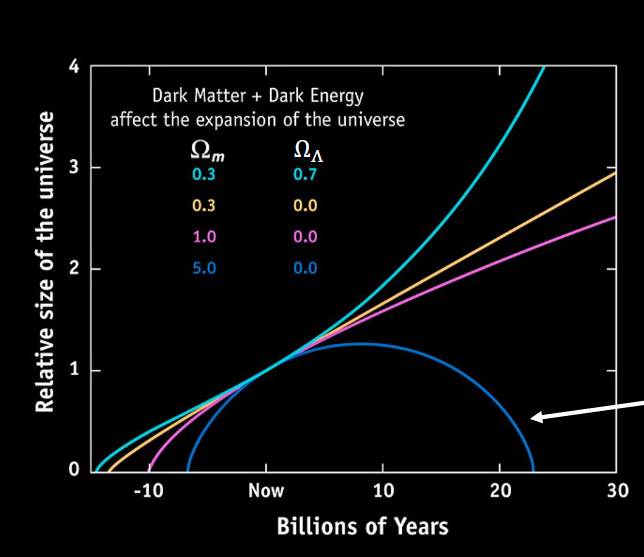
Closed, matter-dominated universe
When matter dominates (ordinary + dark matter)
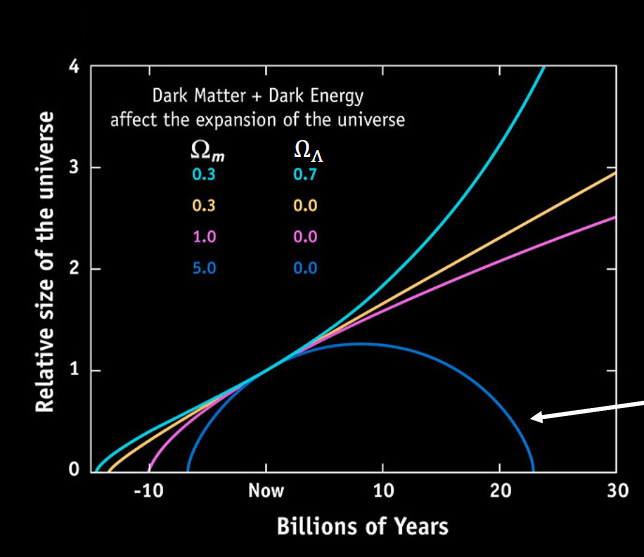
We get a CLOSED universe that ends by collapsing in a reverse Big Bang known as the Big Crunch
Ωₘ = 5, ΩΛ = 0
Flat, matter-dominated universe
When matter is just the right amount (ordinary + dark matter)
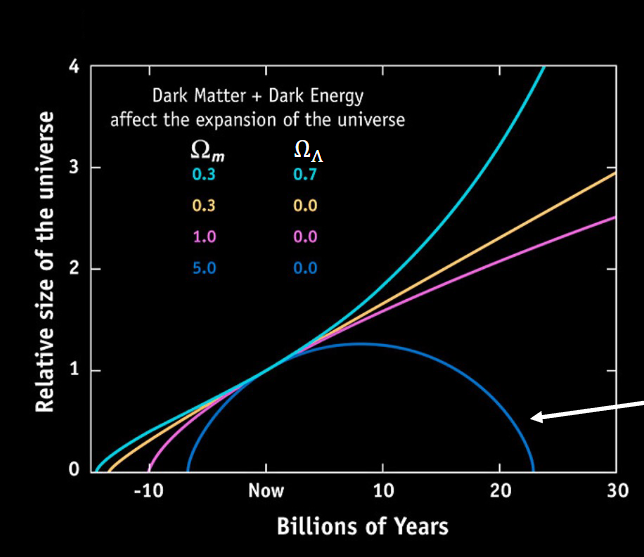
We get a FLAT universe that expands forever at a decelerating rate
Ωₘ = 1, ΩΛ = 0
Open, matter-dominated universe
With less matter AND no dark energy
We get an OPEN universe that expands forever
Ωₘ = 0.3, ΩΛ = 0
Flat, dark energy dominated universe
When dark energy dominates
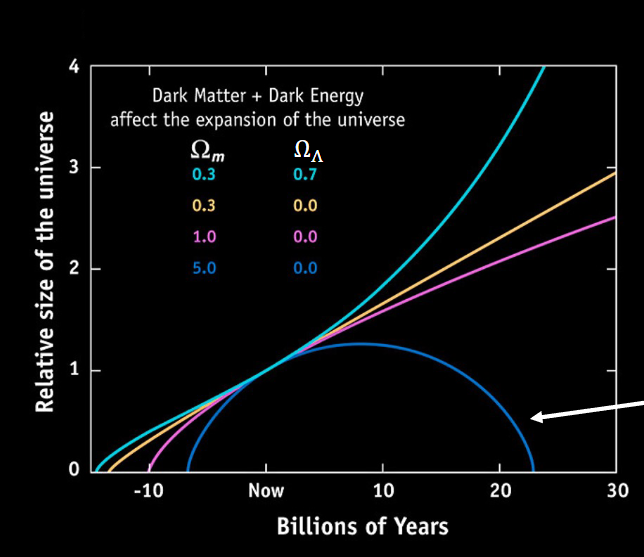
We get a FLAT universe that expands and accelerates indefinitely
Ωₘ = 0.3, ΩΛ = 0.7
Heat Death of the Universe
In the far future, an accelerating universe (i.e. our universe) will experience heat death
All matter and energy will be spread so thinly that interactions become impossible
Everything becomes cold, dark, and isolated
Heat Death of the Universe Characteristics
Star formation slows
Galaxy isolation
CMB undetectable
Black hole dominance
Star Formation SLows
Galaxies will be populated by old stars, night skies will grow dark
Already happening
Galaxy Isolation
Relentless expansion will isolate individual galaxies
i.e. each galaxy will be in its own personal observable universe, no other galaxies will be visible from it
CMB Undetectable
CMB will be redshifted to undetectable wavelengths
At this point, astronomers will have difficulty proving there even was a Big Bang
Black Hole Dominance
More and more matter will end up inside black holes
Problems with the Big Band Model
The conventional Big Bang model predicts the heat death
But it has some known problems to it