Oocyte Analysis (Follicular Phase)

0.0(0)
Studied by 0 people
call kaiCall Kai
learnLearn
examPractice Test
spaced repetitionSpaced Repetition
heart puzzleMatch
flashcardsFlashcards
GameKnowt Play
Card Sorting

1/48

encourage image

There's no tags or description

Looks like no tags are added yet.

Last updated 3:56 AM on 6/5/26
Name
Mastery
Learn
Test
Matching
Spaced
Call with Kai

No analytics yet

Send a link to your students to track their progress

49 Terms

1
New cards
What are the two major components of follicular dynamics?
  • Initial recruitment = continuous recruitment of primordial follicles into a growing pool ending in atresia

  • Cyclic recruitment = postpubertal FSH-driven recruitment occurring during each estrous cycle.

2
New cards
How do FSH and LH differ in their primary follicular functions?
FSH stimulates recruitment and early follicular growth while LH promotes final maturation, dominance, and ovulation of mature follicles.
3
New cards
How are FSH and LH regulated differently?
FSH secretion is suppressed by estradiol and inhibin from growing follicles, while LH secretion is controlled by GnRH pulse frequency.
4
New cards
What happens to FSH concentrations during the bovine estrous cycle?
  • Small FSH rises during metestrus (1st recruitment) and diestrus (2nd recruitment) of antral follicles

  • Growing follicles secrete estradiol and inhibin that suppress FSH through negative feedback.
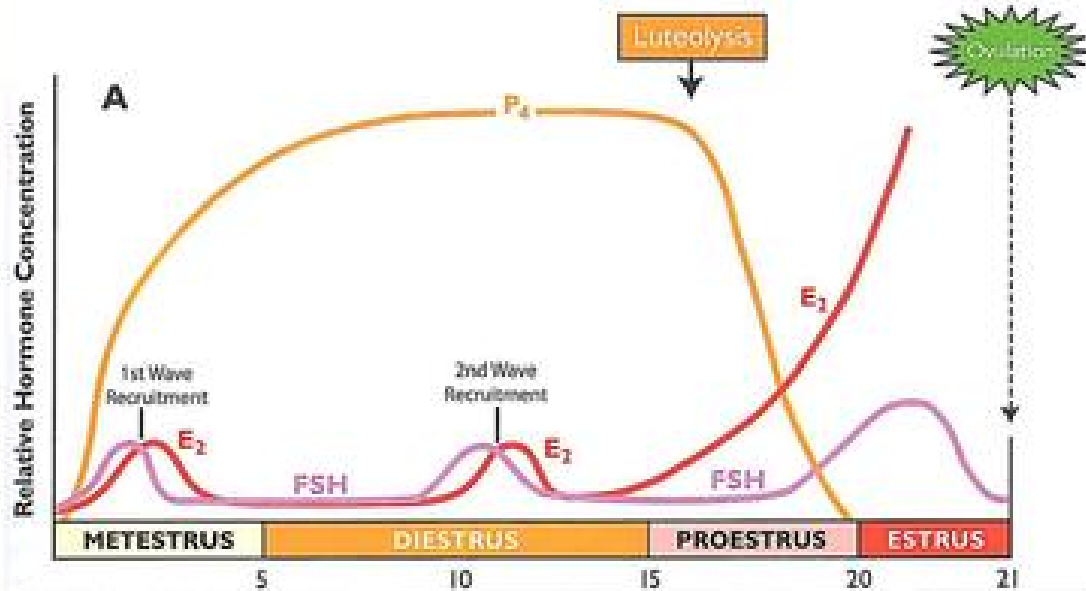
<ul><li><p>Small FSH rises during metestrus (1st recruitment) and diestrus (2nd recruitment) of antral follicles</p></li><li><p>Growing follicles secrete estradiol and inhibin that suppress FSH through negative feedback.</p></li></ul><p></p>
5
New cards
How does LH pulse frequency change during the estrous cycle?
  • During metestrus and diestrus (1st and 2nd wave recruitment), LH pulses occur approx. every 4 hours

  • After luteolysis progesterone drops and LH pulse frequency increases dramatically to ~1 pulse/hour before the preovulatory surge
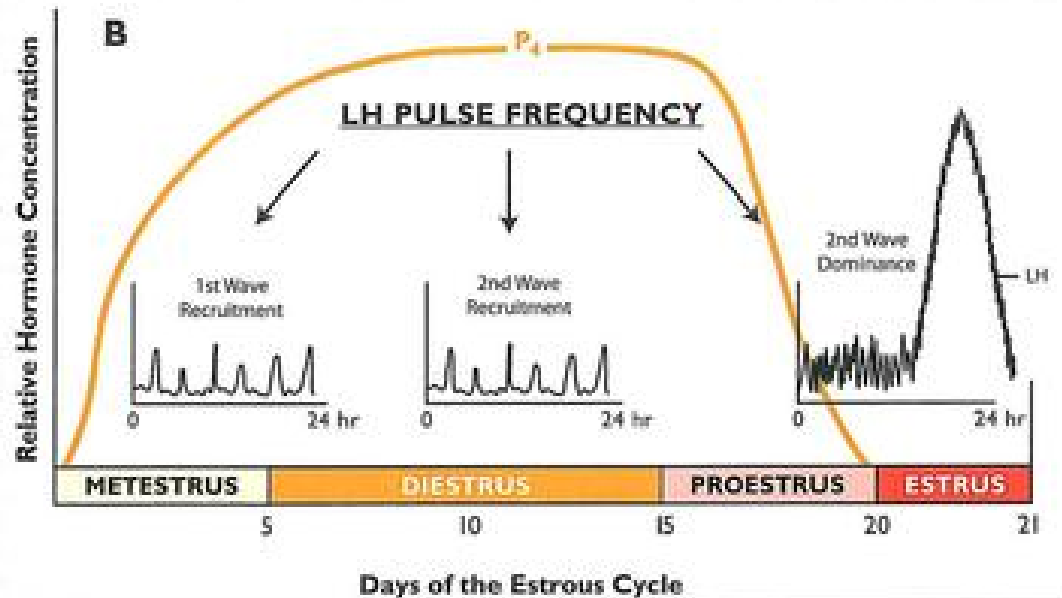
<ul><li><p>During metestrus and diestrus (1st and 2nd wave recruitment), LH pulses occur approx. every 4 hours</p></li><li><p>After luteolysis progesterone drops and LH pulse frequency increases dramatically to ~1 pulse/hour before the preovulatory surge</p></li></ul><p></p>
6
New cards
Why do most follicles undergo atresia during the estrous cycle?
Most follicles lack sufficient LH receptors on granulosa cells to fully respond to LH and continue maturation.
7
New cards
Which follicles are FSH dependent versus LH dependent?
  • Recruited and early selected follicles are primarily FSH dependent

  • Larger selected, dominant, and preovulatory follicles are primarily LH dependent

8
New cards
Why are LH receptors on granulosa cells important?
Threshold numbers of LH receptors allow follicles to enter dominance and respond fully to the preovulatory LH surge.
9
New cards
What is the “2-cell, 2-gonadotropin model” of estradiol synthesis?
  • LH stimulates theca interna cells to produce testosterone

  • Testosterone diffuses into granulosa cells where FSH stimulates conversion to estradiol

10
New cards
What is the role of theca interna cells during estrogen synthesis?
They contain LH receptors and convert cholesterol into testosterone.
11
New cards
What is the role of granulosa cells during estrogen synthesis?
They contain FSH receptors and convert testosterone into estradiol.
12
New cards
Why is synthesis of LH receptors by granulosa cells important?
It prepares the dominant follicle to respond to the preovulatory LH surge and ovulate.
13
New cards
What are the major reproductive tract effects of estradiol?
  • Increased blood flow

  • Genital swelling

  • Leukocytosis

  • Increased mucosal secretions

  • Elevated myometrial tone

  • Increased tissue conductivity

  • Uterine gland growth

14
New cards
How does estradiol affect the cervix and vagina?
It stimulates mucus production that lubricates the tract, flushes contaminants, and helps sperm transport through the cervix.
15
New cards
How does estradiol affect the uterus and oviduct?
It stimulates uterine gland development, increases oviductal secretions, and increases ciliary beat frequency for gamete transport.
16
New cards
What is leukocytosis in the female reproductive tract?
Increased migration of leukocytes into reproductive tissues/lumen under estradiol influence to phagocytize foreign material after copulation.
17
New cards
How does estradiol influence blood flow and edema in the reproductive tract?
Hyperemia increases secretion and leukocyte delivery while elevated capillary pressure causes vulvar edema/swelling.
18
New cards
How can estrous stage be diagnosed using vaginal cytology?
Estradiol causes epithelial changes such as cornified cells in rodents and sheets of squamous cells in dogs/cats.
19
New cards
How does estradiol influence reproductive behavior?
High estradiol with low progesterone induces sexual receptivity, increased activity, lordosis, and standing behavior.
20
New cards
What is the relationship between estrus and ovulation?
Estrous behavior is closely associated with but usually precedes ovulation.
21
New cards
Why is the preovulatory LH surge critically important?
It initiates the ovulatory cascade leading to follicular rupture and ovulation.
22
New cards
What are the major mechanisms responsible for ovulation?
Elevated blood flow, breakdown of connective tissue, follicular pressure, and ovarian smooth muscle contractions.
23
New cards
How does hyperemia contribute to ovulation?
Histamine and PGE2 increase blood flow and vascular permeability causing edema and elevated hydrostatic pressure around the follicle.
24
New cards
Why are angiogenic factors important during ovulation?
Dominant follicles produce angiogenic factors to increase their own blood supply for final maturation.
25
New cards
Why does the dominant follicle begin producing progesterone before ovulation?
Progesterone stimulates collagenase synthesis which breaks down connective tissue in the tunica albuginea.
26
New cards
What is the stigma?
The weakened apex of the dominant follicle that protrudes outward before rupture/ovulation.
27
New cards
How does collagenase contribute to ovulation?
It degrades collagen in the tunica albuginea while follicular fluid volume increases, weakening the follicle wall.
28
New cards
What are the major roles of prostaglandin F2α and prostaglandin E2 during ovulation?
PGF2α causes lysosomal enzyme release and ovarian contractions; PGE2 promotes follicular remodeling into the corpus luteum.
29
New cards
How does prostaglandin F2α contribute to follicular rupture?
It causes ovarian smooth muscle contractions and lysosomal enzyme release that further weakens follicular connective tissue.
30
New cards
What is the role of plasmin during ovulation and luteinization?
Plasmin participates in tissue remodeling and helps convert the follicle into a corpus luteum after ovulation.
31
New cards
What is the difference between spontaneous and induced ovulators?
  • Spontaneous ovulators: ovulate hormonally without copulation

  • Induced/reflex ovulators: require reproductive tract stimulation to trigger ovulation

32
New cards
What are examples of spontaneous ovulators?
Cow, sow, ewe, mare, and human.
33
New cards
What are examples of induced/reflex ovulators?
Rabbit, felids, ferret, and mink.
34
New cards
How does induced ovulation occur?
Copulatory stimulation activates sensory nerves in the vagina/cervix → spinal cord → hypothalamus → GnRH surge → LH surge → ovulation.
35
New cards
Why are rabbits commonly used in reproductive research?
The timing of induced ovulation is highly predictable relative to reproductive tract stimulation.
36
New cards
How are camelids different from other induced ovulators?
Seminal plasma appears more important than tactile stimulation because it contains an ovulation-inducing factor.
37
New cards
How can folliculogenesis and ovulation be manipulated artificially?
Using exogenous hormones to induce luteolysis, ovulation, or superovulation.
38
New cards
How does hormonally induced ovulation work?
Prostaglandin F2α induces luteolysis, progesterone declines, GnRH increases, and FSH/LH stimulate follicular maturation and ovulation.
39
New cards
What is superovulation?
Induction of abnormally high numbers of recruited follicles and ovulations using exogenous gonadotropins.
40
New cards
What hormones are commonly used for superovulation?
eCG or FSH followed later by LH, GnRH, or hCG to induce ovulation.
41
New cards
What are the four phases of oocyte maturation?
  1. Prenatal mitotic divisions

  2. Nuclear arrest (dictyotene)

  3. Cytoplasmic growth

  4. Resumption of meiosis

42
New cards
What is dictyotene/nuclear arrest and why is it important?
Arrest of the primary oocyte in meiotic prophase from fetal life until puberty/ovulation to protect DNA from damage.
43
New cards
What occurs during oocyte cytoplasmic growth?
The oocyte enlarges, accumulates cytoplasm, forms the zona pellucida, and develops communication with granulosa cells.
44
New cards
What are gap junctions and why are they important for oocyte development?
Connections between granulosa cells and the oocyte that allow communication and transfer of materials needed for oocyte growth.
45
New cards
What is the zona pellucida and where does it originate?
A translucent glycoprotein layer surrounding the oocyte synthesized primarily by the oocyte itself.
46
New cards
How does final oocyte maturation begin?
After the LH surge, gap junctions deteriorate and inhibitory signals preventing meiosis are removed.
47
New cards
What substances are proposed to inhibit meiotic resumption before ovulation?
cAMP supplied by granulosa cells and possibly oocyte meiotic inhibitor (OMI).
48
New cards
What are the major meiotic events occurring near ovulation?
  • Nuclear migration

  • Nuclear membrane breakdown

  • Chromosome separation

  • Formation of the first polar body

  • Resumption of meiosis

49
New cards
When does the second meiotic division occur?
Usually after fertilization, producing the second polar body and the ootid/zygote.



