2.3 Plant Tissues, Organs & Organ Systems
 Call Kai
 Learn
Learn Practice Test
 Spaced Repetition
 Match
Match Flashcards
 Knowt Play
1/22

There's no tags or description
Looks like no tags are added yet.
Name | Mastery | Learn | Test | Matching | Spaced | Call with Kai |
|---|
No analytics yet
Send a link to your students to track their progress
23 Terms
What are the plant tissues?
Epidermal tissues
Palisade mesophyll
Spongy mesophyll
Xylem and phloem
Meristem tissue — grows at tips of roots and shoots
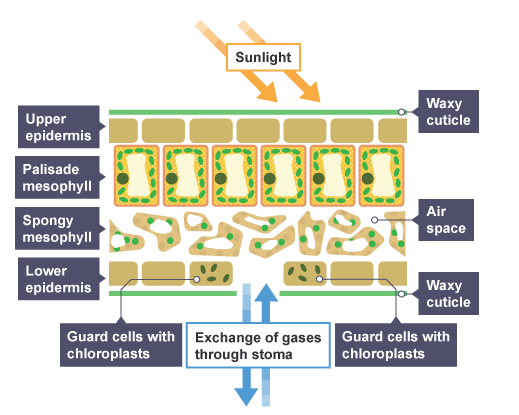
What are the features and function of epidermal tissue?
Covers whole plant
Covered with waxy cuticle → reduces water loss by evaporation
What are the features and function of palisade mesophyll tissue?
Found underneath epidermal tissue
Lots of chloroplasts → rapid photosynthesis
At the top of leaf → lots of sunlight
What are the features and function of spongy mesophyll tissue?
Found underneath palisade mesophyll tissue
Lots of air spaces → gases diffuse in and out of cells
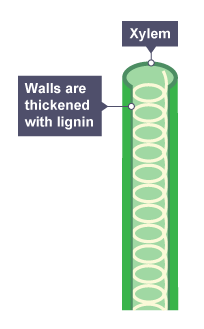
What are the features and function of xylem?
Found in roots, stems, and leaves
Made up of dead cells joined together → creates continuous tube
Strengthened with lignin
Hole along tube — bordered pits
Lignin = strong and waterproof → water doesn’t leave
Except bordered pits — allows minerals to go to specific parts of plant
Allows movement of water and mineral ions from roots → stem and leaves — evaporates and leaves plant
Transpiration stream
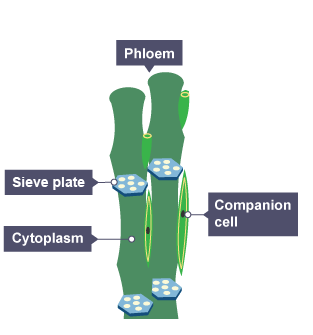
What are the features and function of phloem?
Found in stem, roots, and leaves
Elongated cells — holes in cell walls
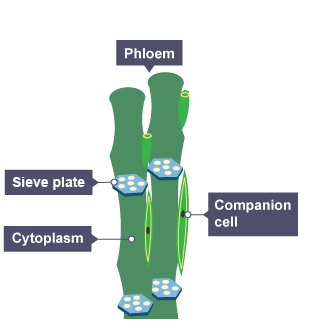
End walls = sieve plates
Many organelles from cells removed so cell sap moves through
Food substances moved in both directions:
From leaves where they are made for use
From storage to parts of plant that need it
Translocation
What are the features and function of meristem tissue?
Found at tips of roots and shoots
Can differentiate → different types of plant cell
Allows plant to grow
The leaf is a plant organ.
What tissues does it have?
Epidermis
Palisade and spongy mesophyll
Xylem and phloem
Guard cells surrounding stomata
What are guard cells?
Cells that surround stomata
Controls opening and closing of them — depending on water availability
What is the role of stomata and guard cells?
Control gas exchange and water loss
What are root hair cells adapted for? (2)
Uptake of water by osmosis
Uptake of mineral ions by active transport
What does phloem tissue do?
Transports dissolved sugars from leaves → rest of plant
For immediate use or storage
What is translocation?
Movement of food substances made in leaves up or down phloem — for immediate use or storage
What is transpiration?
Loss of water from leaves and stems of plants
Result of gas exchange — stomata are open
What factors affect the rate of transpiration? (4)
Temperature
Humidity
Wind
Light intensity
How does temperature affect the rate of transpiration?
Increase in temperature → molecules move faster → evaporation happens faster → rate of transpiration increases
Rate of photosynthesis increases → more stomata open for gas exchange → more water evaporates → rate of transpiration increases
How does humidity affect the rate of transpiration?
High relative humidity = reduced concentration gradient (between water vapour inside and outside of leaf) → slower rate of diffusion → decreased rate of transpiration
How does wind affect the rate of transpiration?
More air moving away from leaf = lower concentration of water vapour surrounding leaf
Steeper concentration gradient → increased rate of transpiration
How does light intensity affect the rate of transpiration?
Increased light intensity → increased rate of photosynthesis
More stomata open for gas exchange → more water evaporates → increased rate of transpiration
Why is there more stomata on the bottom of the leaf?
Allows for gas exchange
Minimises water loss by evaporation — lower surface is shaded and cooler
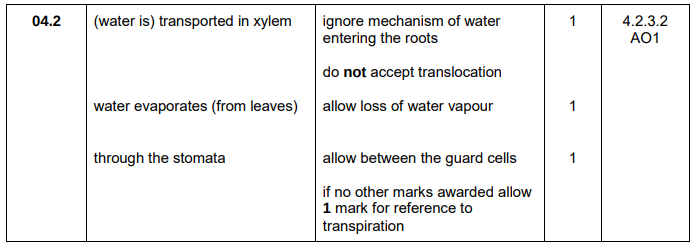
Describe the transport of water through a plant from the roots to the atmosphere. [3 marks]
Water transported in xylem
Water evaporates — through stomata
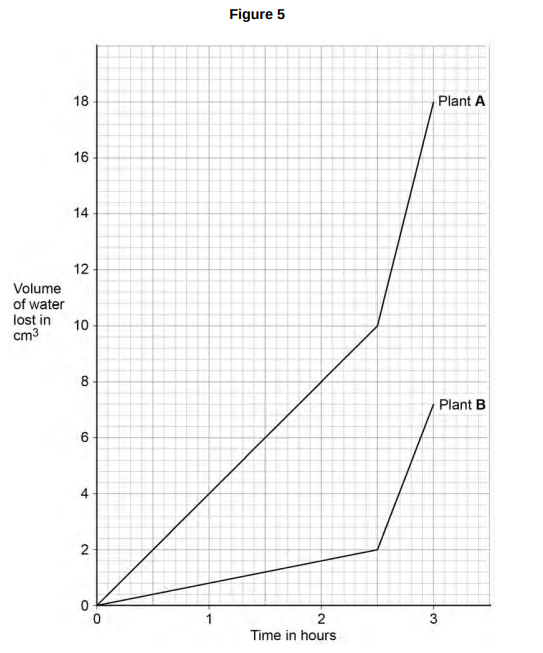
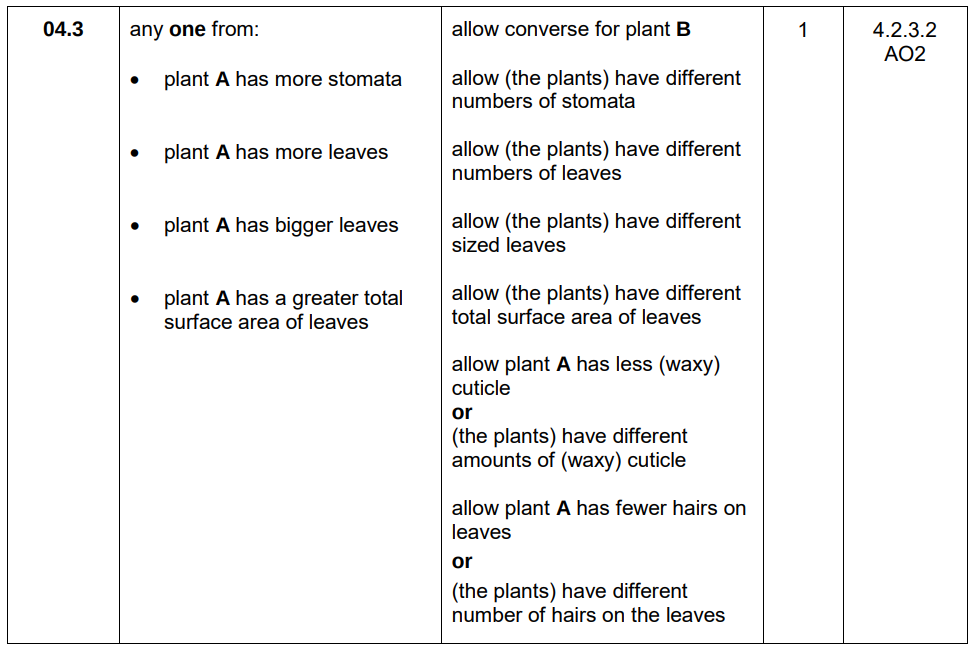
A student investigated the volume of water lost from two plants of different species.
Both plants were kept together.
Figure 5 shows the student’s results.
Suggest one reason for the difference in the rate of water loss from the two plants in the first 2.5 hours. [1 mark}
Plant A has more stomata.
![<ul><li><p>A student investigated the volume of water lost from two plants of different species. </p></li><li><p>Both plants were kept together.</p></li><li><p><strong>Figure 5</strong> shows the student’s results.</p></li></ul><p>Suggest two reasons why the rate of water loss in both plants changed after 2.5 hours. [2 marks]</p>](https://assets.knowt.com/user-attachments/d047bad2-a857-48de-bb8e-a9ecaea14301.png)
A student investigated the volume of water lost from two plants of different species.
Both plants were kept together.
Figure 5 shows the student’s results.
Suggest two reasons why the rate of water loss in both plants changed after 2.5 hours. [2 marks]
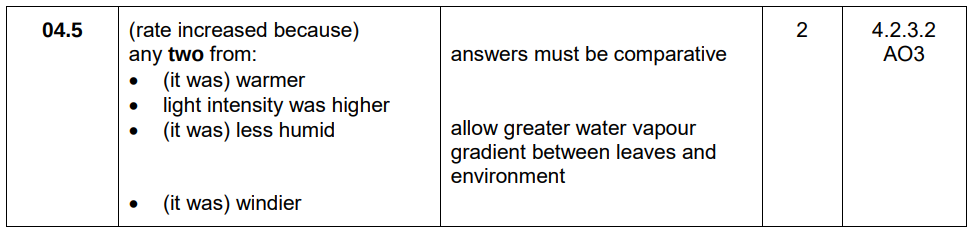
It was warmer.