Lasers
 Call Kai
 Learn
Learn Practice Test
 Spaced Repetition
 Match
Match Flashcards
 Knowt Play
1/101

There's no tags or description
Looks like no tags are added yet.
Name | Mastery | Learn | Test | Matching | Spaced | Call with Kai |
|---|
No analytics yet
Send a link to your students to track their progress
102 Terms
Why are lasers used instead of normal light sources?
They are:
Brighter
Tuneable and monochromatic (have a well defined frequency)
Directional, therefore controllable.
Allow control of polarisation
Temporally and spatially coherent.
What are lasers?
Light amplification by stimulated emission of radiation.
How do lasers work?
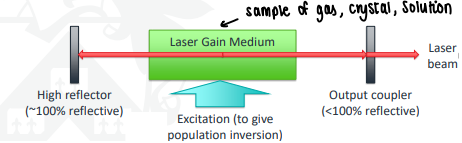
A laser gain medium contains a sample of gas/crystal/solution that is made to emit.
Excitation of gain medium occurs at one wavelengths.
The light passes back and forth between the output coupler and high reflector.
Some light leaks through, forming the laser beam.
What is electromagnetic radiation?
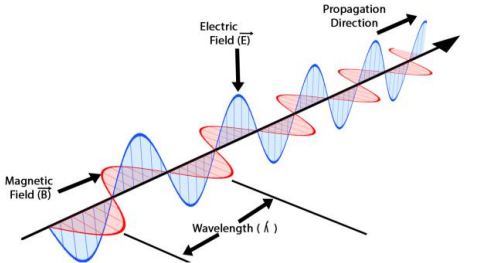
A wave, consisting of two oscillating fields: an electric field and a magnetic field.
Energy varies with wavelength: the higher the wavelength, the lower the energy.
What is stimulated absorption?
A photon excites a molecule from a low energy state to a high energy state.
What is stimulated emission?
A photon induces a molecule to transfer from high energy to low energy state.
What is spontaneous emission?
A transition from high energy to low energy state independent of radiation.
What is spectroscopy?
The interaction of light with molecules.
They are plots of intensity vs frequency or wavelength and consists of ‘bands’ that show that photons have been absorbed/emitted by a molecule at a specific frequency which corresponds to the energy difference between two molecular states.
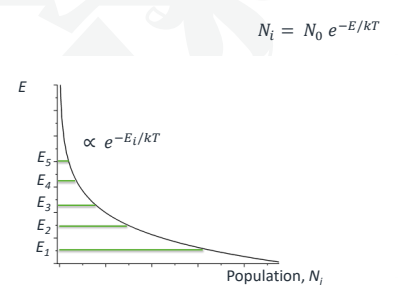
What is the Boltzmann distribution?
What is amplification?
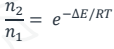
When a photon passing through a medium with a resonant frequency (i.e. a sample which strongly absorbs the photon) gains intensity afterwards – this is the opposite of absorption.
Required to create a laser.
At thermal equilibrium, what are the energy level populations in a gas?
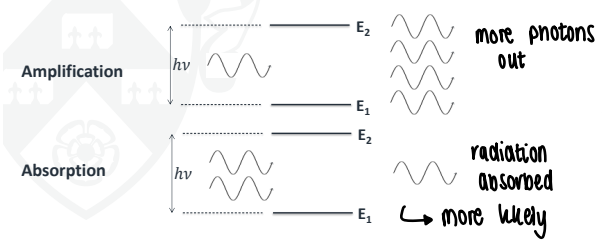
Follows the Boltzmann distribution, most molecules in low energy states.
What is population inversion?
A population inversion occurs when a state or level of a laser gain medium lying higher in energy than one below has a greater population.
This inverts the natural order of populations defined by the Boltzmann distribution.
What is required to achieve amplification?
We need the larger population to occur in the upper state (a population inversion). This requires more than two levels.
This means stimulated emission happens more often than absorption, amplifying the photon.
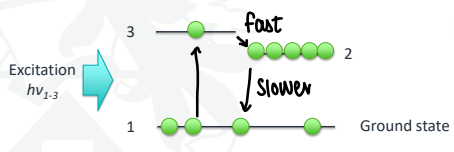
How do you get a population inversions in a 3 level system
A continuous excitation source is used to promote molecules from level 1 to 3. Fast relaxation occurs from 3 to 2.
If rate of transfer from level 2 to 1 is slow, then population accumulates at level 2 causing the population inversion.
When this occurs, a photon resonant with the 1-2 energy gap will trigger spontaneous emission (which is greater than absorption) leading to gain.
Why are 3 level systems inefficient?
More than half of the particles need to be excited to a higher energy state.
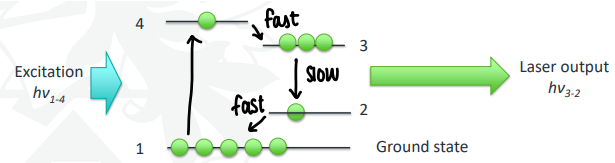
How is a population inversion achieved in a 4 level system?
The molecules are excited to level 4, undergo fast relaxation to level 3 and then slow relaxation to level 2. This causes the population inversion to occur in level 3. Fast relaxation then also occurs from level 2 to 1 to allow accumulation in 3.
What is laser gain?
An increase in light intensity as light passes through the laser gain medium.
Stimulated emission occurs in the gain medium, adding extra photons to the beam.
How does laser gain occur?
Population inversion occurs
Spontaneous emission from the upper inverted state occurs
A photon is emitted along the laser axis causing stimulated emission and amplification.
Light is reflected from the end cavity mirror and is amplified again.
Light is partially reflected from the end cavity mirror – some is released as a laser beam and the rest returned to the gain medium for more amplification.
What are the properties of HeNe lasers?
They are common red gas lasers. They are a 4 level laser.
They have a small size and good beam quality.
Used for alignment of larger laser systems.
Electrodes are used to create a DC discharge, exciting the medium and establishing the population inversion.
What are quantum cascade lasers?
Solid-state lasers made from thin layers of semiconductor material.
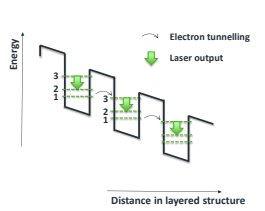
How do quantum cascade lasers work?
Electrons are injected into the structure containing multiple quantum wells.
In each well it undergoes a laser transition between sub-levels 3 and 2.
It then relaxes non-radiatively to sub-level 1 which is aligned with sub-level 3 of the next well, allowing it to tunnel through the barrier.
Multiple laser transitions are used to increase output.
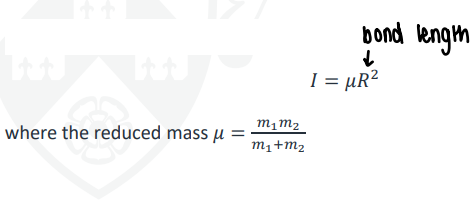
What is the moment of inertia?
The distance of atoms from their rotational axis.
How do you calculate the moment of inertia for a diatomic molecule?
What is a symmetric rotor?
A rigid body with one symmetry (principal) axis Cn with n ≥ 3.
This means that two moments of inertia are the same: Iy=Ix
z is the figure axis of the molecule.
What determines the energy levels of the symmetric rotor?
The energy levels come from the eigenvalues of the Hamiltonian.
The J values (the rotational quantum number) gives the energy levels.
The K value is the projection of the angular momentum on the molecules symmetry axis.
What is the MJ quantum number?
It defines the projection of J (the total angular momentum) along a given direction (usually z axis).
MJ can have values of J, (J-1), (J-2)… -J.
How do you define the axes of inertia?
The three axes (a, b and c) each have a moment of inertia. These axes intersect at the centre of mass.
The c axis is the maximum moment of inertia.
The a axis is the minimum amount of inertia.
The b axis is perpendicular to a.
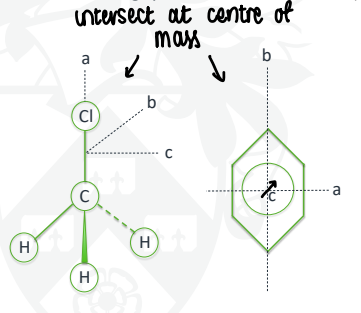
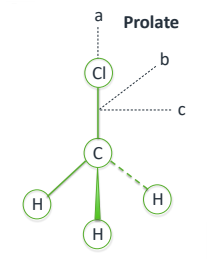
What is a prolate symmetric rotor?
Where Ic = Ib > Ia
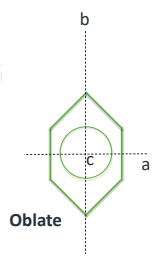
What is an oblate symmetric rotor?
Where Ic > Ib = Ia
How do you calculate the rotational constants?
c is the speed of light in cms-1, therefore the units of the constans are cm-1.
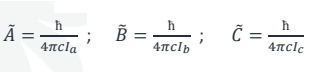
How do you determine the energies of the rotational energy levels of a symmetric rotor?
Where F (the energy term) is in wavenumbers.
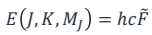
How do you calculate the energy term (F) for a prolate rotor?

How do you calculate the energy term (F) for a oblate rotor?

What does the K value tell you?
K measures the amount of angular momentum that lies along the symmetry axis.
Small K means rotation is mostly perpendicular to the axis.
Large K means there is more rotation along the symmetry axis.
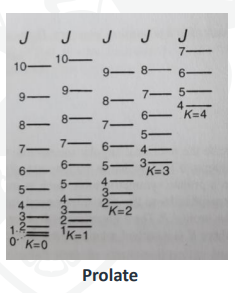
What do the energy levels look like for a prolate rotor?
Higher K states lie higher in energy as more rotation around the symmetry axis requires more energy.
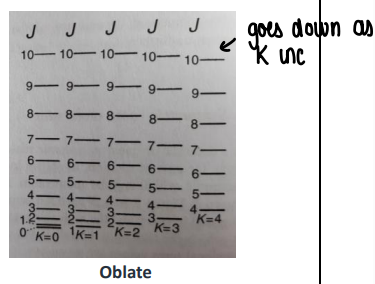
What do the energy levels look like for a oblate rotor?
Higher K states lie lower in energy as rotation around the symmetry axis is energetically favourable.
What are the moments of inertia for a spheric rotor?
Ic = Ia = Ib
What is the gross selection rule?
Only polar molecules can have a pure rotational spectrum.
This is because the electric field of light turns molecules using their dipole moment.
What are the specific selection rules for a symmetric rotor?
K = 0, there is no angular momentum component along the symmetry axis.
MJ = 0, there is no angular momentum in the z component.

What are the specific selection rules for a linear rotor?
Does not depend on K as all atoms are on one axis, so there is no K quantum number.

Why do spherical rotors have no rotational spectra?
Due to the gross selection rule, they have no dipole moment.
What equation establishes the allowed transition frequencies?
As for both symmetric and linear rotors, K and MJ do not contribute. Therefore the equation is simplified to 2B.
The transitions have separations of 2B

What are the features of rotational spectra?
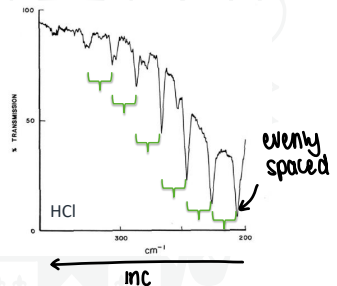
Even spacing of major features.
Complexity arising from other peaks or line broadening.
Pattern is clearer at low frequency.
Intensities relate to temperature
What is centrifugal distortion and how does it affect rotational constants?
At high J values (high rotational energy) centrifugal effects lead to lengthening of the bond.
If the bond length increases, inertia increases and so the rotational constant decreases. The line spaces therefore decrease.
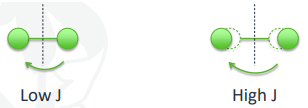
Why is Bv often larger than Bv+1?
As Bv+1 has a higher vibrational energy, this leads to a longer average bond length and so a larger moment of inertia. This then means the B value is lower.
What happens to the B values as a larger temperature is used?
Higher T leads to higher vibrational levels becoming populated. At higher levels, there will be a higher order of anharmonicity and centrifugal distortion is expected to be more prominent.
Descriptions of the rotational energy level positions and D constants would be needed to maintain accuracy.
What is the equation for the energy terms (F) for a linear rotor taking into account centrifugal distortion?

How do you calculate the centrifugal distortion constant?
D is always positive, therefore energy level spacing decreases.

When are K components of symmetric rotors visible?
Centrifugal distortion causes the molecule to stretch as it spins faster. This causes the energy levels to shift slightly depending on the K value.
When do spherical rotors become visible in spectra?
When centrifugal distortion causes the symmetry to break, making them resemble symmetric rotors.
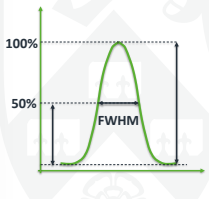
How is width of a peak defined?
Using full width at half maximum height (FWHM)
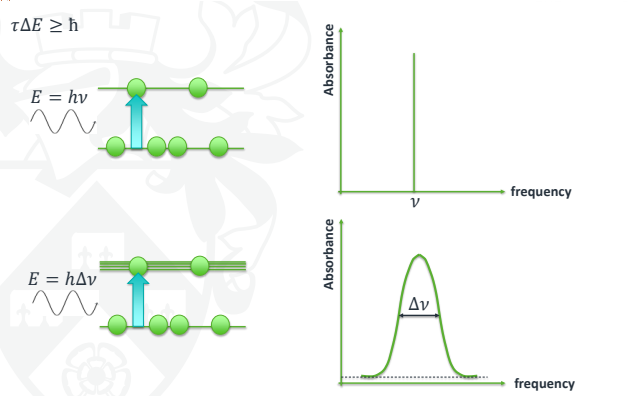
What causes natural linewidth?
Caused by the lifetime of the energy states, the excited states decay over time via a first-order decay process.
A short lifetime gives a broader bandwidth.
A higher frequency also gives broader lines.
What is doppler broadening?
When a molecule moves towards the detection, the observed absorption frequency increases compared to the actual frequency by an amount relative to the ratio of its speed to c.
This causes a spread of observed frequencies and so a broader linewidth.
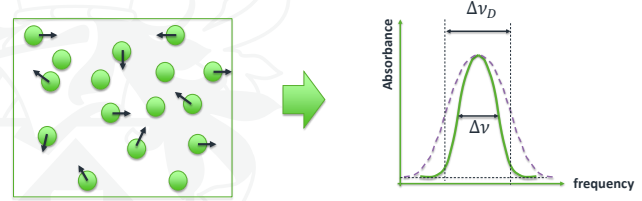
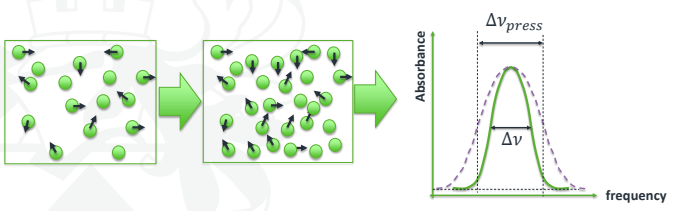
What is pressure broadening?
Collisions between the gas phase molecules leads to exchange of energy between them, therefore blurring the energy levels and causing broadening.
More molecules means a greater pressure, reducing time between collisions which reduces lifetime and so linewidth increases.
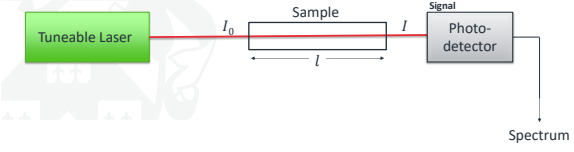
What happens in basic absorption spectroscopy?
A laser is shone at the sample, which absorbs a specific wavelength. A spectra is then created from this data.
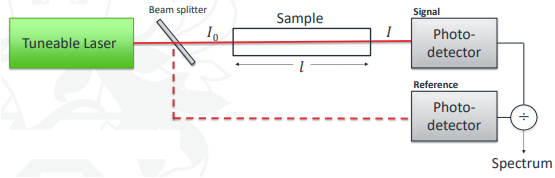
How is the sensitivity of absorption spectroscopy increased?
We need absorption to be bigger than noise, vibrations cause an increase in noise. A reference photodetector can be used.
Dividing the signal by a laser reference reduces the effect of signal fluctuations due to laser power.
The signal measures the intensity after absorption, and the reference measures laser intensity allowing direct measurement of absorbance.
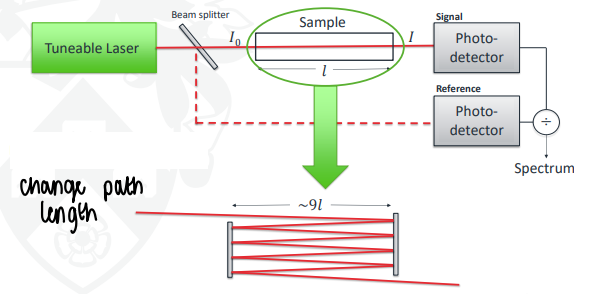
What are multi pass cells and why are they used?
The path length is increased to improve sensitivity. This is done by using focusing mirrors to increase the path length by a factor of 9.
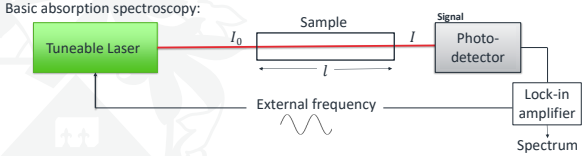
What is signal modulation and why is it used?
A way of minimising the effects of other noise sources. The laser frequency is constantly varied by a small amount with a sine wave function, this is used as a reference for a lock-in amplifier which isolates only signals with a similar frequency.
Acts to isolate and amplify those from the laser.
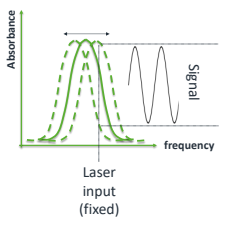
What is velocity modulation and how is it done?
An AC (alternating current) is applied, causing ionic species to travel towards the oppositely charged electrode. The ion then undergoes a sine-wave style Doppler shift at the frequency of the discharge. The electrodes then reverse with an AC discharge, causing oscillation as the electrodes switch polarities back and forth.
Only molecules which oscillate at this frequency are detected.
This separates ions and neutral molecules as it only detects the ions.
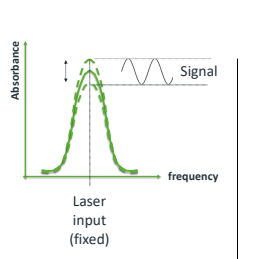
What is population modulation and how is it done?
A way of changing the number of short lived neutral particles present during an AC discharge cycle.
An AC discharge is applied, forming short lived, uncharged species. The concentration of these species rises and falls with the discharge cycle, creating the population difference which oscillates. This causes the amplitude to undergo a sine-wave style oscillation at twice the frequency of the discharge.
Only the signal which oscillates at this AC discharge is detected.
What is cavity ring-down spectroscopy and how does it work?
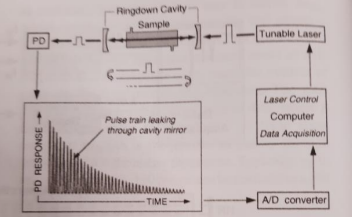
A sample is placed between two highly reflective mirrors, a laser pulse reflects back and forth steadily losing intensity. The signal is measured from the light that leaks from one cavity mirror, this measures the exponential decay of pulse intensity.
An absorbing molecule will increase the rate of decay of the exponential.
Measures how quickly a trapped laser pulse fades between the mirrors.
What is temporal resolution?
Precision of a measurement with respect to time.
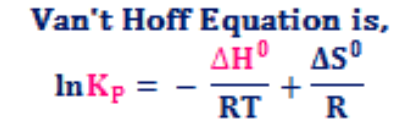
What does Van’t Hoff’s equation tell us?
About equilibrium position versus temperature based on thermodynamic energy change of the reaction.
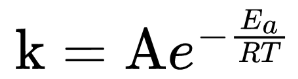
What does Arrhenius equation tell us?
About the rate, which relates to activation energy, not thermodynamic net energy.
What determines how long a transition state lives?
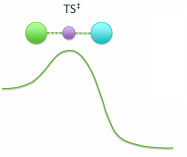
The vibrational motion. The TS is inherently unstable, therefore a small distortion will send the TS forwards or backwards.
What kind of ‘camera’ is needed to see a TS?
Needs to be much faster than standard measurements. The camera must be faster than the lifetime of the vibrational motion of the transition state.
What are the properties of Nd:YAG lasers?
Nd-doped Yttrium Aluminium Garnet laser able of generating ultrafast pulses.
The Nd3+ ions are the bases of the solid state laser gain medium.
Is a 4 level system.
What are the properties of Ti:sapphire lasers?
The Ti3+ ions are embedded in a Al2O3 host. Able of generating ultrafast pulses (fs-ps).
Ultrafast pulses often produced by the Ti:sapphire, then pumped by Nd:YAG.
Has broad bandwidth.
What are the properties of ultrafast laser pulses?
The lasers have a broad bandwidth, therefore it covers a range of frequencies and so may excite several molecular transitions simultaneously.
High time resolution.
What is CPA?
Chirped Pulse Amplification: pulses are stretched in time, then amplified, then recompressed to allow production of high energy, ultrashort pulses.
A short pulse is made longer, then amplified, and finally compressed back into a shorter pulse.
What is the equation for the potential energy of a harmonic oscillator?

What is the equation for the potential energy of an anharmonic oscillator?
Where xe is the anharmonicity constant.

What is the difference between transitions in harmonic oscillators compared to anharmonic?
The specific selection rule states: Δv = ±1
In harmonic oscillators the energy levels are evenly spaced, therefore each transition has the same energy.
In anharmonic oscillators, a number of different energy transitions are possible as energy levels are not evenly spaced.
What transitions are visible for anharmonic oscillators?
Anharmonicity weakens the selection rules, therefore Δv = ±2 become weakly visible even if they are disallowed.
How many vibrational modes are there for a linear molecule?
3N-5
How many vibrational modes are there for a non-linear molecule?
3N-6
What is the vibrational fine structure and when is it visible?
The associated stack of rotational transitions that occur within a vibrational transition.
Only visible for relatively low-pressure gas phase samples at high resolution.
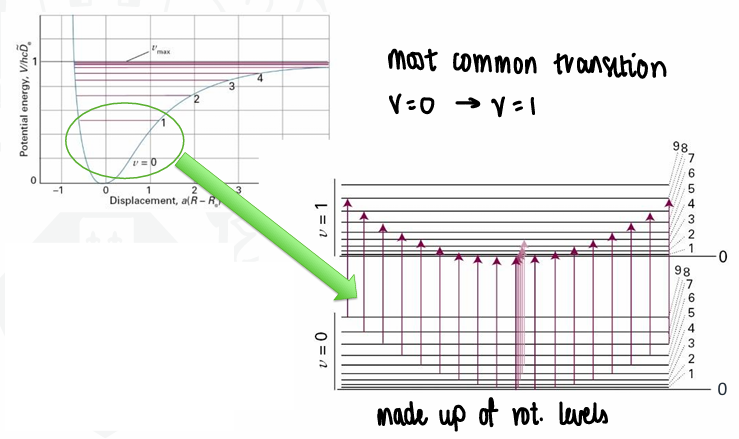
What does the vibration-rotation energy levels look like?
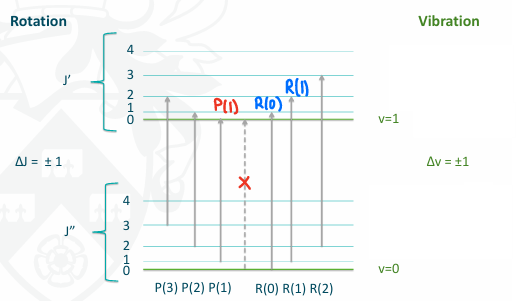
Transitions occur from any of the J levels in v=0 to ΔJ=±1 in the v=1.
ΔJ=1 forms the R branch.
ΔJ=-1 forms the P branch, however P(0) cannot exist as you cannot go lower than J=0.
What does the vibration-rotation spectra look like?
Contains both the R and P branch.
The band centre is at the point of the Q branch, which is disallowed so not seen.
Shoulders occur due to the presence of isotopes, changing the mass changes the rotational constant.
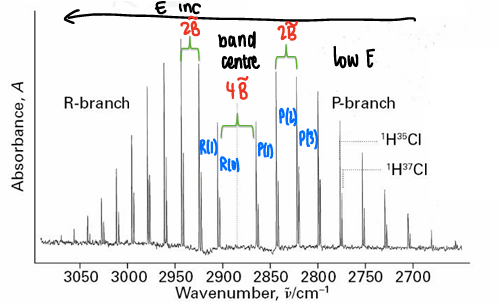
What is the separation between the lines in the P and R branch?
If we assume the two rotational constants in the two vibrational states are equal and that we can neglect anharmonicity, we can approximate the separation is 2B.
What is pump-probe spectroscopy?
A measure of how a molecule responds to pump excitation. Allows probing of FGs of molecules in solution environments.
The pump is the first pulse that excited the system and starts the ‘clock’.
The probe is the second pulse that probes the system a short time later.
How are resonant IR pump probe experiments measured?
The frequency of the laser is tuned to the same energy as the studied transition.
The probe is measured in absence of the pump, creating an IR absorption spectrum to act as a baseline.
Now introduce the pump before the probe, changing the population of the vibrational states. Then measure the probe again.
A difference spectrum is recorded with positive and negative peaks due to the v=0-1 transition depleting and v=1-2 transition now occurring instead.
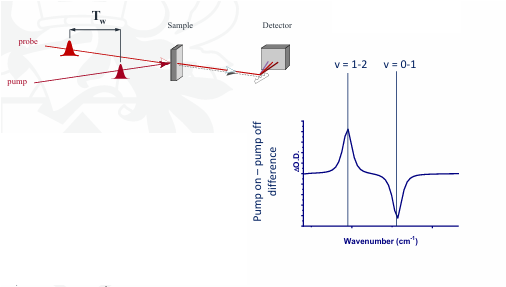
What happens when changing the pump-probe time delay in resonant IR experiments?
We can watch the molecules relax, as the time delay increases, the signals decrease.
Here the v= 1→2 depletes as it relaxes, therefore the v= 0→1 increases as the molecules have relaxed back into this state.
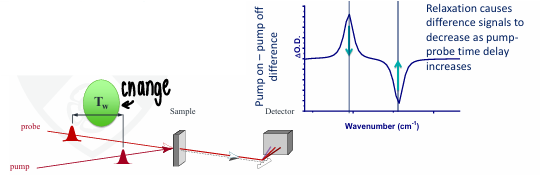
How does rate of relaxation depend on the environment?
The energy is released in order to relax, this can go out into solution. This can cause strong transitions between the excited state and a solvent (such as water). A stronger interaction between them means relaxation happens faster.
Water can allow H-bonding to excited states which can also interact.
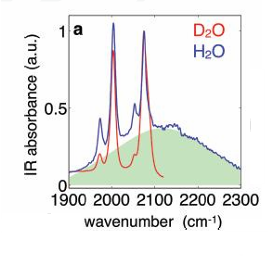
How is anisotropy used in pump-probe spectroscopy?
Anisotropy is non-uniformity in all directions.
Information on molecular rotation can be obtained using two measurements with parallel and perpendicular pump-probe polarisation directions.
How are parallel and perpendicular excitation measured?
The pump direction is set in a specific direction of polarisation, therefore selecting molecules aligned in the pump direction.
The pump will only excite molecules in the sample if their dipole is aligned in the same direction (parallel or perpendicular)
The probe then measures those which are still aligned after pump-probe delay
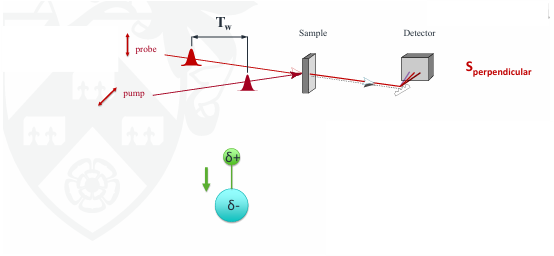
What is the problem with parallel/perpendicular measurements?
They are sensitive to rotation, therefore molecules may rotate between the pump-probe delay and become disaligned and so not detected.
How is lifetime used to optimise reaction conditions?
M-CO lifetime varies, the lifetime is much slower in organic solvent and becomes much faster in water.
Lifetime can be used to tell us something about the molecular environment and interactions between the solute and solvent, therefore what environment is needed for a certain reaction.
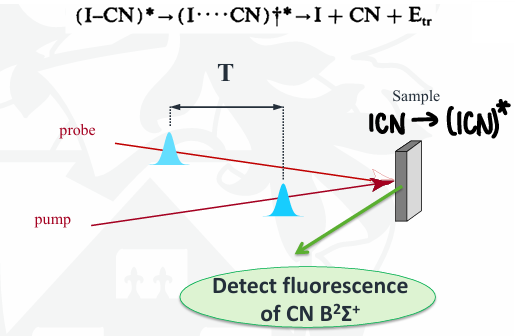
How does femtosecond spectroscopy work?
Relies on ultrashort (40-100 fs) duration laser pulses.
The pump-probe methodology is also used, the first pulse excites the system and starts the clock, the probe them measures the system a short while later.
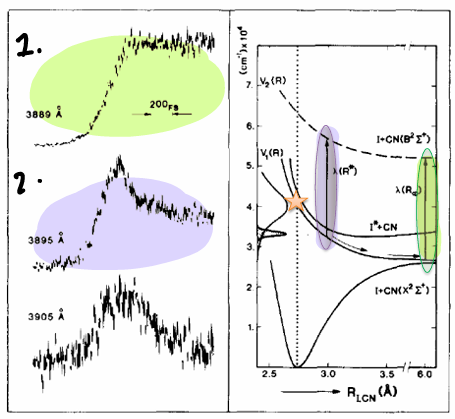
What does a potential energy curve look like for a transition state?
The excited state is created, the I-CN bond is extended to form the TS, which is halfway between the dissociation product.
The ‘tipping point’ energy is reached, this is the point at which the reaction can go in either direction.
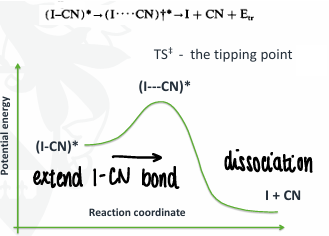

How is femtosecond spectroscopy used to observe a transition state?
The pump excites ICN to ICN*, this causes the bond to begin elongating until eventually breaking.
Changing the frequency of the pulse changes the bond length, therefore probing the formation of the TS.
As the bond length changes, CN will cause fluorescence, therefore tell you if CN exists at certain bond lengths, i.e. the TS.
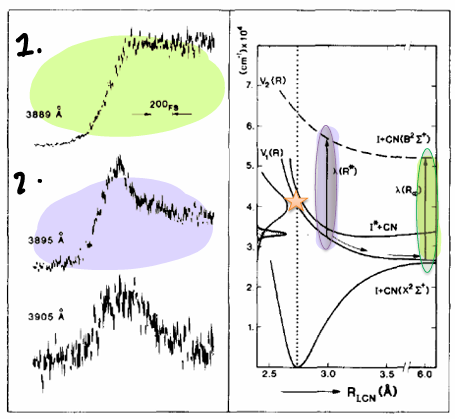
How can you interpret these femtosecond spectras?
Spectra 1 has a longer bond distance (therefore the CN exists and able to fluoresce), therefore fluorescence is constant and signal plateaus.
Spectra 2 shows a rise in signal as bond length increases, until probe is no longer resonant with the transition so the signal drops. The molecule passes through a point at which the bond length is unstable, showing the TS.
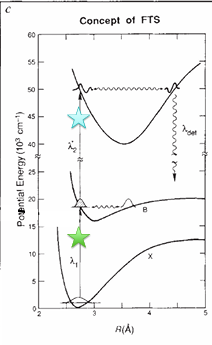
What does the potential energy surface show?
The molecule is excited by the pump to the excited state. This is then excited again to a fluorescent excited state and the fluorescent signal is monitored.
If the surface has a minimum point, the excited state will be stable.
The reaction is probed at the equilibrium bond length in the ground state, which is shorter than in the excited state.
What do the femtosecond signal-time spectra of a bound excited state show?
Shows the time characteristics of the vibrational mode, oscillation occurs as the bond is excited.
The beat period is the time taken to complete a full cycle. If they are closely spaced, interference occurs.
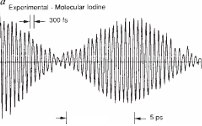
What is happening during excitation to a bound potential energy surface?
Classically, the molecule is vibrating. A recurring signal occurs at the turning point of the excited state vibration.
Quantum mechanically, the pump accesses a set of vibrational levels of the B state simultaneously, creating a coherent superposition of the states (a wavepacket). This oscillates in a manner that reflects the classical vibrations of the excited state.
What happens at longer time delays when measuring excitation of the potential energy surface?
At longer times, the signal disappears and reappears due to the probe observing a rotational recurrence of the excited state molecules. This means they start to rotate during the time delay.
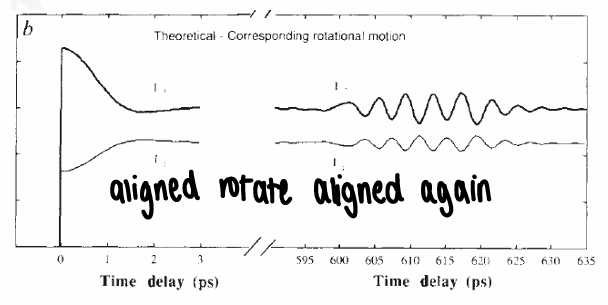
What is the difference between bound and dissociative states?
In a bound state, the excited state does not dissociate and instead stays bound, oscillates, then relaxes.
In a dissociative state, excitation causes the vibration and subsequent breakage of a bond.
How are chirped pulses used to manipulate vibrational excitation?
The chirped pulses drive the molecule up the vibrational energy ladder, the pump causes several transitions sequentially (therefore not violating the specific selection rule).
This allows us to see v=2-3 and v=3-4 transitions.
Why does the signal oscillated following pump-probe excitation?
The probe pulse excites the transition from state A to the fluorescent state B at a specific bond length.
As the excited state oscillates due to vibrational excitation in state A molecules move into and out of resonance with the probe transition.
Forms an oscillating signal with the period of the vibrational motion of the excited state in state A.
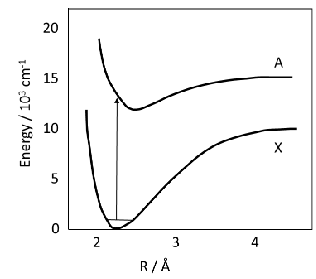
How do you calculate vibrational frequency from the time period of the signal?
Convert the time period into seconds.
v (Hz) = 1/time period
frequency = v/c