RA II Color Theory
 Call Kai
 Learn
Learn Practice Test
 Spaced Repetition
 Match
Match Flashcards
 Knowt Play
1/71

There's no tags or description
Looks like no tags are added yet.
Name | Mastery | Learn | Test | Matching | Spaced | Call with Kai |
|---|
No analytics yet
Send a link to your students to track their progress
72 Terms
What is the premise of color theory?
To be successful in embalming and restorative art you must have an understanding of the theory of color.
What will the knowledge of color theory assist in?
It will assist the sound judgment necessary for optimal performance within our profession.
What Areas of Funeral Service Require a Knowledge of Color Theory?
Cosmetic requirements of the deceased
Clothing/wardrobe considerations of the deceased
Casket interior colors
Flower arranging
Your own professional wardrobe and accessories
Funeral home lighting
Advertising (ads, logos, signage)
Web design
Product packaging
Funeral home décor
Describe Light colors
Soft, quiet, gentle
Describe darker colors
Serious, depth, weight
Describe clear tones
Energetic, youthful, friendly
Describe bright colors
Exciting, draws attention
Describe muted tones
Refined, serious, sophisticated, dull
Describe dull muddy colors
Somber, depressing
What emotions does the color white invoke?
purity, innocence, peace, goodness
What emotions does the color green invoke?
nature, rest, envy, money
What emotions does the color purple invoke?
royalty, wisdom, maturity, drama
What emotions does the color blue invoke?
Harmony, calmness, power, dignity
What emotions does the color black invoke?
Sophistication, power, gloom, misery, darkness, death, evil, badness
What emotions does the color red invoke?
Love, passion, vigor, power, activity, blood, pain, death
What type of sensation is color?
A visual one
What is color the response to?
To light of specific wave-lengths of radiant energy which strike the retina of the eye; this then transmits an impulse to the brain.
What lies within the retina?
six different layers of cells including the rods and cones.
What are rods in the eye?
responsible for our seeing varying degrees of light
What are cones in the eye?
responsible for our perception of color
Perception of color is a highly personal experience and can be influenced by:
Past experience or association
Aesthetic preference
Eye fatigue
Sharpness of vision (visual acuity)
Color blindness
What are some factors that can influence our perception of color?
Color’s appearance can be influenced by the type and amount of illumination
One color’s appearance can be influenced by another adjacent color (emphasize or diminish)
Color begins with light. Without it there is no perceptible color.
what is the color spectrum?
The original scientific standard of color
When a beam of light is passed through a prism, it is dispersed, or broken down into 7 individual colors called a spectrum.
As the light exits on the other side of the prism the colors you see are the 7 colors of the spectrum.
List the colors of the color spectrum
Red
Orange
Yellow
Green
Blue
Indigo
Violet
All color originates from a source of light known as __________, which is a mixture of all colors.
white light
What type of light is daylight?
White light
What technically, has no color of its own, but, rather absorbs certain rays and reflects other?
Pigment
What does pigment do to get its characteristic color?
It will reflect the ray which is responsible for its characteristic color.
Lips absorb all colors but red, which is reflected
Define spectrum
The progressive arrangement of colors (Roy G. Biv) that appear when a beam of light is dispersed (broken down) into its component colors.
Define dispersion
The separation of light waves
Define absorption
Colored objects absorb rays of light, which illuminate it, while others are reflective.
Define reflection
The return of light from a source
The color of an object is the ______________
reflected color
What are the three dimensions of color?
Hue
Value
Intensity (Saturation)
Define hue
The property of a color by which it is distinguished from another
The name by which we know it or the word used to describe it.
Ex: Red
Define Value
The lightness or darkness of a color.
A light value is high and a dark value is low
For example you cannot see hue in a black and white movie but you can see value.
Just as different clothes with different colors are distinguished by their value of colors.
Ex: Light red vs. dark red
How might the value of colors be altered?
by the addition of proper pigments to create tints or shades.
Define tint
A hue into which various quantities of white are mixed. The whites dilute the color, lightening the value.
Ex: Red + White = Pink
Define shade
A hue into which various quantities of black are mixed. The black darkens the value.
Ex: Red + Black = Burgundy
Match a photo of shades

Match a photo of tints

Define intensity (saturation)
The amount of strength a color, or hue, has.
It describes the degree of purity, or the brightness or dullness, of a hue.
Define tone
A hue mixed with either a small quantity of gray, or a compliment of that hue, resulting in a dulling, making it more neutral or less intense.
Define achromatic color
A color not found in the visible spectrum; a neutral color such as gray, black or white. (Black and white technically aren’t colors but are rather the addition or subtraction of light.)
Define monochromatic color
A variation of one hue or a tone, tint or shade of a hue.
Match a photo of tones

Match a photo of hues

Match a photo of intensity

Match a photo of values

Match a photo of achromatic

Match a photo of monochromatic
What is Prangs System of Pigment Color Theory?
A Color Wheel - An illustrative model of hues arranged in a circle.
It shows the relationships between the primary, secondary, and intermediate/tertiary colors.
List the categories on the prang color wheel
Primary Hues (3)
Secondary Hues (3)
Intermediate Hues (6)
Complimentary Hues
List the primary hues
RED BLUE YELLOW
What are the characteristics of the primary hues?
Primary colors are three hues that can be combined to make all other hues.
All colors originate from these three primary hues.
Primary pigment hues cannot be produced by mixtures of other hues.
The mixture of these three primary hues, in equal amounts, produces gray.
List the secondary hues
PURPLE ORANGE GREEN
Describe the secondary hues
Secondary hues are equal mixtures of two primary hues
RED + BLUE = PURPLE
BLUE + YELLOW = GREEN
YELLOW + RED = ORANGE
Match a photo of the primary colors

Match a photo of the secondary colors

List the intermediate hues
Red-Orange
Yellow-Green
Blue-Violet
Yellow-Orange
Blue-Green
Red-Violet
Describe the intermediate hues
Equal mixtures of a primary and secondary color
It is customary to list the primary color first.
List the complimentary hues
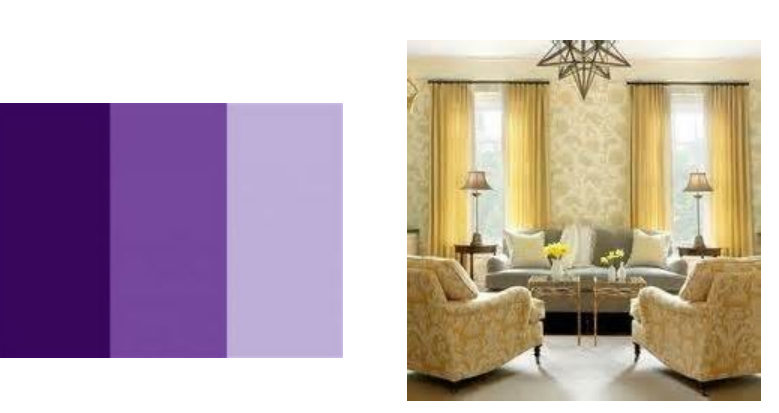
Yellow & Purple
Yellow-Green & Red-Violet
Red & Green
Blue-Green & Red-Orange
Blue & Orange
Yellow-Orange & Blue-Violet
Describe the complimentary hues
Colors found directly opposite one another on the color wheel.
How do you determine complimentary colors?
Refer to a color wheel. The color directly opposite your color is its compliment.
How do you find the compliment of a primary color?
By mixing the two remaining primary colors.
Red (Yellow + Blue) = Green
How do you find the compliment of a secondary color?
By mixing the two remaining secondary colors.
Orange (purple + green) = blue
What is an analogous color?
Two or more hues that have the same hue in common.
They are located adjacent to one another on the color wheel.
Define Juxtaposition
Simultaneous contrasts.
When any two hues are placed side by side or one hue is superimposed upon the other:
If they are compliments, they will enrich each other.
If they are not compliments, they will dull each other.
Ex: Red + Green = Compliment = Enriched
Define after image
Visual impressions remaining after a stimulus is removed.
If you stare at a sheet of colored paper and then stop, a flash of the color’s compliment will appear.
Ex: Blue’s compliment is orange
Define warm color
A color characterized by long wavelengths; makes objects appear closer and larger and reflects warmth.
Orange is the warmest hue.
Define cool color
A color characterized by short wavelenghts; makes objects appear to recede and reflects coldness.
Blue is the coolest hue.
Whats a tip for warm and cool colors?
To determine between warm and cool colors divide the color wheel in half at yellow/yellow-green and violet/red-violet