FUNCTIONALIST VIEW OF CRIME & DEVIANCE BOOKLET 3
 Call Kai
 Learn
Learn Practice Test
 Spaced Repetition
 Match
Match Flashcards
 Knowt Play
1/22

There's no tags or description
Looks like no tags are added yet.
Name | Mastery | Learn | Test | Matching | Spaced | Call with Kai |
|---|
No analytics yet
Send a link to your students to track their progress
23 Terms
Write a definition of crime acting as a warning light
This shows when something is not right and something needs changing
Write a definition for Mertons strain theory
The idea that everyone wants to achieve the American dream (money and success), but some people cant due to class, ethnicity (blocked opportunities), creating a strain between those who can achieve it legitimately and those who can't - they then turn to crime
What is an AO3 of Mertons strain theory?
Not everyone shares the same views of the American dream, and assumes that everyone in poverty turns to crime
What are subcultures?
Group of a people that set up their own norms and values (different from mainstream norms/values)
What does Cohen and Mertons agree on?
The idea of blocked opportunities
Who did Cohen say were responsible for crime?
Subcultures
Write down some examples of blocked opportunities (CAGED)?
Employment (class, ethnicity), housing, education/qualifications, poverty, location
Write down some examples of well known subcultures?
gangs
football fans (hooligans)
nerds
alternative communities (emos, goths, punks, furries)
cults
hippies
What else do Cohen and Merton agree on? (Linking to class)
Deviance is a lower class phenomenon where the lowest classes struggle to achieve mainstream success legitimately
What type of crime does Merton ignore?
Non-utilitarian crime (assault, vandalism) - not committed for financial gain
Cohen focuses on deviance amongst who? (Which gender and social class)
Working class boys - he says boys face anomie in the ,idle class dominant school system
What do working class boys suffer from?
Material deprivation (lack of skills to achieve)
Why do working class boys struggle in education?
lack of parental support
parental support - Gerwitz
material and cultural deprivation
labelling
the way they speak (elaborated and restricted code)(Bernstein)
If people are not very academic, what do they usually want to gain?
Status
How can we AO3 this point?
This pattern on boys becoming part of these deviant subcultures mostly starts at school
deterministic - bad grades = crime/delinquency
self fufilling prophecy
doesn’t include girls - girls develop hyperhetrosexual feminine identities (Archer)
Cohen found subcultures engage in what type of crime?
Non-utilitarian (criminal damage, graffiti, joyriding, violence, antisocial behavior)
What are some examples of subculture getting "revenge" on the society that let them down?
Protests, far right ideologies, teachers/doctors (strike)
What are the differences been social norms/values, and subculture norms/values?
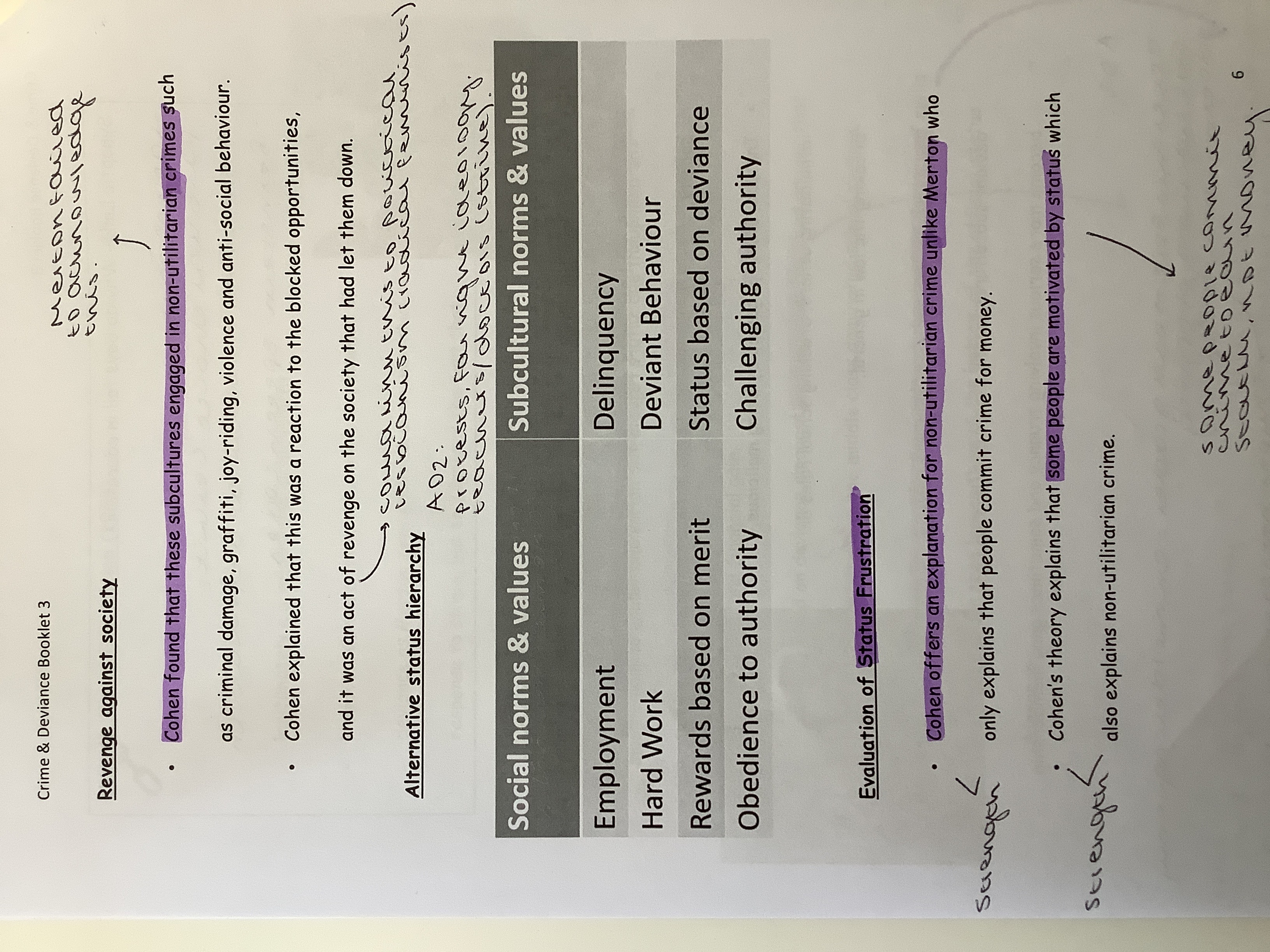
What are the strengths of "status frustration"?
cohen offers an explanation for non-utilitarian crime unlike Mertons who only explains that people commit crime for money
cohens theory explains that some people are motivated by status which also explains non-utilitarian crime (some people commit crime to gain status, not money)
What are the weaknesses of "status frustration"?
like Merton, Cohen also feels that working class boys, like middle-class boys want to be successful however they reject these goals when they fail
cohen ignores the fact that for some working class boys, they don't share the same goals as the middle class and therefore do not feel like they have failed (the boys have different goals, so don't believe that they are failed)
Can you think of any other evaluative points of Cohen's status frustration?
Does not include girls, too deterministic, those with power/wealth have status but still commit crimes (Prince Andrew), ignores upper class crime, ignores internal factors (family life, mental health), even deviant people can be successful later in life
Give a real life example of a person who didn't do something with deviant intent, but technically committed a crime
A man with autism threw a 3 year old girl into a crocodile enclosure
Write a definition of Cohen's status frustration
The idea that some people act in a deviant nature/commit crimes in order to gain status (not necessarily money)