3: motion perception
 Call Kai
 Learn
Learn Practice Test
 Spaced Repetition
 Match
Match Flashcards
 Knowt Play
1/29

There's no tags or description
Looks like no tags are added yet.
Name | Mastery | Learn | Test | Matching | Spaced | Call with Kai |
|---|
No analytics yet
Send a link to your students to track their progress
30 Terms
biological motion
where we distnguish animate from inanimate objects
how sensitive we are to motion like running, walking
inanimate objects also move and their motion carries information on the 3d shape of these objects
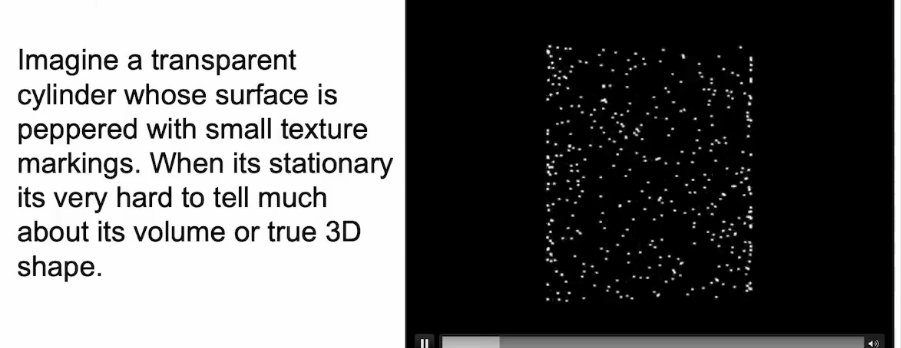
structure from motion
ability to determine the form of an object by its motion
need to see the dots motion in order to tell its volume or true shape
with a transparent rotating cylinder you can see both back and front moves from left to rice or vice versa . this is a bistable percept
what is a bistable percept
we see fist a cylinder in which rotation is first with front moving left to right and after a few seconds the percept jumps to reveal a cylinder rotating in the opposite direction
structure on motion 2
motion of the oject unmasks its volume/3D form
individual cells in MT have been recorded whereby their activity is higher when the monkey reports seeing front surface in preferred direction of the cell, than when he reports the front surface moving in the opposite direction- but the visual stimulus is the exact same
motion processing
V1
V2
MT/MST
processes complex motion: and where we make the concoius decidion as to which way an object is moving
MT direction columns
MT has a columnar architecture organised systemically with regard to the preferred direction of motion of neurons
activity of MT neurons reflect the conscious percepts of subjects- whether they see cylinder rotating clockwise or anticlockwise
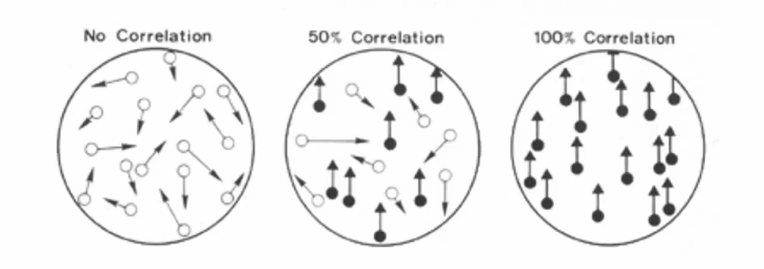
random dot motion
newsome and colleagues trained monkeys to perform a difficult motion discimination task, judging the direciton of motion of noisy, not very coherent moving dot stimuli
monkes view dots and decide which direction the dots using joystick
MT neurons are selectove for motion coherence and direction
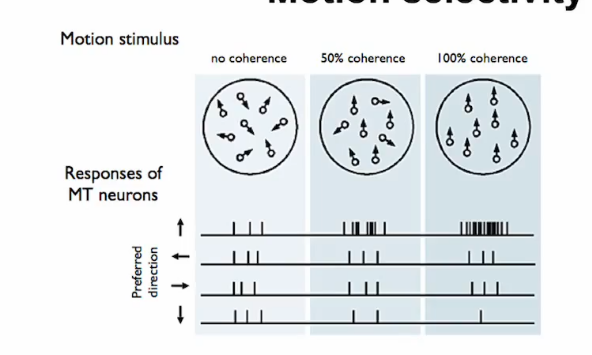
motion selectivity in MT
as coherence increases / number of dots moving in one place there is an increase in the direction of preferrred movement
electrical stimulation affects perception
electrically stimulated one column eg downwards column, and wondered if it changed the monkeys perceptio, making them halluncinate them seeing something else or more
if a MT column selective for downwards motion was electrically stimulated, the monkey would be more likely to respond that the stimulus moved downards
electrical stimulation changes perception
blue curve sows behavioural response of an unstimulated monkey
yellow: with electrical stimulation, perception is influenced a s when coherence is 0 75% responded a specific direction, even when it was not moving that way
more likely to see stimulus move in direction that was electrically stimulated
motion can break camouflage
hard to spot things behind camorflage when still
if the object moves behind the camouflage then easier to spot
visual guidance of locomotion
when you move about, this movement itself causes motino toappear on the retina. this self produced visual motion helps guide out action
helps you move safely and accurately through the environment eg refers to the use of visual information to choose a path, maintain direction and speed, avoid abstacles, whilst moving
optic flow
pattern of the optic flow could be used to tell where one is headed and to steer around obstacles
when moving forward, environent around eg trees look like it is coming towards you
accurate in determing heading from simulated flow fields
elderly subjects not as good as younger in estimating heading
what does optic flow patterns excite
excite cells in the MST
neurons in MST respond to expansions and contractions as well as other optic flow patterns
neurons in MST have large receptive fields
arrival time
knowing where we are going is one thing but estimating how long it takes to get there is arrval time
birds that dive underwater fold their wings streamlining their bodies just before hitting the water - they are aware of their arrival time
how do we know our arrival time
when we move towards an object eg a door or tree, its image on our retinas expand
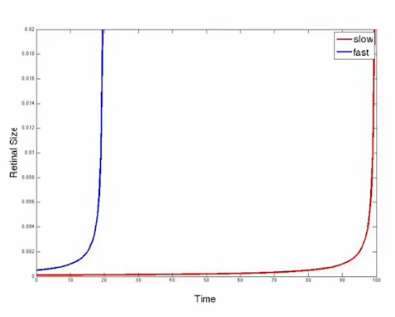
if we approach an oobject at a steady rate then the rate of expansion on the retina specifies the time to collision
however the size of object on retina doesnt change unless you get really close to it
if travelling slowly, expansion of retinal size doesnt change much
if travelling faster, image size does expand quicker but same size regardless of how fast r slow
looming signal
suggested that this signal , which indicates imminent collsion, is important for breaking ( interacting with what we move to ) as it occurs no matter the rate, distance or object size
referred to as a looming signal as the object suddenly takes up most of our visual field
looming in toddlers
we respond to a looming stimulus and that this instinct is present in both a myriad of creatures and in newly bor infants form their first encounter with looming stimulus
motion processing
motion detection
biological motion
shape from motion
aperture problem
plaids
motion coherence
camouflage
all real forms of motions
motion illusions
see motion where motion is not actaully present
apparent motion/Phi motion
apparent motion
a stimulus is flashed briefly in one location and then another, uusally identical stimulus, is flashed in another nearby location
instead of seeing the stimulus in one place, turn off and then appear again next to it, we see the location move from location 1 to location 2 in a smooth manner
what is ISI
apparent motion depends on the interval of time between the flashing of the 2 stimulus ( the inter-stimulus interval)
<30msec will see no motion
30-60msec partial movement
60-200msec will see smooth movement
the flicks
aparent motion is a type of stroboscopic motion; motion seen with a strobe light
a more famliar instance with a stroboscopic motion occurs in movies and on Tv
movies are composed of a series of individual static frames ( snapshots) presented rapidlt
stroboscopic motion
apparent motio created by rapidly flashing or intermittently illuminated images rather than continous movement
brain percieves movement even though nothing is actaully moving
a spinning fan under a strobe light can look like its standing still, moving slow or backwards
correspondence problem
stimuli used to generate apparent motion can sometimes suffer from a temporal correspondence problem
the brain needs to match objects between diferent points in time
stimuli are atched based on similarity in shap colour and to their nearest neighbor
temporal correspondance problem
sometimes the temporal match can be ambigious
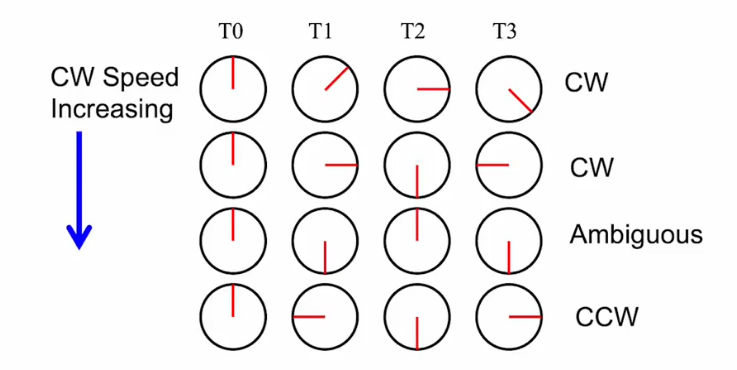
wagon wheel illusion
based on a problem of temporal matching
appears to rotate slowly or even not at all when infact it is spinnig forward
visual system samples motion in discrete time steps rather than continuously
as speed increases harder to tell thr direction of where its spinning ; clockwise or counter clockwise
stroboscopic motion illusion
strobe light used to generate snapshots for brain to process
stimulus is created by being composed of multiple objects that are rotated at speed
light illuminates stimulus generating snapshots or frames
bain matches objects between shots and creates illusion of moving objects
adaptation effects of motion illusions
2 sine wave gratinngs
adaption to a high contrast moving grating
makes it harde to percieve a lower contrast grating
slows down the percieved speed of low contrast gratings
motion aftereffects
after prologed viewing. stationary objects such as rocks at the side of a waterfall appear to be moving in the opposite direction to the adapting stimulus. this aftereffect is immediate and short lived