rp3 -> Production of a dilution series of a solute to produce a calibration curve with which to identify the water potential of plant tissue.
 Call Kai
 Learn
Learn Practice Test
 Spaced Repetition
 Match
Match Flashcards
 Knowt Play
1/5

There's no tags or description
Looks like no tags are added yet.
Name | Mastery | Learn | Test | Matching | Spaced | Call with Kai |
|---|
No analytics yet
Send a link to your students to track their progress
6 Terms
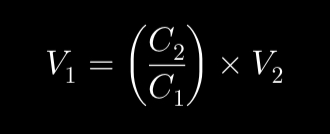
how to calculate dilutions: C1 x V1 = C2 x V2
C1 = concentration of stock solution
V1 = volume of stock solution used to make new concentration
● C2= concentration of solution you are making
● V2= volume of new solution you are making (V2 = V1 + volume of distilled water to dilute with)
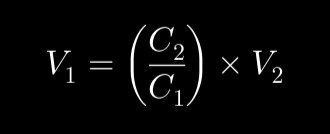
describe how you would use a 0.5 mol dm-3 solution of sucrose (stock solution) to produce 30cm3 of a 0.15 mol dm-3 sucrose solution.
method to produce of a calibration curve with which to identify the water potential of plant tissue (eg. potato)
Part 1: collecting data
1. Create a series of dilutions using a 1 mol
dm-3 sucrose solution (0.0, 0.2, 0.4, 0.6, 0.8,
1.0 mol dm-3 )
● control - Volume of solution, eg. 20 cm3
2. Use scalpel / cork borer to cut potato into
identical cylinders
● control - Size, shape and surface area of plant tissue
● control - Source of plant tissue ie variety or age
3. Blot dry with a paper towel and measure /
record initial mass of each piece
● control - Blot dry to remove excess water before weighing
4. Immerse one chip in each solution and
leave for a set time (20-30 mins) in a
water bath at 30oC
● control - Length of time in solution
● control - Temperature
● control - Regularly stir / shake to ensure all surfaces exposed
5. Blot dry with a paper towel and measure /
record final mass of each piece
● control - Blot dry to remove excess water before weighing
Repeat (3 or more times) at each concentration.
Part 2: data processing
Calculate % change in mass = (final - initial mass)/ initial mass
Plot a graph with concentration on x axis and percentage change in mass on y axis (calibration curve)
● Must show positive and negative regions
Identify concentration where line of best fit intercepts x axis (0% change)
● Water potential of sucrose solution = water potential of potato cells
Use a table in a textbook to find the water potential of that solution
Explain the changes in plant tissue mass when placed in different concentrations of solute
Increase in mass:
● Water moved into cells by osmosis
● As water potential of solution higher than inside cells
Decrease in mass:
● Water moved out of cells by osmosis
● As water potential of solution lower than inside cells
No change:
● No net gain/loss of water by osmosis
● As water potential of solution = water potential of cells
Why calculate %change in mass?
● Enables comparison / shows proportional change
● As plant tissue samples had different initial masses
Why blot dry before weighing?
● Solution on surface will add to mass (only want to measure water taken up or lost)
● Amount of solution on cube varies (so ensure same amount of solution on outside)