Settlements & Multi-Party
 Call Kai
 Learn
Learn Practice Test
 Spaced Repetition
 Match
Match Flashcards
 Knowt Play
1/17

There's no tags or description
Looks like no tags are added yet.
Name | Mastery | Learn | Test | Matching | Spaced | Call with Kai |
|---|
No analytics yet
Send a link to your students to track their progress
18 Terms
What relationship does Pro Tanto apply to?
Between non settling Defendants and Plaintiffs. Asks “how much do the non-settling defendants owe P?”
P gets into a car crash with D1 and D2. D2 finalizes a settlement with P, leaving only D1 left in the litigation. Result?
Once D2 finalizes a settlement with P, D2 steps out of the litigation entirely and “buys peace.”
D1 CANNOT sue D2 for indemnification.
Pro Tanto: J&S Liability Jurisdictions
How Does it Work?
Who Bears Bad Settlement Risk?
P suffers $1M damages. D1 liable for 60% and settles with P for $200K. D2 liable for 40%. P and D2 go to trial. How much is D2 liable for?
D2 gets dollar-for-dollar credit for what D1 paid. P WILL be made whole.
D2. Because if D1 gets a good deal, D2 is on the hook.
$800K ($1M - $200K)
Pro Tanto: Several Liability Jurisdictions
How Does it Work?
Who Bears Bad Settlement Risk?
P suffers $1M damages. D1 liable for 60% and settles with P for $200K. D2 liable for 40%. P and D2 go to trial. How much is D2 liable for?
D is strictly liable for his own actions and nothing more.
Plaintiff
D2 pays $400K (strictly their 40%). P eats the $400K loss.
Percentage Share
How Does it Work?
Who Bears Bad Settlement Risk?
P suffers $1M damages. D1 liable for 60% and settles with P for $200K. D2 liable for 40%. P and D2 go to trial. How much is D2 liable for?
Subtract settling D’s percentage of liability from P’s damages.
Plaintiff, but D2 if D1 is insolvent
D2 pays $400K ($1M - 60%)
What is a Mary Carter Agreement? Provide an example.
D1 promises P will get a particular settlement amount.
If D1 overpromises: he’s on the hook for the excess to honor his promise and meet his number.
If D1 underpromises, D2 covers everything. D1 is pointing fingers at D2 to avoid paying.
Example: D1 promises P $1M. P is awarded $1.5M in court. D2 is 40% liable ($600K). D1 must pay $400K to honor his promise.
What is a High-Low Agreement? Provide an example?
Defendant guarantees P a minimum and a maximum.
Example: D guarantees minimum of $50K, maximum of $100K. If verdict is $1M, P gets $100K. If verdict, is $10K, P gets $50K.
What is Contribution?
What word indicates it?
Which jurisdictions is it only available in?
What are the main limits?
A negligent D overpays P for damages and seeks to recover the excess amount from other liable Ds.
ACTIVE.
Only in J&S Liability jurisdictions.
Intentional Tortfeasor: An intentional tortfeasor cannot sue for contribution against the negligent tortfeasor.
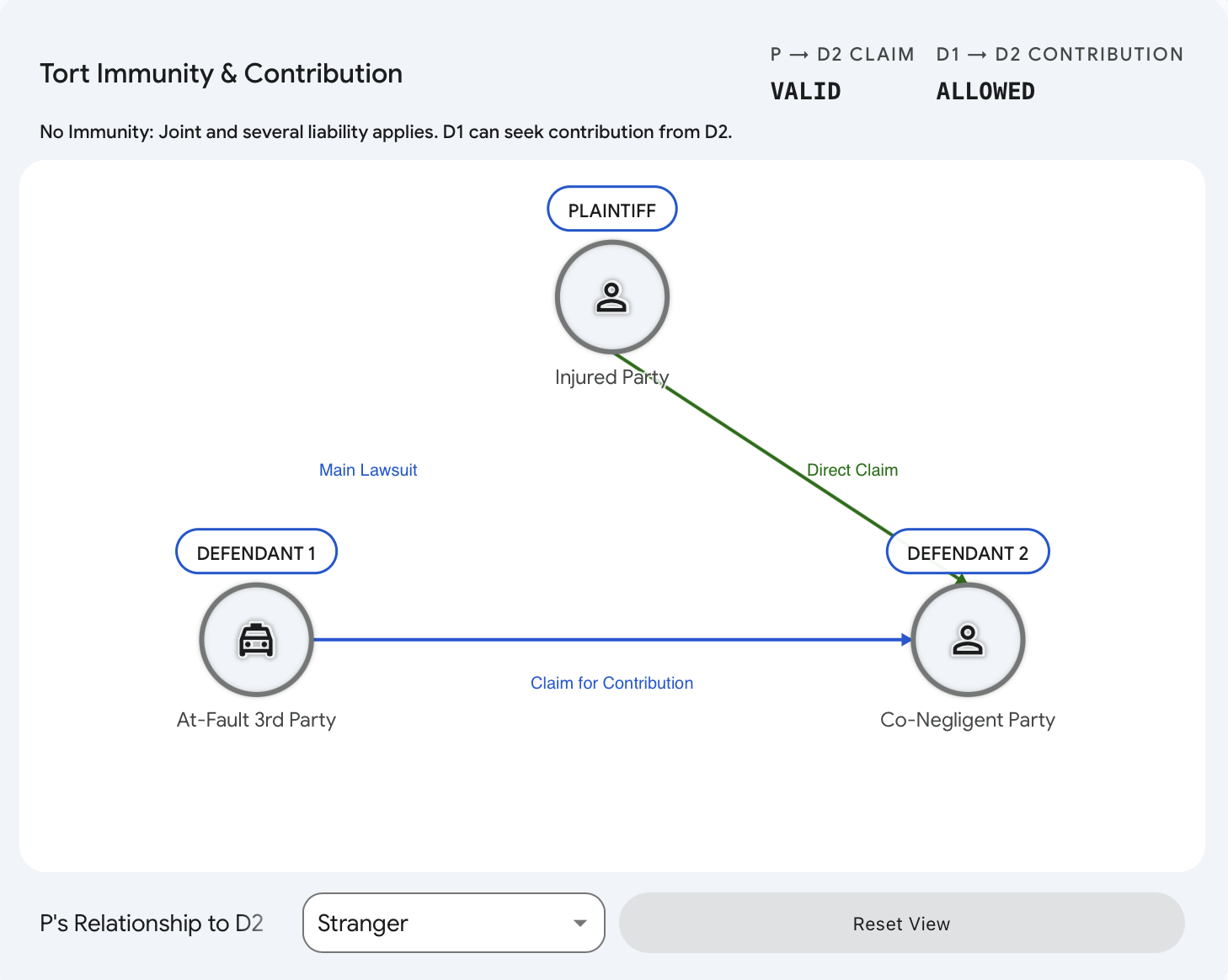
Immunity: D1 can’t seek from D2 if protected by immunity (e.g. spouse or employer) (Yellow Cab case).
Good Faith Settlement: Can’t seek contribution from party who made good-faith settlement with Plaintiff (release).
What is Indemnification? What term indicates it?
Passive. Non-negligent party forced to pay 100% of damages (e.g. insurance, employer pays under respondeat superior and sues employee)
P and D settle for a super low amount. Is this bad faith? If not, what is?
Not bad faith unless collusion/secrecy, fraud, dishonesty, or wrongful conduct
Plaintiff suffers $200,000 in financial damages during the acquisition of a small business due to fraudulent misrepresentations. The jury determines that Plaintiff was 20% at fault for failing to conduct proper due diligence. Seller (D1) is found 50% at fault. Broker (D2) is found 30% at fault. Prior to trial, D2 settles with Plaintiff for $10,000. In a jurisdiction that has jettisoned joint and several liability in favor of several liability only, and applies a "pro tanto" reduction, how much is D1 required to pay Plaintiff?
(A) $100,000.
(B) $90,000.
(C) $150,000.
(D) $160,000.
Explain your reasoning and the rule.
A.
No windfalls are allowed, so P shouldn’t get more than $200K - 20% = $160K. D1 is 50% liable. 50% of $200K damages = $100K. D2 already paid $10K. $100K + 10K = $110K—less than what P’s entitled to. And in a several liability jurisdiction, each D is only liable for their own portion.
Plaintiff is remodeling a luxury home and suffers $100,000 in property damage from a severe water leak. The jury finds Plaintiff 10% at fault. Plumber (D1) is found 40% at fault. General Contractor (D2) is found 50% at fault. Before trial, D2 settles with Plaintiff for $60,000. In a jurisdiction with several liability only and a "pro tanto" reduction rule, what is Plaintiff entitled to collect from D1?
(A) $40,000.
(B) $30,000.
(C) $90,000.
(D) $100,000.
Explain your reasoning and the rule.
B.
D1 liable for 40%. 40% of $100K = $40K. If D1 pays $40K, P will walk away with a windfall because he was 10% liable himself. Windfall exception.
Plaintiff purchases a commercial warehouse that collapses shortly after closing, causing $500,000 in damages. The jury assigns 0% fault to Plaintiff. Inspector (D1) is found 70% at fault. Appraiser (D2) is found 30% at fault. D2 enters a good faith settlement with Plaintiff for $100,000 before the verdict. In a jurisdiction that retains traditional joint and several liability and applies a "pro tanto" reduction, how much can Plaintiff collect from D1?
(A) $350,000.
(B) $400,000.
(C) $500,000.
(D) $250,000.
B.
No windfalls allowed for P. P already got $100K. Under J&S, P can recover damages from whomever they want. The only remaining amount is $400K.
Plaintiff is injured in an accident and sustains $300,000 in damages. The jury determines Plaintiff is 10% at fault. D1 is 60% at fault. D2 is 30% at fault. D2 settles before trial for $50,000. In a jurisdiction that applies joint and several liability but uses the "percentage share" approach for settlements, how much is D1 liable to pay?
(A) $180,000.
(B) $220,000.
(C) $270,000.
(D) $130,000.
A.
Under Percentage Share Approach, D only pays their fault. D1 is 60% liable. 60% of $300K = $180K.
Now check if there’s a windfall: P is entitled to $270K. Already got paid $50K = $220K. $180K doesn’t exceed $220K.
Plaintiff slips and falls at a local deli, suffering indivisible injuries. Defendant 1 and Defendant 2 are both found negligent. Defendant 2 finalizes a good faith settlement with Plaintiff for $25,000 and steps out of the litigation. Defendant 1 goes to trial, loses, and ends up paying significantly more than their equitable share of the damages. Defendant 1 files a claim against Defendant 2 to recover the excess amount. What is the most likely result?
(A) Defendant 1 will succeed if they can prove Defendant 2 was the primary active tortfeasor.
(B) Defendant 1 will succeed under the doctrine of contribution.
(C) Defendant 1 will fail since a valid good faith settlement protects the settling party from contribution claims by other negligent defendants.
(D) Defendant 1 will fail unless they specifically requested indemnification instead of contribution.
C.
D2 made a good faith settlement and is forever released.
What framework should you use when analyzing a muddled Pro Tanto/Percentage Share/J&S/Several question?
Are we in a J&S (P can collect from anyone) or Several jurisdiction (D is only liable for their portion of fault)?
What is P’s ceiling? (Subtract their portion of fault from their damages)
If there’s a good faith settling fellow D, Pro Tanto or Percentage Share?
Plaintiff is injured by a defective medical device and suffers $200,000 in damages. The jury finds Plaintiff 0% at fault. The device Manufacturer is 50% at fault. The Surgeon is 30% at fault. The Hospital is 20% at fault. Prior to trial, the Manufacturer settles with Plaintiff for $80,000. The jurisdiction applies traditional Joint and Several Liability and uses the 'percentage share' reduction approach. How much can Plaintiff collect from the Surgeon?
A. $200K
B. $60K
C. $120K
D. $100K
D.
Step 1: We are in J&S Liability. P can recover from whomever they please.
Step 2: P has no fault.
Step 3: Good faith settling D - percentage share approach: $200K - 50% =$100K
Plaintiff suffers severe injuries in a multi-car collision and sustains $500,000 in damages. The jury finds Plaintiff 20% at fault. Driver A is 60% at fault. Driver B is 20% at fault. Before the verdict, Driver A settles with Plaintiff for $350,000. The jurisdiction applies Several Liability only and uses a 'pro tanto' reduction. How much is Driver B required to pay Plaintiff?
A. $150K
B. $50K
C. $100K
D. $0