hreap ref: labor code of ph
 Call Kai
 Learn
Learn Practice Test
 Spaced Repetition
 Match
Match Flashcards
 Knowt Play
1/85

There's no tags or description
Looks like no tags are added yet.
Name | Mastery | Learn | Test | Matching | Spaced | Call with Kai |
|---|
No analytics yet
Send a link to your students to track their progress
86 Terms
R.A. No. 11360 (2019)
An Act Providing that Service Charges Collected by Hotels,
Restaurants and Other Similar Establishments be Distributed in Full to All Covered
Employees, Amending for the Purpose Presidential Decree No. 442, as Amended,
Otherwise Known as the “Labor Code of the Philippines.”
R.A. No. 11210 (2019),
“An Act Increasing the Maternity Leave Period to One
Hundred Five (105) Days for Female Workers with an Option to Extend for an
Additional Thirty (30) Days Without Pay, and Granting an Additional Fifteen (15) Days
for Solo Mothers, and for Other Purposes.”
R.A. No. 11058 (2018),
“An Act Strengthening Compliance with Occupational Safety
and Health Standards and Providing Penalties for Violations Thereof.”
R.A. No. 10911 (2016)
“An Act Prohibiting Discrimination Against Any Individual in
Employment on Account of Age and Providing Penalties Therefor,” or the “Anti-Age
Discrimination in Employment Act.”
R.A. No. 10917 (2016),
“An Act Amending Certain Provisions of R.A. No. 9547,
Otherwise Known as An Act Strengthening and Expanding the Coverage of the Special
Program for Employment of Students, Amending for the Purpose Provisions of R.A.
No. 7323, Otherwise Known as the Special Program for Employment of Students
(SPES).”
R.A. No. 10741 (2016),
“An Act Strengthening the Operations of the National Labor
Relations Commission.”
R.A. No. 10757 (2016),
“An Act Reducing the Retirement Age of Surface Mine
Workers from Sixty (60) to Fifty (50) Years, Amending for the Purpose Article 302 of
P.D. No. 442, As Amended.” Section 3 of the said law contains a Renumbering Clause:
“For purposes of uniformity, the numerical designation of Title II (Retirement), Book
Six of Presidential Decree No. 442, as Article 302 in Section 1 of this Act, shall be
renumbered in accordance with Republic Act No. 10151 and as promulgated by the
Department of Labor and Employment in their Department Advisory Order No. 01,
series of 2015.”
R.A. No. 10801 (2016)
“An Act Governing the Operations and Administration of the
Overseas Workers Welfare Administration,” otherwise known as the Overseas
Workers Welfare Administration Act.
R.A. No. 10706 (2015),
“An Act Protecting Seafarers Against Ambulance Chasing and
Imposition of Excessive Fees, and Providing Penalties Therefor” or the Seafarers
Protection Act which provides that attorney’s fees or fees for representation /
appearance before the NLRC, NCMB, POEA, and any of the DOLE offices, shall not
exceed ten percent (10%) of the compensation or benefit awarded to the seafarer
of his/her heirs.
R.A. No. 10691 (2015),
“An Act Defining the Role of the DOLE, LGUs, and Accredited
NGOs in the Establishment and Operation of the PESO, and the Operation of Job
Placement Offices in Educational Institutions ... Otherwise Known as the PESO Act of
1999.” The DOLE issued D.O. No. 157 (2016) to serve as its Implementing Rules and
Regulations, as mandated under Sec. 6 of the said law.
ART. 1. Name of Decree.
This decree shall be known as the “Labor Code of the
Philippines.”
ART. 2. Date of Effectivity.
This Code shall take effect six (6) months after its
promulgation.1
ART. 3. Declaration of Basic Policy.
The State shall afford protection to labor, promote
full employment, ensure equal work opportunities regardless of sex, race or creed, and
regulate the relations between workers and employers. The State shall assure the rights of
workers to self-organization, collective bargaining, security of tenure, and just and humane
conditions of work.
ART. 4. Construction in Favor of Labor.
All doubts in the implementation and
interpretation of the provisions of this Code, including its implementing rules and regulations,
shall be resolved in favor of labor.
ART. 5. Rules and Regulations.
The Department of Labor and other government
agencies charged with the administration and enforcement of this Code or any of its parts shall
promulgate the necessary implementing rules and regulations. Such rules and regulations shall
become effective fifteen (15) days after announcement of their adoption in newspapers of
general circulation.
ART. 6. Applicability.
All rights and benefits granted to workers under this Code shall,
except as may otherwise be provided herein, apply alike to all workers, whether agricultural
or non-agricultural.
ART. 7. Statement of Objectives.
Inasmuch as the old concept of land ownership by a
few has spawned valid and legitimate grievances that gave rise to violent conflict and social
tension and the redress of such legitimate grievances being one of the fundamental objectives
of the New Society, it has become imperative to start reformation with the emancipation of
the tiller of the soil from his bondage.
ART. 8. Transfer of Lands to Tenant-Workers
Being a vital part of the labor force,
tenant-farmers on private agricultural lands primarily devoted to rice and corn under a system
of share crop or lease tenancy whether classified as landed estate or not shall be deemed
owner of a portion constituting a family-size farm of five (5) hectares if not irrigated and three
(3) hectares if irrigated.
In all cases, the land owner may retain an area of not more than seven (7) hectares if such
landowner is cultivating such area or will now cultivate it.
ART. 9. Determination of Land Value.
For the purpose of determining the cost of the
land to be transferred to the tenant-farmer, the value of the land shall be equivalent to two
and one-half (2-1/2) times the average harvest of three (3) normal crop years immediately
preceding the promulgation of Presidential Decree No. 27 on October 21, 1972.
ART. 10. Conditions of Ownership.
No title to the land acquired by the tenant-farmer
under Presidential Decree No. 27 shall be actually issued to him unless and until he has become
a full-fledged member of a duly recognized farmers’ cooperative.
ART. 11. Implementing Agency.
The Department of Agrarian Reform shall promulgate
the necessary rules and regulations to implement the provisions of this Chapter.
Sec. 3 of E.O. No. 797 (1982),
“Reorganizing the Ministry of Labor and Employment, Creating the Philippine Overseas Employment Administration, and For
Other Purposes,” created the Bureau of Local Employment which assumed the functions of the Bureau of Apprenticeship and the domestic employment functions
of the Bureau of Employment Services.
Sec. 17. Bureau of Local Employment.
(1) Formulate policies, standards and procedures on productive manpower
resources, development, utilization and allocation; (2) Establish and administer a machinery for the effective allocation of manpower resources for maximum
employment and placement; (3) Develop and maintain a responsive vocational guidance and testing system in aid of proper human resources allocation; (4)
Regulate and supervise private sector participation in the recruitment and placement of workers locally under such rules and regulations as may be issued by the
Secretary; (5) Establish and maintain a registration or work permit system to regulate employment of aliens; (6) Develop and maintain a labor market information
system in aid of proper manpower and development planning; (7) Formulate employment programs designed to benefit disadvantaged groups and communities;
and (8) Perform other functions as may be provided by law.
P.D. No. 1177,
“Revising the Budget Process in Order to Institutionalize the Budgetary Innovations of the New Society.”
EO No. 247,
The functions of the Overseas Employment Development Board (OEDB) are now being undertaken by the POEA.
“Reorganizing the POEA and for Other Purposes,” shall refer to the POEA’s powers and functions to: (a) Regulate private sector participation in the recruitment
and overseas placement of workers by setting up a licensing and registration system; (b) Formulate and implement, in coordination with appropriate entities
concerned, when necessary, a system for promoting and monitoring the overseas employment of Filipino workers taking into consideration their welfare and the
domestic manpower requirements; (c) Protect the rights of Filipino workers for overseas employment to fair and equitable recruitment and employment practices
and ensure their welfare; (d) Exercise original and exclusive jurisdiction to hear and decide [all claims arising out of an employer-employee relationship or by virtue
of any law or contract involving Filipino workers for overseas employment including the disciplinary cases
ART. 18. Ban on Direct-Hiring
No employer may hire a Filipino worker for overseas
employment except through the Boards and entities authorized by the Secretary of Labor.
Direct-hiring by members of the diplomatic corps, international organizations and such other
employers as may be allowed by the Secretary of Labor is exempted from this provision.
ART. 19. Office of Emigrant Affairs.
Pursuant to the national policy to maintain
close ties with Filipino migrant communities and promote their welfare as well as establish a
data bank in aid of national manpower policy formulation, an Office of Emigrant Affairs is
hereby created in the Department of Labor. The Office shall be a unit at the Office of the
Secretary and shall initially be manned and operated by such personnel and through such
funding as are available within the Department and its attached agencies. Thereafter, its
appropriation shall be made part of the regular General Appropriations Decree.
ART. 20. National Seamen Board.
(a) A National Seamen Board is hereby created
which shall develop and maintain a comprehensive program for Filipino seamen employed
overseas. It shall have the power and duty:
1. To provide free placement services for seamen;
2. To regulate and supervise the activities of agents or representatives of shipping
companies in the hiring of seamen for overseas employment and secure the best possible
terms of employment for contract seamen workers and secure compliance therewith;
3. To maintain a complete registry of all Filipino seamen.
(b) The Board shall have original and exclusive jurisdiction over all matters or cases
including money claims, involving employer-employee relations, arising out of or by virtue of
any law or contracts involving Filipino seamen for overseas employment. The decisions of the
Board shall be appealable to the National Labor Relations Commission upon the same grounds
provided in Article 22320 hereof. The decisions of the National Labor Relations Commission
shall be final and unappealable.
ART. 21. Foreign Service Role and Participation.
To provide ample protection to
Filipino workers abroad, the labor attachés, the labor reporting officers duly designated by the
Secretary of Labor and the Philippine diplomatic or consular officials concerned shall, even
without prior instruction or advice from the home office, exercise the power and duty:
(a) To provide all Filipino workers within their jurisdiction assistance on all matters
arising out of employment;
(b) To insure that Filipino workers are not exploited or discriminated against;
(c) To verify and certify as requisite to authentication that the terms and conditions of
employment in contracts involving Filipino workers are in accordance with the Labor Code and
rules and regulations of the Overseas Employment Development Board and National Seamen
Board;
(d) To make continuing studies or researches and recommendations on the various
aspects of the employment market within their jurisdiction;
(e) To gather and analyze information on the employment situation and its probable
trends, and to make such information available; and
(f) To perform such other duties as may be required of them from time to time.
ART. 22. Mandatory Remittance of Foreign Exchange Earnings.
It shall be mandatory
for all Filipino workers abroad to remit a portion of their foreign exchange earnings to their
families, dependents, and/or beneficiaries in the country in accordance with rules and
regulations prescribed by the Secretary of Labor.
ART. 23. Composition of the Boards
(a) The OEDB shall be composed of the Secretary
of Labor and Employment as Chairman, the Undersecretary of Labor as Vice-Chairman, and a
representative each of the Department of Foreign Affairs, the Department of National
Defense, the Central Bank, the Department of Education, Culture and Sports, the National
Manpower and Youth Council, the Bureau of Employment Services, a workers’ organization
and an employers’ organization and the Executive Director of the OEDB as members.
ART. 27. Citizenship Requirement.
Only Filipino citizens or corporations, partnerships
or entities at least seventy-five percent (75%) of the authorized and voting capital stock of
which is owned and controlled by Filipino citizens shall be permitted to participate in the
recruitment and placement of workers, locally or overseas.
Minister of Labor (ART. 35. Suspension and/or Cancellation of License or Authority)
have the power to suspend or cancel any license or authority to recruit employees
for overseas employment for violation of rules and regulations issued by the Ministry of Labor,
the Overseas Employment Development Board, or for violation of the provisions of this and
other applicable laws, General Orders and Letters of Instructions.
Illegal Recruitment
– (a) Any recruitment activities, including the prohibited
practices enumerated under Article 34 of this Code, to be undertaken by non-licensees or non-
holders of authority, shall be deemed illegal and punishable under Article 39 of this Code. The
Department of Labor and Employment or any law enforcement officer may initiate complaints under this Article.
(b) when committed by a syndicate or in large scale shall be considered an offense involving economic sabotage and shall be penalized in accordance with Article 39 hereof. deemed committed by a syndicate if carried out by a group of three
(3) or more persons conspiring and/or confederating with one another in carrying out any
unlawful or illegal transaction, enterprise or scheme defined under the first paragraph hereof.
Illegal recruitment is deemed committed in large scale if committed against three (3) or more
persons individually or as a group.
[(c) The Secretary of Labor and Employment or his duly authorized representatives shall
have the power to cause the arrest and detention of such non-licensee or non-holder of
authority if after investigation it is determined that his activities constitute a danger to national
security and public order or will lead to further exploitation of job-seekers. The Secretary shall
order the search of the office or premises and seizure of documents, paraphernalia, properties
and other implements used in illegal recruitment activities and the closure of companies,
establishments and entities found to be engaged in the recruitment of workers for overseas
employment, without having been licensed or authorized to do so.]
Articles 289 and 290 of the Labor Code.
Any non-resident alien who shall take up employment in violation of the provision of
this Title and its implementing rules and regulations shall be punished in accordance with the
provisions of
thirty (30) days
Any employer employing non-resident foreign nationals on
the effective date of this Code shall submit a list of such nationals to the Secretary of Labor
within what after such date indicating their names, citizenship, foreign and local
addresses, nature of employment and status of stay in the country. The Secretary of Labor
shall then determine if they are entitled to an employment permit.
two (2) representatives of national organizations of employers; two (2) representatives of
national workers’ organizations; and one representative of national family and youth
organizations, each for a term of three (3) years.
National Manpower and Youth Council; Composition, the President shall appoint the following members from the private sector:
National Manpower Plan.
The Council shall formulate a long-term national
manpower plan for the optimum allocation, development and utilization of manpower for
employment, entrepreneurship and economic and social growth. This manpower plan shall,
after adoption by the Council, be updated annually and submitted to the President for his
approval. Thereafter, it shall be the controlling plan for the development of manpower
resources for the entire country in accordance with the national development plan. The
Council shall call upon any agency of the Government or the private sector to assist in this
effort.
Under Sec. 10 of R.A. No. 10022,
the POEA, in the exercise of adjudicatory power, may impose the penalty of reprimand, suspension, or cancellation or
revocation of license for pre-employment/recruitment violation cases.
R.A. No. 7796
The TESDA Act of 1994,
industry boards
assist in the
establishment of manpower development schemes, trades and skills standards and such other
functions as will provide direct participation of employers and workers in the fulfillment of the
Council’s objectives, in accordance with guidelines to be established by the Council and in
consultation with the National Economic and Development Authority.
ART. 52. Incentive Scheme
An additional deduction from taxable income of one-half
(1/2) of the value of labor training expenses incurred for development programs shall be
granted to the person or enterprise concerned provided that such development programs,
other than apprenticeship, are approved by the Council and the deduction does not exceed
ten percent (10%) of the direct labor wage.
"Train workers, pay less tax."
it can claim an additional tax deduction equal to 50% of its training expenses.
ART. 53. Council Secretariat.
The Council shall have a Secretariat headed by a Director-
General who shall be assisted by a Deputy Director-General, both of whom shall be career
administrators appointed by the President of the Philippines on recommendation of the
Secretary of Labor. The Secretariat shall be under the administrative supervision of the
Secretary of Labor and shall have an Office of Manpower Planning and Development, an Office
of Vocational Preparation, a National Manpower Skills Center, regional manpower
development offices and such other offices as may be necessary.
shall serve for a term of ten (10) years.
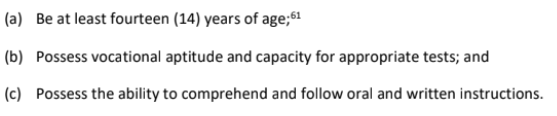
Qualifications of Apprentice. – To qualify as an apprentice, a person shall:
75 percent
Apprenticeship agreements providing for wage rates below the legal minimum wage, which in no case shall start below how many of the applicable minimum wage,
five (5) days
apprenticeship: The decision of the authorized agency of the Department of Labor and Employment may be appealed by any aggrieved person to the Secretary of Labor and Employment within how many days from receipt of the decision. The decision of the Secretary of Labor and Employment shall be final and executory.
ten (10%)
apprenticeship: An additional deduction from taxable income
of one-half (1/2) of the value of labor training expenses incurred for developing the
productivity and efficiency of apprentices shall be granted to the person or enterprise
organizing an apprenticeship program: Provided, That such program is duly recognized by the
Department of Labor and Employment: Provided, further, That such deduction shall not
exceed how many percent of direct labor wage; and Provided, finally, That the person or
enterprise who wishes to avail himself or itself of this incentive should pay his apprentices the
minimum wage.
Train apprentices, pay minimum wage, get tax benefits.
When Learners May Be Hired
Learners may be employed when no
experienced workers are available, the employment of learners is necessary to prevent
curtailment of employment opportunities, and the employment does not create unfair
competition in terms of labor costs or impair or lower working standards.
Learnership Agreement
3 → Maximum of 3 months
75 → At least 75% of minimum wage
Regular → Must be hired as regular employee after completion; if terminated after 2 months through no fault, becomes a regular employee
R.A. No. 7686
Dual Training System Act of 1994,
Magna Carta for Disabled Persons,
Summer Program for Employment of Students,
R.A. No. 7277
Magna Carta for Disabled Persons,
“those suffering from restriction of different abilities, as a result of a mental, physical or sensory impairment, to perform an activity in the manner or within the range considered normal for a human being.”
R.A. No. 8972
Solo Parents' Welfare Act, for Parental Leave
R.A. No. 9262
Anti-Violence Against Women and their Children Act of 2004, for the Battered Woman Leave, thus “victims
under this Act shall be entitled to take a paid leave of absence up to ten (10) days in addition to other paid leaves
Labor-Only Contracting
No Capital + Core Business
Workers perform core business activities
Indirect Employer
person or company that benefits from the work of employees hired by a contractor or subcontractor, even though those employees are not directly hired by the indirect employer.
Bond
financial guarantee or security deposit that can be used to pay workers if the contractor cannot fulfill its obligations.
ex: ABC Corporation hires XYZ Contractor.
Cost of labor under the contract = ₱500,000
ABC requires XYZ to post a ₱500,000 bond.
Later, XYZ becomes insolvent and fails to pay workers.
Worker Preference in Case of Bankruptcy.
“No wages left unpaid before banks or government get paid.”
Workers = Priority #1 in bankruptcy
R.A. No. 6715
An Act to Extend Protection to Labor, Strengthen the Constitutional Rights of Workers to Self-Organization, Collective Bargaining and Peaceful Concerted Activities, Foster Industrial Peace and Harmony, Promote the Preferential Use of Voluntary Modes of Settling Labor Disputes
Regional Tripartite Wages and Productivity Boards (RTWPBs)
government creates special bodies in each region to study and decide on minimum wage adjustments and productivity improvements.
R.A. No. 7730
An Act Further Strengthening the Visitorial and Enforcement Powers of the Secretary of Labor and Employment,
sixteen (16) weeks
for women night workers, Before and after childbirth, for a period of at least how long which shall be divided between the time before and after childbirth;
fifty (50)
two hundred (200)
fifty (50)
(a) The services of a full-time registered nurse when the number of employees exceeds how many but not more than how many except when the employer does not maintain hazardous workplaces, in which case, the services of a graduate first-aider shall be provided for the protection of workers, where no registered nurse is available.
The Secretary of Labor and Employment shall provide by appropriate regulations the services that shall be required where the number of employees does not exceed how many and shall determine by appropriate order, hazardous workplaces for purposes of this Article;
Hazardous = Stay in the Workplace
Part-time physician/dentist → 2 hours
Full-time physician/dentist → 8 hours
Non-Hazardous = Retainer Allowed
"Dangerous workplace = Doctor must be present."
"Safe workplace = Doctor on call."
Code
means the Labor Code of the Philippines instituted under Presidential Decree
Numbered Four Hundred Forty-Two, as amended.
Commission
means the Employees’ Compensation Commission created under this Title.
"Income benefit"
means all payments made under this Title to the employee or his
dependents.
"Related benefit"
means all payments made under this Title for appliances and
supplies.
"Appliances"
means crutches, artificial aids and other similar devices.
"Supplies"
means medicine and other medical, dental or surgical items.
"Monthly salary credit"
means the wage or salary base for contributions as provided in Republic Act Numbered Eleven hundred sixty-one, as amended, or the wages or salary.
the salary amount used to determine how much contribution is paid and how much benefit a member may receive.
"Average monthly salary credit"
in the case of the SSS means the result obtained by
dividing the sum of the monthly salary credits in the sixty-month period immediately preceding the semester of death or permanent disability by sixty (60), except where the month
of death or permanent disability falls within eighteen (18) calendar months from the month
of coverage, in which case it is the result obtained by dividing the sum of all monthly salary
credits paid prior to the month of the contingency by the total number of calendar months of
coverage in the same period.
average of the Monthly Salary Credits used as basis for computing social insurance benefits.
"Average daily salary credit"
Sum of the 6 highest Monthly Salary Credits in the 12-month period immediately preceding the semester of contingency ÷ 180 days
"Semester"
means a period of two consecutive quarters ending in the quarter of
death, permanent disability, injury or sickness.141
"Replacement ratio"
The sum of twenty percent and the quotient obtained by
dividing three hundred by the sum of three hundred forty and the average monthly salary
credit.
How much of your salary is replaced by your pension?
When a person stops working due to:
Retirement
Permanent disability
Death (for beneficiaries)
Monthly Income Benefit
Monthly pension received from SSS.
can never be less than ₱250.
"AMSC × RR + Service Bonus"
State Insurance Fund (SIF)
60 Rule"
✅ Below 60 → Automatically covered
✅ Above 60 + still contributing → Covered
❌ Above 60 + not contributing → Not compulsorily covered
Liability of Third Parties
"Pay First, Recover Later"
ECS pays the employee.
ECS sues the third party.
Any excess recovery goes to the employee.
When a third party causes a work-related injury, disability, or death, the Employees' Compensation System pays the benefits first and is subrogated to the employee's right to recover damages from the third party; any excess recovery belongs to the employee or beneficiaries
Employees’ Compensation Commission (ECC)
It ensures that workers who suffer work-related illness, injury, disability, or death receive proper benefits.
Initiate policies for Employees’ Compensation
Coordinate GSIS and SSS compensation programs
Ensure proper delivery of benefits to workers
Improve and manage the compensation system
GSIS and SSS = implement benefits
this = sets rules and policies
CHAPTER V – MEDICAL BENEFITS
1. Immediate Medical Care
✔ Provided right after injury/sickness
2. System Control
✔ System chooses doctor/hospital
✔ Unauthorized changes = no liability
3. No Confidentiality
✔ Medical records may be shared with System
4. Refusal Rule
✔ Refusal of treatment = suspension of benefits
5. Regulated Fees
✔ Medical fees must follow ECC standards
Chapter VI – DISABILITY BENEFITS
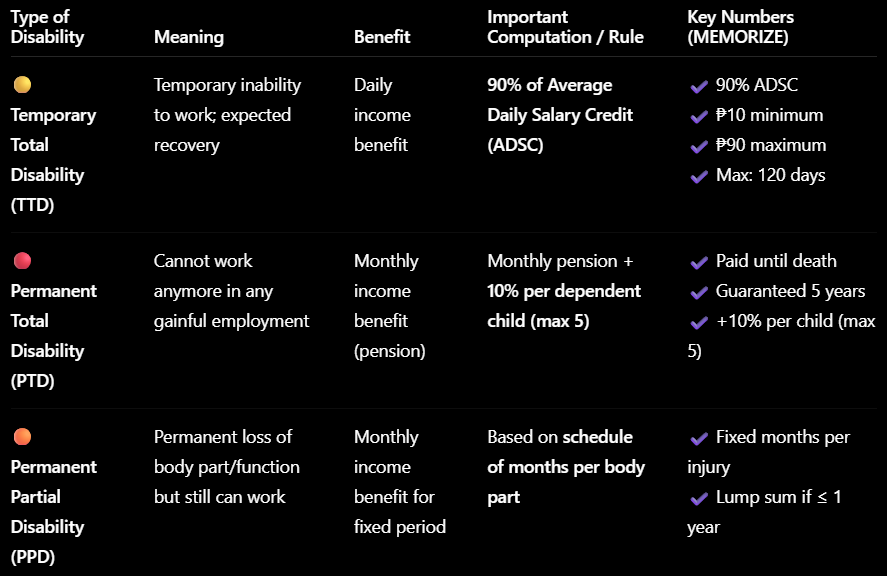
DEATH BENEFITS
✔ Primary beneficiaries
Receive full death pension
✔ Secondary beneficiaries
Only if no primary beneficiaries
Limited to 60 months
✔ Dependent rule
+10% per child
Maximum 5 children
No substitution
✔ Funeral benefit
Fixed at ₱3,000
Death benefits include monthly income benefit with +10% per dependent child (max 5), 5-year guarantee, ₱15,000 minimum benefit, 80% pension rule for PTD pensioners, and ₱3,000 funeral benefit.
Chapter VIII – PROVISIONS COMMON TO INCOME BENEFITS
Common provisions ensure that dependency is fixed at death, employer delinquency creates liability and lien, benefits are non-transferable, claims must be filed within 3 years, safety violations carry a 25% penalty, legal fees are prohibited, and the State Insurance Fund is tax-exempt.
"Bureau"
means the Bureau of Labor Relations and/or the Labor Relations Divisions in
the regional offices established under Presidential Decree No. 1, in the Department of Labor.
"Board"
means the National Conciliation and Mediation Board established under
Executive Order No. 126.
"Council"
means the Tripartite Voluntary Arbitration Advisory Council established
under Executive Order No. 126, as amended.