NUCLEIC ACID PART 1
 Call Kai
 Learn
Learn Practice Test
 Spaced Repetition
 Match
Match Flashcards
 Knowt Play
1/49

There's no tags or description
Looks like no tags are added yet.
Name | Mastery | Learn | Test | Matching | Spaced | Call with Kai |
|---|
No analytics yet
Send a link to your students to track their progress
50 Terms
REPLICATION |
PROCESS : DNA molecules produce exact duplicates of themselves
Old strands act as templates for the synthesis of new strands
DNA POLYMERASE
checks the correct base pairing and catalyzes the formation of phosphodiester linkages
This enzyme can ONLY FUNCTION in the 5’-TO-3’ DIRECTION
leading strand
top
grows continuously in the direction of unwinding
lagging strand
Okazaki fragments
grows in segments
called that segment
NICK
Okazaki fragments
gap called
15% by mass DNA and 85% by mass protein.
A chromosome is about
% by mass DNA
% by mass protein.
tranSCRIPTION
PROCESS: DNA directs the synthesis of mRNA molecules
tranSLATION
PROCESS: mRNA is deciphered to synthesize a protein molecule
HAIRPIN LOOP
produced when single-stranded RNA doubles back on itself and complementary base pairing occurs
HETEROgeneous nuclear RNA (hnRNA) |
Formed directly by DNA transcription.
Post-transcription processing converts the hnRNA to mRNA
Messenger RNA(mRNA) |
Carries instructions for protein synthesis (genetic information) fromDNA
The molecular mass of mRNA varies with the length of the protein
SMALL NUCLEAR RNA (snRNA) |
Facilitates the conversion of hnRNA to mRNA.
Contains from 100 to 200 nucleotides
Ribosomal RNA (rRNA):
Combines with specific proteins to form ribosomes
the physical site for protein synthesis Ribosomes have molecular masses on the order of 3 million
Transfer RNA (tRNA)
Delivers amino acids to the sites for protein synthesis
tRNAs are the smallest (75–90 nucleotide units)
GENE |
A segment of a DNA base sequence responsible for the production of a specific hnRNA/mRNA molecule
GENOME
All of the genetic material (the total DNA) contained in the chromosomes of an organism
20,000–25,000
Human genome is about —- genes
HELICase
what ENZYME?
Unwinding
unzipping
TOPO ISOMERASE
what ENZYME?
keep the DNA for SUPERCOILING
DNA POLYMERASE
what ENZYME?
builder
PRIMASE
what ENZYME?
Inializer
5 to 3
LIGASE
what ENZYME?
GLUE to okazaki fragment
MOLECULES |
responsible for such information are nucleic acids
DNA: Deoxyribonucleic Acid |
Storage and transfer of genetic information
FOUND: within cell nucleus
PASSED: one cell to other during cell division
RNA: Ribonucleic Acid |
Occurs in all parts of cell
PRIMARY FUNCTION: synthesize the proteins
NUCLEOTIDE
NUCLEIC ACID |
Polymers in which REPEATING UNIT IS
Pentose Sugar: Monosaccharide
Phosphate Group (PO4 3- )
Heterocyclic Base
A NUCLEOTIDE has THREE COMPONENTS:
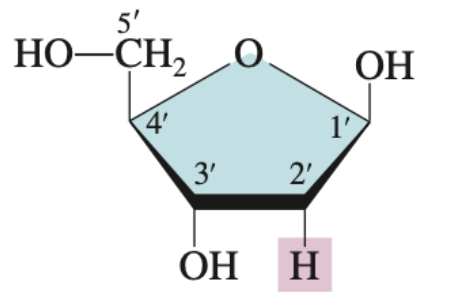
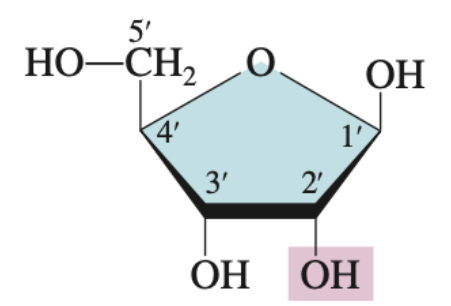
RIBOSE
present in RNA
a —OH group present on carbon 2’ in ribose
2-DEOXYRIBOSE
present in DNA
a —H atom in 2-deoxyribose
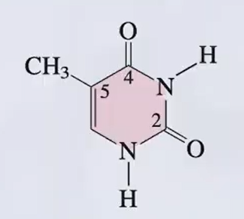
Thymine (T)
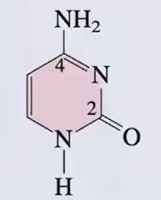
Cytosine (C)
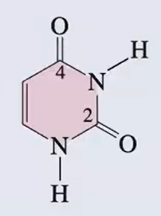
Uracil (U)
THREE PYRIMIDINE DERIVATIVES
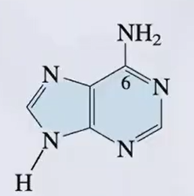
Adenine (A)
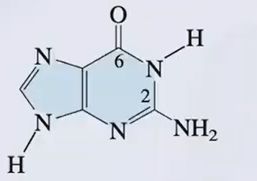
Guanine (G)
TWO PURINE DERIVATIVES
URACIL (U)
found only in RNA
THYMINE (T)
found only in DNA
PHOSPHORIC ACID (H3PO4 )
PHOSPHATE
is derived from
SUGAR-PHOSPHATE GROUPS
are referred to as nucleic acid backbone
Found in all nucleic acids
Phosphate-Sugar
Backbone:
Nucleic acids
Peptide bonds
Backbone:
Proteins
Phosphodiester
bond at 3’ and 5’ position
Thymine
Adenine
MAJOR GROOVE
2 hydrogen bond
Guanine
Cytosine
MINOR GROOVE
3 hydrogen bond
Backbone
Phospho Di Ester
SUGAR PHOSPHATE
LOCATION
BOND
Center
Hydrogen bond
Nitrogenous BASE
LOCATION
BOND
JAMES WATSON
FRANCIS CRICK
WHO DISCOVER
DNA DOUBLE HELIX
5 methyl 2 4 di oxo Pyridine derivatives
THYMINE
4 amino 2 oxo Pyridine derivatives
CYTOSINE
2 4 di oxo Pyridine derivatives
URACIL
6 amino Purine derivatives
ADENINE
2 amino 6 oxo Purine derivatives
GUANINE
RIBOSE
DEOXYRIBOSE