AP Chem Unit 2 Practice
 Call Kai
 Learn
Learn Practice Test
 Spaced Repetition
 Match
Match Flashcards
 Knowt Play
1/18

There's no tags or description
Looks like no tags are added yet.
Name | Mastery | Learn | Test | Matching | Spaced | Call with Kai |
|---|
No analytics yet
Send a link to your students to track their progress
19 Terms


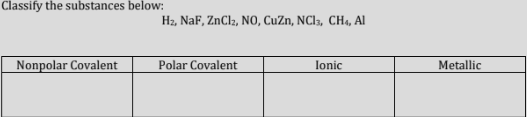
Nonpolar Covalent: H2, CH4
Polar Covalent: NO, NCl3,
Ionic: NaF, ZnCl2,
Metallic: CuZn, Al
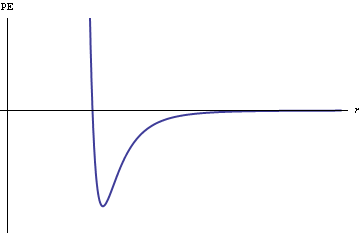
The bond energy for a C=C bond is 614 kJ/mol with a bond length
of 1.34 Å. It is shown on the graph below. Sketch a C-C bond and
a C=C bond on the graph. Include a key.
The line for triple bond would have lower energy and would be to the left of
the C=C line. The line for single bond would be to the right of the C=C and
would have less of an energy dip.
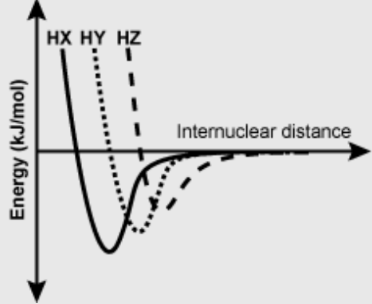
One possible way to identify an unknown atom in a molecule is to measure bond energy within the molecule while increasing the internuclear distance between the atoms. In the diagram, the bond energy between H and the atoms X, Y, and Z in their respective molecules are shown with increasing molecular distance.
Based on the information in the diagram, which set of molecules correctly identifies HX, HY, and HZ, respectively?
HCl, HBr, HI
In terms of electronegativity: Cl < Br < I
Why does KBr (672 kJ/mol) have a higher lattice energy than KI (632 kJ/mol)?
Bromide ions (Br-) have a smaller ionic radius than iodide ions (I-). This results in a smaller distance between the potassium ion and the bromide ion. The smaller distance increases the coulombic attraction resulting in higher lattice energy.
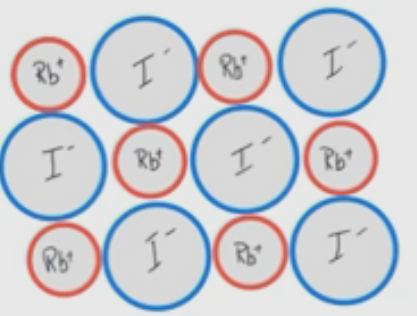
Draw a particle diagram of rubidium iodide. Be sure to include relative sizes.
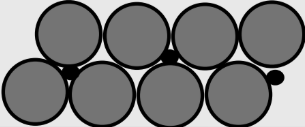
Carbon steel is an alloy composed of a small amount of carbon atoms combined with iron. Consider the atomic radii of both carbon and iron and draw a model that describes the alloy that forms.
An interstitial alloy will form. Carbon has a much smaller radius than the iron. It will fit into the interstices.
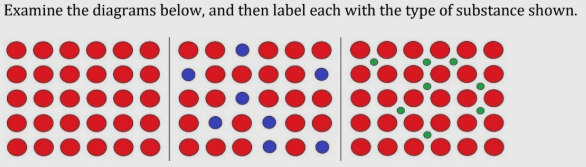
Pure Metal
Substitutional Alloy
Interstitial Alloy





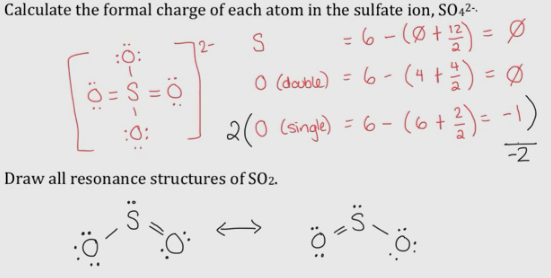
Calculate the formal charge of each atom in the sulfate ion, SO42-.
Draw all resonance structures of SO2.
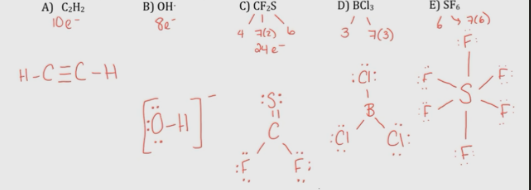
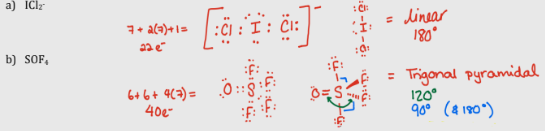
Determine the molecular geometry and predict the bond angles of the following:
ICl2-
SOF4
Draw a Lewis structure for the following chemical species. Indicate the hybridization on the central atom and the total number of sigma and pi bonds in the molecule.
CN-
H2CO

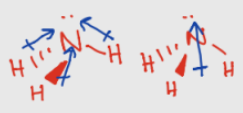
Is ammonia, NH3, polar or nonpolar? Explain using molecular shape, polar bonds and indicate if the dipoles cancel using arrows.
Ammonia is polar. The central atom has lone pairs, so the shape is trigonal pyramidal. The N-H bond is polar due to the differences in the electronegativities. Since the bonds are polar and the shape is asymmetrical, the bond dipoles will not cancel out and the molecule is polar.
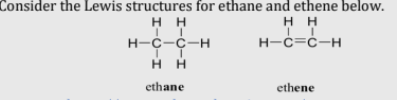
The carbon-carbon bond in which molecule has the highest bond order?
The carbon-carbon bond in which molecule has the lowest bond energy?
ethene
ethane
Draw the Lewis structures for ethyne, C2H2 and carbon dioxide, CO2. Predict the molecular geometries and the bond angles for each molecule. For ethyne, predict the geometry around each central atom.


No, the hybridization does not change because the central atom, carbon, in both molecules are surrounded by two electron domains. Both carbons are sp hybridized.
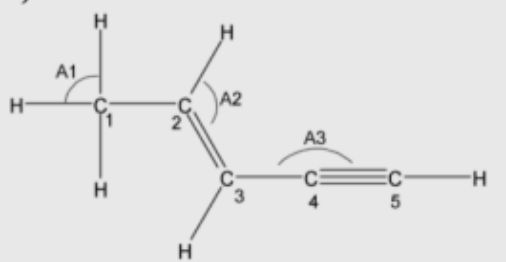
In the Lewis structure shown above determine:
the hybridization of each carbon atom labeled 1, 2, 3, 4 and 5
the bond angles of A1, A2 and A3
the total number of sigma and pi bonds in the molecule
Atom 1 is sp3 hybridized. Atom 2 is sp2 hybridized. Atom 3 is sp2 hybridized. Atom 4 is sp hybridized. Atom 5 is sp hybridized.
Angle 1 is 109.5 degrees. Angle 2 is 120 degrees. Angle three is 180 degrees.
The molecule has a total of 10 sigma bonds and 3 pi bonds.