AMATH 342 Final Review
 Call Kai
 Learn
Learn Practice Test
 Spaced Repetition
 Match
Match Flashcards
 Knowt Play
1/30

Earn XP
Description and Tags
Flashcards of Quiz Questions
Name | Mastery | Learn | Test | Matching | Spaced | Call with Kai |
|---|
No analytics yet
Send a link to your students to track their progress
31 Terms
A spike count generated by a poison process with a constant firing rate that is the same on each trial will have zero variance (where variance is measured from trial to trial).
False
When we are defining the "encoding" property of a cell, which probability distribution is most related?
P(Response | Stimulus)
The ideal mathematical Poisson process has a Fano factor of __
1
Consider a spike count produced by counting spikes from a Poisson process with rate r over a window of length T ms. True or false: if the rate r were to double, the variance of the spike count would double.
True
Consider a spike count produced by counting spikes from a Poisson process with rate r over a window of length T ms. Consider gradually increasing the firing rate r, say as a stimulus parameter changes. The standard deviation of that spike count would
Increase proportionally to the square root of r
sample_list = [0 2]
Is a list of samples of a random variable. What answer best describes the value of the sample standard deviation in this case?
a number greater than or equal to 1
When we are defining the "decoding" property of a cell, which probability distribution are we defining?
P(stimulus | response)
On the last part of the homework, we looked at responses of three types of inhibitory neurons: Vip-IRES-Cre, Sst-IRES-Cre, and Pvalb-IRES-Cre. What statement best describes the role of inhibitory neurons in networks?
They tend to reduce the firing of downstream cells that they connect to.
What statement best describes the contributions of work by Hubel and Wiesel discussed in class?
Their work led to a hierarchical model of neural coding, with complex cells downstream of simple cells in the sense that simple cells send inputs to complex cells.
When we are defining the "decoding" property of a cell, which probability distribution are we defining?
P(Stimulus | Response)
If there are two possible stimuli stimulus1 and stimulus2, under maximum likelihood decoding one would decode a response by choosing the stimulus 1 if
proba(response|stimulus1) > proba(response|stimulus2)
True
The linear discriminant analysis (LDA) method of decoding used in class:
sometimes decodes the same stimuli as exact maximum likelihood decoding, in special cases such as the response distributions being Gaussian with identical "spherical" shapes.
Consider decoding single trials as expressing the organism’s point of view. This means that a stimulus – for example, a visual image in the world – elicits a response in its neurons – for example a number of spikes that occur over a time interval of, say, 250 ms (or the dF/F signals integrated over a similar time interval). One such response corresponds to one trial in the experimental data we have been studying in class. These responses contain all the information that the organism has about the stimulus! Say, roughly as in class, the linear discriminant analysis (LDA) decoding algorithm for a single neuron gives a fraction correct of 0.1 for decoding the direction of a drifting grating. If we wanted to predict the fraction of correct choices that the organism might produce when it is "asked" to decode the direction of motion, which additional considerations are relevant?
Both of the other answers given here
The RC circuit model with current-based input and initial voltage V(0)=0 exactly follows the superposition principle (which states that the voltage response to the sum of two inputs is the sum of the voltage responses to each of the inputs delivered separately).
True
Suppose x(t) solves
dx/dt = f(x) with initial condition x(0) = 0. The Euler
method solution for x at time 1, with timestep deltat = 1, is the following:
deltat (f (0))
True
The primary biological feature of a neuron that gives rise to the term g in the effective neuron model of a neuron is
the ion channel conductance
The Hodgkin-Huxley equations contain:
A mix of voltage-dependent conductances and voltage-independent conductances
The Hodgkin-Huxley equations contain:
to make the incoming spike rates approximately equal
All other things being equal, for HIGHER values of the constant potassium conductance gK,extra that we added in class, there was typically:
a suppressive effect on firing rates, in which firing rates of the model neuron went down
All other things being equal , for HIGHER values of the Calcium-dependent potassium conductance that we added in the homework, there was, typically, MORE:
positive charge (current) flowing OUT of the neuron
The role of synaptic depression, in the model you simulated from the homework and from class, was -- for constant input rates and at steady state --
to make the incoming spike rates approximately equal
All other things being equal, for HIGHER values of the constant potassium conductance gK,extra that we added in class, there was typically:
a suppressive effect on firing rates, in which firing rates of the model neuron went down
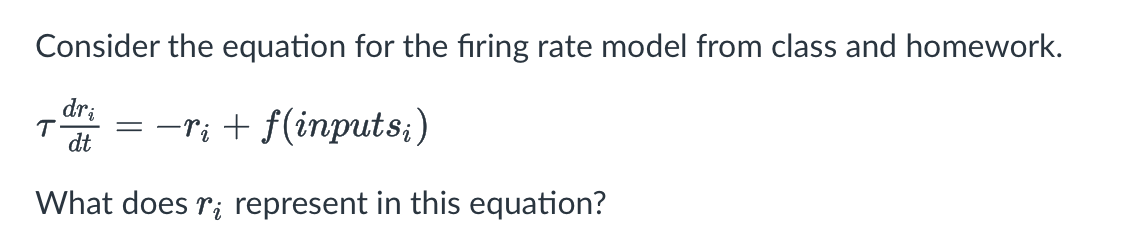
the firing rate of cell i
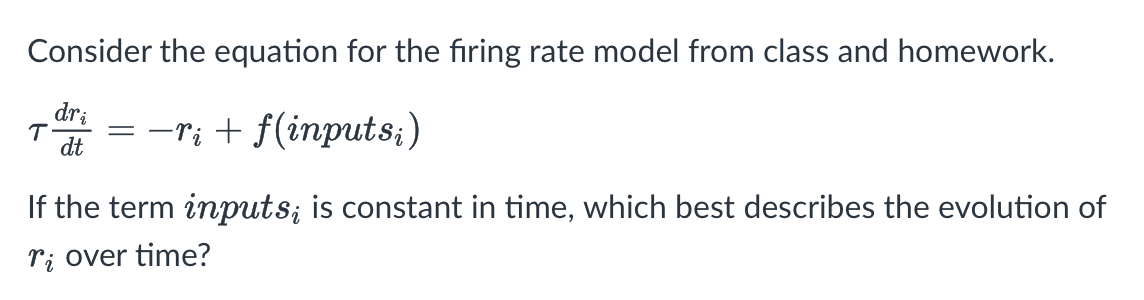
it will approach f(inputs_i)
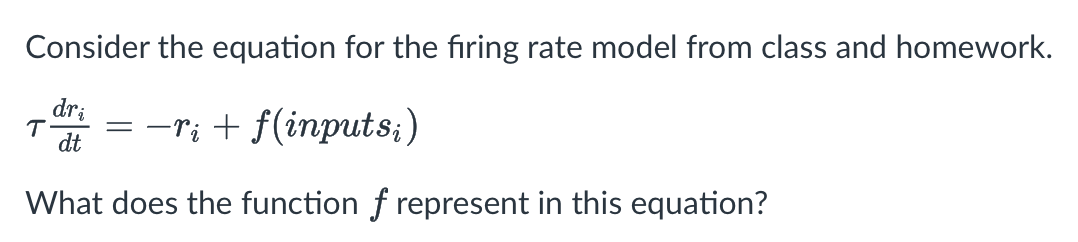
The steady state firing rate that neuron i will achieve in response to inputs input_i, like we plotted in class as the frequency-input curve for the Hodgkin Huxley equations
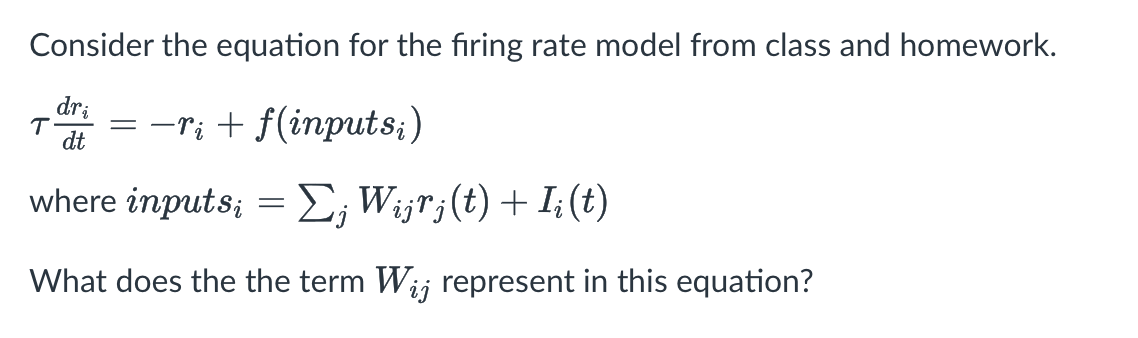
The synaptic weight from cell j to cell i
In the simplest analysis presented in class, trajectories flowed downhill on the "funnel function" to values of firing rates that matched the smallest values of the weight matrix W_ij.
False
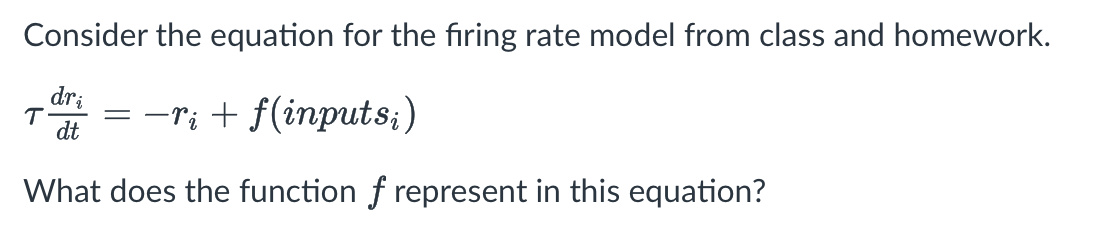
The steady state firing rate that neuron i will achieve in response to inputs input_i, like we plotted in class as the frequency-input curve for the Hodgkin Huxley equations
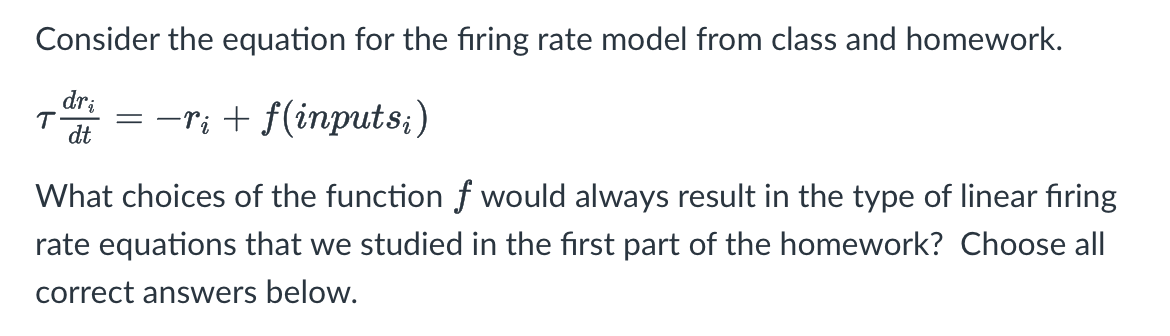
f(inputs) = inputs
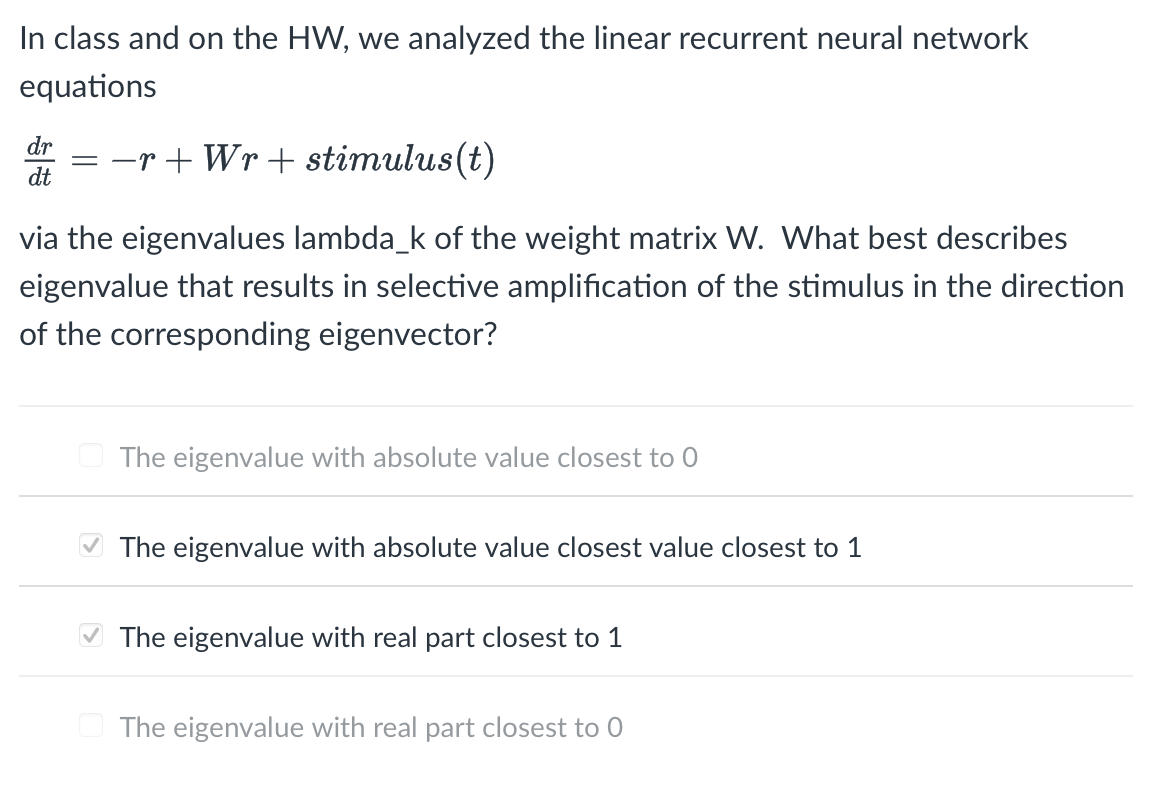
The eigenvalue with real part closest to 1
The Erdos-Reyni model of a random graph
has all connections made at random and independently