Intro to Psychology basic processes - Chapter 3: Biological bases of behaviour (con't)
 Call Kai
 Learn
Learn Practice Test
 Spaced Repetition
 Match
Match Flashcards
 Knowt Play
1/63

There's no tags or description
Looks like no tags are added yet.
Name | Mastery | Learn | Test | Matching | Spaced | Call with Kai |
|---|
No analytics yet
Send a link to your students to track their progress
64 Terms
Myelination
This process produces the myelin sheath
Myelination (con’t)
Has small gaps that save lots of energy during the resting potential process
Synthesis
Neurotransmitters, or at least parts of them, are made in the cell body of each neuron
Transportation and storage
When neurotransmitter molecules are transported from the cell body to the axon terminal for storage
Release
When the synaptic vesicles fuse with the cell membrane, causing the release of the neurotransmitter into the synapse after an action potential reaches the axon terminal
Binding
When neurotransmitter molecules bind to specialized proteins called receptors
Receptors
Allow neurotransmitter molecules to influence whether the next cell, the postsynaptic cell, will have its own action potential.
Deactivation
One type of neurotransmitter that an enzyme can destroy in the synapse
Autoreceptor activation
Some neurotransmitters bind to receptors on the same neuron that released it (autoreceptor)
Autoreceptor
Only respond to neurotransmitters that have been released by the same neuron on which it is situated.
e.g. This binding can decrease the synthesis and release of the neurotransmitter
Reuptake
When leftover and excess neurotransmitter molecules can be brought back into the presynaptic region of the cell.
Degradation
When enzymes in the presynaptic region break down excess neurotransmitter molecules, which are then eliminated
Graded potential (con’t)
A neuron must integrate signals arriving at many synapses before it “decides” whether to fire an action potential
Normal development
Is characterized more by the elimination of old synapses than the creation of new synapses
Long-term potentiation
Refers to a long-lasting increase in neural excitability in synapses along a specific neural pathway
Transcranial magnetic stimulation (TMS)
A technique that permits scientists to temporarily enhance or depress activity in a specific area of the brain
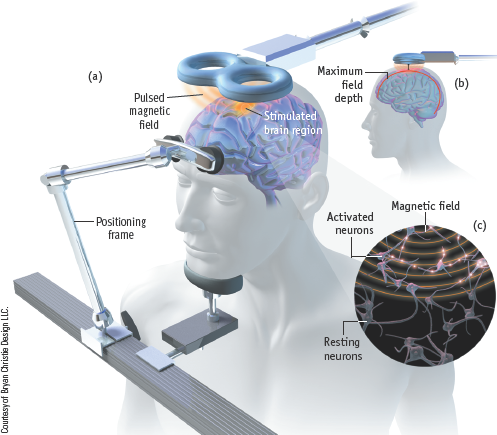
Transcranial magnetic stimulation (TMS) [con’t]
It’s been used to explore whether specific areas of the brain are involved in visual–spatial and sensorimotor processing short-term memory, and language
Transcranial magnetic stimulation (TMS) process
A magnetic coil that creates a magnetic field that penetrates to a depth of 2 centimetres gets mounted on a small paddle is held over a specific area of a person’s head
Transcranial magnetic stimulation (TMS) process (con’t)
A researcher can either increase or decrease the excitability of neurons in the local tissue through varying the timing and duration of the magnetic pulses
Transcranial magnetic stimulation (TMS) limitations
It can’t be used to study areas deep within the brain. Still, its potential as a research tool is enormous
Neuroscientists
Investigators who conduct research on the brain or other parts of the nervous system
Neuroscientists (con’t)
Involves collaboration by neuroscientists from several disciplines,
e.g. Anatomy, physiology, biology, pharmacology, neurology, neurosurgery, psychiatry, and psychology.
Lesioning
Destroying a piece of the brain by inserting an electrode into a brain structure and passing a high frequency electric current through it to burn the tissue and disable the structur
Electrical stimulation of the brain (ESB)
When a weak electric current is sent into a brain structure through an implanted electrode to stimulate (activate) it
CT (computerized tomography) scan
A computer-enhanced X-ray of brain structure. X-rays are taken from many angles, and the computer combines these images to create vivid, albeit two dimensional pictures of cross sections of the brain
MRI (magnetic resonance imaging) scan
Uses magnetic fields, radio waves, and computerized enhancement to map out brain structures in three dimensional pictures with more detail than a CT scan
Electroencephalograph (EEG)
A device that monitors the electrical activity of the brain over time to show the functioning of the brain
Electroencephalograph (EEG) [con’t]
Uses small electrodes attached to the scalp to measure electric potentials (primarily graded potentials) occurring in thousands of brain cells
PET (positron emission tomography)
Uses radioactive markers to map chemical activity in the brain over time.
PET (positron emission tomography) [con’t]
Can provide colour-coded maps indicating which areas of the brain are active when people clench their fist, sing, or contemplate the mysteries of the universe
Functional magnetic resonance imaging (fMRI)
Consists of new variations of MRI technology that monitor blood flow and oxygen consumption in the brain to identify areas of high activity
e.g. Researchers have identified patterns of brain activity associated with specific creative-thinking tasks, the contemplation of complex decisions related to gambling, reactions to pictures of alcoholic beverages
Hormones
The chemicals released by the endocrine glands
Hormones (con’t)
Have a similar job as neurotransmitters, but are much slower
Oxytocin
A hormone released by the pituitary gland, which regulates reproductive behaviours
Oxytocin (con’t)
Triggers contractions when a woman gives birth and stimulates the mammary glands to release milk for breastfeeding
Oxytocin (III)
Fosters fidelity and loyalty to partners in men, as it may facilitate the development of a sense of security, feelings of safety, and a highly tuned sensitivity to and empathy for others
Spinal cord
Connects the brain to the rest of the body through the peripheral nervous system, and transmits signals from the brain to the neurons that allow our muscles to move
Behavioural genetics
An interdisciplinary field that studies the influence of genetic factors on behavioural traits.
Perceptual asymmetries
Left-right imbalances in visual or auditory processing
The left brain hemisphere
The left hemisphere is usually better at tasks involving verbal processing,
e.g language, speech, reading, and writing.
The left brain hemisphere (con’t)
Is connected to the right side of the body
The right brain hemisphere
The right hemisphere exhibits superiority on many tasks involving nonverbal processing
e.g. Spatial, musical, and visual recognition tasks and tasks involving the perception of emotions
The right brain hemisphere (con’t)
Is connected to the left side of the body
Split-brain surgery
When the bundle of fibres that connects the cerebral hemispheres (the corpus callosum) is cut to reduce the severity of epileptic seizures
Chromosomes
Threadlike strands of DNA (deoxyribonucleic acid) molecules that carry genetic information
Genes
DNA segments that serve as the key functional units in hereditary transmission
Polygenic traits
Characteristics that are influenced by more than one pair of gene
Phenotype
The ways in which a person’s genetic makeup is manifested in observable characteristics
Heredity and the environment
Heredity and experience jointly influence most aspects of behaviour
Epigenetics
The study of heritable changes in gene expression that do not involve modifications to the DNA sequence
e.g. Chemical events at the cellular level like stress exposure and poor nuturing, leading to alterations in traits, health, and behaviour
Epigenetics (con’t)
Epigenetic changes may contribute to many psychological disorders, including drug addiction, (intergenerational) trauma, schizophrenia, etc
Family studies
Researchers assess hereditary influence by examining blood relatives to assess how much they resemble one another on a specific trait
Family studies (con’t)
If heredity affects the trait under scrutiny, phenotypic similarity should be higher among relatives, and, there should be more similarity among relatives who share more genes
e.g. Siblings should exhibit more similarity than cousins
Family studies usages
They’re used to estimate the risk of a relative developing a mental health disorder based on whether other family members suffer with this disorder and see whether a trait runs in families
Twin studies
When researchers assess hereditary influence by comparing the resemblance of identical twins and fraternal twins with respect to a trait
Adoption studies
Assess hereditary influence by examining the resemblance between adopted children and both their biological and their adoptive parents
Adoption studies (con’t)
If adopted children resemble their biological parents in a trait, even though they were not raised by them, this suggests that genetic factors may influence that trait
Adoption studies (III)
If adopted children resemble their adoptive parents, even though they inherited no genes from them, environmental factors probably influence the trait
Genetic mapping
A tool to determine the location and chemical sequence of specific genes on specific chromosomes
CRISPRs (clustered regularly interspaced short palindromic repeats)
Store a small section of harmful viruses to recognize them next time you are attacked and precisely snip the DNA of an invading virus so that it can’t replicate