Exam 1 Human Physiology- Muscular System
 Call Kai
 Learn
Learn Practice Test
 Spaced Repetition
 Match
Match Flashcards
 Knowt Play
1/25

Earn XP
Description and Tags
Muscular System learning goals
Name | Mastery | Learn | Test | Matching | Spaced | Call with Kai |
|---|
No analytics yet
Send a link to your students to track their progress
26 Terms
Describe the major functions of muscle tissue
Muscle tissue primarily functions to generate force and movement.
Key roles include producing body movements (walking, breathing), maintaining posture and joint stability, circulating blood via the heart, and generating heat to maintain temperature.
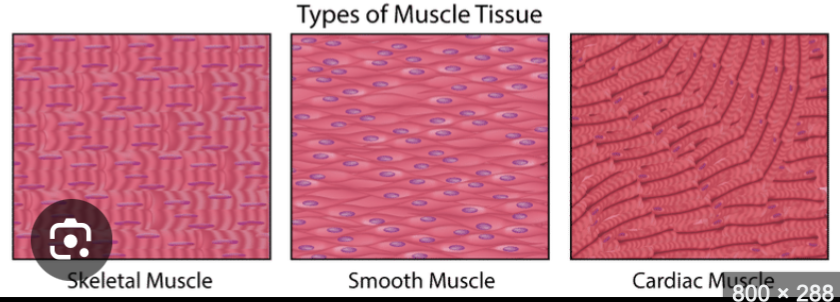
Identify skeletal, cardiac and smooth muscle
Skeletal (Striated, Voluntary): Contracts only in response to stimulus— Wrapped around bones by tendons, multiple nuclei located at the periphery of the fiber.
Cardiac (Striated, Involuntary): Only found in the heart (Paracrine + hormonal control), Involuntary pumping of blood
Smooth (Non-striated, involuntary): Surrounds internal organs, controlled by hormone + autonomic nervous system, spindle-shaped + single, centrally located nucleus.
Describe the structure, location in the body and function of skeletal, cardiac and smooth muscle
I. Skeletal: voluntary, striated, attached to bones for movement + stability in the body
II. Cardiac: Involuntary, striated, found only in the heart for pumping blood
III. Smooth: Involuntary, non-striated, lining hollow organs for involuntary movements like digestion.
Compare and contrast the characteristics of skeletal, cardiac, and smooth muscle
Skeletal + Cardiac are striated, whereas smooth is not.
Smooth muscle needs to maintain long-term tension (contraction) and contract more slowly and rhythmically in organs such as the stomach, intestines, and blood vessels. Striation would not allow it to stretch significantly without sacrificing its contractile function.
Smooth + Cardiac muscles are involuntary, whereas skeletal muscles are voluntary, controlled by the somatic nervous system. This is because of their locations + functions. Skeletal muscles are attached to bones and move when we move our limbs. We want smooth and cardiac muscles to be involuntary because we don’t want to actively think about pumping blood + hormones to parts of the body; our body should be able to do it on its own.
Skeletal contraction is fast, cardiac is rhythmic/ intermediate + fatigue-resistant, and smooth is slow + sustained + fatigue- resistant.
- This is ideal because skeletal muscles are required for rapid, precise movement as they rely on the cross-bridge cycle to react instantly to voluntary commands.
- Cardiac muscles require rhythmic, involuntary movements to continuously pump blood over our lifetime without stopping.
- Smooth muscles require slow/ sustained + fatigue-resistance because
Describe the organization of muscle tissue from cell to whole muscle to groups of muscles
Describe a skeletal muscle fiber including the transverse (1) tubules, sarcoplasmic reticulum, and myofibrils
Explain the organization of a myofibril
Name and describe the function of each of the contractile, regulatory, and structural protein components of a sarcomere
Describe the anatomy of the neuromuscular junction
List the anatomical and metabolic characteristics of fast, slow, and intermediate muscle fibers
Explain the sliding filament theory of muscle contraction
Describe the sequence of events involved in the contraction cycle of skeletal muscle
Explain how an electrical signal from the nervous system arrives at the neuromuscular junction
Describe, in order, the events that occur at the neuromuscular junction that elicit an action potential in the muscle fiber
Explain what is meant by the expression "excitation-contraction coupling"
List the sources of energy stored in a typical muscle fiber
Explain the factors that contribute to muscle fatigue
Provide specific examples to demonstrate how the
muscular system responds to maintain homeostasis in the body
Explain how the muscular system relates to other
body systems to maintain homeostasis
Predict factors or situations affecting the muscular
system that could disrupt homeostasis
Predict the types of problems that would occur in the
body if the muscular system could not maintain
homeostasis