Unit 2 - Atomic Structure
 Call Kai
 Learn
Learn Practice Test
 Spaced Repetition
 Match
Match Flashcards
 Knowt Play
1/55

There's no tags or description
Looks like no tags are added yet.
Name | Mastery | Learn | Test | Matching | Spaced | Call with Kai |
|---|
No analytics yet
Send a link to your students to track their progress
56 Terms
400 BC - Democritus
everything is related because everything is made up of atoms
matter cannot be divisible past an atom, the atom is the smallest
1803 - John Dalton (5 key ideas)
atoms make up everything
*Atoms of the same element are all the same (didn’t know about isotopes)
atoms of different elements are different
atoms combine in whole number ratios
compounds are formed by joining two or more atoms
*atoms are indivisible and indestructible
Black box demo
indirect measurement - measuring the thickness of a book page by measuring the thickness of a book and dividing by the number of pages
Aristotle’s four element theory
Air, water, fire, earth
1880s - JJ Thompson
Discovered the electron using cathode ray experiments, demonstrating that atoms are divisible.
- Proposed the "plum pudding model" of the atom, where negatively charged electrons (the "plums") were embedded in a positively charged sphere (the "pudding").
knew there needed to be something positively charged, just didn’t know what it was
1895 - Wilhem Roentgen
discovers x-rays, high energy electromagnetic radiation that can penetrate soft tissue but is blocked by the bone
Used first to image feet for cobblers to make shoes
1897 - Henri Becquerel
discovers radioactivity
had a device that could pick up ionizing radiation, radiation that creates ions in the air around a radioactive substance
1905 - Albert Einstein
photo-electric effect
Photo-electric effect
When you add energy to densely packed atoms, something has to give → since protons are dense, they’ll stay but electrons will change
Theory = electron moves from ground state to excited state when energy is added, so when they go back to the ground state, they produce photons
More electrons are excited → more photons
Ex: copper over a flame shines green light because Cu has # of electrons in the middle of the periodic table, and green is in the middle of ROYGBIV
photon
particle of light
quanta
bundles of light
1911-12 - Ernest Rutherford
gold foil experiment:
radioactive source that spewed high speed alpha positively charged particles
went through a hole in the lead focusing plate
detecting screens showed the path of the alpha particles on a zinc sulfide screen
then, the beam went through gold foil, which is 10k atoms thick
finally, a final detecting screen was used to detect the scattering of the particles after going through the foil
Conclusions:
atoms are made up of mostly space
went/cut through gold atoms, didn’t go around them
center (nucleus) is very small and dense
nucleus is positively charged, specifically protons
DISCOVERED PROTONS
1915 - Henry Moseley
Decided to order elements based on their increasing atomic number
1920s - Neils Bohr
planetary orbit model
theory: electrons orbit the nucleus like how the planets orbit the sun
flaw: planetary orbits are all on a 2D plane, but atoms aren’t 2D and electrons never return to the same place
figured out that electrons that are furthur out have more energy and electrons spin a certain distances (energy levels) from the nucleus in 3D
electron cloud
electrons move so fast that you can’t even see them, you only see a cloud
1930s - James Chadwick
discovers neutron, neutrally charged particle found in nucleus with roughly same size and mass and proton
relative atomic sizes
1930s - Louis deBroglie & Max Planck
described duality of electrons
they have properties of both waves and particles
E = (h x c)/wavelength
h = Plank’s constant (relates energy of electron to its frequency, more frequency = more energy)
c = velocity of light
c and h are constant, so energy and wavelength are the only changing factors
frequency and wavelength are indirectly prop.
frequency and energy are directly prop.
energy and wavelength are indirectly prop.
1930s - Shröedinger
8 variable equation that predicts location of single electron in Hydrogen (which only has 1 electron), and it only works for hydrogen
1930 - Heisenberg
uncertainty principle - if you know about an electron’s motion, you can’t know about its location. if you know about its location, you can’t know about its motion.
What are the four fundamental forces and who attempted to unite them into one force?
Gravity
Electromagnetism
Strong Force
Weak force
Strong force
holds protons together in the nucleus and its strong because protons repel each other since they are both positive
weak force
weak force keeps protons and neutrons together
In a normal atom, why are there the same amount of protons as there are electrons?
Atoms are electrically neutral, so there must be an equal number of electrons as protons to balance the charges out
Cathode ray tude
In a tube, the electrons flowed between the positive and negative side of the battery. When a magnet was put against the tube with the negative side, the electron flow was repeled. When the positive side was placed next to the tube, the electron flow came close to the magnet, so that proved it was negatively charged
isotope
atoms are the same element, but there are a diff. # of neutrons
ions
atoms that lose or gain electrons
particle
individual atoms or individual molecules (2+ atoms chemically combined)
mole
the atomic weight of an element
if 3 substances are 1 mole, but all weigh different, it’s because…
they have a different number of protons/neutrons/electrons
avogadro’s number
6.023 × 10^23
how many energy levels are there?
7 levels
what are the four sublevels in an atom?
s, p, d, f
orbital
lanes in each sublevel (s:1, p:3, d:5, f:7)
how many max. electrons are in each lane in sublevels?
2
formula for total electrons in energy level
2n², n = level
aufbau
to build upon (a nucleus)
octet rule
atoms with an octet are noble gasses. atoms that have an octet (s²p^6) are very stable, but atoms that are one electron away are super reactive, trying to get the last electron
elements in the same colum are related because they have the same number of ____
valence electrons (outermost s and p electrons)
why is there stealing for Cr and its column?
there are 4 electrons in a row in the d lanes, and two in a colum in the s lane. The electrons prefer an even spread, so the bottom electron in the s lane is pulled over to the fifth lane. so, Cr is [Ar]4s^13d^5
why is there stealing for Cu and its column?
there’s a bigger preference for being fully filled, so copper takes and electron from ‘s’ for all 10 d lanes, resulting in [Ar]4s^13d^10
In orbital notation, what is the order of filling each circle?
for p, OOO, you do one electron in each circle before going back and making crosses in both
Hund’s Rule
electrons spread out in available orbitalsPa
Pauli’s Exclusion principle
2 electrons max. per orbital
[Core]
used as a shortcut by indicated all previously filled sublevels always with a previous energy level’s noble gas element as the core
quantum numbers/values
first way of electron arrangement, uses electron zipcode to represent ONE electron
n = energy level (1,2…7)
l = sublevel (s=0, p=1, d=2, f=3)
m = # of orbitals/lanes (l = 1 → (-1)-(0)-(1))
s = spin ( / → +1/2, X → -1/2)
what is helium (He) in quantum numbers
(1, 0, 0, -1/2)
shape of s orbital
spherical
shape of p orbital
peanut
shape of d orbital
double peanut
shape of f orbital
flower
modern atomic theory
all matter is made up of atoms, which have protons + neutrons in the nucleus and electrons forming a cloud around the nucleus
subatomic particle
protons, neutrons, electrons.
proton mass + neutron mass = very similar
proton mass + electron mass = protons are much heavier and much more dense
Moseley’s law
experiment = bombarded elements with electrons so they would emit characteristic x-rays
found: square root of x-ray frequency is proportional to the atomic number
proved: atomic number is the way to order elements, not atomic weight
Nuclide
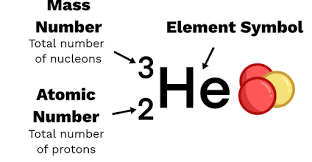
An atom characterized by a specific number of protons and neutrons in its nucleus.
atomic weight
average definite mass, average of all masses from isotopes
angstrom
1 A = 10^-8 cm