Respiration
 Call Kai
 Learn
Learn Practice Test
 Spaced Repetition
 Match
Match Flashcards
 Knowt Play
1/37

Earn XP
Description and Tags
Name | Mastery | Learn | Test | Matching | Spaced | Call with Kai |
|---|
No analytics yet
Send a link to your students to track their progress
38 Terms
List the four stages of aerobic respiration.
1) Glycolysis.
2) Link reaction.
3) Krebs cycle.
4) Oxidative phosphorylation.
Why is respiration sensitive to temperature and pH changes?
Respiration is an enzyme-controlled reaction.
Give the overall word equation for respiration.
Glucose + oxygen → carbon dioxide + water
What is the respiratory substrate in aerobic respiration?
Glucose.
Give a source of glucose in animals.
Hydrolysing glycogen.
Give a source of glucose in plants.
Hydrolysing starch.
How can lipids be used to allow aerobic respiration to take place?
Lipids can be hydrolysed into glycerol (and fatty acids), this glycerol can be phosphorylated into triose phosphate and enter aerobic respiration at the Krebs cycle.
How can proteins be used to allow aerobic respiration to take place?
Proteins must be hydrolysed to produce amino acids that are then deaminated, the remaining carbon compound can enter the Krebs cycle.
True or false? Glycolysis is an aerobic process.
False. GLYCOLYSIS IS AN ANAEROBIC PROCESS.
Where does glycolysis take place?
In the cytoplasm.
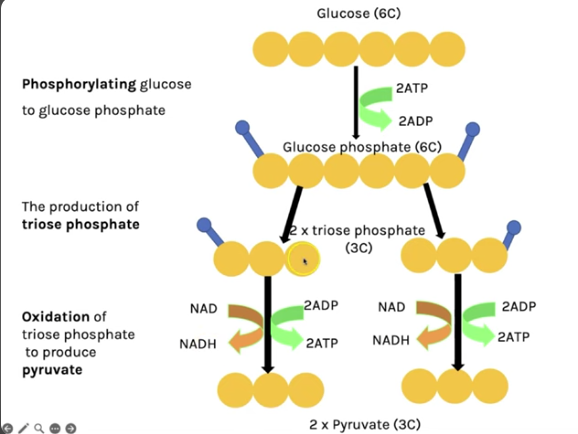
Talk me through the process of glycolysis.
1) Glucose is phosphorylated by adding two phosphate groups to it, two ATP molecules are used for this.
2) Glucose phosphate is split in half to produce two molecules of triose phosphate.
3) Triose phosphate is oxidised (the H is given to NAD) and desposphorylated (produces four ATP) to make pyruvate, net gain of two ATP and two NADH (reduced NAD).
Draw and label a diagram illustrating the process of glycolysis.
What are the products of glycolysis?
NET GAIN 2 molecules of ATP.
2 molecules of NADH.
2 molecules of pyruvate.
Where do the link reaction and Krebs cycle take place?
In the mitochondrial matrix.
True or false? Pyruvate and NADH are actively transported from the cytoplasm to the mitochondrial matrix.
True.
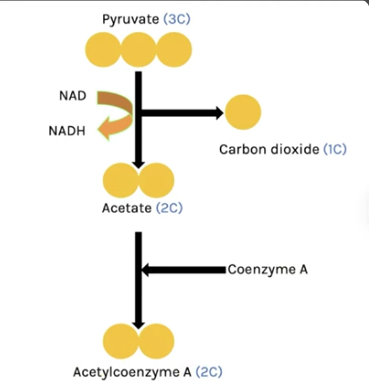
Talk me through the link reaction.
1) Pyruvate is oxidised and loses a carbon (forming carbon dioxide) to acetate.
2) Hydrogen from oxidising pyruvate is taken by NAD, making NADH.
3) Acetate combines with coenzyme A to produce acetylcoenzyme A.
Draw and label a diagram illustrating the link reaction.
What are the overall products of the link reaction?
2 molecules of acetylcoA
2 molecules of carbon dioxide
2 NADH
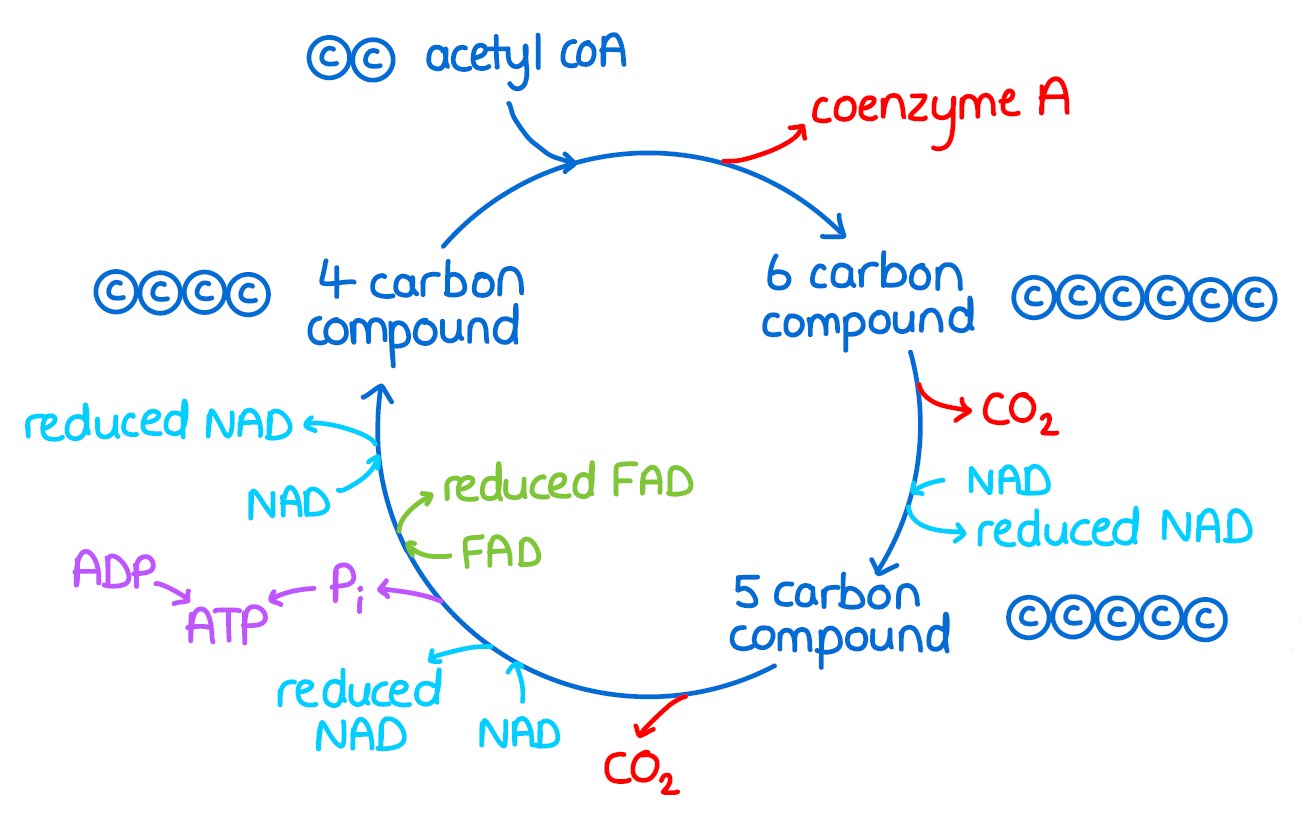
Talk me through the Krebs cycle.
1) Acetylcoenzyme A reacts with a four carbon molecule, producing a six carbon molecule and releasing coenzyme A.
2) In a series of redox reactions, reduced coenzymes are produced, ATP is produced by substrate-level phosphorylation, two molecules of carbon dioxide are lost from the six carbon molecule.
3) Three molecules of NADH and one molecule of FADH are produced.
Draw a diagram illustrating the Krebs cycle.
What are the products for one Krebs cycle?
3 NADH
1 FADH
1 ATP
2 CO2
How many Krebs cycle happen per glucose molecule?
Two.
What are the products of the Krebs cycle per glucose molecule?
6 NADH
2 FADH
2 ATP
4 CO2
When in aerobic respiration is the majority of the ATP produced?
Oxidative phosphorylation.
Where does oxidative phosphorylation take place?
Inner membrane of the cristae in the mitochondria (inner mitochondrial membrane).
Where are the protons and electrons for oxidative phosphorylation sourced from?
All the reduced coenzymes release the H that has reduced them, H consists of a proton and an electron.
Talk me through the process of oxidative phosphorylation.
1) Reduced coenzymes release protons and electrons in the mitochondrial matrix.
2) The electrons pass down a chain of electron carrier proteins embedded in the inner mitochondrial membrane, each time going down an energy level and releasing energy.
3) This energy is used to actively transport protons across the inner mitochondrial membrane from the matrix into the intermembrane space, creating an electrochemical gradient.
4) The protons move down their electrochemical gradient through ATP synthase enzyme which synthesises ATP by phosphorylating ADP.
5) Oxygen is the terminal acceptor of electrons, it reacts with two protons and two electrons at the end of the electron transport chain, forming water.
Give the balanced symbol equation showing oxygen being the terminal acceptor of electrons.
2H+ + 2e- + ½ O2 → H2O
When does anaerobic respiration occur?
When there is a lack of oxygen for aerobic respiration.
Where does anaerobic respiration take place?
Cytoplasm.
Which step happens in both aerobic and anaerobic respiration?
Glycolysis.
What happens to the pyruvate produced in glycolysis in anaerobic respiration?
It is reduced.
What happens to pyruvate in anaerobic respiration in plants and microbes?
Pyruvate is reduced to form ethanol and carbon dioxide.
What happens to the pyruvate in aerobic respiration in animals? What enables this to happen?
Pyruvate is reduced to form lactate. It is reduced by the H from NADH, reforming NAD that can be reused in glycolysis.
Draw a diagram illustrating what happens to the pyruvate produced in glycolysis in anaerobic respiration in animals.

What is the source of ATP in anaerobic respiration?
ATP produced in glycolysis.
Why does anaerobic respiration produce less ATP than aerobic respiration?
Anaerobic respiration only produces ATP in glycolysis, which is not much.
Draw a diagram illustrating what happens to pyruvate produced in glycolysis in anaerobic respiration in plants and microbes.
