Evolution Unit 3
 Call Kai
 Learn
Learn Practice Test
 Spaced Repetition
 Match
Match Flashcards
 Knowt Play
1/58

There's no tags or description
Looks like no tags are added yet.
Name | Mastery | Learn | Test | Matching | Spaced | Call with Kai |
|---|
No analytics yet
Send a link to your students to track their progress
59 Terms
Anagenesis
character modification
Taxonomy
the study of biological nomenclature which has as its focus the naming and assignment of particular organisms to different groups
assigning species to higher taxonomic categories
Phylogenetic systematics
1. Attempts to recover the phylogenetic (genealogical) relationships among a group of organisms and,
2. Produce classifications that exactly reflect those hypotheses of genealogical relationships.
use derived characters to reconstruct relationships
Original theory of phylogenetics (Willi Hennig)
1. The relationships lending to the cohesion of living and extinct organisms are genealogical ("blood") relationships.
2. Such relationships exist for individuals within populations, between populations, and between species.
3. All other types of relationship (i.e. phenotypic and genetic) are phenomena correlated with genealogical descent and thus are best understood within the context of genealogical descent with modification.
4. The genealogical relationships among populations and species may be recovered (discovered) by searching for particular characters which document these relationships.
5. The best general classification of organisms is one that exactly reflects the genealogical relationships among these organisms.
Species
lineages that are independent of other lineages in the sense that they may evolve independently of other such lineages. Comprise the highest level of taxonomic organization on which the processes of evolution may work
Monophyletic group
a group that contains an ancestor and all of that ancestors descendents. Another term for clade.
Paraphyletic group
(non-natural taxon) A group with no ancestor that is unique to its component species. Hence it is a group that contains an ancestor and some but not all of its descendents.
Sister group
a species or higher monophyletic taxon that is hypothesized to be the closest genealogical relative of a given taxon exclusive of its ancestor.
Out-group
a species or higher monophyletic taxon that is examined in the course of a phylogenetic study to determine which of two character states is apomorphic (derived) and which is plesiomorphic (primitive).
Homology
something in two or more taxa that can be traced back to the common ancestor of these two taxa
Analogous character
a similar character in two or more taxa that cannot be traced back to the common ancestor of those taxa
Convergence
similarity in a character or trait in distantly related taxa
Homoplasy
character which display similarity but are thought to have arisen independently either from independent characters or from the same character at different times
Apomorphy
a derived character or evolutionary novelty
Plesiomorphy
a primitive character. the alternative character state to apomorphy
synapomorphy
a shared derived character
On the tree what represents a speciation event?
points where the line segments split
On the tree what represents a lineage?
line between where each speciation event is
typological species concept
species concept that dates back to the time of Plato and Aristotle and holds that species consist of a number of individuals that share the same essence.
-one weakness is that there is really no objective way to measure reproductive isolation unless two species are in sympatry.
evolutionary species concept
This species concept was first proposed by George Gaylord Simpson in 1951.
- This species concept states that species are a lineage of ancestor-descendent populations that maintain their own identity from other such lineages and have their own tendencies and fate.
phylogenetic species concept
This species concept states that a species is the smallest diagnosable cluster within which there is a pattern of ancestry and descent.
vicariance speciation
This model of speciation is described as the physical separation of two or more relatively large populations of a single ancestral species and the attainment of lineage independence by these populations.
Which of the following scientists can be considered a proponent of the phylogenetic species concept?
joel cracraft
The big bang occurred roughly how long ago based on the best estimates of scientists?
15 billion years ago
In 1953 Stanley Miller published a paper that was very important to evolutionary theory. Briefly, what did the set of experiments described in this paper suggest to the evolutionary biology community regarding the origin of life?
Miller circulated Ammonia, Methane, Hydrogen, and Water Vapor in a flask, and subjected the compounds to electrical discharge. After 7 days of this he analyzed the brown slurry that developed and found that it contained a very rich variety of organic compounds including some of the most important (common) amino acids found in proteins. Other than these amino acids, this slurry also contained Urea, Acetic Acid, and Lactic Acid. As no oxygen was thought to be present in this primitive atmosphere, there would be nothing to break down these complex molecules and subsequently they would get concentrated into a thick “soup” existing in small pools across the face of the planet.
RNA world hypothesis
RNA molecules were precursors to current life, which is based on DNA, RNA and proteins. RNA stores genetic information like DNA, and catalyzes chemical reactions like an enzyme protein. It may, therefore, have played a major step in the evolution of cellular life.
sympatric speciation
An array of mechanisms that produce one or more new species from an ancestral species with no geographic segregation of the populations.
oparin and haldane
There had been a gradual pre-biotic evolution of molecules followed by an aggregation of these molecules that eventually resulted in self-replication complex molecular aggregates, or life.
intracellular mutualisms
Theory that asserts a eukaryotic cell was derived from a community of prokaryotic cells living in mutualism.
What is the estimated age of the earth based on the most recent geophysical data?
4.5 billion years
Roughly how much oxygen is hypothesized to have been present in the primitive earth atmosphere?
none
What does Margulis hypothesize to be the source of the mitochondrion?
Endosymbiotic theory
1. Organic molecules are synthesized by abiotic processes. Heat, electrical discharge, or something else could have played a role in the formation of these compounds.
2. Molecules aggregated spontaneously into spheres with intensified internal chemical activity.
3. Such spheres may have been split by impact with other things in their environment or could have budded off duplicates simply due to geometric instability once the sphere reached a certain size. Some of these lines of proto-cells persisted longer than others.
4. Abiotic selection of the most stable entities analogous to natural selection of biotic forms produced long lasting lineages of precellular molecular clusters that ultimately became capable of controlled replication.
Non-living organic chemicals have the capacity to form colloidal protein molecules that when mixed with other compounds tend to clump together to form
coacervate droplets
What does the endosymbiotic theory assert was the source of the chloroplast? (or mitochondrion, or undulipodium, or ?).
Asserts that the eukaryotic cell is a community of prokaryotic cells. Anecdotal evidence supporting this, a eukaryotic cell is about 10 times the size of a prokaryotic cell, and the organelles within a eukaryotic cell are about the same size as prokaryotic cells. The theory further asserts that eukaryotes evolved gradually through a series of mutualistic relationships that developed between prokaryotes. This theory is also called the serial endosymbiosis theory.
Stepwise presentation of theory:
1. Invasion of a large cell by a purple bacterium capable of respiration--develops into mitochondria.
2. Acquisition of undulipodium (a cilium, or eukaryotic flagellum used for locomotion and/or feeding).
Could have occurred through acquisition of a spirochete.
3. Invasion of the cell by a photosynthetic cyanobacterium--this provided photosynthetic capability in a cell that was already capable of respiration.
4. Source of nucleus is problematic as it has no capability of protein synthesis.
Anaerobic organisms that generate energy and methane by the reduction of C02.
A. Methaongens: Anaerobic organisms that generate energy and methane by the reduction of CO2.
B. Halophiles: Aerobic organisms that have a very simple photosythetic system based on the pigment rhodopsin.
C. Thermophiles: Aerobic organisms
What is the primary assertion of the iron—sulfur world theory for the origin of life?
Gunter Wächtershäuser proposes that the earliest form of life, termed "pioneer organism", originated in a volcanic hydrothermal flow at high pressure and high (100 °C) temperature. The theory proposes that early life may have formed on the surface of iron sulfide minerals, hence the name. It was developed by retrodiction from extant biochemistry in conjunction with chemical experiments
Which of the following scientists can be considered a proponent of the evolutionary species concept?
g.g simpson
At position 1138 of the cytochrome b gene, most fish possess a C nucleotide residue while humans possess a G residue. What type of homology do these two character states exhibit?
serial homology
At position 1139 of the cytochrome b gene, rainbow darters and orange throat darters both possess a C nucleotide residue while all other species of darters possess a T. What type of homology does the C nucleotide residue represent?
two of the above (synapomorphy, special homology)
paraphyletic group
A group that contains an ancestor and some but not all descendent taxa
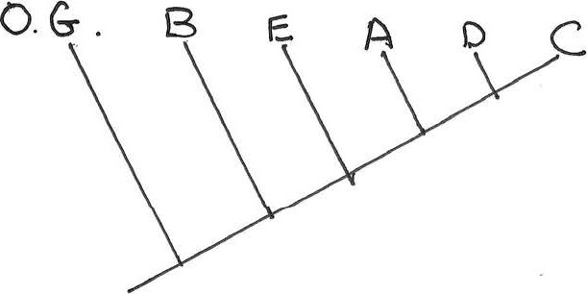
On the tree above, the group (a, d) is
paraphyletic
coevolution
reciprocally induced evolutionary change between two or more species or populations
Which school of systematic thought groups taxa based on overall similarity?
phenetics
proteinoid microspheres
Spherical particles that form when heated amino acids react and are mixed with water.
How do phylogenetic systematists determine which character states are primitive and which are derived.
using outgroups
Which schools of systematic thought use only derived characters to reconstruct relationships?
phylogenetic systematics
Which schools of systematic thought weight characters?
evolutionary systematics
Which schools of systematic thought insist on the publication of an explicit data matrix and list of character and state data?
phenetics
Which genetic material is likely to have evolved first, RNA or DNA? What’s the data to support?
The RNA world hypothesis is supported by the observation that many of the most critical components of cells (those that evolve the slowest) are composed mostly or entirely of RNA. This would mean that the RNA in modern cells is an evolutionary remnant of the RNA world that preceded ours. Also, many critical cofactors (ATP, Acetyl-CoA, NADH, etc.) are either nucleotides or substances clearly related to them.
Which school of systematic thought is most closely associated with Robert Sokal.
phenetics
deme
local, stable population
cospeciation
When the speciation patterns in the host are reflected in the speciation patterns of that hosts parasites.
Which school of systematic thought developed as a rebellion toward another more established school of systematic thought?
phenetics or numerical taxonomy
Adherents to this school of systematic thought would feel justified in applying a formal taxonomic category (like Reptilia) to a paraphyletic group.
evolutionary systematics
To which of the following groups of vertebrates are you most closely related?
bats (mammals)
polyploid event
mechanisms where organisms acquire more than two complete sets of chromosomes, acting as a major driver of speciation and evolutionary innovation
higher taxonomic categories
Kingdom, Phylum, Class, Order, Family, Genus, Species
allopatric speciation
two or more species found in different geographic localities. No overlap.
ed wiley
He is primarily recognized however as a leading philosopher of systematic (phylogenetic) methodology.