GEO 101 Exam 1
 Call Kai
 Learn
Learn Practice Test
 Spaced Repetition
 Match
Match Flashcards
 Knowt Play
1/89

There's no tags or description
Looks like no tags are added yet.
Name | Mastery | Learn | Test | Matching | Spaced | Call with Kai |
|---|
No analytics yet
Send a link to your students to track their progress
90 Terms
What is the current theory for the formation of our Solar System?
The Sun and planets condeensed from a cloud of gas and dust
Which of the following statements about the early universe is NOT true?
Complex elements like Carbon and Iron formed during the Big bang
The key evidence that the universe is expanding is
the red shift of light from distant galaxies
Which statement represents the favored geological theory describing the formation of the Earth?
The earth formed by the coalescence of planetesimals that occured in a ring orbiting the sun
According to the geocentric model
the earth lies at the center of the universe
Differentiation of the core from the mantle early in Earth's history was possible because theplanet was ____________ at the time.
very hot
Most asteroids inhabit the "asteroid belt" between the planets
Mars and Jupiter
In 2006, the International Astronomical Union produced a major announcement concering Pluto. What was it?
Pluto has been officially demoted from its former status as one of nine major planets in our solar system
Aside from Earth, the terrestrial (rocky) planets are
Mars, Mercury and Venus
According to the Big Bang theory
everything that now comprises the universe started at a single point about 13.7 billion years ago
Which of the following is NOT true of the mantle
Generates the Earth's magnetic field
Which of the following is NOT one of the driving forces for plate tectonics
Wadati-Benioff zone
A mid-ocean ridge IS an example of which of the following active tectonic plate margins?
Divergent margin
What is the largest of Earth's concentric zones by volume?
the mantle
The lithosphere is composed of the ____________.
crust and the uppermost part of the mantle
Wegener proposed continental drift after he observed evidence from fossils, glacial deposits, andthe fit of the continents that suggested all of the continents were once ____________
combined to form a supercontinent (he termed Pangaea) in the late Paleozoic through the Mesozoic
The Wadati-Benioff zone is a belt of earthquakes found
within a downgoing plate at a subduction zone
Most of the pushing force driving plate motion is produced
at mid-ocean ridges
Every plate boundary can be recognized by
the presence of an earthquake belt
At a transform plate boundary, two opposed plates
slide past one another
The most common mineral group within Earth is the (1 word)
silicates
Which of the following physical characteristics of minerals refers to the appearance of a mineral's surface under reflected light?
Luster
When we say that a material is "crystalline" we mean that internally
atoms are distributed in an orderly arrangement
Which of the following processes does NOT lead to the formation of a mineral?
Precipitation from an aqueous solution in the laboratory
The seven principle classes of minerals are distinguished from each other based on:
chemical composition
The fundamental unit of the most common mineral class on Earth is:
the silicon-oxygen tetrahedron
Clastic sedimentary rocks are primarily classified on the basis of
grain size
Which of the following IS an example of chemical weathering processes
Oxidation
Which of the following is NOT a characteristic used to classify clastic sedimentary rocks?
Cleavage
The single property that can be used to identify any mineral is ____________.
none of the above; multiple properties MUST be used to identify a mineral
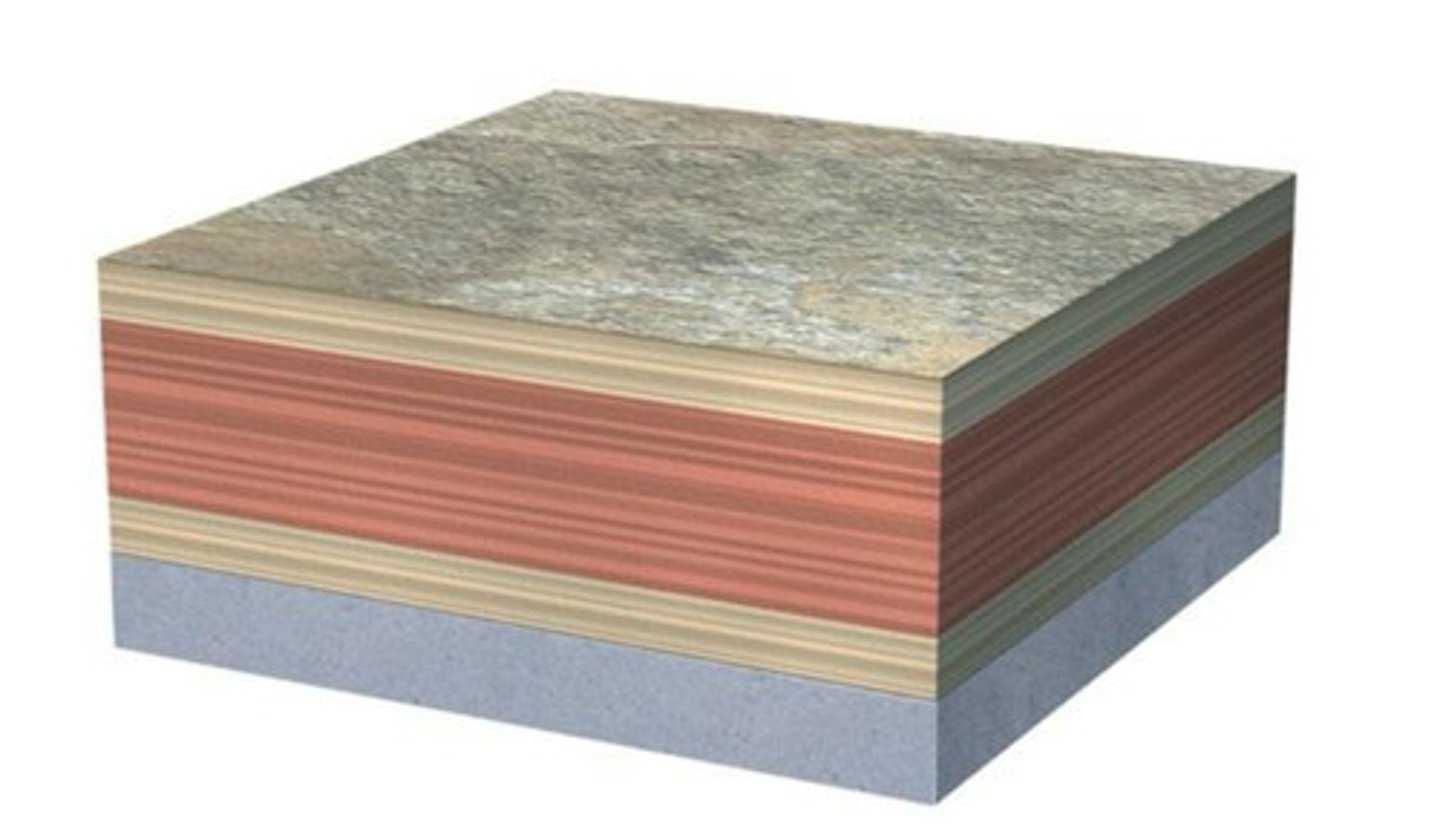
Which of the four sedimentary laers in this figure is the oldest?
The layer on the bottom
Which principle of relative dating can be used at Siccar Point in Scotland todetermine that the rocks below the unconformity were tilted to vertical beforeerosion occurred?
Original horizontality
What type of feature is represented by the boundary between geologic units 2 and 3?
unconformity
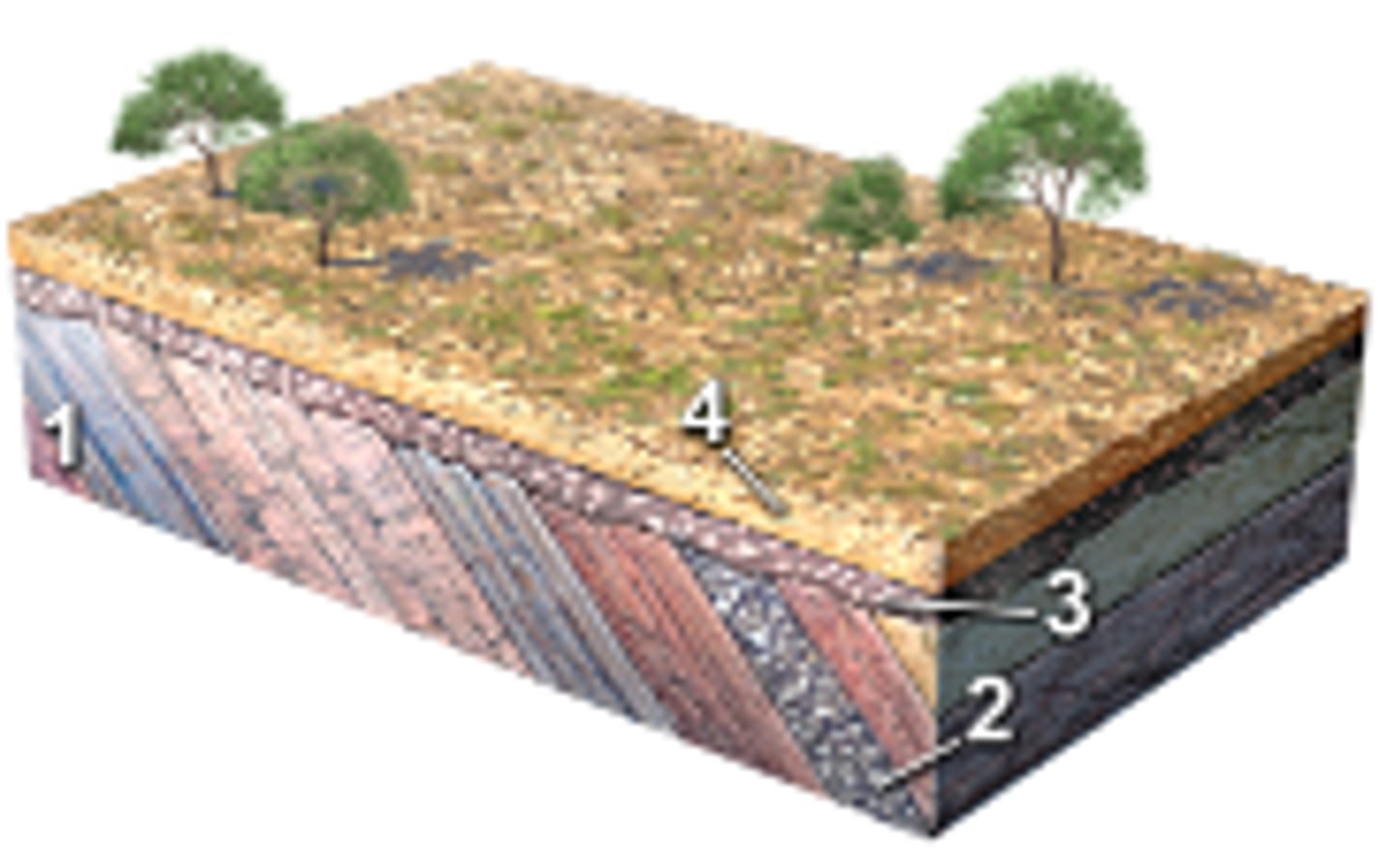
Missing geologic time caused by erosion is called a (an)
unconformity
If a rock started with 1,000 atoms of a parent but now contains 250 atoms, how many half lives have passed?
2 half lives
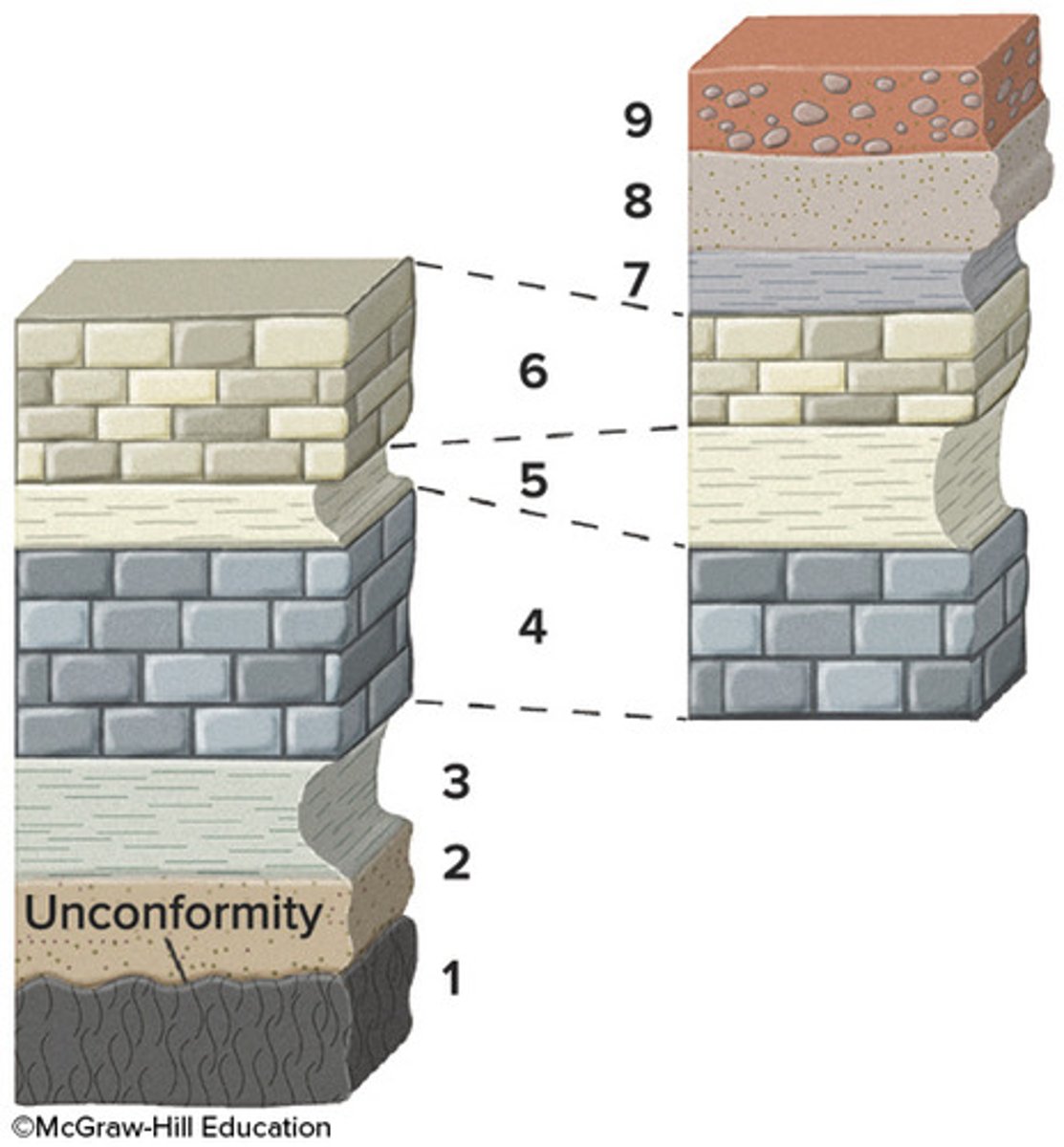
Why don't these two sequences of fossil-bearing rocks match exactly?
they have different histories of erosion and deposition
This figure shows two sections that partially overlap in age. Dashed lines show how the two sections correlate. What can you conclude from these correlations?
the left section represents older rocks than the right section
What was the Big Bang?
14 billion years ago a cosmological event occurred that resulted in all of time, space, energy and eventually, matter.
What happened after the Big Bang?
The universe expanded quickly and cooled (inflation)
What is inflation?
A brief period of extremely rapid expansion of the universe immediately after the big bang
How were new elements formed?
Light elements (H, He) formed shortly after the Big Bang. Heavier elements were formed by nuclear fusion inside stars and during supernova explosions.
What is redshift?
The stretching of light to longer (redder) wavelengths as galaxies move away from us due to the expansion of space.
What is the doppler effect (in cosmology?)
The apparent change in wavelength of light due to objects moving away from each other.
What is the compositional structure of the Earth?
crust, mantle, outer core, inner core
What is the mechanical properties of the earth?
Lithosphere, Asthenosphere, Mesosphere (lower mantle), Outer Core (liquid), Inner Core (solid)
What is a plate?
A section of the lithosphere that slowly moves over the asthenosphere, carrying pieces of continental and oceanic crust.
What are the three types of plate boundaries?
Convergent (collide), Divergent (move apart), Transform (slide past each other)
What is the driving force behind plate tectonics?
Slab pull (sinking dense plates), ridge push (gravity sliding from ridges), and minor mantle convection. (convection most used)
What geologic features are related to plate tectonics?
Mid-ocean ridges, trenches, abyssal plains, mountain belts, volcanoes, faults.
What was the hypothesis of Continental Drift?
The idea that continents were once joined together (Pangaea) and later drifted apart.
Evidence for Continental Drift?
1) continental fit, 2) similarity of fossil plants and animals, 3) similarity of rock sequences/formations, 4) paleomagnetism (glacial deposits across continents)
How is Earth's magnetic field generated?
By the geodynamo (turbulent movement of molten iron in the outer core.)
What is a mineral? (5-part definition)
A naturally occurring, inorganic, solid, with a crystalline structure and definite chemical composition.
What is a rock?
An aggregate (mixture) of one or more minerals.
What is the rock cycle?
the series of processes that change one type of rock into another type of rock
Difference between soil and sediment?
Sediment is loose rock fragments. Soil is sediment altered by weathering and biological processes. Soil has been modified by leaching or by accumulation of ions and may contain organic matter, whereas the sedi has not.
Difference between sediment and sedimentary rock?
Coherence: sediment consists of loose grains, sedimentary rock consists of a solid aggregate.
How is sediment generated?
weathering and erosion
How is sediment turned into rock?
Lithification through compaction and cementation.
Principal depositional environments discussed?
Rivers (fluvial) and beaches (coastal/marine).
Common sedimentary structures and what they indicate?
Ripples — water or wind movement
Cross-bedding — current direction
Graded bedding — decreasing energy
Mud cracks — drying conditions
How can ripples distinguish environments?
Symmetrical ripples → beach (wave action)
Asymmetrical ripples → river (one-directional flow)
Difference between relative and absolute age?
Relative age determines order of events.
Absolute age gives a numerical date (in years).
Principle of Uniformitarianism?
the present is the key to the past
Principle of Superposition?
In undeformed layers, oldest rocks are at the bottom.
Principle of Original Horizontality?
sedimentary rock layers are deposited in horizontal layers
Cross-cutting relationships?
A feature that cuts another rock unit is younger than the rock it cuts.
Intrusions and baked margins?
Igneous intrusions are younger than surrounding rock; surrounding rock is "baked" by heat.
What is radiometric dating?
Dating rocks using radioactive decay of isotopes.
What is a half-life?
the time taken for the radioactivity of a specified isotope to fall to half its original value.
How do you calculate number of half-lives passed?
Count how many times the parent isotope has been reduced by half.
How are fossils used to determine age?
Using first appearance, last appearance, fossil assemblages, and rapid evolution of index fossils.
What is an unconformity?
A gap in the geologic record caused by erosion or non-deposition.
What is a nonconformity?
Sedimentary rock overlying igneous or metamorphic rock.
What is a disconformity?
when two sedimentary rock layers are separated by an erosional surface
What is an angular unconformity?
Tilted/folded layers overlain by horizontal layers.
Which tectonic setting has the following melting mechanisms?
convergent margins matches devolatilization
divergent margins matches decompression
hotspots matches heating
At which margin type would you NOT find volcanoes?
transform margin
Which of these pairs are types of sedimentary rocks?
biogenic & clastic
The slide on the screen shows a series of sediments. Which order did these environments occur in?
Deeper ocean
Shallow sea/Shoreline
Beach
Shoreline/River system
Which of the following is NOT a manifestation of chemical weathering?
Breaking down of rocks by the growth of tree roots.
Which of the following is not a manifestation of a physical weathering process?
Water reacts with minerals and breaks molecules apart.
2 characteristics of a mineral
1) Naturally Occurring - A mineral must form through natural geologic processes. It cannot be man-made.
2) Crystalline Structure - A mineral must have an orderly, repeating internal atomic structure. The atoms are arranged in a definite geometric pattern.
Is ice a mineral?
Ice is a mineral because it is solid, has a crystalline structure, building blocks of rocks, naturally occurring, inorganic, and has a known composition.
Is volcanic glass a mineral?
No. It's not crystalline.
Name and describe two physical layers of the earth
Lithosphere - rigid, brittle outer layer, includes crust + uppermost mantle, broken into tectonic plates
Asthenosphere - soft, plastic layer beneath lithosphere, partially molten, allows tectonic plates to move
Describe how one type of unconformity form
Angular unconformity
1. Sedimentary layers are deposited horizontally
2. A tectonic event tilts or folds the layers
3. Erosion removes part of the tilted layers
4. New horizontal layers are deposited on top
How clastic sediment rock differs from another class
Clastic - made of fragments (clasts) of rock, formed by weathering, erosion, transport, and deposition (sandstone, shale, conglomerate)
Chemical - Forms from precipitation of dissolved minerals from water, often forms by evaporation, ex: gypsum
4 classes of sedi rock
Clastic, Chemical, Biochemical, Organic
Processes of Plate Margins (3 types)
Divergent (move apart) - new crust forms, mid-ocean ridges, shallow earthquakes, volcanism present
Convergent Boundary (plates collide) - ocean-continent, ocean-ocean, continent-continent
Transform Boundary (plates slide past) -strike-slip faults, shallow earthquakes, no volcanoes