Bio 3 animal phyla
 Call Kai
 Learn
Learn Practice Test
 Spaced Repetition
 Match
Match Flashcards
 Knowt Play
1/59

There's no tags or description
Looks like no tags are added yet.
Name | Mastery | Learn | Test | Matching | Spaced | Call with Kai |
|---|
No analytics yet
Send a link to your students to track their progress
60 Terms
Porifera
“Holes”
Sponges
toxins
There are few sponge predators because they usually contain _______
true tissues
Sponges lack _____ ______
- Do not have a circulatory, respiratory, digestive, nervous system, or muscles.
Boring sponges
Sponges that are parasitic and attach to hard surfaces to absorb nutrients from the animal
Asexually
Sponges can reproduce _______ through fragmentation, budding, or regeneration
sequential hermaphroditism
Individuals have both male and female parts, but function first as one sex, then as the other. Therefore, sponges can also reproduce sexually.
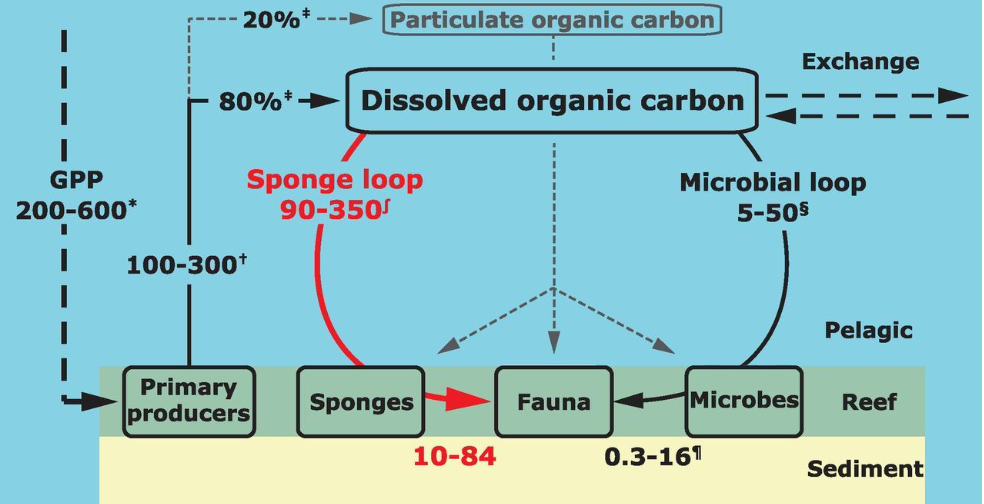
Sponge loop
Sponges can take up as much dissolved organic matter from the water in 30 minutes as free living bacteria can take up in 30 days
Sponges retain this organic matter, rapidly shed cells (food source for many organisms)
Cnidaria
“Nettle” → all of these organisms sting
Corals, anemones, jellies, and hydras
polyp, medusa
Two variations of cnidaria body plan, sessile ____ and motile ______
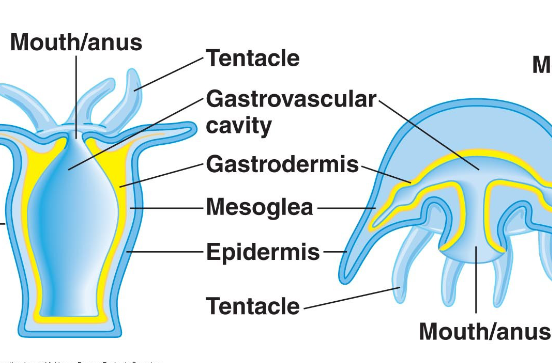
Cnidaria body plan
Diploblastic, radially symmetrical
Have a very simple “nerve net”
Have a simple muscular system
Corals and anemones
______ __ _______ exist only as polyps
Jellyfish
Have a dominant medusa stage
Includes scyphozoans and cubozoans
Hydrozoans
Alternate between polyp and medusa phases
Zooxanthellae
Corals contain endosymbiotic brown algae called ________
→ example of mutualism
Calcium carbonate
Coral polyps absorb ______ ________ out of the water then secrete it to build the reef
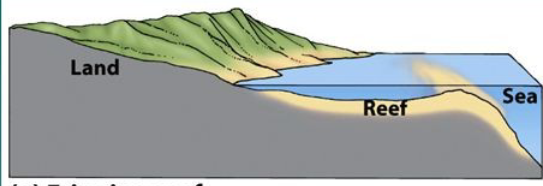
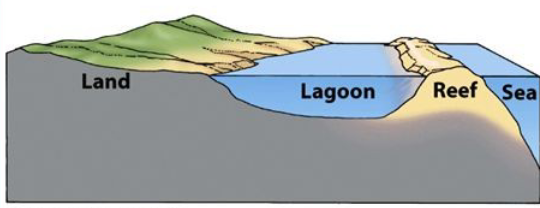
Fringing
Reef grows close to shore
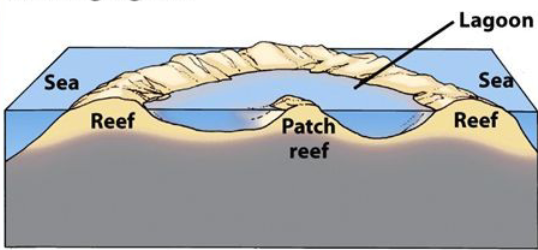
Atoll
a ring of coral that surrounds a lagoon, often grows on a submerged mountain of volcano
Barrier
reef grows close to shore but has a lagoon separating it from the shore
Cnidocysts
Specialized cells of cnidaria that contain cnidae (nematocysts) which are launched from the body to harpoon prey
- BAAAD Stings
Platyhelminthes
“flat”
Flat worms :)
Live in marine, freshwater, damp terrestrial habitats
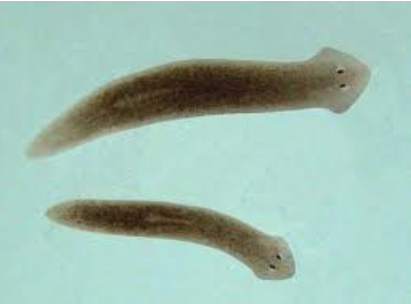
Platyhelminthes body plan
Triploblastic, bilaterally symmetrical acoelomates
Planarians
Nearly all free living and mostly marine
Move by using cilia on their ventral surface
Have a more specialized nervous system than cnidarians
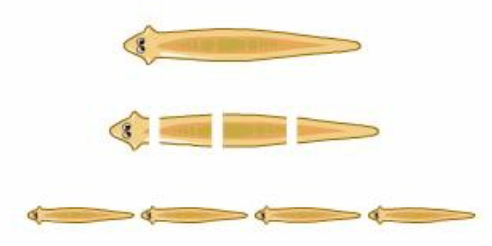
Planarian reproduction
Planarians can reproduce asexually through ______. They are _________ but can commonly cross-fertilize
Parasitic Platyhelminthes
Monogeneans, Trematodes, Tapeworms
Rotifera
Wheel-like orafice
Have a gastrovascular cavity, digestive tube with separate mouth and anus
Have a crown of cilia around their mouth which moves water
Rotifera reproduction
Many species consist only of females
- Parthenogenesis (asexual)
- Under poor environmental conditions, some species produced short lives males whose only purpose is to fertilize eggs
Ectoprocta
Live in sessile colonies, covered by a tough exosckeleton, suspension feeders
Have a lophophore
Triploblastic, have a true coelom
Lophophore
ring of ciliated tentacles that surround the mouth
Zooid
A single multicellular animal that makes up part of a whole organism
May be polymorphic (take up different functions in the animal)
Autozooids
Feeding zooids, make up bulk of colony (in ectoprocta)
Kenozooids
Zooids modified to serve as stolons, attachment discs, or defensive spines in ectoprocta
Heterozooids
Ovicells produce eggs, testes produce sperm
(Zooids in ectoprocta)
Brachiopoda
Triploblastic, bilaterally symmetrical coelomates
Have a pedicle that anchors them to the substrate
Pedicle
Acts like a stem for brachiopoda
Mollusca
Triploblastic, bilaterally symmetrical coelomates
- “Foot”, “Mantle”, “Shell”
Gastropoda
Mollusca class
- Torsion, coiling of the shell
Chitons (Polyplacophora)
Mollusca class
- Shell consists of 8 plates
Cephalopoda
Mollusca class
- Lobed foot, highly developed head, shell reduced/lost
Bivalves
Mollusca class
- Clams, mussels, oysters, scallops
-Shell is divided into two halves
- No distinct head, radula has been lost
Suspension
Bivalves are mainly _______ feeders
Internal
Bivalves typically have _____ fertilization
Cephalopods
Squid, cuttlefish, octopus, nautilus
Predacious
Cephalopods body plan
Shell often reduced/lost
Foot is lobed and forms tentacles
Highly developed head + sensory organs
Closed circulatory system with three hearts
Cuttlefish
Have a reduced, internal shell called a cuttlefish bone
Cephalopods
Nautilus
Have a chambered shell that aids in maintaining buoyancy + have about 90 arms
Cephalopods
Octopus
Completely lost shell, Benthic lifestyle, most intelligent invertebrate
Cephalopods
Squid
Highly reduced internal shell “pen”, live in deep ocean and make nightly migrations to surface to feed
Cephalopods
Cephalopod reproduction
Male transfers spermatophore to female
Female seals eggs in a den
Usually dies after eggs hatch
Direct development
Annelida
Segmented worms
Marine, freshwater, and terrestrial
Oligocheates, Polycheates, Hirudinea
Simple nervous system
Closed circulatory system
Chaetae
Chitinous bristles on annelida
Metamerism
Body made up of repeated segments called metameres that are separated from one another by septa
Peristalsis
Alternation of two muscle groups (one contracting and one relaxing)
Earthworm movement
Human digestive tract
Oligocheates
Few chaetae
Feed on detritus
(Annelids)
Polycheates
Each segment has paired chaetae
Mostly marine
Many are filter feeders
(Annelids)
Hirudinea
Leeches
Secrete anesthetic and anticoagulant hirudin
Blood-sucking parasites
(Annelids)
Annelida reproduction
Many forms of asexual reproduction → fragmentation, budding
External fertilization in aquatic species, internal in others
Most develop into trocophore larvae before maturing to adults
Nematoda
Roundworms
Ecdysozoans
Aquatic habitats, soil, tissues of plants/animals
NO segmented bodies, circulatory system
Pseudocoelomates, triploblastic, alimentary canal
Sexually, internal
Nematodes reproduce _______ by ______ fertilization
model
C. Elegans is a ______ species of nematode, used to study development