KINETICS
 Call Kai
 Learn
Learn Practice Test
 Spaced Repetition
 Match
Match Flashcards
 Knowt Play
1/99

There's no tags or description
Looks like no tags are added yet.
Name | Mastery | Learn | Test | Matching | Spaced | Call with Kai |
|---|
No analytics yet
Send a link to your students to track their progress
100 Terms
Which of the following will give maximum gas conversion?
A. Fixed bed reactor.
B. Fluidized bed reactor.
C. Semi-fluidized bed reactor.
D. Plug-flow catalytic reactor.
C. Semi-fluidized bed reactor.
. __________ explains the mechanism of catalysis.
A. Activated complex theory
B. Collision theory
C. Thermodynamics
D. None of these
A. Activated complex theory
The fractional volume change of the system for the isothermal gas phase
reaction, A → 3B, between no conversion and complete conversion is
A. 0.5
B. 1
C. 2
D. 3
C. 2
A catalyst
A. initiates a reaction.
B. lowers the activation energy of reacting molecules.
C. is capable of reacting with any one of the reactants.
D. cannot be recovered chemically unchanged at the end of a chemical
reaction.
B. lowers the activation energy of reacting molecules.
What is the order of a chemical reaction, A + 2B → C , if the rate of formation of 'C', increases by a factor of 2.82 on doubling the concentration of 'A' and increases by a factor of 9 on trebling the concentration of 'B'?
A. 7/2
B. 7/4
C. 5/2
D. 5/4
A. 7/2
For high conversion in a highly exothermic solid catalyzed reaction, use a __________ bed reactor.
A. fixed
B. fluidized bed reactor followed by a fixed
C. fixed bed reactor followed by a fluidized
D. fluidized
B. fluidized bed reactor followed by a fixed
. For every 10°C rise in temperature, the rate of chemical reaction doubles. When the temperature is increased from 30 to 70°C, the rate of reaction increases __________ times.
A. 8
B. 12
C. 16
D. 32
C. 16
The single parameter model proposed for describing non-ideal flow is the
__________ model.
A. tank in series
B. dispersion
C. both (a) & (b)
D. neither (a) nor (b).
C. both (a) & (b)
A first order reaction requires two equal sized CSTR. The conversion is
A. less when they are connected in series.
B. more when they are connected in series.
C. more when they are connected in parallel.
D. same whether they are connected in series or in parallel.
B. more when they are connected in series.
In case of physical adsorption, the heat of adsorption is of the order of
__________ kcal/kg-mole.
A. 100
B. 1000
C. 10000
D. 100000
D. 100000
The most unsuitable reactor for carrying out reactions in which high reactant concentration favors high yields is
A. backmix reactor
B. plug flow reactor
C. series of CSTR
D. PFR in series
A. backmix reactor
. Pick out the wrong statement pertaining to space velocity of flow reactors.
A. The unit of space velocity is (time)-1 .
B. The space velocity of 3 hr-1 means that three reactor volumes of feed
at specified conditions are being fed into the reactor every hour.
C. The space velocity of 3 hr-1 means that one third reactor volume
of feed at specified conditions are being fed into the reactor.
D. none of these.
C. The space velocity of 3 hr-1 means that one third reactor volume
of feed at specified conditions are being fed into the reactor.
A reactor is generally termed as an autoclave, when it is a
A. high pressure batch reactor.
B. atmospheric pressure tank reactor.
C. high pressure tubular reactor.
D. atmospheric pressure CSTR
A. high pressure batch reactor.
6 Kg of carbon is burnt with an amount of air containing 18 gm oxygen. The product contains 16.5 gms CO2 and 2.8 gms CO besides other constituents. What is the degree of conversion on the basis of disappearance of limiting
reactant?
A. 100%
B. 95%
C. 75%
D. 20%
B. 95%
The rate constant of a chemical reaction decreases by decreasing the
A. pressure
B. concentration of reactants
C. temperature
D. duration of reaction
C. temperature
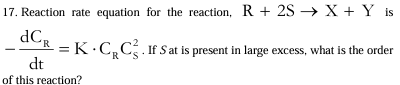
A. zero
B. one
C. two
D. three
B. one

A. (atm)-1
B. (hr)-1
C. (atm)-1.(hr)-1
D. atm.(hr)-1
C. (atm)^-1.(hr)^-1
__________ is the response curve for a step input signal from a reactor.
A. S-curve
B. C-curve
C. I-curve
D. none of these
B. C-curve
. 'If the catalyst pore size is small in comparison with the mean free path, collisions with the pore wall controls the process'. The diffusivity under this condition is called 'Knudsen diffusivity', which is affected by the
A. pressure
B. temperature
C. both (a) & (b)
D. neither (a) nor (b)
B. temperature
Which of the following is the most suitable for very high pressure gas phase reaction?
A. Batch reactor
B. Tubular flow reactor
C. Stirred tank reactor
D. Fluidized bed reactor
B. Tubular flow reactor
The reaction between oxygen and organic material is a/an __________
reaction.
A. exothermic
B. endothermic
C. biochemical
D. photochemical
A. exothermic
With decrease in temperature, the equilibrium conversion of a reversible
endothermic reaction
A. decreases
B. increases
C. remains unaffected
D. increases linearly with temperature
A. decreases
In an exothermic chemical reaction, the reactants compared to the products have
A. higher temperature
B. more energy
C. less energy
D. same energy.
B. more energy

A. (K1+K1)CX
B. (K1+K2+K3)Cx
C. K1CV - K2CX
D. (K1-K2)CX
C. K1CV - K2CX

A. increase of temperature.
B. decrease of temperature.
C. increase in initial concentration of A.
D. decrease in initial concentration of A.
A. increase of temperature.
A reversible liquid phase endothermic reaction is to be carried out in a plug flow reactor. For minimum reactor volume, it should be operated such that the temperature along the length
A. decreases.
B. increases.
C. is at the highest allowable temperature throughout.
D. first increases and then decreases.
C. is at the highest allowable temperature throughout.
The rate constant of a chemical reaction increases by 100 times when the temperature is increased from 400 °K to 500 °K. Assuming transition state theory is valid, the value of E/R is
A. 8987°K
B. 9210°K
C. 8764°K
D. 8621°K
C. 8764°K
A batch reactor is suitable for
A. achieving cent percent conversion of reactants into products.
B. large scale gaseous phase reactions.
C. liquid phase reactions.
D. obtaining uniform polymerization products in highly exothermic
reactions.
C. liquid phase reactions.
For a heterogeneous catalytic reaction
A. free energy of activation is lowered in the presence of catalyst,
which remains unchanged at the end of reaction.
B. a relatively small amount of catalyst can cause the conversion of
large amount of reactants which does not mean that catalyst
concentration is important.
C. the catalyst does not form an intermediate complex with the reactant.
D. the surface of the catalyst does not play an important role during
reaction.
A. free energy of activation is lowered in the presence of catalyst,
which remains unchanged at the end of reaction.
The increase in the rate of reaction with temperature is due to
A. increase in the number of effective collisions.
B. decrease in activation energy.
C. increase in the average kinetic energy of the reacting molecules.
D. none of these.
B. decrease in activation energy.
A catalyst loses its activity due to
A. loss in surface area of the active component.
B. agglomeration of metal particles caused by thermal sintering of the
solid surface.
C. covering of the catalytic active sites by a foreign substance.
D. all (a), (b) and (c).
D. all (a), (b) and (c).
'N' plug flow reactors in series with a total volume 'V' gives the same
conversion as a single plug flow reactor of volume 'V' for __________ order reactions.
A. first
B. second
C. third
D. any
D. any
Specific rate constant for a second order reaction
A. is independent of temperature.
B. varies with temperature.
C. depends on the nature of the reactants.
D. both (b) and (c).
D. both (b) and (c)

A. CA(K1+K2)
B. CA(K1 + K2)/2
C. CA . K1/2
D. CA . K2/2
A. CA(K1+K2)
For an isothermal variable volume batch reactor, the following relation is
applicable for a first order irreversible reaction.
A. Xₐ = k · t
B. (Cₐ₀ / (1 + εₐXₐ)) · (dXₐ/dt) = k
C. −ln(1 − Xₐ) = kt
D. εₐ · ln(1 − Xₐ) = k · t
B. (Cₐ₀ / (1 + εₐXₐ)) · (dXₐ/dt) = k
. For a zero order chemical reaction, the
A. half life period is directly proportion to the initial concentration of
the reactants.
B. plot of products concentration with time is a straight line through the
origin.
C. products concentration increases linearly with time.
D. all (a), (b) and (c).
D. all (a), (b) and (c).
BET apparatus
A. measures the catalyst surface area directly.
B. operates at very high pressure.
C. is made entirely of stainless steel.
D. none of these.
D. none of these.
Radioactive decay follows __________ order kinetics.
A. first
B. second
C. third
D. zero.
A. first
The excess energy of reactants in a chemical reaction required to dissociate into products is termed as the __________ energy.
A. activation
B. potential
C. binding
D. threshold
A. activation
For a solid catalyzed chemical reaction, the effectiveness of solid catalyst
depends upon the __________ adsorption.
A. physical
B. chemical
C. both (a) and (b)
D. neither (a) nor (b)
B. chemical
Pick out the correct statement.
A. In catalytic reactions, the catalyst reacts with the reactants.
B. A catalyst initiates a chemical reaction.
C. A catalyst lowers the activation energy of the reacting molecules.
D. A catalyst cannot be recovered chemically unchanged at the end of
the chemical reaction.
C. A catalyst lowers the activation energy of the reacting molecules.
The dimensions of rate constant for reaction 3A → B are (l/gm mole)/min.
Therefore the reaction order is
A. 0
B. 1
C. 2
D. 3
C. 2
Pick out the correct statement
A. Reactions with high activation energies are very temperature sensitive.
B. Chemical equilibrium is a static state.
C. A photochemical reaction is catalyzed by light.
D. A chemical reaction occurs when the energy of the reacting molecule is less than the activation energy of the reaction.
A. Reactions with high activation energies are very temperature
sensitive.
If the time required to complete a definite fraction of reaction varies
inversely as the concentration of the reactants, then the order of reaction is
A. 0
B. 1
C. 2
D. 3
C. 2
Sulphuric acid is used as a catalyst in the
A. hydrogenation of oils.
B. gas phase oxidation of SO2 in chamber process.
C. alkylation of hydrocarbons.
D. none of these.
C. alkylation of hydrocarbons.
Fractional conversion __________ with increase in pressure for ammonia synthesis reaction i.e., N2 + 3H2 ←→ 2NH3.
A. increases
B. decreases
C. remains unchanged
D. unpredictable from the data
A. increases
Pick out the wrong statement.
A. The vessel dispersion number (D/UL) for plug flow and mixed flow
approaches zero and infinity respectively.
B. Space time in a flow reactor is a measure of its capacity and is equal
to the residence time when the density of reaction mixture is
constant.
C. Mixed reactor is always smaller than the plug flow reactor for
all positive reaction orders for a particular duty.
D. In an ideal tubular flow reactor, mixing takes place in radial
direction and there is no mixing in longitudinal direction.
C. Mixed reactor is always smaller than the plug flow reactor for
all positive reaction orders for a particular duty.
The reason why a catalyst increases the rate of reaction is that, it
A. decreases the energy barrier for reaction.
B. increases the activation energy.
C. decreases the molecular collision diameter.
D. none of these.
A. decreases the energy barrier for reaction.
A first order irreversible reaction, A → B is carried out separately in a
constant volume as well as in a variable volume reactor for a particular period.
It signifies that __________ in the two reactors.
A. both conversion as well as concentration are same
B. conversion in both will be the same but concentrations will be
different
C. both the conversion as well as concentrations will be different
D. none of these.
B. conversion in both will be the same but concentrations will be
different
When the density of the reaction mixture is constant in a chemical reaction, the ratio of the mean residence time to space time is
A. > 1
B. < 1
C. 1
D. 0
C. 1
In an ideal tubular-flow reactor
A. there is no mixing in longitudinal direction.
B. mixing takes place in radial direction.
C. there is a uniform velocity across the radius.
D. all (a), (b) and (c).
D. all (a), (b) and (c).
At a given value of E/R (ratio of activation energy and gas constant), the ratio of the rate constants at 500°K and 400°K is 2, if Arrhenius law is used. What will be this ratio, if transition state theory is used with the same value of E/R?
A. 1.6
B. 2
C. 2.24
D. 2.5
D. 2.5
__________ is the controlling step in a highly temperature sensitive fluid
solid non-catalytic reaction.
A. Gas film diffusion
B. Ash diffusion
C. Chemical reaction
D. none of these
C. Chemical reaction
An autothermal reactor is
A. most suitable for a second order reaction.
B. most suitable for a reversible reaction.
C. completely self-supporting in its thermal energy requirements.
D. isothermal in nature.
C. completely self-supporting in its thermal energy requirements.
The rate constant of a first order reaction depends on the
A. concentration of the reactant.
B. temperature.
C. concentration of the product.
D. time.
B. temperature.
A reaction in which one of the products of reaction acts as a catalyst is called a/an __________ reaction.
A. catalytic
B. autocatalytic
C. photochemical
D. none of these
B. autocatalytic
The ratio of volume of mixed reactor to the volume of P.F.R. (for identical
flow rate, feed composition and conversion) for zero order reaction is
A. ∞
B. 0
C. 1
D. > 1
C. 1
Which of the following will favor the reverse reaction in a chemical
equilibrium reaction?
A. Increasing the concentration of one of the reactants.
B. Increasing the concentration of one or more of the products.
C. Removal of at least one of the products at regular interval.
D. None of these.
B. Increasing the concentration of one or more of the products.
Conversion increases with increase in temperature in case of a an
__________ reaction.
A. autocatalytic
B. irreversible
C. reversible endothermic
D. reversible exothermic
C. reversible endothermic
. Effective diffusivity (DE) in a catalyst pellet is related to molecular diffusivity (DN) and Knudsen diffusivity (DK) as
A. Dₑ = Dₘ + Dₖ
B. 1/Dₑ = 1/Dₘ + 1/Dₖ
C. Dₑ = Dₘ · Dₖ
D. Dₑ = Dₘ/Dₖ
B. 1/Dₑ = 1/Dₘ + 1/Dₖ
A photochemical reaction is __________ light.
A. initiated by
B. accompanied with emission of
C. catalyzed by
D. used to convert heat energy into
A. initiated by
Pick out the wrong statement.
A. In a batch reactor, which is exclusively used for liquid phase
reactions; temperature pressure and composition may vary with
time.
B. In a semi-batch reactor, one reactant is charged batch wise, while the
other reactant is fed continuously.
C. In a continuous flow reactor, uniform concentration cannot be
maintained throughout the vessel even in a well agitated system.
D. In a continuous flow reactor, both the reactants and the products
flow out continuously.
C. In a continuous flow reactor, uniform concentration cannot be
maintained throughout the vessel even in a well agitated system.
In a/an __________ reactor, there is exchange of heat with the surroundings
with sizeable temperature variation.
A. adiabatic
B. isothermal
C. non-adiabatic
D. none of these.
C. non-adiabatic
'Unreacted core model' represents the reaction involving
A. combustion of coal particles.
B. roasting of sulphide ores.
C. manufacture of carbon disulphide from elements.
D. none of these.
B. roasting of sulphide ores.
For a vapor phase catalytic reaction (A + B → P) which follows the Ridel mechanism and the reaction step is rate controlling, the rate of reaction is given by (reaction rate is irreversible, product also absorbs).
A. −rₐ = (kPₐPᵦ) / (1 + kₐPₐ + kₚPₚ)
B. −rₐ = (kPₐ² − k₁Pₚ) / (1 + kₐPₐ + kₚPₚ)
C. −rₐ = (kPₐPᵦ) / (1 + kₐPᵦ + kᵦPᵦ · kₚPₚ)
D. −rₐ = (kPₐPᵦ) / (1 + kₐPₐ)
If a solid-gas non-catalytic reaction occurs at very high temperature, the rate controlling step is the __________ diffusion.
A. film
B. ash layer
C. pore
D. none of these
A. film
The units of frequency factor in Arrhenius equation
A. are the same as those of the rate constant.
B. depend on the order of the reaction.
C. depend on temperature, pressure etc. of the reaction.
D. are cycles per unit time.
A. are the same as those of the rate constant.
Which of the following is not a chemical step in a fluid solid catalytic
reaction?
A. Surface chemical reaction
B. Adsorption
C. Desorption
D. None of these
D. None of these
For a series of reactions A —k₁→ B —k₂→ C having k₁ << k₂, the reaction system can be approximated as:
A. A —k₁→ B
B. A —k₂→ B
C. A —k₂→ C
D. A —k₁→ C
A. A —k₁→ B
At a given temperature, K₁, K₂, and K₃ are equilibrium constants for the following reactions 1, 2, and 3 respectively.
CH₄(g) + H₂O(g) ⇌ CO(g) + 3H₂(g)
CO(g) + H₂O(g) ⇌ CO₂(g) + H₂(g)
CH₄(g) + 2H₂O(g) ⇌ CO₂(g) + 4H₂(g)
Then K₁, K₂, and K₃ are related as:
A. K₃ = K₁K₂
B. K₃ = (K₁K₂)⁰·⁵
C. K₃ = (K₁ + K₂)/2
D. K₃ = (K₁K₂)²
A. K₃ = K₁K₂
In case of __________ reactions, the reaction rate does not decrease
appreciably as the reaction proceeds.
A. catalytic
B. parallel
C. series
D. auto catalytic
D. auto catalytic
For nearly isothermal operation involving large reaction time in a liquid
phase reaction, the most suitable reactor is a __________ reactor.
A. stirred tank
B. tubular flow
C. batch
D. fixed bed
A. stirred tank
What is the Thiele modulus of the solid catalyzed first order reaction,
X—k→ Y , if the pore diffusion offers negligible resistance to reaction ?
A. < 5
B. < 0.5
C. > 1
D. 5
B. < 0.5
B.E.T. method can be used to determine the __________ of a porous
catalyst.
A. solid density
B. pore volume
C. surface area
D. all (a), (b) and (c)
C. surface area
Rate constant for a first order reaction does not depend upon reaction time, extent of reaction and the initial concentration of reactants; but it is a function of reaction temperature. In a chemical reaction, the time required to reduce the concentration of reactant from 100 gm moles/liter to 50 gm moles/liter is same as that required to reduce it from 2 gm moles/liter to 1 gm mole/liter in the same volume. Then the order of this reaction is
A. 0
B. 1
C. 2
D. 3
B. 1
Which of the following is an independent variable for a batch tank reactor
with uniform concentration and temperature?
A. Time
B. Useful volume of the tank
C. Diameter of the reactor
D. None of these
A. Time
For reactions in parallel viz A → P (desired product) and A → Q (unwanted product), if the order of the desired reaction is higher than that of the undesired reaction, a
A. batch reactor is preferred over a single CSTR for high yield.
B. tubular reactor is preferred over a single CSTR for high yield.
C. both (a) and (b).
D. single CSTR is the most suitable.
C. both (a) and (b).
For a gaseous phase reaction, rate of reaction is equal to K CA CB. If the volume of the reactor is suddenly reduced to l/4th of its initial volume, then the rate of reaction compared to the original rate will be __________ times.
A. 8
B. 16
C. 1/8
D. 1/16
B. 16
In a reversible chemical reaction having two reactants in equilibrium, if the concentration of the reactants is doubled, then the equilibrium constant will
A. remain the same
B. be halved
C. also be doubled
D. become one fourth
A. remain the same
The equilibrium constant of a catalytic chemical reaction __________ due to the presence of a catalyst.
A. increases
B. decreases
C. remains unaffected
D. unpredictable from the data
C. remains unaffected
The rate constant of a chemical reaction increases by increasing the
A. temperature
B. pressure
C. reactant's concentration
D. none of these
A. temperature
The catalytic activity of enzymes is due to their capacity to lower the
__________ energy.
A. activation
B. potential
C. kinetic
D. none of these
A. activation
A first order reaction requires two unequal sized CSTR. Which of the following gives higher yield?
A. Large reactor followed by smaller one.
B. Smaller reactor followed by larger one.
C. Either of the arrangement (a) or (b) will give the same yield.
D. Data insufficient can't be predicted.
C. Either of the arrangement (a) or (b) will give the same yield.
Pick out the correct statement.
A. A lower temperature favors the reaction of lower activation
energy.
B. The dispersion number for a reactor/vessel is uL/D.
C. The rate controlling step in a reaction involving many steps is the
fastest step.
D. Pore volume and porosity of a catalyst is measured by Brunaver
Emmet-Teller (BET) technique.
A. A lower temperature favors the reaction of lower activation
energy.

A. pressure has no effect.
B. backward reaction is favored.
C. forward reaction is favored.
D. none of these.
A. pressure has no effect.

A. (1 + x)
B. (1 - x)
C. (1 + x)2
D. (1 - x)2
A. (1 + x)
A batch reactor is characterized by
A. constant residence time.
B. variation in extent of reaction and properties of the reaction
mixture with time.
C. variation in reactor volume.
D. very low conversion.
B. variation in extent of reaction and properties of the reaction
mixture with time.
When a catalyst increases the rate of forward reaction, the value of rate
constant
A. increases
B. decreases
C. remain same
D. becomes infinite
A. increases
Rate determining step in a reaction consisting of a number of steps in series is the __________ step.
A. fastest
B. slowest
C. intermediate
D. data insufficient; can't be predicted
B. slowest
The rate of a chemical reaction is almost doubled for every 10°C rise in temperature. The rate will increase __________ times, if the temperature rises from 10 to 100°C.
A. 256
B. 512
C. 112
D. 612
B. 512
A catalyst in a chemical reaction __________ free energy change in the
reaction.
A. increases
B. decreases
C. either (a) or (b); depends on the type of catalyst
D. neither (a) nor (b).
C. either (a) or (b); depends on the type of catalyst
Signal normally used to study non-ideal flow by stimulus response
technique is __________ input.
A. pulse
B. step
C. both (a) & (b)
D. neither (a) nor (b)
C. both (a) & (b)
When all the limiting reactant is consumed in the reaction, the operational
yield __________ the relative yield.
A. is greater than
B. is smaller than
C. equals
D. can be either greater or smaller than (depends on the type of
reaction)
C. equals
The half life period of a first order reaction is
A. always the same irrespective of the reaction.
B. dependent on initial concentration of the reactants.
C. proportional to the initial concentration of reactants.
D. half the specific rate constant.
B. dependent on initial concentration of the reactants.
The catalyst in a second order reversible reaction increases the rate of the forward reaction
A. and decreases that of backward reaction.
B. and backward reaction equally.
C. only.
D. to a greater extent than that of the backward reaction.
B. and backward reaction equally.
Catalyst carriers
A. have very high selectivity.
B. increase the activity of a catalyst.
C. provide large surface area with a small amount of active
material.
D. inhibit catalyst poisoning.
C. provide large surface area with a small amount of active
material.
For the liquid phase zero order irreversible reaction A → B, the conversion of A in a CSTR is found to be 0.3 at a space velocity of 0.1min-1. What will be the conversion for a PFR with a space velocity of 0.2 min-1? Assume that all the other operating conditions are the same for CSTR and PFR.
A. 0.15
B. 0.30
C. 0.60
D. 0.90
C. 0.60
A high space velocity means that a given
A. reaction can be accomplished with small reactor.
B. conversion can be obtained with a high feed rate.
C. both (a) and (b).
D. none of these.
C. both (a) and (b).
In flow reactors, the performance equations interrelate the rate of reaction to the
A. feed rate.
B. reactor volume,
C. extent of reaction.
D. all (a), (b) and (c).
D. all (a), (b) and (c).