Lab 1 Review: BI 341 OSU
 Call Kai
 Learn
 Practice Test
 Spaced Repetition
 Match
 Flashcards
 Knowt Play
1/56

Earn XP
Description and Tags
if you're using these then good luck soldier
57 Terms
Mesenchyme
A type of embryonic connective tissue that gives rise to various structures in the body, including muscle, bone, and blood. Mesenchyme is characterized by a loose arrangement of cells and a gel-like extracellular matrix.
Epithelial Tissue
A type of tissue that covers body surfaces and forms glands. Epithelial tissue is composed of closely packed cells with minimal extracellular matrix, serving functions such as protection, absorption, and secretion.
Muscle Tissue
A type of tissue responsible for movement in the body, consisting of cells that can contract and relax. Muscle tissue is classified into three types: skeletal, cardiac, and smooth.
Nervous Tissue
A type of tissue that transmits electrical impulses throughout the body, consisting of neurons and supporting cells called glia. Nervous tissue is essential for coordinating body functions and responding to stimuli.
Connective Tissue
A type of tissue that supports, binds together, and protects other tissues and organs in the body. Connective tissue includes various forms such as bone, adipose, blood, and cartilage.
Anatomical Planes: Frontal
Plane dividing front and back of body
Anatomical Planes: Sagittal
Plane dividing left and right side of body vertically
Anatomical Plane: Transverse
Horizontal at the midpoint of the body
Contralateral
On opposite sides of the body
Ipsilateral
On the same side of the body
Medial
Towards the center of the body
Lateral
Towards the edge of the body
Intermediate
Between a medial and lateral structure. Ex: The eye is intermediate to the nose and ear.
Proximal
Closer to the trunk or attachment of the body
Distal
Farther from the trunk or attachment to the body
Superior
Body parts closer to your head are
Inferior
Body parts closer to your feet are
Hypertonic solution
More solute outside of a cell than inside
Hypotonic
Less solute outside of a cell than inside
Does a channel require ATP?
No
Where is K+ most concentrated?
Inside the cell - Gradient will cause it to flow out
Where is Na+ most concentrated?
Outside of the cell - Gradient will cause it to flow IN
Where can we consider an action potential to have ended?
-70 mV
Where on the cell does an action potential start?
Axon hillock
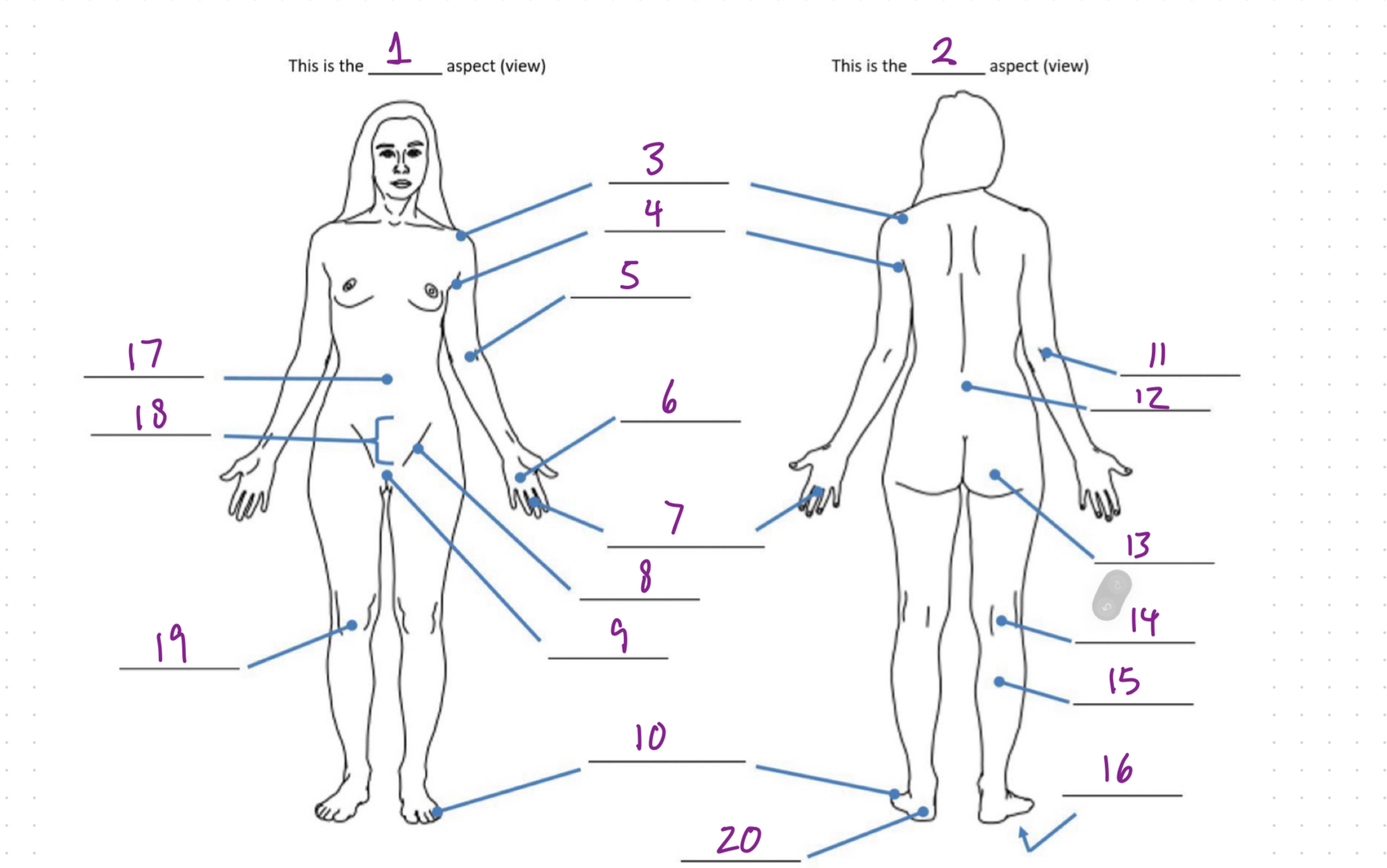
Number 1
Anterior

Number 2
Posterior

Number 3
Shoulder

Number 4
Axillar

5
Antecubital

6
Palmar

7
Digital

8
Inguinal

9
Pubic

10
Digital

11
Elbow

12
Lumbar

13
Gluteal

14
Popliteal

15
Calf

16
Plantar

17
Umbilical

18
Pelvic

19
Patellar

20
Calcaneal

A
Cephalic

B
Cervical

C
Thoracic

D
Abdominopelvic

E
Pollex

F
Thigh

G
Leg (Crus)

H
Pes

I
Brachial

J
Ante-brachial

K
Manus

L
Sacral

M
Hallux