1. Pathogens and their Transmission
 Call Kai
 Learn
Learn Practice Test
 Spaced Repetition
 Match
Match Flashcards
 Knowt Play
1/14

There's no tags or description
Looks like no tags are added yet.
Name | Mastery | Learn | Test | Matching | Spaced | Call with Kai |
|---|
No analytics yet
Send a link to your students to track their progress
15 Terms
Communicable / Infectious Disease Definition
A disease caused by foreign organisms entering the body and multiplying within it
Contagious Disease
One which is passed on by direct contact with the infected person or by contact with someone touched by the person
What is a pathogen?
A disease-causing organism
Bacteria
Most bacteria are harmless to humans (found on skin and in the intestines) but some may cause illness or death
Some damage cells and tissues directly by breaking down the host’s cells for food. Others release toxins that interfere with the host’s normal activity.
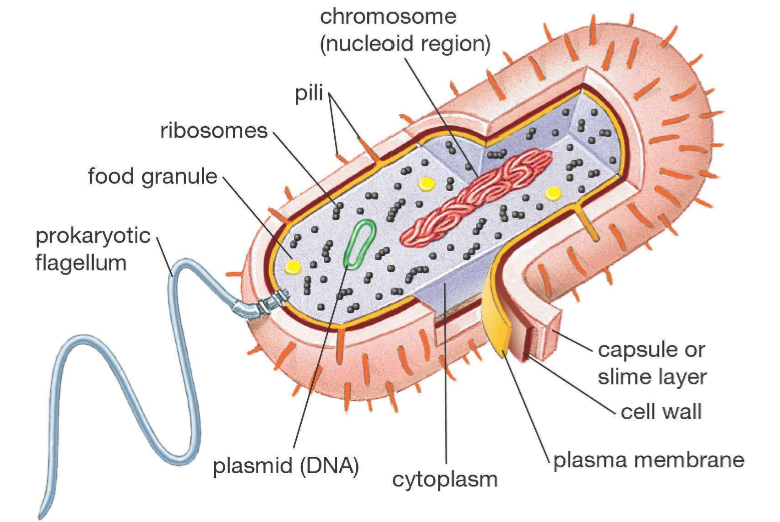
Bacteria are:
single celled
can be seen under a light microscope
classified according to cell shape
Diagram of Bacteria
Viruses
Are too small to be seen with a light microscope
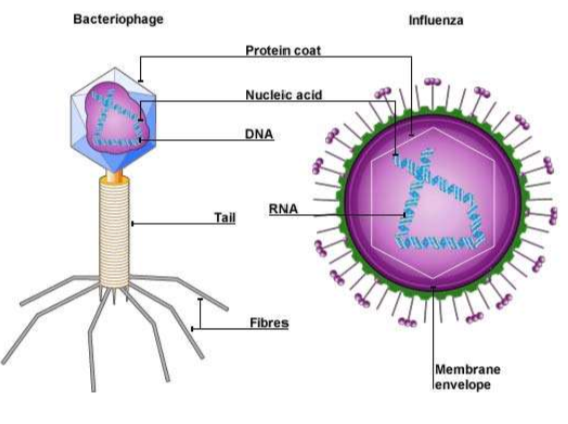
Contain genetic material either as a molecule of DNA or RNA surrounded by protein coat (some have external lipid envelope)
Infect a living cell and induces it to manufacture more virus particles which are able to leave that cell and infect other cells
Bacteriophages - viruses that multiply in bacterial cells
Diagram of Virus
Viral Replication
DNA viruses all replicate in the nucleus, whereas RNA viruses replicate in the cytoplasm
What are the ways of pathogen transmission?
Physical Contact
Transfer of Body Fluids
Infection by Droplets
Ingestion
Airborne Transmission
Transmission by vectors
Physical Contact
Touching an infected person (direct) or touching an object that has been touched by an infected individual (indirect)
e.g skin infections, STI’s
Transfer of Bodily Fluids
Transfer of pathogens in blood or body fluids from an infected person, through the mucous membranes of an uninfected person or via the bloodstream
e.g HIV, Hep B, and C
Infection by droplets
Pathogens transmitted through breathing, talking, coughing, or sneezing. Droplets may be inhaled or settle on food utensils and ingested with food.
e.g. colds, measles, mumps, influenza
Ingestion
Consuming food or drink contaminated with pathogens
e.g. salmonella food poisoning, typhoid fever, dysentery
Airborne Transmission
Viruses and some bacteria remain viable after evaporation of moisture in exhaled air and can continue to infect when inhaled
e.g. Tuberculosis (TB) and measles
Transmission by vectors
Other animals such as insects, ticks, or mites transfer the pathogen directly or spread it to food / water which is then ingested
e.g. malaria and dengue fever (mosquitos), bubonic plague (fleas from rats and mice), and Lyme disease (ticks)