PSYC 101 Ch. 9 Flashcards: Language and Thought
 Call Kai
 Learn
Learn Practice Test
 Spaced Repetition
 Match
Match Flashcards
 Knowt Play
1/164

Earn XP
Description and Tags
Language, Thinking (Concepts & Categories, Planning & Problem-Solving, Reasoning & Judgement, Decision-Making)
Name | Mastery | Learn | Test | Matching | Spaced | Call with Kai |
|---|
No analytics yet
Send a link to your students to track their progress
165 Terms
Language
system of communication that uses signals that are combined according to rules of grammar, and that convey meaning
Grammar
rules that specify how units of language can be combined to produce meaningful messages- includes morphology and syntax
Morphology / Morphological Rules
word rules, how morphemes can be combined into words
e.g. “how do you make a noun plural to make it say there’s many?”
Syntax / Syntactic Rules
sentence rules, how words can be combined to make sentences
e.g. combinations of words → adjectives going before nouns, etc.
Units of Language
Phonemes → Morphemes → Words → Phrases → Sentences
Phonemes
smallest units of sound in language (smallest units of speech) that change meaning when altered e.g., /b/ vs /p/ in “bat” and “pat”
important in speech perception and language processing
Phonological rules
Mental rules for how sounds are organized and combined in a language, including pronunciation patterns and sound changes
Morphemes
The smallest units of meaning in language, such as words or meaningful word parts
e.g., “un-,” “dog,” “-ed”
Content morphemes
things and events
e.g. “cat”, “dog”, “take”, etc.
Function morphemes
grammatical functions i.e. tying sentences together
e.g. “and”, “or”, “but”, “-s” to make plural, “re-” to convey idea of second attempt
Telegraphic speech
Early child speech using mostly content words and omitting smaller grammatical words
e.g., “want cookie”
Semantics
meaning
i.e. “what are we trying to say?”
“Frank discovered a louse combing his beard.” What type of structure does this violate, and why?
violates surface structure, can imply different scenario than intended → Frank discovered the louse while combing his beard, not a louse that was combing his beard
“Colourless green ideas sleep furiously.” What type of structure does this violate, and why?
violates deep structure- surface structure/syntax is fine, deep structure (meaning behind each word") doesn’t really make sense together
0-4 months
tell difference b/t speech sounds (phonemes) that are not distinguished in their native language
cooing esp in response to speech
Dishabituation paradigm
pacifier study in infants 1-4 months
type of discrimination in preverbal babies
measured ability to distinguish different sounds based on how often they suck on pacifier
overtime: focus in on 1 language → loses ability to differentiate sounds that aren’t distinguished in their language → can’t discriminate
4-6 months
babbles consonants
6-10 months
understands some words and simple requests
can now only tell difference b/t sounds that are distinguished in native language
10-12 months
begin to use simple words
12-18 months
vocabulary 30-50 words (simple nouns, adjectives, verbs)
18-24 months
2-word phrases ordered according to syntactic rules
vocabulary 50-200 words
understands rules
**** comprehension exceeds production*****
24-36 months
vocabulary ~1000 words
production of phrases and incomplete sentences
telegraphic speech
Telegraphic speech
Early child speech using mostly content words and omitting smaller grammatical words
e.g., “want cookie”
36-60 months
vocabulary >10,000 words
production of full sentences
mastery of grammatical morphemes (e.g. -ed) AND function morphemes (e,g, and, but)
can form questions and negations
At every stage of language development, children _____ language better than they can _____ it.
understand, speak
Behaviourist explanation for language learning
B. F. Skinner
reinforcement learning => operant conditioning
parents spend little time training/reinforcing grammar, spend more time correcting mindset/intention behind things they say
children generate unique sentences
errors are over-regularizations of rules they’ve learned but often can’t express
Nativist explanation for language learning
Chomsky
parents reinforce early babbling, richness of language canNOT be explained by reinforcement learning
Nativist Theory
brain equipped with universal grammar
Nativist Theory
language is an innate biological capacity in which you acquire language rapidly through simple exposure to speech
Universal grammar
collection of processes that facilitates language learning
Genetic dysphasia
frequent grammar errors disproportionate to IQ
specific difficulties w/ grammar compared to other cognitive test domains
e.g. Carol is cry in the church
Critical periods
requires exposure to language before a certain point, ~b/t age 6 and puberty
easier to learn language/instrument during childhood/certain window
language acquisition
explanation of the processes by which the innate, biological capacity for language combines with environmental experience.
Interactionist explanation for language learning
Although infants are born with an innate ability to acquire language, social interactions play a crucial role in language.
both biological and social process
Language Areas in the Brain; located in ____ hemisphere
left hemisphere
Broca’s Area
Wernicke’s Area
arcuate fasciculus
Broca’s area
left frontal cortex
language production
motor programs for articulation
syntax rules
Wernicke’s area
left temporal cortex
language comprehension
arcuate fasciculus
pathway that connects Broca’s area & Wernicke’s area
Aphasia
difficulty producing or comprehending language
Alexia
difficulty putting ideas into words after injury to occipital lobe
Broca’s aphasia
understand language relatively well
increasing comprehension difficulty as grammatical structures get more complex
**impaired speech production
speak mostly in short content morphemes
Wernicke’s aphasia
grammatical speech normal BUT lacks meaning
comprehension difficulties
Pure word deafness:
own speech excellent
cannot recognize and comprehend speech
can recognize non-speech sounds (e.g. barking dogs, door bells)
Dorsal stream
“where” pathway
V1 → Dorso-posterior (Parietal lobe)
spatial awareness and guiding actions
Ventral stream
“what” pathway
V1 → Ventral-lateral (Temporal lobe)
object recognition and perception
Bilingual and monolingual children show ____ rates of langauge development.
similar
Some bilingual children show greater _____, such as the ability to ______ and flexibly _____.
executive control capacities; prioritize information; focus attention
_____ tend to have a later onset of Alzheimer’s disease.
Bilinguals
linguistic relativity hypothesis
The idea that the language people speak influences how they think and perceive the world.
Concept
mental representation that groups or categorizes shared features of related stimuli
Prototype theory
we make category judgements to assess new items by resemblance/comparison with the category’s prototype i.e. most typical member of that category
Family resemblance theory
similar to prototype theory, but less systematic; we don’t learn the technical rules, we just learn general characteristics (1 or 2 key things, which could form the basis of the prototype) of a group of things
e.g. “this thing looks just like people in that family”, so just jump right to that conclusion
**prototype theory requires brain to have built that stimulus in order to make that comparison- not comparing to an alike group, but rather a single prototype already built
Exemplar theory
we make category judgements to assess new items by comparison with stored memories of specific instances
Adam suffered a stroke when he only a day old. When tested aged 16, he could identify pictures of inanimate (non-living) objects well (e.g. chair, spoon, hammer) but was poor at recognizing pictures of living things (e.g. faces, plants, animals). From your other knowledge about vision, we might call this an example of:
Category-specific agnosia
explanation:
A. Prosopagnosia - problem recognizing faces; can identify voice but not face
‘Proso’ Greek for ‘faces’, ‘pagnosia’ is object recognition
D. Category-specific agnosia is a problem in object recognition
Frontal lobe
forward from the central sulcus
central sulcus
deep groove on cerebral cortex, separates frontal lobe from the parietal lobe
Primary motor cortex & premotor areas
aka M1- plans and sequences complex movements, then issues direct commands to muscles
PFC
further organization here
Dorsal & lateral = ‘cold’ executive functions
Ventral & medial = ‘hot’ emotional functions (aka ‘orbitofrontal’)
Cold executive functions
logical, analytical, and task-oriented, handling planning, working memory
Hot executive functions
emotional regulation, motivation, and decision-making during high-stakes or emotionally charged situations
Anterior cingulate gyrus
surrounds corpus callosum, involved in pain network
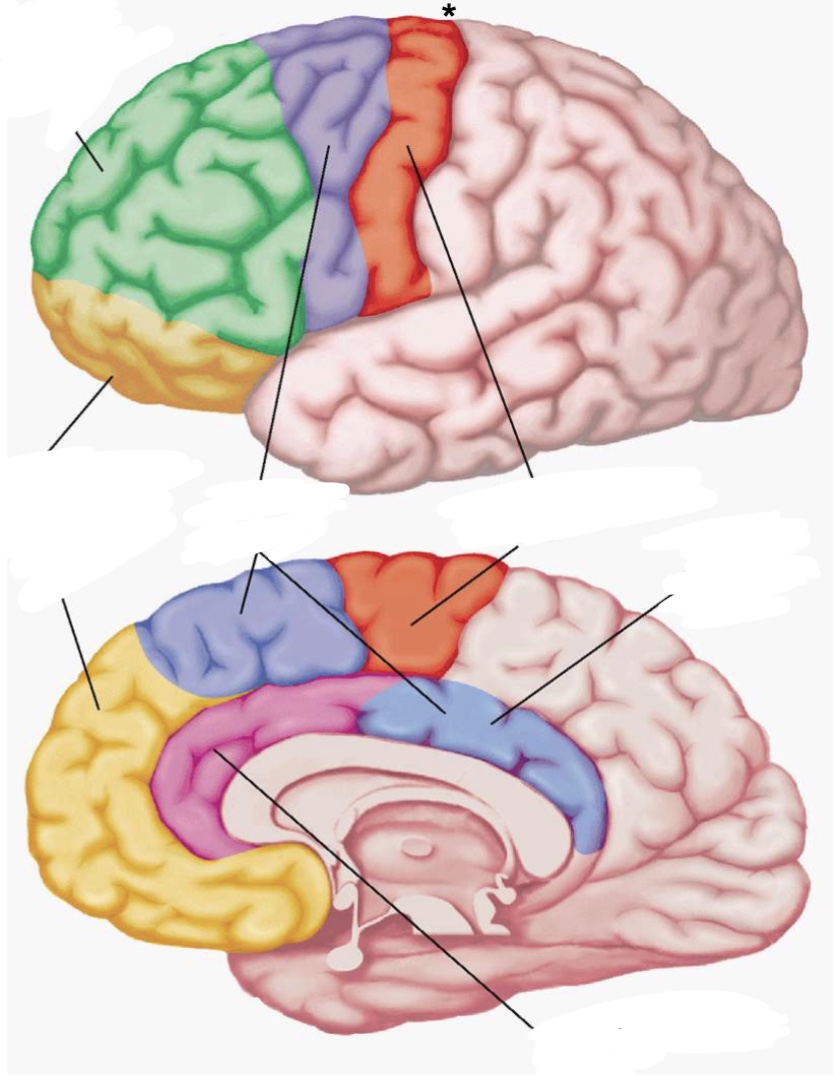
green
lateral pfc
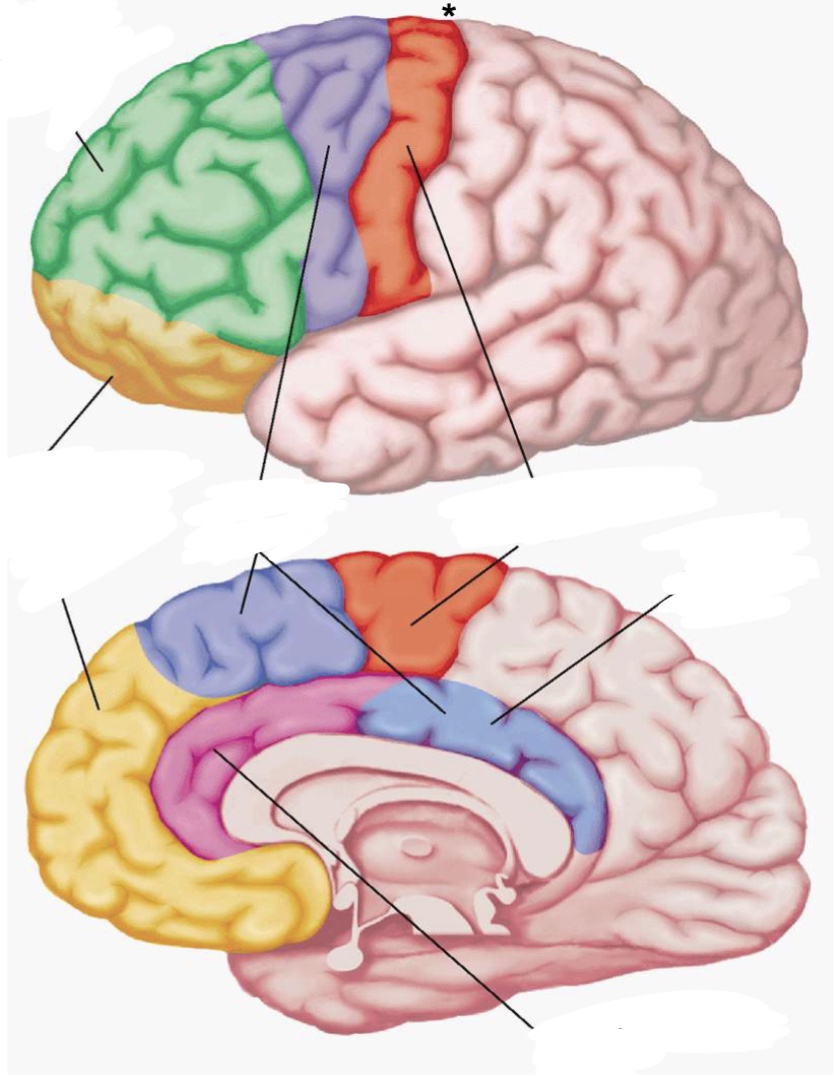
purple
premotor areas
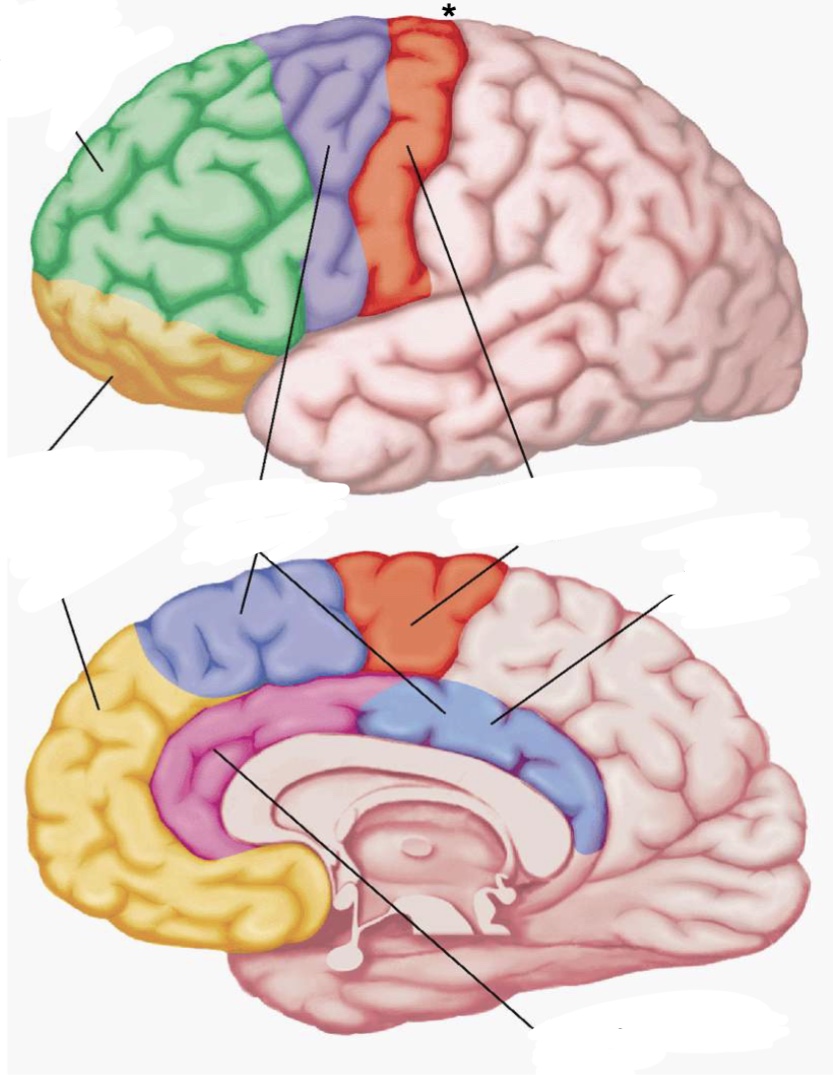
red
primary motor area (M1)
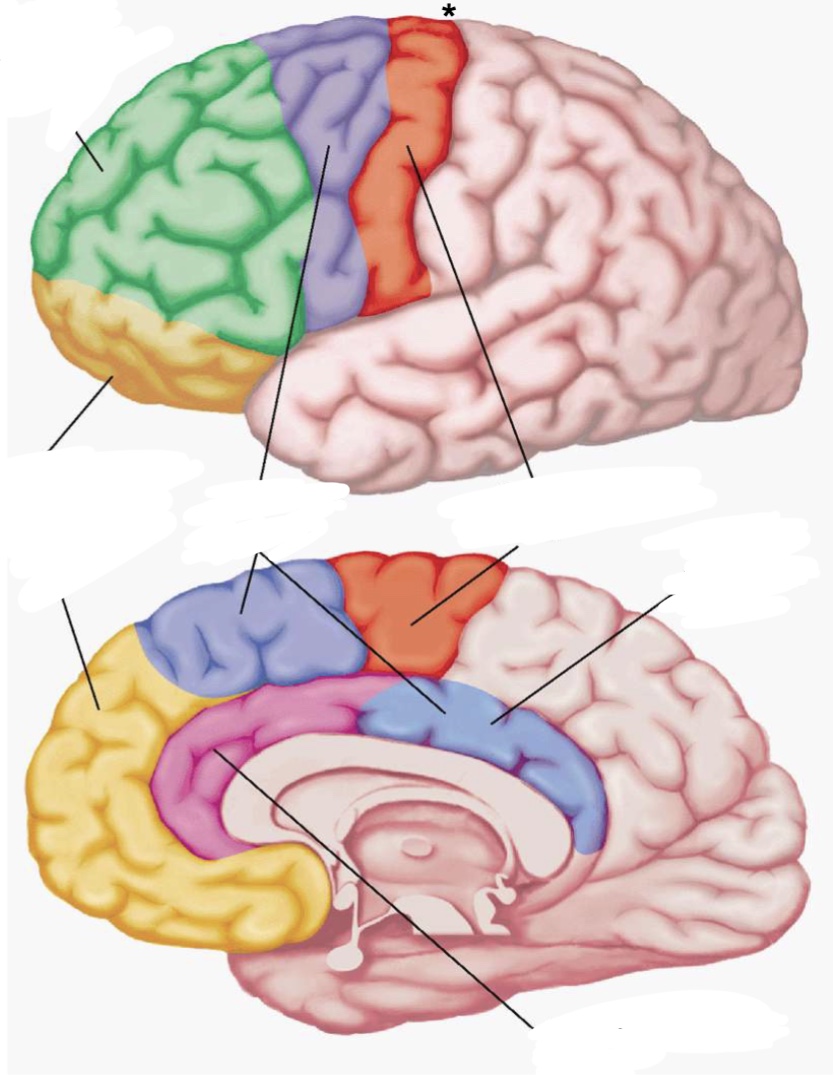
star
central sulcus
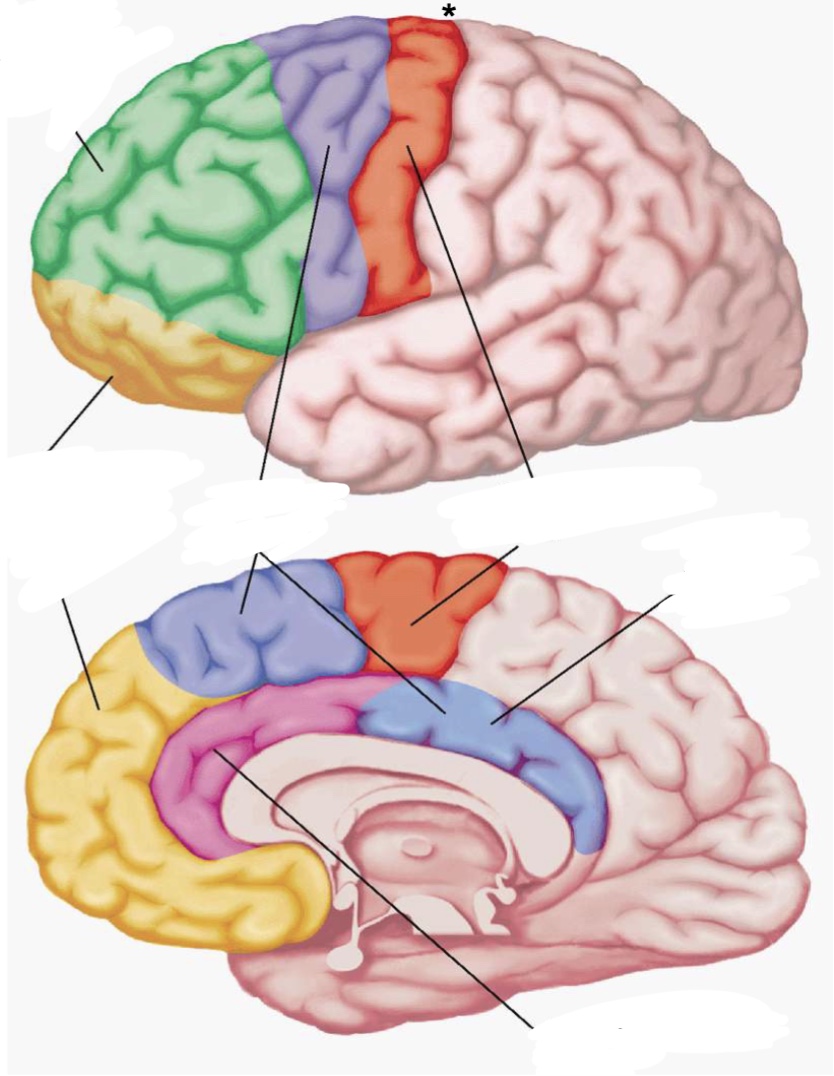
yellow
ventromedial pfc
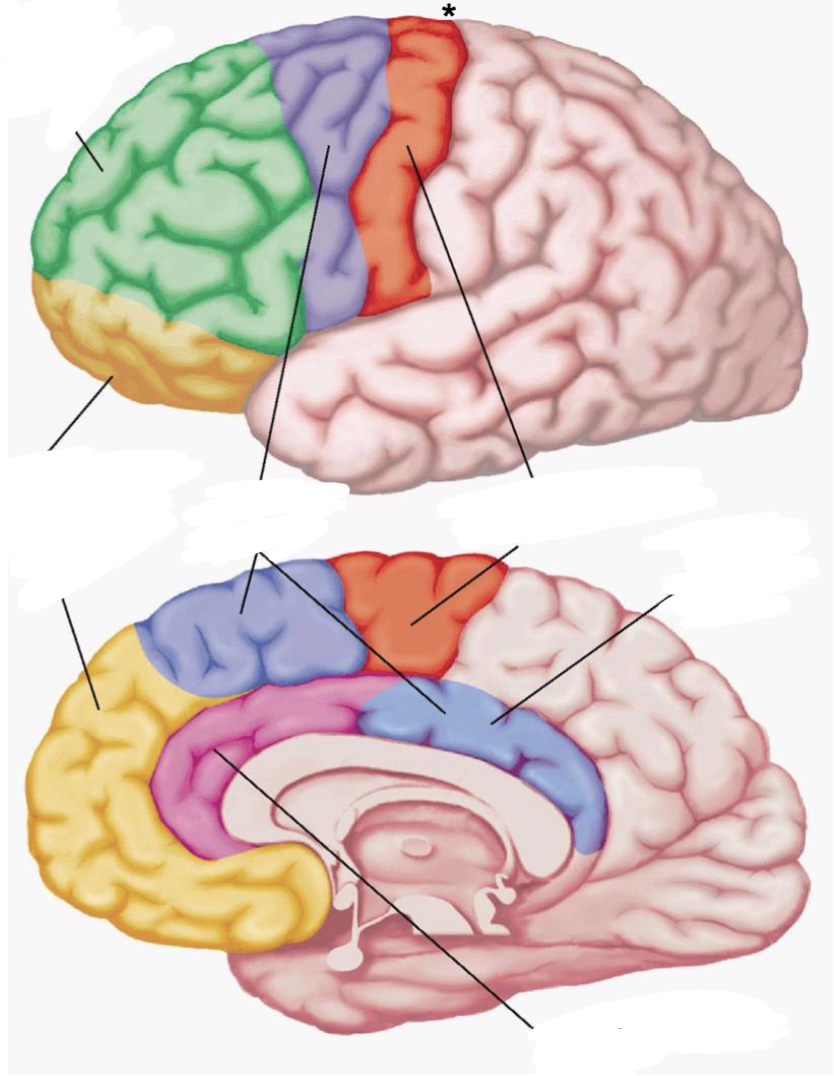
pink
anterior cingulate gyrus
Executive functions
processes that involve the control and monitoring of behaviour
2 distinctions of executive functions
automatic vs controlled: how much conscious effort you put in, how much thinking is required
bottom-up vs top-down: how much you draw from the world around you that drives how much effort you put in
automatic
habitual, ingrained, do them w/o thinking, can multitask with them
bottom-up
driven by sensory input- something appears in visual field, automatically move head & eyes to look at it
controlled
effortful, have to concentrate on them, one thing at a time
top-down
guided by knowledge or strategy
Example: You’re driving to campus, know route well, don’t really have to think, then all of a sudden you hear an ambulance/siren, and you become more present. What mechanism explains this transition?
automatic bottom-up process → controlled top-down process
3 types of executive processes
Planning
Flexibility
Inhibition
Tower of Hanoi (executive functions)
forward PLANNING
move only 1 ring at a time, place each ring directly onto a peg, take only the top ring on a peg, you cannot place a larger ring on top of a smaller ring
have to think thru mind’s eye whole solution
emphasizes ‘thinking into the future’
In relation to the executive process involved in the Tower of Hanoi test, patients with ______ damage confined to the ______ sector experience a _______ deficit and are (impaired / not impaired) at this task.
dorsal prefrontal; lower/orbital; planning; impaired
PET Imaging of Planning
identify number of moves to solve
particip. plans ahead in ‘mind’s eye’
****PET displays cerebral blood flow increasing with problem difficulty aka moves required
Wisconsin Card Sort Test
test of cognitive FLEXIBILITY, called ‘gold standard ‘ task of frontal lobe integrity
feedback processing, inhibition of previous rule
perseveration: sticking with unsuccessful strategy
given card & 4 decks in front
have to think of ways the given card can be sorted- colour, number, shape, etc.
after P chooses which deck to sort in, neuropsychologist says if it’s “right” or “wrong”
P has to figure out what the rule is
rule will stick for repeated trials, then w/o warning rule will change ~ P has to use new method to see what new rule is
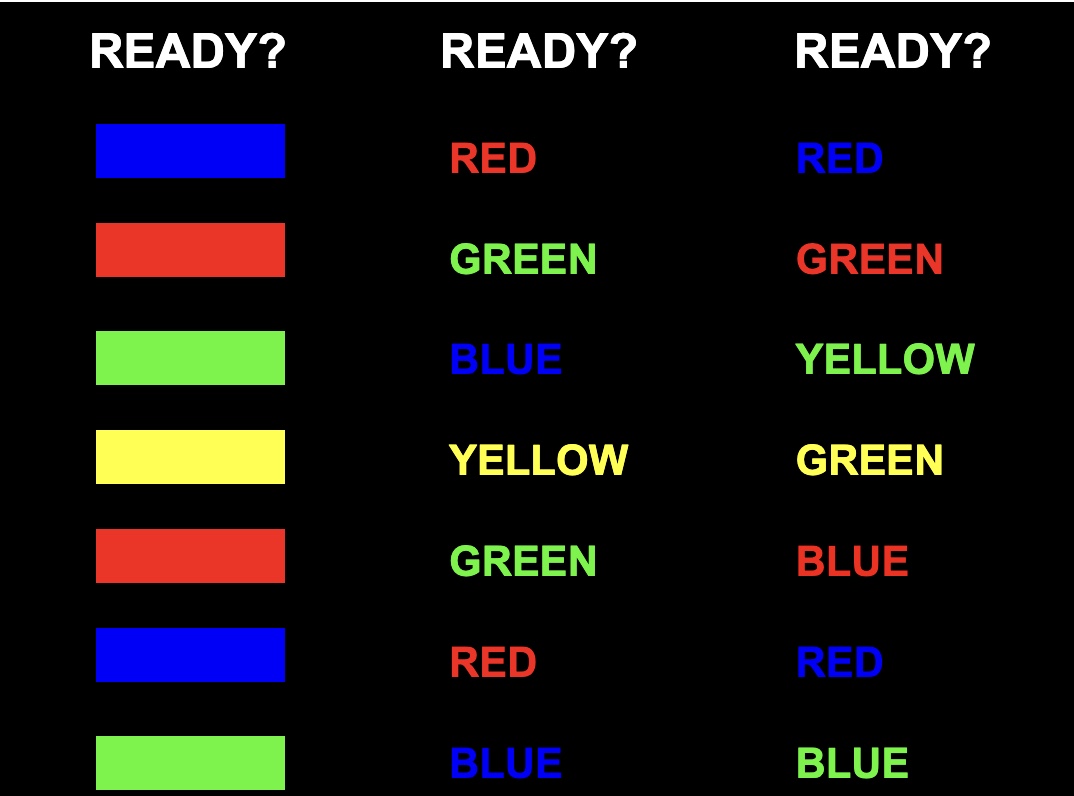
the Stroop Test
way to measure INHIBITION in healthy people
“name the colour of the stimulus”
automatic to read what word says ∵ the unusual colour-naming response asked isn’t used often in life
Analogical problem-solving
process in which new inputs (problems) are interpreted in terms of old knowledge
Characteristics of psychological problems
given state and goal state
number of rules that constrain solution
viable number of moves that create a problem space
problem space
map, can be visual map, conatins given state, goal state, amd all viable states in between
Tower of Hanoi (problem-solving)
measures forward planning
purpose of the study: thinking about rules in real-life scenario - lot of uncertainty in terms of particular outcomes
e.g. forgot keys inside house, now locked out- do you smash the windows open to get into the house, among other possible outcomes?
What’s a way you can solve a psychological problem, particularly one that utilizes forward planning?
means-end analysis (definition)
means-end analysis (term)
analogical problem-solving that offers pathways to effective solutions, ALTHOUGH we often frame things in terms of what we already know and already understand
Note difference between current state and goal state
Form a sub-goal that reduces that difference
Select mental operator that permits attainment of sub-goal
working through subgoals 1 at a time, no master plan in mind’s eye to entire solution to the problem
Psychological factors that affect problem-solving
Constraint relaxation
Addition of new information e.g. a hint
Goal-subgoal conflict
Functional fixedness
Analogy
Matchstick problem
“Imagine these problems are made of matchsticks. I want you to move just one matchstick, in order to make each statement true.”
P’s solve Type B problems slower than Type A
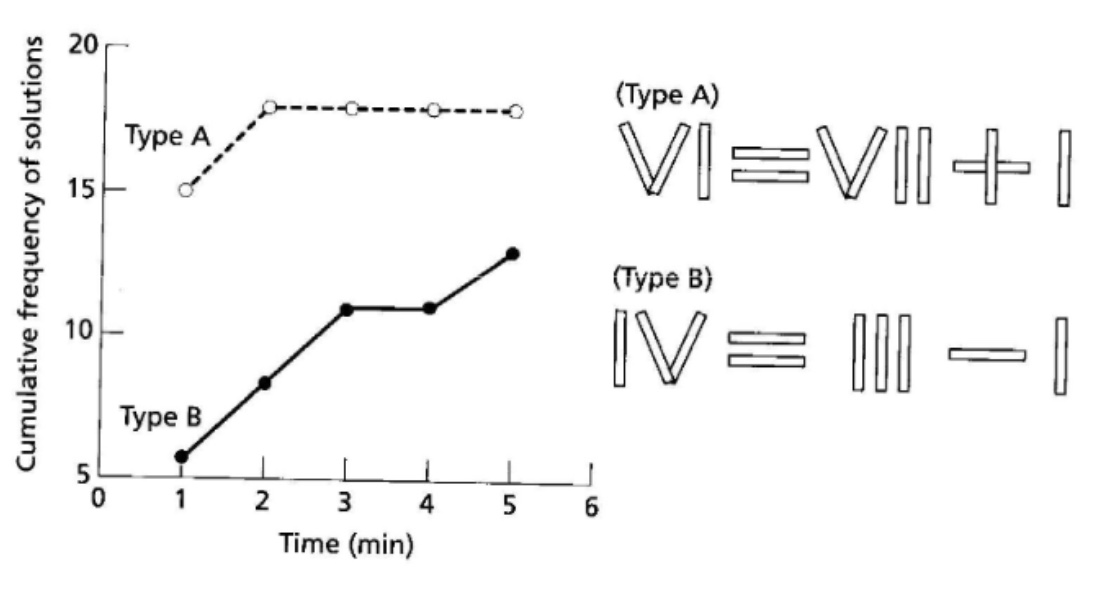
Why are Type B problems harder than Type A in the Matchstick problem?
Type B requires constraint relaxation
for Type A problems, we naturally understand that numbers are things that can be broken up
***assumed/perceived a rule that was never actually stated to you
constraint relaxation
cognitive process of overcoming impasses (assumed/perceived rules) in problem-solving by abandoning unnecessary, self-imposed, or assumed limitations
e.g. Matchstick problem, 9-dot problem
Addition of new information
get a ‘hint’ that draws your attention to certain materials within problem => making it easier
Goal-subgoal conflict
one of subgoals in conflict with ultimate goal, feels like you’re going away from goal state in order to get back there,
have to start off going in the opposite direction to where you want to end up.
e.g. Tower of Hanoi
Maier’s (1931) Two-String Problem
Participants must find a way to swing and tie two strings together that are out of reach of each other, room contains several objects- matches, hammer, nails
Solution: tie hammer to one of the strings, swing hammer → weight allows you to catch it and tie strings
tricky ∵ people don’t realize you can use hammer for that purpose
functionally fixed on the hammer as something you hit stuff with
Duncker’s (1945) Candle Problem
Participants given candle, thumbtacks, matches, → asked to attach a candle to a wall so that it doesn’t drip wax onto the table
Solution: use box of matches or thumbtacks creatively
functionally fixed on the matchbox’s normal function
Functional fixedness
tendency to perceive functions of objects as fixed (a failure to ‘re-structure’ the problem).
e.g. Maier (1931) ~ Two-String Problem, Duncker (1945) ~ Candle Problem
The 2-string problem is difficult because subjects are ‘functionally fixed’ on the conventional uses of a hammer. But when subjects solve the problem, that sudden restructuring of the problem is also interesting to psychologists, and was originally recognized by the Gestaltists. This moment is usually called:
Insight
Radiation Problem
“Imagine you are a surgeon with a patient who has a stomach tumour. If the tumour is not destroyed, the patient will die. However, his condition is such that an operation is impossible: that would also kill him. All you have available are machines producing rays that can destroy tumours; however, rays at sufficient intensity to do this will also destroy surrounding healthy tissue, and that will kill the patient too. How can you save him?”
Fortress Problem
“A general was trying to capture a fortress in the middle of a country. Many roads led out from the fortress. Each road was mined so that only small groups of people could travel the road safely. However, the general needed all his forces to capture the fortress. The general decided to split his army and send small groups down each of the roads so that they converged at the fortress.”
Fortress & Radiation Problems
problem solving by analogy – these scenarios
are ‘isomorphic’
structurally & fundamentally- equivalent
superficially & systematically- different
supposed to use fortress problem & solution as analogy to solve radiation problem
Solution: surgeon can use several ray machines that converge on the tumour with sufficient intensity to destroy the tumour without destroying the healthy tissue
Analogy
applying a known solution to a similar problem
isomorphism
e.g. Fortress & Radiation Problem
Issues with Analogy
humans are poor at spontaneous use of analogy- many subjects also need its relevance to be highlighted
analogy requires mapping structure from known problem to new problem – but hard to know which past problem is relevant!
highest percentage of people who got Radiation Problem correct who were given Fortress Problem, its solution, AND a hint that it might be relevant to solving the Radiation Problem, compared to people who solved it without the hint, or simply unprompted
‘Aha!’ Experience
Insight moment
solution appears suddenly, powerful moment when way to arrive at solution clicks
key to these experiences ~ how sudden they are e.g. using “hot”/”cool” to measure how close to solving a problem, participant feels cold, then all of a sudden they get it