Calcium and phosphorus homeostasis
 Call Kai
 Learn
Learn Practice Test
 Spaced Repetition
 Match
Match Flashcards
 Knowt Play
1/33

There's no tags or description
Looks like no tags are added yet.
Name | Mastery | Learn | Test | Matching | Spaced | Call with Kai |
|---|
No analytics yet
Send a link to your students to track their progress
34 Terms
What are the two classes of hormones?
Water soluble and lipid soluble
How do water soluble hormones interact with cells?
They bind to receptors on the surface of the cell
How do lipid soluble hormones interact with cells?
They bind to receptors in the cytoplasm or nucleus of the cell
Compare the transport of water and lipid soluble hormones
WS: Freely soluble in blood plasma
LS: Protein-bound in blood plasma. Only the free portion is biologically active, the protein-bound portion acts as a reservoir
Do water or lipid soluble hormones act faster?
Water soluble
Do water or lipid soluble hormones have a longer half life?
Lipid soluble
What is the role of growth hormone?
It is a tropic hormone which stimulates the liver to produce insulin-like growth factor 1 (IGF1). This stimulates growth of all tissues.
Growth hormone also has a direct effect on the target tissues:
- Growth of body mass and elongation of bones (so essential for growth until skeleton is fully developed)
- Cartilage and soft tissue growth
- Important in lactation
- Stimulates protein synthesis and lipolysis
- Inhibits tissue uptake and utilisation of glucose (opposes insulin)
How is growth hormone secretion regulated?
Two hormones both produced by the hypothalamus: growth hormone releasing hormone (GHRH) and growth hormone inhibiting hormone (GHIH) / somatostatin
GHRH is the most important
What increases demand for growth hormone?
- CNS input
- Strenuous physical activity
- Starvation
- Stress
- Decreased plasma glucose and FFAs
- Increased plasma amino acids
- Ghrelin from parietal cells and the hypothalamus
- Thyroid hormone, oestrogens and androgens
What are calcium and phosphate stored as in bone?
Hydroxyapatite
How much of the body's calcium is stored in bone?
99%
Describe the levels of calcium in plasma
Total Ca2+ concentration = 2.5mM/l
10% associated with anions, 40% protein-bound, 50% free
Therefore free Ca2+ concentration = 1.25mM/l
This needs to be tightly regulated (within 2%)
How is plasma Ca2+ maintained?
- Absorbed from the gut (increases plasma Ca2+)
- Excreted from the kidneys (decreases plasma Ca2+)
- Absorbed by or released from bone
Which process causes vitamin D2 and D3 to become biologically active?
Hydroxylation
Where is vitamin D2 produced?
In plants
Where is vitamin D3 produced?
In skin in response to UV light
Describe the hydroxylation process of vitamin D
- Hydroxylated twice
- First hydroxylation in the liver forms 25-hydroxycalciferol (still inactive)
- This can be stored in adipose tissue
- Second hydroxylation in the kidneys forms 1,25-dihydroxycalciferol (also called calcitriol). This is the active form of vitamin D
How is calcitriol transported?
It is lipid soluble, so needs to be protein-bound in the blood. It travels bound to vitamin D binding globulin
What is the effect of calcitriol?
Increases plasma Ca2+ by:
- Increasing Ca2+ uptake from small intestine (main effect)
- Increases renal reabsorption of Ca2+
- Increases mobilisation of Ca2+ from bone
Which hormone regulates the metabolism of vitamin D (and formation of calcitriol)?
Parathyroid hormone
Describe the parathyroid glands
- Four total
- Two on each lobe of the thyroid
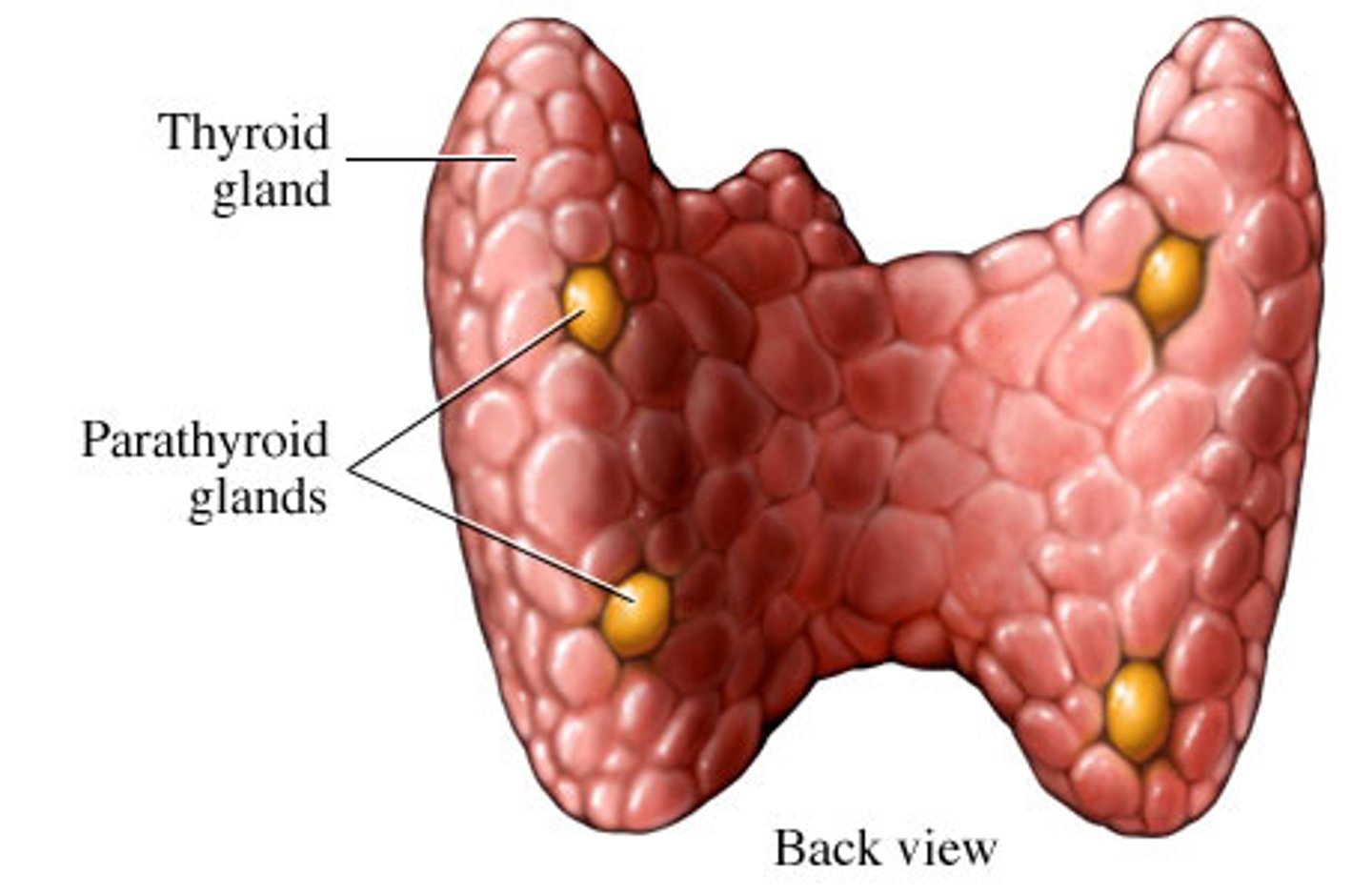
Which cells produce parathyroid hormone?
Chief cells of the parathyroid gland
How do the parathyroid glands help regulate Ca2+?
- Detect small decreases in free Ca2+
- Release parathyroid hormone (PTH)
- PTH increases mobilisation from bone, decreases urinary excretion from the kidneys, and increases calcitriol production so more Ca2+ is absorbed from the gut
Which cells allow mobilisation of Ca2+ from bone?
Osteoclasts
What is parathyroid hormone related protein (PTHrP)?
It is a protein with the same function as parathyroid hormone. It is produced naturally in small amounts by most tissues, but certain types of cancer cause it to be overproduced. It is not under negative feedback like PTH, so this leads to hypercalcaemia
Which hormones regulate plasma Ca2+?
- Calcitonin (produced by thyroid gland, lowers Ca2+)
- Parathyroid hormone (produced by parathyroid glands, increases Ca2+)
Which cells produce calcitonin?
C cells (parafollicular cells) of the thyroid gland. They are dotted around outside the follicles
What are the effects of calcitonin?
- Inhibits osteoclasts (so less bone broken down)
- Increases urinary excretion of calcium
- Decreases absorption of Ca2+ from the gut
What is the ratio of Ca:P in the body?
2:1
How much of the body's phosphate is stored in bone?
85%
How is regulation of phosphate different to regulation of calcium?
Ca2+ regulation depends largely on absorption in the small intestine, phosphate regulation depends largely on urinary excretion
What is the effect of parathyroid hormone on phosphate?
Increases urinary excretion by decreasing reabsorption in the PCT (so decreases plasma phosphate levels)
Why does PTH need to increase plasma Ca2+ but decrease plasma phosphate?
When bone is broken down, equal amounts of calcium and phosphate are released, but a 2:1 ratio is needed so some of this phosphate needs to be removed
When is demand for calcium highest?
- Late gestation (as foetal skeleton mineralises)
- Lactation (lots of calcium is needed to produce milk)
- Eggshell production (in birds)