Language & Development - Block 3
 Call Kai
 Learn
Learn Practice Test
 Spaced Repetition
 Match
Match Flashcards
 Knowt Play
1/155

There's no tags or description
Looks like no tags are added yet.
Name | Mastery | Learn | Test | Matching | Spaced | Call with Kai |
|---|
No analytics yet
Send a link to your students to track their progress
156 Terms
Neonates
the term used for newborns/under 4 weeks
Methods for studying newborns
Looking time methods (Visual preference, habituation, violation of expectation)
Preferential sucking
Eye tracking
Physiological measures like EEG
Poor control
Infants have ____ ______ over eye focus necessary for sharp focus. Visual acuity of infants is approximately 1/30th the level of adult acuity. Both factors improve rapidly over 6 months
Acuity
Another term for sharpness of vision
Accommodation
Another term for visual focus
Spontaneous visual preference
two visual stimuli (left and right), preferential looking, measure which one they look at more
Human faces
Infants have an innate preference for _____ _____ as early of 5 days of age, as well as their mother's face just 12 hours old.
Edges, central
At 1 month old, infants eyes study the ____ of a human face, where as at 2 months old, they study the ______ part of the face
Chimeric
Infants also prefer attractive or _______ faces. This is a prototypical face.
Habituation
The process in which attention to novelty decreases with exposure Used to test infants' sensory abilities and memory
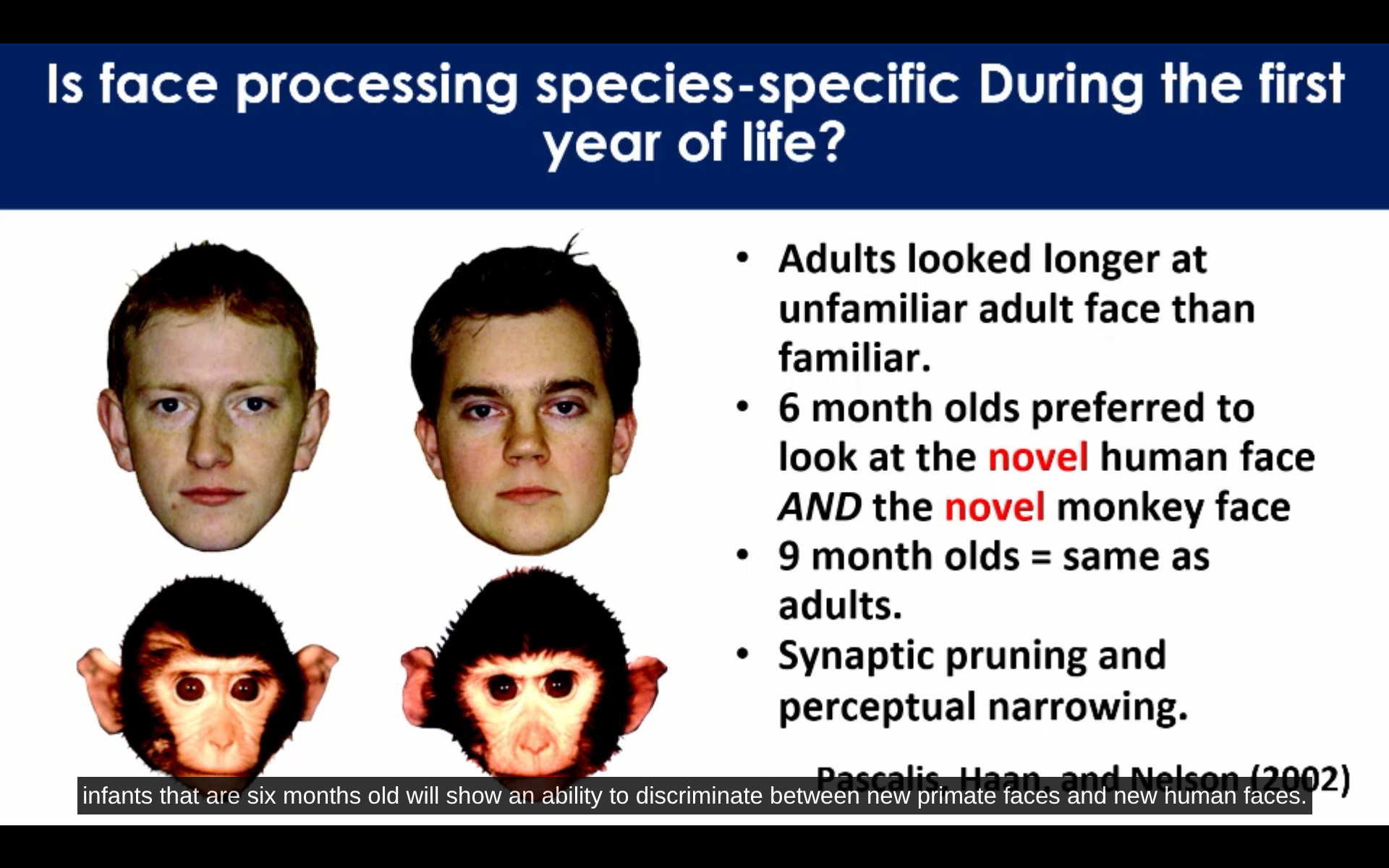
Pascalis, Haan & Nelson (2002)
Infants at 6 months old have the ability to discriminate between new, similar looking primate faces AND human faces. Adults are not telling the difference between the primate faces as much
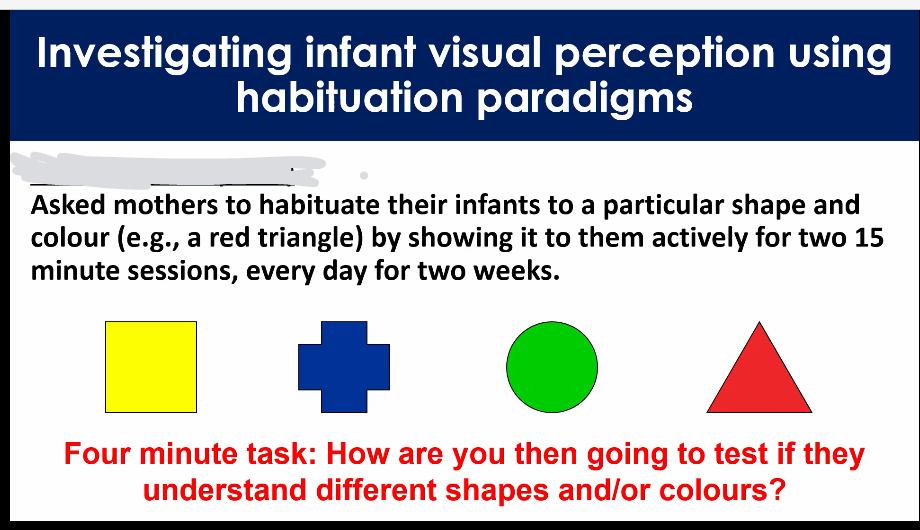
Bushnell et al. (1984)
Asked mothers to habituate their infants to a particular shape and color (e.g., a red triangle) by showing it to them actively for two 15 minute sessions, every day for two weeks
Habituation rate
This can be an indicator of brain integrity and cognitive competence, such as IQ.
Birth difficulties can result in slower habituation and may indicate neurological defects.
Visual recognition memory predicts IQ.
Visual recognition memory
ability to distinguish a familiar visual stimulus from an unfamiliar one when shown both at the same time
degree of preference for novelty
Violation of expectation
Stimuli that involve moving objects:
allows us to measure object knowledge in very young infants and how they reason about physical events
reveals infants as "budding physicists" (Spelke 1994)
infants show impressive awareness of rules that govern physical entities
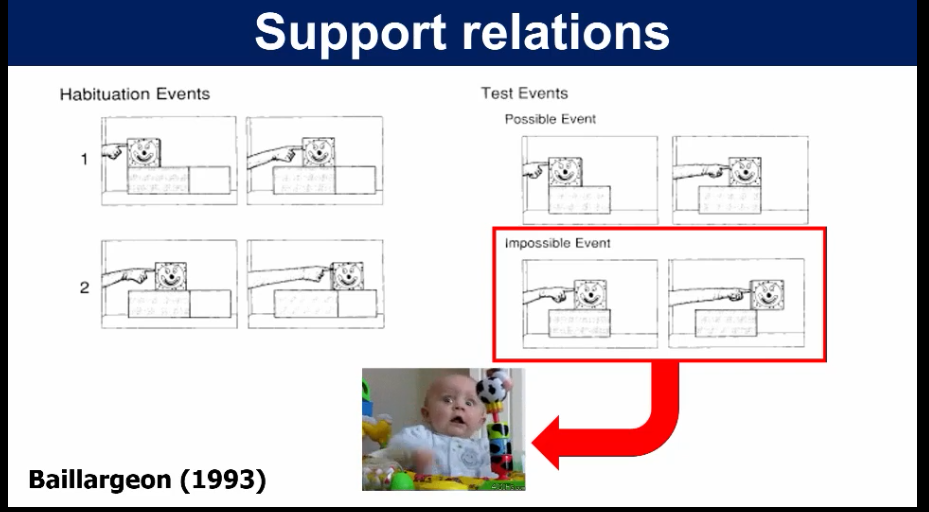
Baillargeon (1993)
Habituation tasks studying impossible events - violation of expectations.
Kim & Spelke (1992)
Infants show preference for unnatural event at 7 months but not at 5 months.
Surprise = evidence for concept of gravity
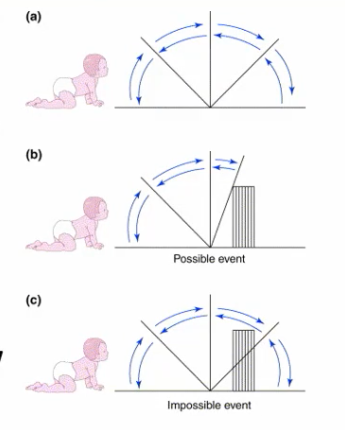
Baillargeon's Drawbridge task
Infants familiarized with repeated event a flap rotated from flat on the table through 180 degrees
Two types test event presented, in both, a cube was placed in the path of the flap
"Possible" event: flap rotated but came to a stop when met the cube
"Impossible" event: flap rotated full 180 degrees through cube
Infants as young as 3.5 months looked at more impossible event, MEANING they understand object permanence and that an object cannot move through another
Remember to be skeptical
Photo
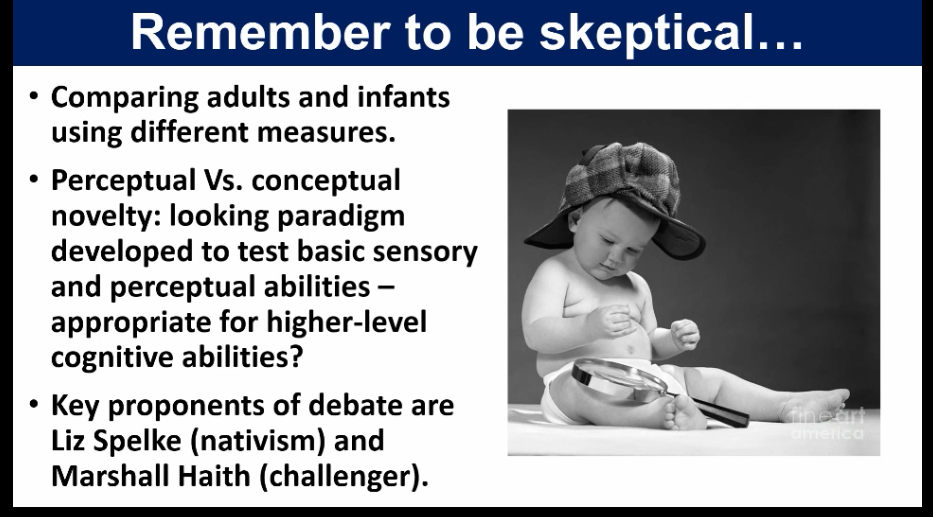
High amplitude sucking (HAS)
A technique used to study infant perceptual abilities; typically involves recording an infant's sucking rate as a measure of its attention to various stimuli.
Dummy is connected to pressure transducer. When it reaches predetermined level, a stimulus appears. Can be used in habituation procedures
Eimas et al. (1971)
Study using HAS. 2 month olds can discriminate phonemes [p] in pat from [b] in bat.
Khul (2011)
Study using HAS. 6-8 month old infants in Japanese-speaking environments can discriminate [ra] and [la] while some adults cannot
DeCasper and Fifer (1980)
Study using HAS and studying transnatal learning. Newborns prefer their mom's voice.
DeCasper and Spence (1986)
Study using HAS and studying transnatal learning. Newborns "remember" stories they heard in the womb.
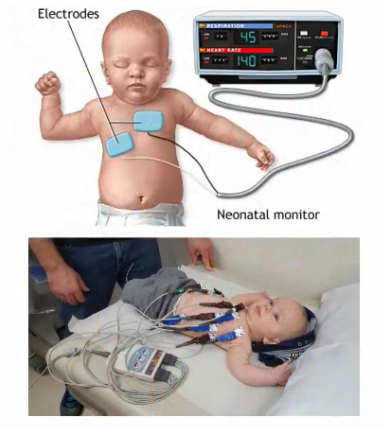
Electrocardiogram (ECG)
Measures heart rate
Falls with decreased attention, increases with wariness
Can even measure feral heart rate - responds to sounds at only 12 weeks gestation
Can be combined with other measures
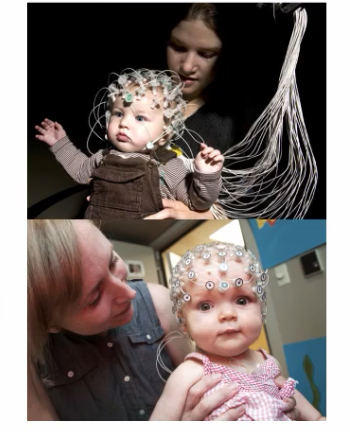
High-density event-related potentials (ERPs)
Involves placing "geodesic net" composed of large number of electrodes onto head
Sensors pick up the natural electrical changes at the scale as groups of neurons are activated within the brain
Infants' brains show more widespread activation when presented a face than adults — evidence gradual specialization and pruning of connections with development
Danielle Lierow
Spent the first 8 years of her life alone with minimal social interactions. Cognitively, she will likely remain at 6-24 months for the rest of her life.
Harlow (1958)
Harlow conducted research with 8 rhesus monkeys which were caged from infancy with wire mesh food dispensing and cloth-covered surrogate mothers, to investigate which of the two alternatives would have more attachment behaviours directed towards it. Harlow measured the amount time that monkeys spent with each surrogate mother and the amount time that they cried for their biological mother. Harlow's findings revealed that separated infant rhesus monkeys would show attachment behaviours towards a cloth-covered surrogate mother when frightened, rather than a food-dispensing surrogate mother. Monkeys were willing to explore a room full of novel toys when the cloth-covered monkey was present but displayed phobic responses when only the food-dispensing surrogate was present.
Bowlby (1958)
claimed baby's attachment type was determined by warmth and continuity of parental love a balance between exploration and proximity
Social signals
Unlike other species, human infants are unable to follow adults so they depend on_____ _____
Spandrels
It is possible for traits to have no biological function. They can be by-products of other useful traits.
Kewpie doll effect
the notion that infant-like facial features are perceived as cute and lovable and elicit favorable responses from others
"neotenous" features
Miesler, Leder, and Herrmann (2011)
Made cars look "cuter" by applying baby schema
Parent-infant interactions
Meets basic needs, protection, and survival
Promote social understanding
Acquire language
Emotional regulation
Before
Facial gestalts/expressions can develop ______ birth.
The social baby: smiling
Before 1 month, infants' smiles are reflexive
By 1-2 months, infants start to smile during social engagements and interactions with adults
Infants smile in response to pleasing and gently surprising social stimuli
Around 8-10 months, infants smile at an object and then gaze at an adult while continuing to smile (anticipatory smiling: socially communicative act: "That was a funny toy, wasn't it?"
Smiling aids process of attachment/bonding
Parents report wanting to spend more time with their infants once they begin smiling
Basic Emotions
Happiness Interest Surprise Disgust Sadness Distress Anger Fear
Complex Emotions
Embarrassment Guilt Jealously Pride Shame Shyness
self-conscious emotions
Michael Lewis Emotions that require self-awareness, especially consciousness and a sense of "me"; examples include jealousy, empathy, and embarrassment.
Mirror Self Recognition (MSR)
This ability emerges around 15-24 months
Bischof-Kohler (1991)
Only infants who passed the MSR task displayed empathy (facial expression or action)
Lewis, Sullivan, Stanger, and Weiss (1989)
Infants who showed embarrassment also showed recognition of self in the mirror
Draghi-Lorenz
Some developmentalists have proposed a radically different chronology. Evidence supporting self-consciousness distinction has been challenged with interpretations accused of being theory driven.
coy smile
This is thought to reflect the feeling of ambivalence between pleasure and aversion during the social interaction (seen in adults and children)
Reddy (2000)
Coy smiles reported in 2-4 month infants following the onset of attention from other or self in the mirror
Draghi-Lorenz, Reddy, & Morris (2005)
Study: These expressions are perceived as shy, coy, bashful, or embarrassed by naive adults
not
These coy smiles do ___ assume a sense of self
Hart and Carrington (2002, 2004)
6 months: exhibited greater negativity when mothers directed positive attention towards a lifelike baby doll vs a book
Piaget (1932)
8 months: reported jealously in babies when other people take their place in the mother's attentions
Mize et al. (2014)
9 months: recent EEG research demonstrates that jealousy identifiable through anterior activity
Lewis (1997)
Argues that until the infant is capable of consciousness, the ability to experience emotions - even basic ones - doesn't exist
Field (1982)
Neonates can discriminate between emotions posed by live model and even imitate the expressions
Hepach & Westermann (2013)
Infants viewed videos of actors showing happy or angry demeanor
- show emotion and action (petting the pet tiger vs punching the pet tiger)
- measured pupil dilation
- older infants (14 months) surprised by incoherence, younger infants (10 months) were not
- violation of expectation method
1-3 hours
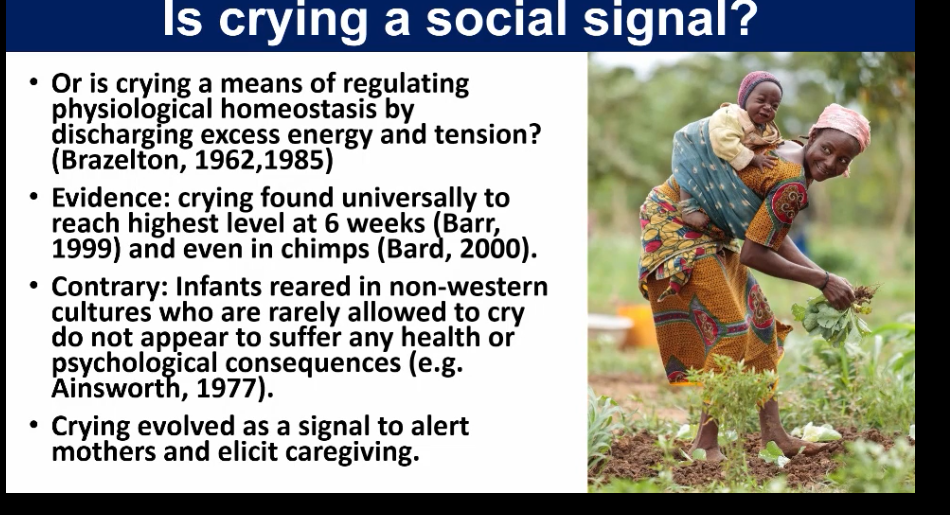
Infants cry anywhere from ______ _____ a day in the first 6 weeks of life.
Schaffer (1971)
3 patterns recognized by mothers.
Basic (e.g., hunger) starts arhythmically, builds up
Mad/angry: with phases varying in length
Pain: sudden onset, long loud cry-breath holding
Studies on crying
Photo
Mampe et al. (2009)
Newborns cry melody is shaped by their native language. This means the ability to actively produce language is present much earlier than previously assumed.
Meltzoff and Moore (1977); Kugiumutzakis (1985)
Piaget believed initiation was impossible until 8-9 months. However, this study saw that newborns a few minutes old can imitate facial expressions of other people.
Oostenroek et al. (2016)
Infants <2 months were just as likely to produce gestures in control conditions as models
Protoconversations
Infants join in rhythmic protoconversational exchanges from birth. From 6 weeks, infants orient strongly to a partners eyes and they join in turn taking. Protoconversations including coordinating coos, pre-speech lip and tongue movements, and hand gesture
Tronick (1989)
Still face procedure
- Infants 2 months old show disturbance — gazing warily at mother, alternately smiling and sobering, looking away
Murray and Trevarthen (1985)
Infants (2m) and mothers communicated via a video system live interaction. Played back to infant out of sync. Infant quickly disengages, looks away, and even shows distress
Social referencing
Infants look to caregiver to glean info on how to respond to uncertain situation Studies use potentially frightening situations to study whether infants use maternal cues to guide.
Straino and Rochat (2000)
At 1 year old, infant will respond positively to stranger if mother's reaction is positive
2 months
At what age does smiling cease to be reflexive and infants start to smile in response to pleasing/gently surprising stimuli?
Pupil dilation
What was Hepach and Westermann's (2013) DV when they reported the infants showed surprise when presented with incongruent emotion and action?
Mutual Knowledge Problem
occurs when agents are not necessarily aware of each other's knowledge
Gesture
- A universal feature of human communication
- Produced by speakers in every culture we know of
- Can be used in absence of visual communicative partner
- often taken for granted
Koko the gorilla
regularly uses ASL signs understood more than 1000 signs and 3000 spoken words
Dunbar (1996)
Gossip and grooming hypothesis — a pressure for more efficient communication
Gillespie-Lynch et al. (2013)
Gestural theory posits that human language developed from gestures — the initial means of communication
Operationalization
Turning abstract concepts into measurable observations
Emblems
These are NOT gestures in the way we are studying necessarily. They are specific gestures with specific meaning that are consciously used and understood. Sometimes they are culturally specific. (Peace sign, heart sign, etc.)
Sign language
This is also not what we are studying in terms of gestures.
Ostensible gestures
What we DO mean by gesture. These are a trote of intentional communication where a child uses a gesture, often involving holding or touching an object, to direct another person's attention. They are considered the first gestures that children produce to communicate, control behavior, and understand the world around them.
Deictic gestures
Pointing gestures
Iconic gestures
gestures with a form that represents the concept about which a speaker is talking Semantic gesture
Broaders and Goldin-Meadow (2010)
This study showed that gestures can mislead in child interviews
Metaphoric gestures
This is is type of Iconic gesture these are used to present something abstract or related to maths/spelling
beat gestures
gestures that occur in a rhythm that matches the speech rate and prosodic content of speech
Vygotsky (1978)
Infant's communication may not begin intentionally, but they learn response associations Example: infant reaches towards something they want, mother interprets this and gives the infant the item they want
Speech
______ and gesture are tightly coupled
Babbling
Repeated sounds that happen at 6 months first evidence that infant is trying to communicate 75% co-occurrence with rhythmic manual activity
Petitto and Marantette (1991)
Hand babbling: raised by deaf parents
Word comprehension
8-10 months paired with deictic gestures and culturally derived gesture routines
CDI
Communicative, Developmental Inventory which is a measure of infant vocabulary
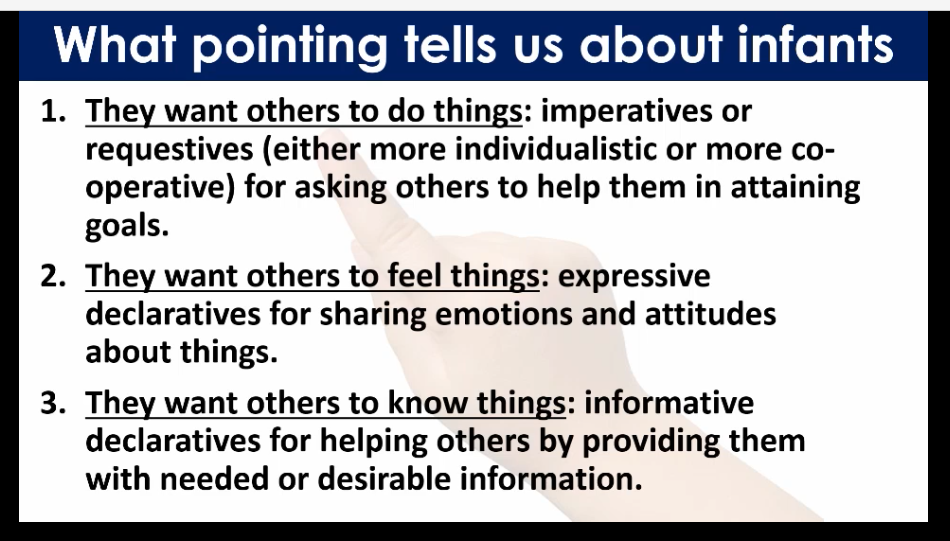
Functional pointing
Can either be imperative (get the adult to do something) or declarative (get the adult to know something) can be related to cooperation - the video with the two tubes and can
Liszkowski et al. (2007)
Explored declarative pointing using a range of toys Adults expressed interest or disinterest and it was argued that they understood the adult did not share their enthusiasm as they did not prolong or repeat their pointing
Liskowski et al. (2004)
12 month old babies where shown a puppet behind a screen and manipulated the experimenter's reaction Showed awareness of others reactions
Liskowski et al. (2009)
Explored pointing to help others. Adults dropped differ by objects in infant's vicinity and amount of pointing to help adult look for objects was measured
Summary of pointing
Image
First words
There is a 3 month lag between this deictic gestures. Happens anywhere from 10-14 months of age
Complementary
One kind of gesture speech combo. Happens around 15-16 months Directly pointing at bag and saying "bag"
Supplementary
Another kind of gesture speech combo. Happens around 16-22 months Provides extra information. looking at empty milk bottle and saying "gone!"
One word stage
Around 11 months +
Two word stage
Happens around age 2/18-24 months
Few, high
American children produce very ___ symbolic gestures compared to their ____ production of pointing gestures.
As many
Italian children produce __ ____ symbolic gestures as pointing gestures. Also their gestures are more varied Example: Objects (wiggling nose for rabbit), Actions (empty hand to mouth for eat), Characteristics (waving hands for hot)
Around 12 months
This is when first words and symbolic gestures + increasing sophistication in play happen
Enactive naming
-Around 12 months infants begin to produce actions carried out on object, e.g. holding phone to ear, drinking from empty cup. -These play schemes argued to be enactive names for things (Escalona, 1973). -Demonstrate infants' ability of symbolic representation and form the beginnings of symbolic play (Inhelder et al 1971).