Biology 1020 Chapter 34
 Call Kai
 Learn
Learn Practice Test
 Spaced Repetition
 Match
Match Flashcards
 Knowt Play
1/108

There's no tags or description
Looks like no tags are added yet.
Name | Mastery | Learn | Test | Matching | Spaced | Call with Kai |
|---|
No analytics yet
Send a link to your students to track their progress
109 Terms
The study of the interactions of organisms with each other and with their physical environment is called?
Ecology
Click and drag on elements in order from largest to smallest with respect to ecological organization.
biosphere
ecosystem
community
population
organism
Distinguish between a population and a community.
A population is all of the organisms of the same species within a specific area. A community is all of the populations present in one location.
Describe the central goal of modern ecology.
Ecology seeks to better understand how organisms interact with other organisms within their physical environmnt.
population
Group of organisms of the same species occupying a certain area and sharing a common gene pool.
Species
Group of similarly constructed organisms capable of interbreeding and producing fertile offspring; organisms that share a common gene pool; the taxon at the lowest level of classification.
Community
Assemblage of species interacting with one another within the same environment.
Ecosystem
Biological community together with the associated abiotic environment; characterized by a flow of energy and a cycling of inorganic nutrients.
Biosphere
Zone of air, land, and water at the surface of the Earth, in which living organisms are found.
Which of the following is the best example of a population?
A flock of starlings in a roost tree.
A community is different from a population because?
The community includes multiple species interacting.
A community and its physical environment including both living and nonliving components is call a(n)
ecosystem
The study of interactions between living things and all aspects of their environments is called?
ecology
The biosphere can be defined as the collection of all of the ____ on Earth.
ecosystems
The ecological level that includes various populations, but is only one component of an ecosystem, it the--.
community
All of the organisms of the same species interacting with the environment in a given area is referred to as a(n)--.
population
If a population of 500 individuals has a birth rate of 40 per year and a death rate of 80 per year the per capita growth rate is?
-8%
Which of the following is an example of a community?
butterflies and bees feeding on flowers in a garden
The biotic potential for a species?
is the highest possible per capita rate of increase.
An ecosystem is
a community with all of the living and nonliving components.
All of the ecosystems of Earth, including their biotic components, are collectively known as the--
biosphere
The type of growth curve expected for a population undergoing exponential growth is -- shaped.
J or j
Given a population of 1000 individuals that is growing exponentially with a per capita growth rate of 40%, what will the size of the population be after one year?
1400
If a population of 100 individuals has a birth rate of 40 per year and a death rate of 20 per year the per capita growth rate is?
20%
The two types of population growth are-- and --.
exponential / logistic
The absolute highest possible per capita growth rate that would only be obtained if each individual was able to maximize reproductive output is called the -- --.
biotic potential
Select all that apply
Select the phases of an exponential growth curve.
exponential / lag
A community and its physical environment including both living and nonliving components is called a(n)--.
ecosystem
Select all that apply
Select the conditions that are components of environmental resistance.
Food supply / competition / predation
True or false: In a population that is growing exponentially, the number of individuals added to the population each generation remains the same.
False
Given a population of 300 individuals that is growing exponentially with a per capita growth rate of 50%, what will the size of the population be after one year?
450
What type of population growth curve does the tan line on this graph represent?
logistic
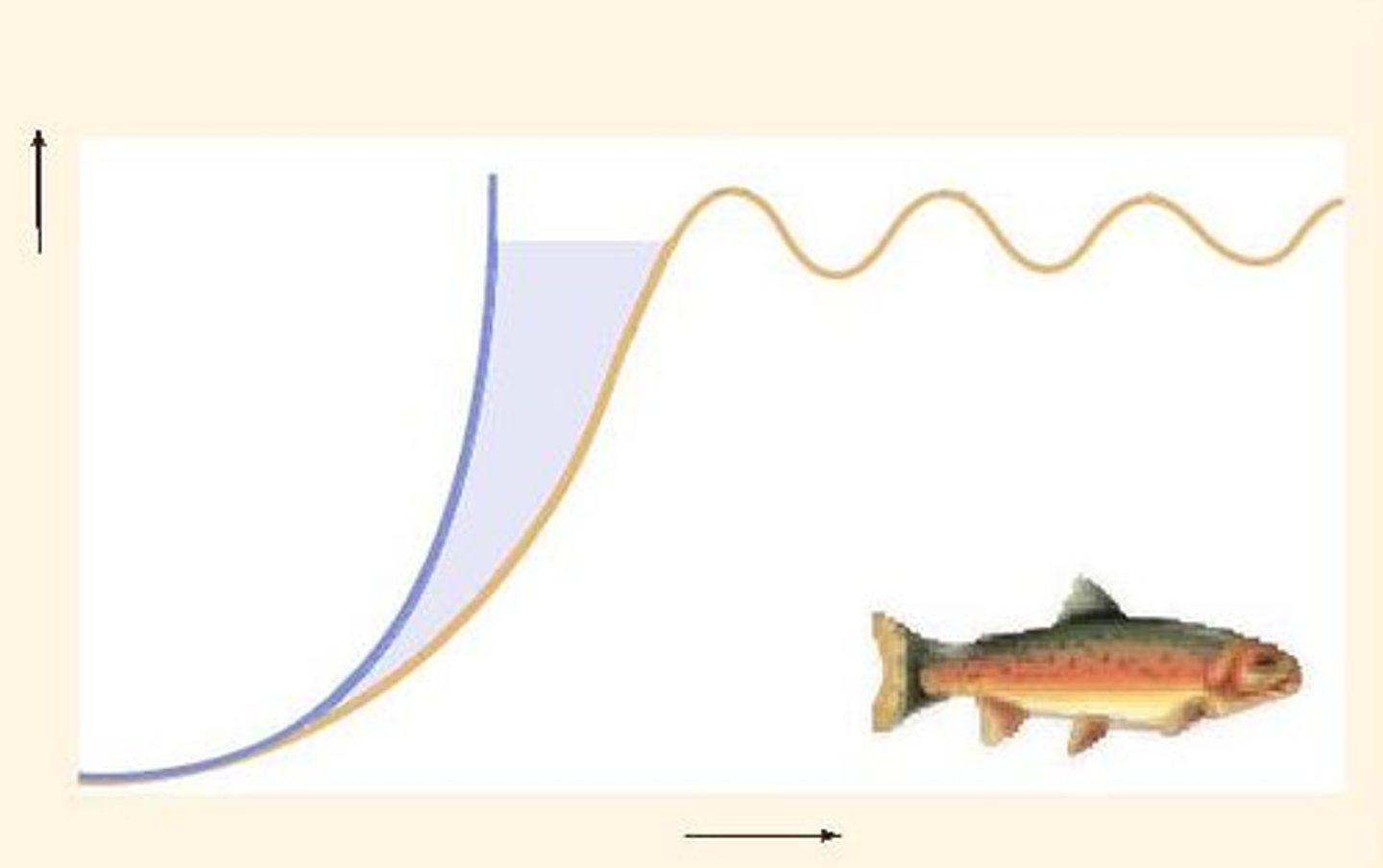
Select all that apply
Select the two types of population growth.
exponential / logistic
The growth curve for logistic growth is -- shaped
S
What type of population growth does this graph represent?
exponential
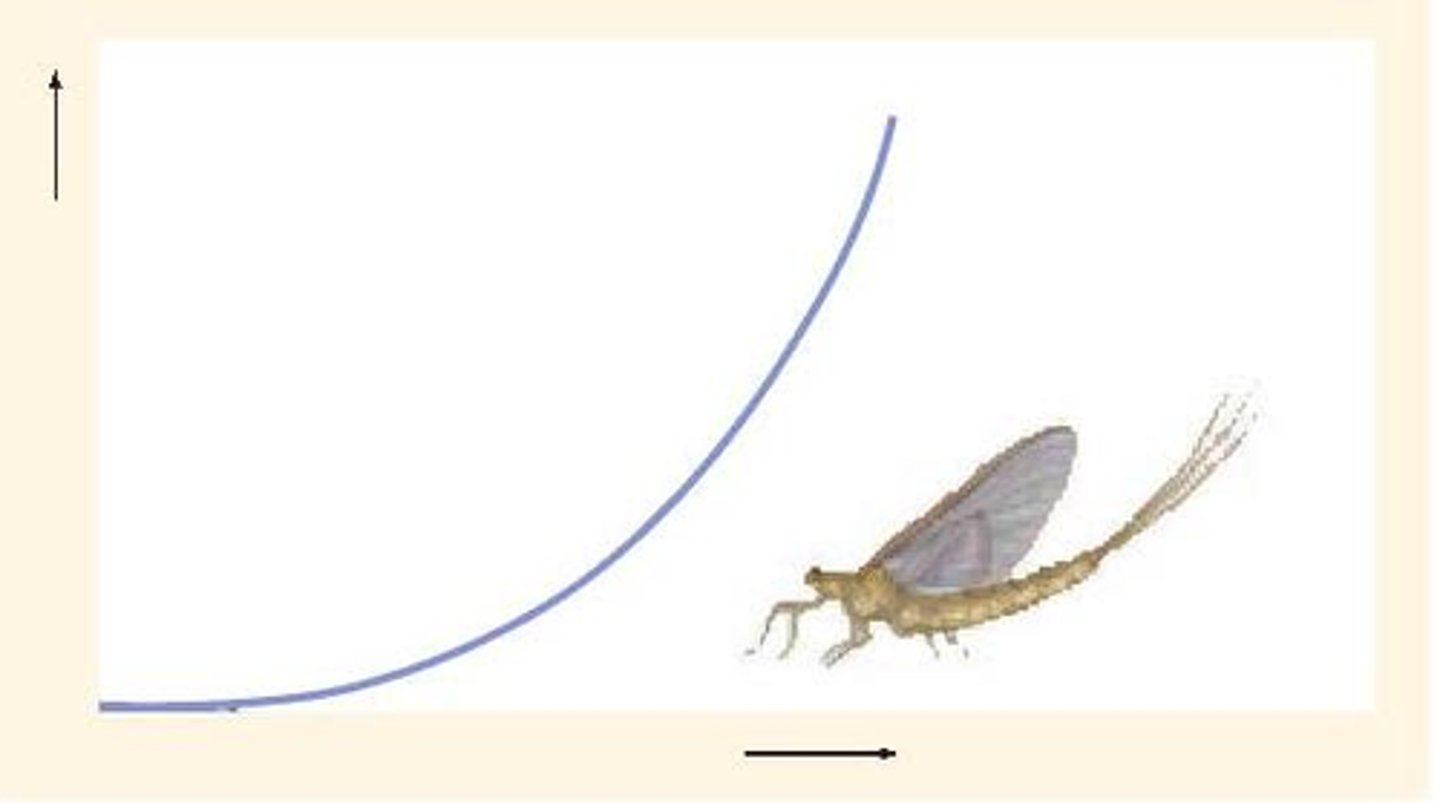
Carrying capacity refers to the?
number of individuals an environment can support.
Environmental -- is all of the environmental conditions that prevent populations from achieving their biotic poetential.
resistance
The best way to limit the growth of a pest population is to decrease the -- -- of the environment for that pest population.
carrying capacity
The type of population growth experienced by a population with a J-shaped growth curve is called -- growth.
exponential
A cohort is a group of individuals that
are the same age
Select all that apply
Select the phases of a logistic growth curve.
logistic / lag / stable equilibrium / exponential
A J-shaped curve can become an S-shaped curve when the population growth encounters environmental resistance, then the population growth is referred to as -- growth.
logistics
Which of the following is an example of a type III survivorship curve?
Dandelions produce lots of seeds but only a few survive to maturity.
The number of individuals that a particular environment can support is called the -- --.
carrying / capacity
About how many new individuals are added to the world's population per day?
220,000
If humans wish to harvest large numbers of individuals from a population that is at the carrying capacity for its environment, they should
maintain the population at its exponential phase of growth.
A group of individuals born at the same time that can be studied over their life span is called a(n)
cohort
Currently, the doubling time for the human population is about?
35-60 years
Zero population growth requires that?
the birth rate equals the death rate.
Bald eagles have 1-2 offspring, and both parents are involved in caring for the young. These animals mostly likely exhibit which survivorship curve?
Type I
About how many new individuals are added to the world's population per year?
80 million
Select all that apply
Select the examples of more-developed countries.
Japan / Australia / United Kingdom / United States
The best way to limit the growth of a pest population is to decrease the -- -- of the environment for that pest population.
carrying / capacity
A country experiencing severe poverty and a rapid population growth rate would be considered a(n)
LDC
The length of time it takes a population to double in size is called the -- time.
doubling
If a population experiences a decreased death rate followed by a decreased birthrate, this is referred to as a(n) -- transition.
demographic
Match the letter on the left with the type of survivorship curve on the right.
A: I, B: II, C: III
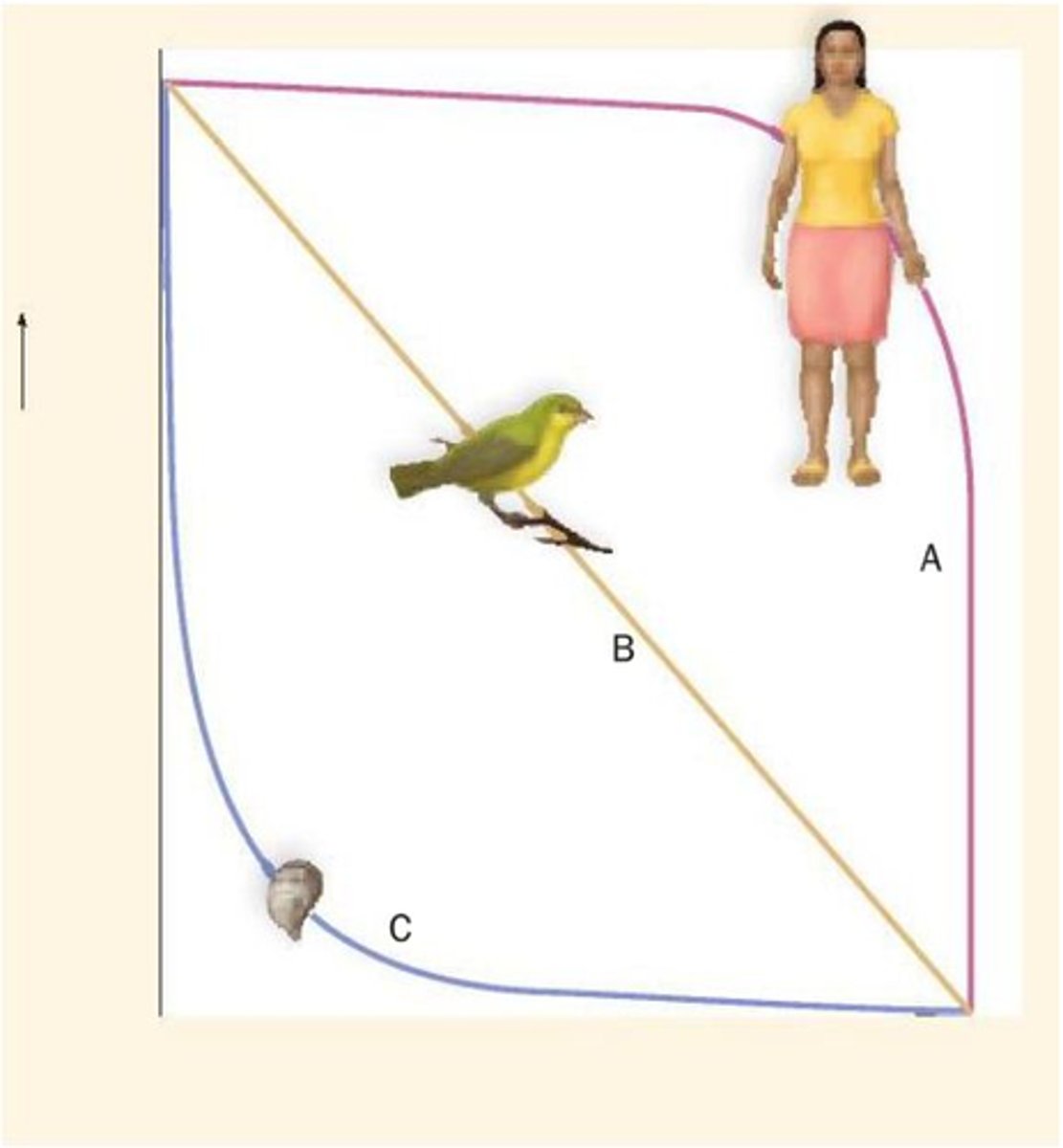
Select all that apply
Select all of the following that describe more-developed countries (MDCs).
have good standard of living / have low population growth rates
Less-developed countries are countries in which -- growth is expanding rapidly and the majority of people live in
population / poverty
Demographic transition is characterized by decreased -- rate followed by decreased rate of --. (The order in which these events occur is important)
death / birth
Populations of insects and weeds often grow very rapidly and individuals provide no parental care to their offspring. These are characteristics of an -- life history pattern.
opportunistic
Select all that apply
Select the examples of species with equilibrium life history patterns.
Florida panthers / bears / whales
Density-independent factors
have roughly the same effect on different populations regardless of size.
Factors that have greater effects on larger populations are referred to as density- factors.
dependent
Competition is a density- factor that occurs when members of different species try to utilize a resource that is in limited supply.
dependent
Select all that apply
Select the characteristics of a species with an opportunistic life history pattern.
less likely to become extinct if environment is altered / generalists
The ecological -- of a species is the role it plays in the community.
niche
Select all that apply
Select the characteristics of species with an equilibrium life history pattern.
specialization / population at carrying capacity / long life span
Factors that have the same effect on population growth, no matter the size of the population, are referred to as density -- factors.
independent
According to the --- --- principle, no two species can occupy the same ecological niche at the same time.
competitive exclusion
Density-dependent factors that affect populations tend to be
biotic
When members of two species try to utilize resources that are in limited supply, they are in -- with each other.
competition
Resource partitioning
decreases competition between two species for a resource.
Habitat is a component of the -- niche that a species fills.
ecological
True or false: Competition is always greatest between member of the same species.
True
If a snake eats a frog, the snake is the -- and the frog is the __ and this event would be an example of __.
predator / prey / predation
The competitive exclusion principle predicts that
no two species can occupy the same niche
Select all that apply
What are the two conditions that predict cycling of predator and prey populations instead of maintenance of a steady state?
The prey population overshoots the carrying capacity and suffers a crash / The predator population overkills the prey
Factors that have greater effects on larger populations are referred to as density- factors.
dependent
When each of two species adapts in response to selective pressure imposed by each other, it is called
coevolution
The division of feeding niches, called -- -- decreases competition between two species and allows occupancy of different niches, and thereby survival.
resource partitioning
Select all that apply
Select adaptations that animals have evolved to avoid predation.
concealment / mimicry / poisons in their skin / warning coloration / flocking together
The greatest competition for resources is always
intraspecific
A close interaction between members of two different species is called
symbiosis
Predation occurs when one organism, the --, eats another organism, the --
predator / prey
Parasitism, commensalism, and mutualism are the three main types of -- relationships, or close interactions between members of different species.
symbiotic
Select all that apply
Select the two cycles that explain the cycling of Canadian lynx and snowshoe hare population numbers.
hare-food cycle / predator-hare cycle
Parasitism is a(n) -- relationship in which the parasite derives nourishment from another organism called the --
symbiotic / host
Coevolution occurs when two species
adapt in response to selective pressures imposed on each other
Select all that apply
Which of the following are examples of parasitism?
tapeworm inside a dog / malaria in a human / strep infection of a human / mistletoe / athlete's foot on a human
Select all that apply
Select adaptations that plants have evolved to avoid predation.
spines / poisonous compounds / tough leathery leaves
A symbiotic relationship in which one species is benefited and the other is neither benefited nor harmed is called
commensalism
When the members of two different species have a relationship that involves close interactions between the organisms it is called
symbiosis
Cattle egrets feeding on insects disturbed by cattle have what is technically considered a symbiotic relationship called -- with the cattle though this relationship and others like it often border on mutualism.
commensalism
Select all that apply
Select the three types of symbiotic relationships.
commensalism / mutualism / parasitism
Select all that apply
Which of the following are examples of mutualism?
ants and acacia trees / cleaning fish and larger fish with mouth parasites / flowers and their pollinators
When an organism of one species derives nourishment from an organism of another species (called the host) that is harmed as a result the symbiotic relationship is called
parasitism
Mutualism is a type of symbiotic relationship in which both members-.
benefit
Tapeworms, mistletoe, and infectious bacteria are all examples of symbiotic organisms called
parasites
Ecological succession
is a change in the composition of a community over time