2. Explanations of attachment
 Call Kai
 Learn
Learn Practice Test
 Spaced Repetition
 Match
Match Flashcards
 Knowt Play
1/21

Earn XP
Description and Tags
spec point: • Explanations of attachment: learning theory and Bowlby’s monotropic theory. The concepts of a critical period and an internal working model
Name | Mastery | Learn | Test | Matching | Spaced | Call with Kai |
|---|
No analytics yet
Send a link to your students to track their progress
22 Terms
What are the 2 types of learning theory?
Classical conditioning (CC)
Operant conditioning (OC)
What is the learning theory in psychology?
a set of explanations that help to understand behaviour in terms of:
learning via experience and consequences
learning theories do not include innate traits as a factor in behaviour
What is behaviourism and learning?
EL BAO
Environment
Learning/ conditioning
Blank slate: children are born as ‘blank slates’
Animals: can be studied to
Observable behaviours: can be measured and used to understand people
Children attach to the caregiver because they provide their food
Classical conditioning
learning that is developed through the association of stimuli
Draw Pavlov’s dogs experiment
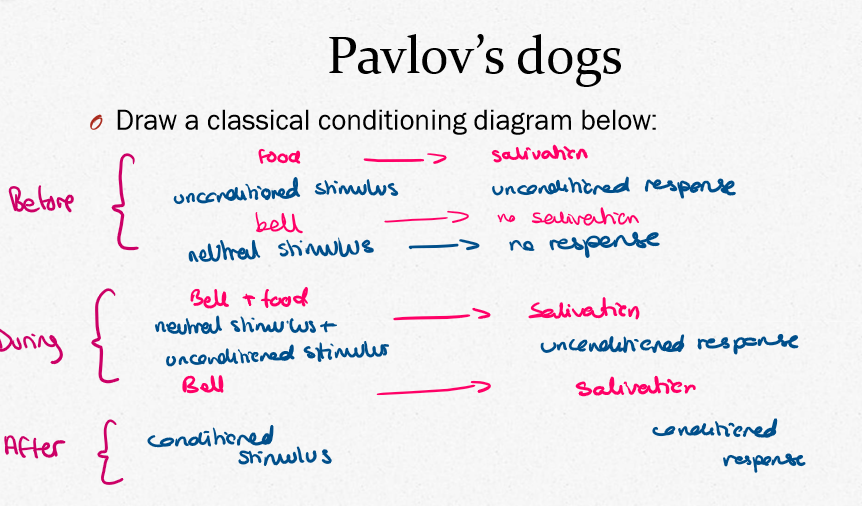
According to the learning theory of classical conditioning, does the baby have to learn to form an attachment to their caregiver?
Yes
Explain in words the process of classical conditioning
he baby forms an association between the caregiver (a neutral stimulus) and the feeling of pleasure that comes from being fed (an automatic unconditioned response)
the baby feels comforted (UCR) by the food (UCS).
each time he is fed, the caregiver (NS) is there too.
he quickly associates the caregiver with the feeling of pleasure
Eventually the caregiver stimulates a feeling of pleasure, even without food.
The caregiver becomes the conditioned stimulus (CS), and pleasure becomes a conditioned (CR).
This means the baby feels happier when the caregiver is near. It is the beginning of attachment.
Once the baby is simply happy in the caregiver’s presence an attachment is formed
What is operant conditioning
it is learning from a consequence of a behaviour
if the behaviour produces a pleasant consequence, the behaviour will be repeated (reinforced)
if the behaviour produces a negative consequence (punishment), the behaviour is less likely to be repeated.
Define positive reinforcement
a direct reward e.g sweets (something is given to reinforce behaviour)
Define negative reinforcement
indirect rewards (removing something unpleasant)
e.g if there was a buzzing noise in the room that only got turned off when you focused
What do both types of reinforcement lead to?
the repetition of a behaviour
Define punishment
A type of deterrent that can be positive/direct e.g. told off by the teacher
A deterrent can also be negative/indirect e.g. not being allowed to attend a party
In terms of operant conditionings explanation for attachment what is hunger? Why?
Hunger is a primary driver as we are innately motivated to eat to reduce hunger
In terms of operant conditionings explanation for attachment what is food? Why?
A primary reinforcer as it satisfies basic survival needs
In terms of operant conditionings explanation for attachment, a secondary reinforcer? Why?
the person feeding the baby, as she/he provides the primary reinforcer of food.
In terms of operant conditionings explanation for attachment, what is a secondary drive?
attachment is a secondary drive, and is learned by association between the caregiver and the satisfaction of a primary driver
Is the mother reinforced for feeding the baby?
Yes, the caregiver receives negative reinforcement is the baby stops crying when it is fed. It makes the caregiver want to repeat the feeding behaviour in the future when the baby cries
What strengthens the attachment?
the interplay of reinforcement
What is the major limitation of the learning theory? Use evidence from Animal Studies
the learning theories explanation of attachment is counteracted by evidence from animal research.
a range of animal studies shows that young animals do not necessarily attach to who feeds them.
Lorenz’s study states that geese were imprinted before they were fed and maintained these attachments regardless of who fed them.
In addition, Harlow’s monkeys were attached to a soft surrogate in preference to a wire that dispensed milk, suggesting that contact comfort is more important in the bond between a mother and her offspring than feeding.
This suggests that food may not be as important in attachment as learning theory suggests
Give a strength of the learning theory of attachment, using examples
There is evidence for ‘safety conditioning’
It seems likely that food is central to attachment.
However safety conditioning may play an important role in attachment (when an attachment figure becomes associated with lower anxiety/ feelings of safety).
Guy Bosmans et al, suggested that classical conditioning occur when the attachment figure becomes associated with lower anxiety.
Operant conditioning occurs when attachment behaviour (e.g proximity - seeking) is rewarded by a reduction in anxiety.
Give another limitation of the learning theory of attachment using Dale Hay and Jo Vespo research
They suggested that SLT (social learning theory) could explain the processes of attachment better than the learning theory alone.
E. g parents teach children to love them by modelling (demonstrating) attachment behaviours such as hugging. SLT can also explain some aspects of attachment, for example the active role of the infant
Give another limitation of the learning theory of attachment using Rudolph Schaffer and Peggy Emerson’s research
They studies mother-baby interactions by observing them over a period of 18 months and interviewed the mother about the baby’s separation anxiety.
They found that babies tend to form their main attachment to their mother regardless of whether she was the one who usually fed them.
suggesting that food isn’t the main factor responsible for the formation of attachments