ENVR 301 Final
 Call Kai
 Learn
Learn Practice Test
 Spaced Repetition
 Match
Match Flashcards
 Knowt Play
1/101

There's no tags or description
Looks like no tags are added yet.
Name | Mastery | Learn | Test | Matching | Spaced | Call with Kai |
|---|
No analytics yet
Send a link to your students to track their progress
102 Terms
air pollution
any material added to the atmosphere (naturally or by humans) that harms living organisms, affects the climate, or impacts structures
Natural Sources of Air pollution
natural fires
volcanoes
sea spray
vegetation (generally not dangerous on their own)
bacterial metabolism
dust
pollen
primary pollutants
released directly from the source
secondary pollutants
modified to hazardous form after entering air and mixing with other environmental components
point source for air pollutants
“identifiable” source like a smokestack (generally stationary)
non-point source for air pollutants
mobile, small, or diffuse sources: gas stations, automobiles, cement plants, and country roads
mobile sources: vehicles
fugitive emissions
do not go through smokestack /pipe
ex: dust from human activities, fires
Primary Air Quality issues
particulate matter (rocks)
acid precipitation (SOx and NOx)
smog / ozone (NOx)
Toxins/irritants (Tox)
SOx pollutant forms
SO2, SO3, and SO4
NOx pollutant forms
NO and NO2
Criteria for air pollutants to be regulated by the EPA
1. Harmful to human health or environment
2. Come from numerous sources
HAPs
Hazardous Air Pollutants: pollutants that are toxic even in very small amounts
particulate matter
Aerosols (particulates/droplets) small enough to remain aloft in the air for a long period of time
solid or liquid particulates in atmosphere that are larger than individual molecules
90% of all particulates are natural
salt spray, dust, and volcanoes
How are particulates in the atmosphere classified? What are the ranges?
classified by size
PM44: μm or less (can remain suspended but generally don’t make it into the lungs)
PM10: 10 μm or less (coarse); actually worry about this
most natural PMs are larger than this
generally direct result of combustion
can make it into lungs
PM2.5: 2.5 μm or less (fine); generally secondary pollutants
SOx from coal fired power plants
some can enter blood stream
what are add on pollution controls?
AKA end of stack/ end of pipe
reduces pollution after it is produced
Usually at release point
source reduction
change process so pollution is not produced
Types of add on controls and what they do
Fabric filters/baghouse: smaller the particles, smaller pore size = more energy it takes to push air through. Cheapest option
electrostatic precipitator: turn power off and particles drop to clean; more efficient; size of particle doesn’t matter; expensive; high power usage; only cleans charged particles
Wet scrubber: get lots of particles out of air; won’t clog; creates a lot of liquid waste
How to create source reductions
switch fuels
don’t burn coal
use alternatives
use less electricity
Industrial Smog
Product of coal burning/ common during industrial revolution
SO2 forms particulates, acid rain
CO: toxic gas
carbon particles: particle matter (ash and smoke)
greatly declined due to particle matter
Photochemical Smog
most concerning pollutants
Ingredients: NO, VOCs, O2, UV radiation
Production of Smog
Daily cycle
NO + VOC → NO2
NO2 + UV → NO + O (only starts when sun is out)
O + O2 → O3
NO2 + VOC → PAN etc
sources of VOCs in the atmosphere
organic chemicals that exist as gases
Natural: plants
Anthropogenic: mostly unburned hydrocarbons (fossil fuels)
How does acid rain form?
SO2 and NO react with O2 and H2O in atmosphere to form H2SO4 and HNO3
Sulfur in atmosphere
Natural:
Evaporation of sea spray
sulfate containing dust from arid regions
volcanoes
biogenic emissions: Hydrogen sulfide in soil
Anthropogenic:
SO2 gas (majority) from combustion of fossil fuels
smelting sulfide ores
Effects of atmospheric sulfur
SO2 toxic (lung damage) above 5ppm
Acid Rain
Effects of NOx in atmosphere
NOx gases are toxic (part of smog)
In precipitation it leads to:
fertilization (Nitrogen) of terrestrial plants and aquatic environments; some plants are adapted to low nutrients (mountain tops)
pH of unpolluted rainwater
5.6
pH of acid rain
< 5.5 (typically between 4 and 5)
Acid rain terrestrial impacts
damages vegetation
Acidic soils release toxic metals (aluminum and mercury)
aluminum drops pH as it leeches out
fertilization of nutrient poor soils can stress native plants
makes nutrient uptake more challenging
Acid rain aquatic impacts
simplifies food web
- lose sensitive species like zooplankton, plants, and insects
Fish
- eggs and fry die around pH of 5
- adults die below pH of 5
- enzymes denature and metabolic functions are disrupted
- toxic metals become soluble: Aluminum gets stuck on gills and suffocates
Why does buffering capacity of soil and/or water matter for acid rain?
Calcium carbonate (CaCO3)
limestone
areas with lots of limestone: acid rain is neutralized
Clean air act types of pollutants
Criteria pollutants and Hazardous Air Pollutants
Criteria Pollutants
do harm and are more common (come from lots of sources
not specifically listed out in the act
PAM, O3, CO, SOx, NOx, Pb
established National Ambient Air Quality Standards
Primary: human health
Secondary: materials, environmental, aesthetic, comfort
Hazardous Air Pollutants
pollutants that may cause serious health effects or environment damage at low concentrations
don’t have to come from numerous sources
EPA created list of 189 HAPs and can add more
Air quality control regions
country is broken into air quality control regions (like a watershed for WQS’s but with no designated use)
each region is either at attainment or non-attainment
meeting NAAQs
States create Implementation Plans (SIPs)
sets limits on pollutants as they see fit → not on cars because on interstate travels
primarily point sources (factories and power plants)
Federal Emissions Standards
set for “major sources” for all listed pollutants
Criteria Pollutants attainment Region: limits emissions from major new stationary sources
Major = 100 tons per year of the pollutant
Criteria Pollutants non-attainment region: major new AND major existing stationary sources
must offset pollution for major new sources
HAPS: limits ALL major sources regardless of location
definition of major is lower
Federal Emissions Standards: mobile sources
Pb phased out of gasoline: 1975-1995
National fuel economy limits (minimums for mpg)
National emissions limits
Required 90% reduction of CO, VOCs, NOx, from 1970 emissions levels (tailpipe)
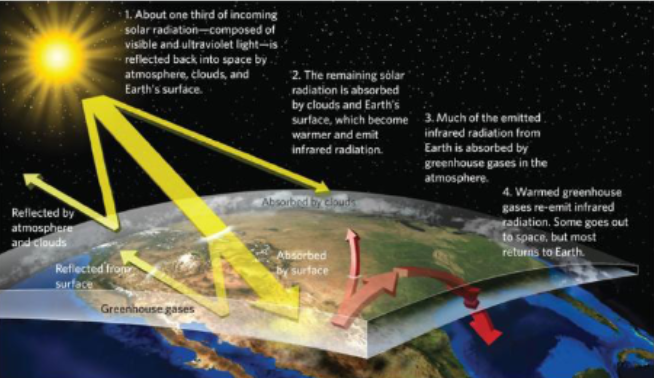
The Greenhouse effect
warming of earth as greenhouse gases trap heat near earth’s surface
we need some ggs to stay warm; makes earth livable
greenhouse gases
gases in atmosphere that trap heat (infrared light) near earth’s surface
Types of Greenhouse gases
H20: water vapor (least concern)
CO2: Carbon dioxide; fossil fuels
O3: ozone; fossil fuels
N2O: Nitrous oxide; fossil fuels
CH4: methane; fossil fuels
CFCs: chlorofluorocarbons; entirely man made
Enhanced Greenhouse effect
humans are elevating amounts of greenhouse gases in atmosphere; 33% CO2 increase since 1700s
more heat is trapped by more greenhouse gases
How is relative heat trapping ability measured?
based on CO2 molecule
CFCs have the highest heat trapping ability
weather
a description of physical conditions of the atmosphere at any given time
climate
a description of long-term patterns of average temperatures
albedo
measure of earth’s reflectivity
High albedo = more reflective (like snow)
low albedo = less reflective (like asphalt)
global warming potential
ability to trap heat and how long it stays in the atmosphere
impacts of climate change
global average temp has increased 1.2-1.3°C since 1900s
1.6-5.5 °C increase predicted by 2050; hoping to keep it below 1.5°C increase
Make an argument for 2 most important greenhouse gases to regulate
CO2 and CH4 are probably the easiest to argue for
Impacts of climate change on patterns
some areas are wetter or drier
more extreme weather
increase in intensity, not in frequency
Warmer ocean water feeds storms
melting glaciers and ice sheets
80% of earth’s glaciers are retreating
rising sea levels from glacial water melt and thermal expansion
effects on biodiversity
current evidence of climate change
sea level increase of another 2-3 feet by 2100 with only 2°C increase
Storm surge: storm pushes water up; climate change brings up high tide making storm surges more dangerous
Effects on biodiversity
What is biodiversity?
the variety of life that exists in an area
community (species) diversity, genetic diversity, and ecosystem diversity
species richness
total number of species in a community
species evenness
relative abundance of individuals within each species
genetic diversity
variation within a species, variation of alleles within a species
ecological/habitat diversity
variation in habitats, ecological interactions, ecological niches
the more complex a habitat, the more species you will find
Landscape diversity
differences in variety and abundance of species in an area
Result of variation in
abiotic factors (any disturbance or change) i.e. fires and floods
geology/soils
elevation/slope
Biodiversity from largest to smallest
Ecosystem → landscape → species → genetic
When is there high species diversity?
High productivity conditions (nutrients, water, temperature)
top predator is present (keystone predator)
there is an intermediate level of disturbance
intermediate disturbance hypothesis
high disturbance favors pioneer species
low disturbance favors climax species
**Best diversity in the middle**
gene
section of DNA that codes for a protein
allele
variations of a gene
trait
what gets expressed (phenotype)
result of environment and genes
proteins
make variety of traits that help determine structure and function
Where do new alleles come from?
Mutations: change in genetic code
more likely to have a negative effect; often protein doesn’t function or is not adaptive
others are neutral and don’t change the protein at all
most mutations are recessive
allelic diversity
number of alleles available at a given gene
Heterozygosity
% of genes in individual that are heterozygous
good to have options to better adapt for future
less chance of expressing a mutation
measures of genetic diversity
allelic diversity and heterozygosity
Why are harmful recessive alleles not commonly expressed?
all organisms have multiple harmful alleles resulting from mutations
if harmful it is selected against
rare and recessive harmful alleles
instrumental value
A species has value if its existence or use benefits us
aka utilitarian or anthropocentric
can calculate value based on dollars
intrinsic value
a species has value for its own sake
ecosystem services
ecological processes that make life possible: what biodiversity does for us
provisioning
regulating and supporting
cultural
Benefits of biodiversity- food
200,000 + plant species
modern ag focuses on about 30
3 species fulfill 50% of global food needs (rice, wheat, corn)
Benefits of biodiversity- food security
genetic diversity for our current food supply
more options to adapt, avoid inbreeding
easier when we already have an allele
cultivated varieties are highly selected for certain traits
lose genetic variation, lost other beneficial qualities
How do wild populations benefit from genetic diversity
natural selection creates beneficial traits
disease and parasite resistance
better survival in the wild
tolerance to adverse conditions
plant breeders search wild populations for beneficial genes
maize saved the corn population
Biodiversity and Drugs/medicines
½ of medicines are derived from wild species
(see notes for examples)
periwinkle
Jarac snake
Pacific Yew
Key parts of ecosystem
keystone species: species that extremely impact the shaping of its community (generally predators)
ecosystem engineers: species that alter physical environment of ecosystem (beavers and prairies dogs
ecosystem function
higher levels of biodiversity generally lead to greater ecosystem function
nutrient cycling, primary productivity etc
sampling effect
when more species present more likely productive species present
complementarity effect
different species exploit different niches; more species means more niches filled
ecosystem stability
higher levels of biodiversity generally lead to greater ecosystem stability
redundancy of function: more than 1 species doing the same jobs
increase in function → increase in stability after certain species number is increased
extinct
completely gone
extirpated
no longer exists in a specific area
endemic
only exists in a specific area
Natural rate of extinction
1 spp/million/yr
extinction rate over the last 400 years
.01%/yr
Threats to Biodiversity
Habitat loss
Invasive species
Pollution
Overexploitation
Disease
Habitat destruction
loss due to conversion to different land use
most impacted by habitat destruction in US. Globally?
Wetlands: from being drained
grasslands: only 3% left
longleaf pine savannas: 1% left
Globally: half of the tropical forests are gone
Forest/ecosystem fragmentation results
smaller populations
dangerous migration: intraspecific competition
some species require multiple habitat types within their range
edge effects
different species/different ecosystems
other human impacts at the edge
air pollution, poaching, invasives, roadkill
common places to find fragmentation
wetlands (separated by drained areas)
rivers (dams)
grasslands (agriculture)
coral reefs (areas killed by acidification and sedimentation)
Habitat simplification
reduces ecological/ habitat diversity
same type of ecosystem
removing dead trees and logs from forests
forest monocultures
streams channelized: stream embeddedness
Invasive species
introduced species that causes damage to environment, human health, or economy
introduced species
species that has been introduced to a new habitat outside of its native habitat
Process of invasion
Introduction
establishment: dispersal
Invasive spread
Tens rule
10% of introduced become established
10% of established cause damage
roughly 1% of introduced become invasive
How do invasive species intentionally move?
pet trade: fish, snakes, cats
agriculture/aquaculture
landscaping
How do invasive species unintentionally move?
lots of species come from Eurasia because we have similar climate and lots of trade
ballast water: water released by ships in ports
recreational
contaminants of shipped goods: emerald ash borer
Ecological Release
escape from factors that limit populations
predators, parasites, disease
food or space limitations
environmental conditions are just right
Allelopathic chemicals
Allelopathy: inhibition of growth of competitor plants by release of chemicals that inhibit growth or germination