AST 201 Second test
 Call Kai
 Learn
Learn Practice Test
 Spaced Repetition
 Match
Match Flashcards
 Knowt Play
1/74

There's no tags or description
Looks like no tags are added yet.
Name | Mastery | Learn | Test | Matching | Spaced | Call with Kai |
|---|
No analytics yet
Send a link to your students to track their progress
75 Terms
Stellar spectral classification — what do we already know?
Surface temp (wiens law)
Distance (parallax)
Luminosity (apparent brightness and distance)
Chemical composition (spectra)
1800s Harvard college ovservatory
Hired women to process mass data
Williamina Fleming
Analyzed stellar spectra
Created Henry Draper Catalogue
Henrietta Swan Leavitt
Calculating large astronomical distances
After some reordering…
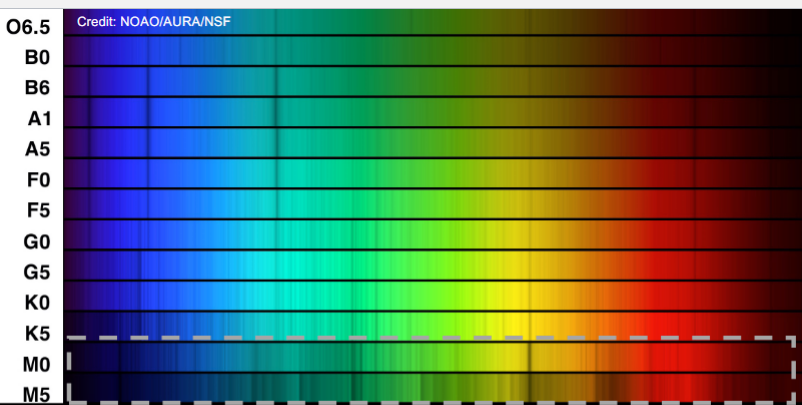
Stellar Spectral types
Organized stellar spectra into alphabetical groups
Absorption lines become stronger or fainter as move from one class to another
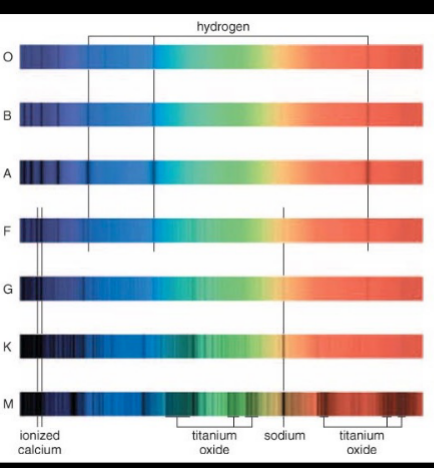
Henry-Draper catalogue
Revised scheme is a sequence of surface temperatures (not the temp of the whole star)
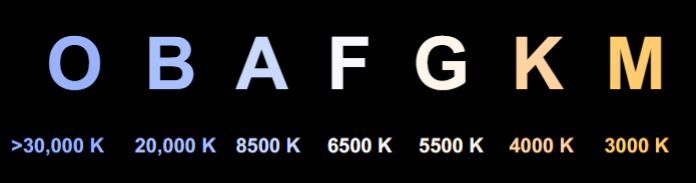
Why would differences in surface temperatures produce the observed pattern of spectral lines? (balmer series)
Hydrogen spectra lines originating and ending at n=2 level is called Balmer series
In order for star to show balmer lines, have to be electrons in n=2 shell
NOT ground state
Needs HEAT for excitation
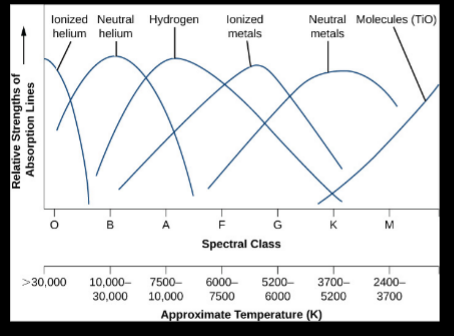
Why would differences in surface temperatures produce the observed pattern of spectral lines? — continued
Cool star
Most electrons in ground state, cant make balmer lines
Warmer star
More electrons into n=2, make balmer lines
Hot stars
A large fraction in n=2, balmer lines reach their darkest/strongest
Very hot stars
Most electrons above n=2, balmer lines weaken again (or completely ionized)
Each atom or molecule has a similar pattern: weak at one temp, stronger at higher temp, then weak again at very high temp
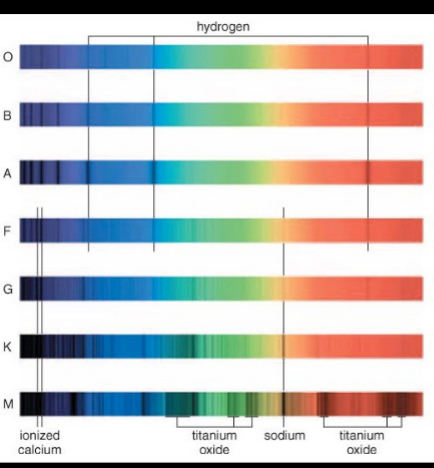
Why would differences in surface temperatures produce the observed pattern of spectral lines? — molecules
Very cool stars are cool enough for MOLECULES to be intact in atmospheres
Makes huge number of spectral lines
Atoms can make molecules
Only cool stars bond remains
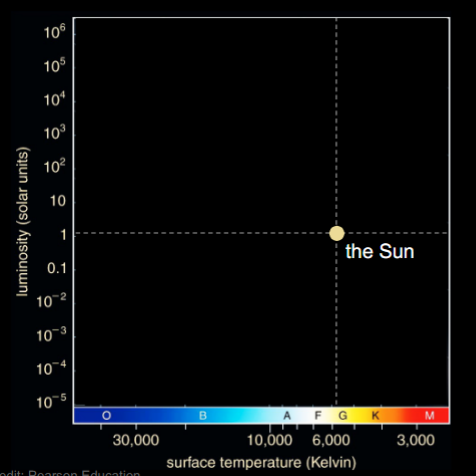
Building the Hertzsprung-Russell diagram (HR diagram)
Stellar luminosity vs Surface temp (colour, spectral class)
Temp higher on the left
Luminosities in solar luminosity (1 = luminosity of sun) (logarithmic)
Diagonal lines of stellar radius
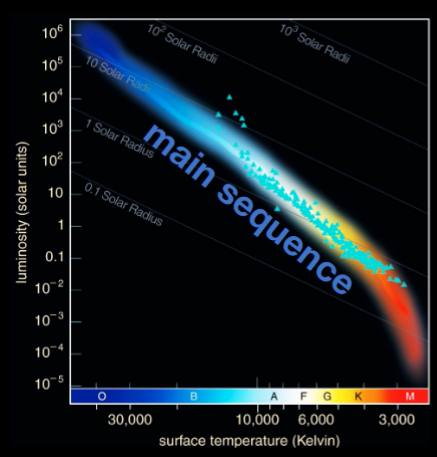
Building the Hertzsprung-Russell diagram (HR diagram) — GAIA spacecraft
Recorded the properties of more than billion stars
Building the Hertzsprung-Russell diagram (HR diagram) — Main sequence
Cluster in a group along a diagonal
from red and low luminosity to blue and high luminosity
MAIN SEQUENCE
Still fusing hydrogen in the core (alive)
Anything below is dead
Anything above is close to death
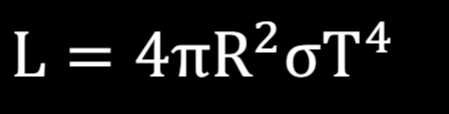
Luminosity and Surface temp correlation
Surface temp measures amount of light emitted per square metre
Luminosity = (surface area) X (amount of light emitted per unit area)
Amount of light per square metre given Stefan-Boltzmann equation for blackbody radiation
Stars on main sequence
Refered to as dwarf stars — even though they can be very large
All M stars are small and red
All O stars are large and blue
.
Top main sequence have higher mass & shorter lifespans
Fuses hydrogen fast
Few million years
Bottom main sequence and lower mass and longer lifespans
Fuses hydrogen slowly
Trillions of years
.
Main sequence is not a time sequence
Stars start on the main sequence, and stay there for most of their lifespan
Interpreting HR Diagrams
The H-R diagram and the study of stellar evolution
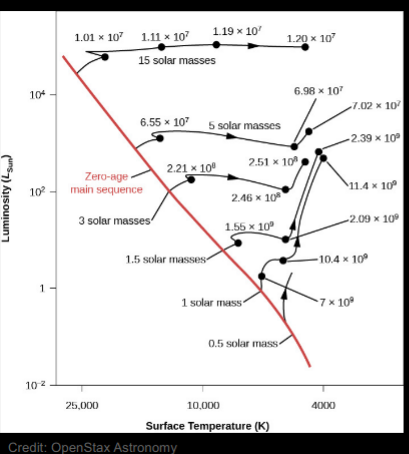
As a star ages, it changes places on the HR diagram
Stars not on main sequence have ceased to fuse hydrogen in their cores
Interpreting HR Diagrams — continued
Above main sequence
subgiants, giants, supergiants
are in the process of dying
Below
Mainly white dwarfs, dead
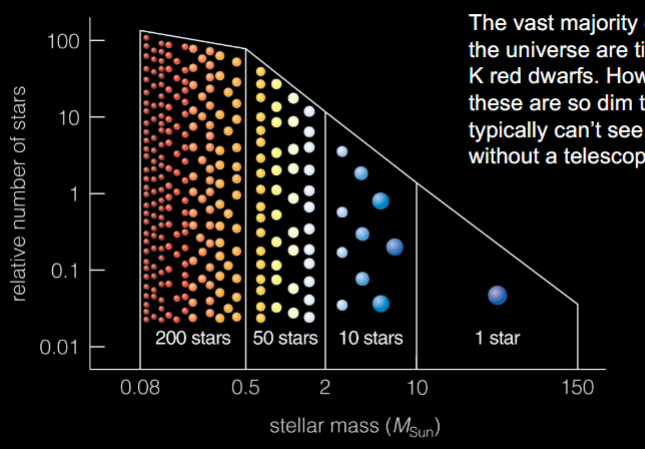
Vast majority of stars in universe are M and K red dwarfs
But, very dim so hard to see without telescope
Most stars near the sun are red dwarfs
Mostly SEE giants and supergiants — dead or dying suns, very bright
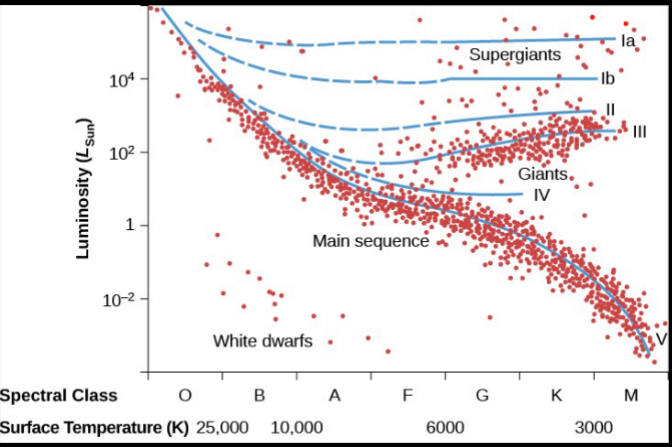
Luminosity classes
Luminosity class tells you where a star is in its lifecycle, but not directly about its luminosity
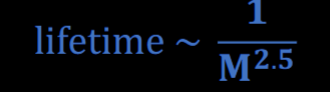
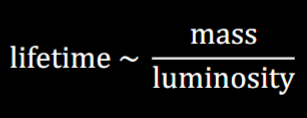
Why do more massive stars have shorter lifespans?
Burns fuel more quickly
The rate of fuel use can be quantified via luminosity, the amount of energy released/sec
Luminosity scales with mass
Most stars form in clusters
Messier 7 — open cluster
Tucanae — globular cluster, 13 bil years old
We can learn a lot about a star cluster by plotting its stars on an HR diagram
Age
If a star cluster shows complete main sequence — young
As cluster ages, O and B leaves main sequence, medium lifespan stars start leaving
Even later, most of the stars would leave the main sequence
Die in sequence from top to bottom
.
At any given time, we can estimate the age looking at the lifespan of the shortest-lived star still on the main sequence
Main-sequence turnoff point
The age of cluster is lifespan of star that just recently finished its lifespan
Picture of galaxy — gas and dust clouds
Pink areas are hot, ionized hydrogen gas — HII regions
Dark areas correspond to cold dust clouds, hydrogen is molecules — emits more infrared light
Molecular clouds often have blue stars in their cores
Birthplace of stars
Long-lived stars are far away from their origins
Don't see much blue stars away, associated with molecular clouds
.
E.g: Rosetta nebula. Orion nebula
Shows a cluster of blue stars forming inside the nebula
Molecular clouds are the engine of star formation
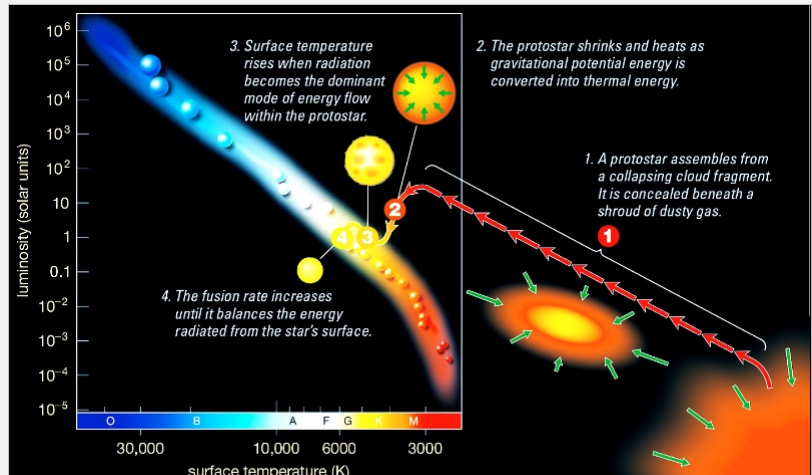
Formation of a star from molecular clouds
Molecular cloud core can only stay stable shortly
Own gravity will destabilize and compress
.
Conservation of energy —→ starts heating up
gravitational potential energy converted to kinetic energy
Atoms fall inward and heat up —→ protostar forms at the core
shrinks
Rotation amplifies as collapses, flatten into disk
surrounded by protostellar disk, producing jets of materials
.
Until core reaches 10mil K, no fusion due to mutual electric repulsion
Fusion stars: pre-main sequence star
enough pressure to counteract gravity
gravitational collapse slows and stops
Settles onto main sequence
Becomes a zero-age main sequence star (ZAMS)
Hydrostatic equilibrium of main sequence stars
The outward pressure produced by the release of energy from hydrogen fusion in the core exactly balances the inward pull of gravity
Stars remain on main sequence for long time
Not expanding or contracting
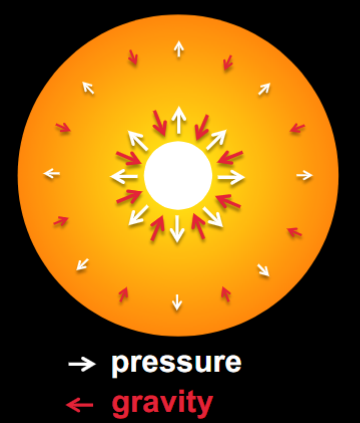
Gravity is always trying to win (uh oh ran out of fuel)
When the star runs out of fuel, gravity begins to win
The exact sequence of steps depends on the starting mass of the star
High mass vs Low mass star
8 times the mass of the star – high mass star
Less than 8 times – low mass star
Death of a low mass star — main sequence
At zero age, it is roughly about 10% helium and 90% hydrogen in its volume
Hydrogen fusion stars converting hydrogen to helium, percentage of helium in the core increases
After a long time, most of the core will be converted to helium
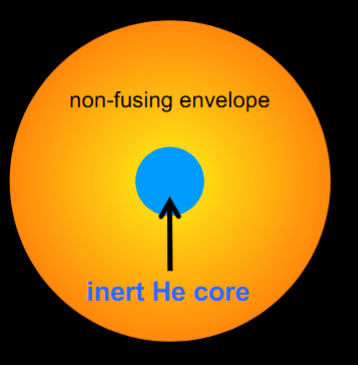
Death of a low mass star — Inert helium core
Isnt producing energy to sustain pressure to counteract gravity
Core contracts until degeneracy pressure halts contraction
Layer of hydrogen around core reaches temp and density for fusion — hydrogen shell burning
Death of a low mass star — Hydrogen shell burning
Fresh layer of fusion produces energy at a higher rate
release of extra energy causes outer layers to expand
outer layers cool down — becomes redder
subgiant stage
Lifts off main sequence
Death of a low mass star — red giant
Cools down but increases in size
overall luminosity goes UP
expands in size dramatically
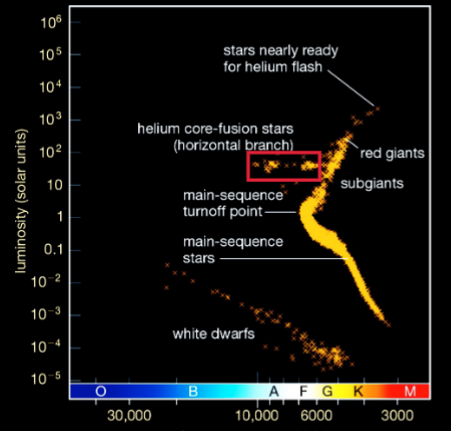
moves to upper right of HR diagram
Death of a low mass star — Helium flash
H-burning adds inert helium to core
compress and heat the core
eventually reach enough temp for helium fusion
done in few minutes
expands the core, h-burning slows down
star shrinks and settles into new equilibrium — horizontal branch
powered by helium fusion and hydrogen shell burning
Death of a low mass star — asymptotic giant stage
Helium fuses into inert carbon and oxygen
low mass star will never get hot enough to fuse carbon or oxygen
die permanently
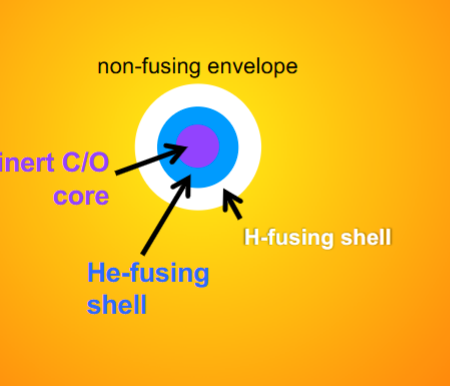
So why don't stars keep collapsing into a black whole?
Electrons in stars obey the Pauli exclusion principle
Can only force them to get so close to one another before they exert a strong repulsion
State of degeneracy = Electron degeneracy pressure
Electron degenerate matter is very dense (1 teaspoon is 2 SUVs)
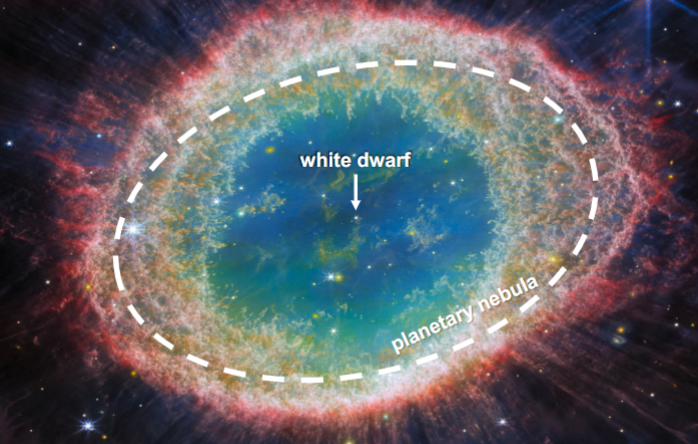
White dwarf
The electron degenerate core is called a white dwarf, only about the size of earth
Really hot and bright
But really small
Planetary nebulae
Once a helium layer around the core starts fusing, it releases energy that propels the outer layers of the star into space – leaving the white dwarfs
will fade after 10,000 years
white dwarf will survive until the end of the universe until it becomes a black dwarf
Tracks of stars on HR diagram
Life cycle of a high mass star — onion structure
Massive main sequence stars DO get hot and dense enough to fuse helium on main sequence
By the time a massive star leaves the main sequence, it has fused H, He, C, O, Ne, Mg, Si
each type of fusion begins in the core and then moves to a shell around the core — Onion structure
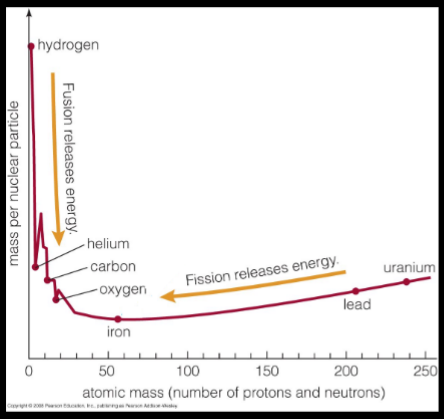
Why cant stars fuse past iron (Fe)?
In fusion, particls are fused into nuclei of lower mass
Mass is converted as energy and release
The mass per nuclear particle changes from atom to atom (binding energy is different for each element)
Separating two objects requires energy, which is added on to the mass
.
Only nuclear reactions that reduce the mass per particle can release energy
fusion into lower mass particles
fission into lower mass particles
IRON has particles of lowest mass, neither fusion or fission will release energy
Gravity wins
After massive star has iron core
Can no longer produce energy
Take apart iron, need energy
Fuse iron, also need energy
No longer produce pressure to counteract gravity
Gravity wins
Once a massive star leaves the main sequence it becomes a supergiant
Gravity contracts and heat up the star
Burns heavier elements
Star swells until IRON
Massive star collapse
All of the ways that the core of a massive star can collapse are extremely sudden and typically very violent
Neutrionization — avoiding electron degeneracy matter
In mere seconds nearly all of it is converted into neutrons
Proton + electron → neutron + neutrino
Dramatically implode, falling inward very fast
Core contracts to a ball of neutrons, 20km diameter
Neutron degeneracy pressure kicks in, stops contraction
Neutrionization — type 2 supernova
Great mass falling inward suddenly hit an immovable ball of neutrons
All of the neutrinos come rushing out at all the same time
Explodes in a supernova
Type 2 supernova – core-collapse supernova
Type 2 supernova – core-collapse supernova
Insanely bright, can briefly outshine the entire galaxy it occurs in
A single supernova can release as much energy as the sun will in 10bil years!
The only stars capable of doing this are rare stars
(e.g. SN1987A: closest supernova to earth, discovered by uoft student)
Type Ia supernova (not from a massive star)
Low mass stars will not die in supernova, it will become a white dwarf
Type Ia supernova — Chandrasekhar limit
White dwarfs have a maximum mass of 1.4 solar masses
But if a white dwarf is in a binary system, it can accrete matter from the other star
Mass can exceed Chandrasekhar limit
Causing a Type Ia supernova
Type Ia supernova — explosion proceedings
Immediately undergo fusion reactions, causing it to explode
Every Type Ia supernova, it is basically the same as every other Type Ia supernova
Able to identify it easily (intensity, luminosity)
CANNOT be done by itself, NEEDS companion star
We can identify a type of supernova by its spectra
Type II supernova has spectral lines of hydrogen
Made of hydrogen
White dwarf doesn't have much hydrogen
And if it is type Ia, can identify distance
Supernova remnants
Supernovae leave behind shells of expanding gas, called supernova remnants
Expand and dissipate, rejoining gas and dust of interstellar medium
Most elements came from supernovae
Enrich interstellar medium with elements heavier than hydrogen and helium
Gets recycled into planets and stars
We are made of recycled stars!
The afterlives massive stars
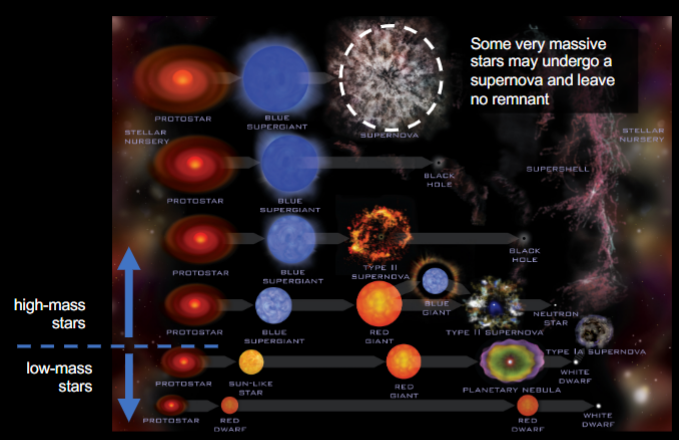
The final state of a dead star depends on its initial mass and the sequence of events that happened to it
Harder to predict for massive stars — unstable, lose mass to stellar winds
There is no one-to-tone relationship between the starting mass and the final
Massive stars usually die where they're born
The afterlives massive stars — Options after death
Supernova and leave no remnant
Failed supernova and collapse into black hole (star vanish)
Supernova and then collapse into black hole
Supernova and leave neutron star
Neutron stars
If the mass remaining after supernova is 1.5--3 solar masses, then the remnant is a neutron star
Ball of neutrons from neutronization
Typical star compressed into a city sized ball about 20km
EXTREMELY dense
First observed by Jocelyn Bell Burnell
Understanding neutron stars — Conservation of angular momentum
If the net external force on an object is zero, angular moment must remain constant
L = mass x speed x radius
When neutron stars form, radius decreses DRAMATICALLY
Mass stays constant, so speed goes WAYYY up

Pulsars (radiowaves)
Pulars have strong magnetic fields
Channel charged particles from the star into two beams
Often misaligned with rotation axis
If light passes us, get rapidly blinking/pulsing radiowaves
Pulsars — continued
These pulses were observed by Bell-Burnell in 1967
Whether or not you see a neutron star is a matter of perspective, if its beam sweeps past
Very fast rotations – millisecond pulsars
e.g. Crab nebula: Identification of neutron stars embedded in supernova remnants establishes the connections between the two
The milky way galaxy
Flat disk shape
Shows up as band on earth
We can get the entire sky as a flat image (black spots are dust)
.
In near infrared
Thin disk shape is seen more easily
Far infrared
Mostly cold dust
The milky way galaxy — properties
Barred spiral — central region is like straight bar
(bars can be strong or weak), milky way has moderate bar
Solar system about halfway from centre, 27,000 ly from galactic centre
Total diameter is 100,000 light years
The milky way galaxy — Three compartments
Disk
Flat disk, spiral
Bulge
Central part, thicker than disk
Halo
Speckles around the galaxy
The galactic disk
Thin — 3000 light years
Contains most the dust and gas in the milky way
The galactic disk — galaxy arms (formation?)
Stars come and go from arm, but general pattern of movement, regions of enhanced density (circular orbit)
Blue star formation
Always associated with spiral arms
Clumps of blue stars with red hydrogen and black dust
Starburst galaxies (superwind)
Starburst galaxy is one that is undergoing an exceptionally rapid burst of star formation
Formation and supernova death
Driving superwind — blowing gas and dust, forcing hydrogen out of the galaxy
Often triggered by gravitational interactions among galaxies (creates heat)
.
e.g:
M82
Starburst galaxies example — antennae galaxies
Interacting galaxies resultig in a starburst
pair of spiral galaxies colliding
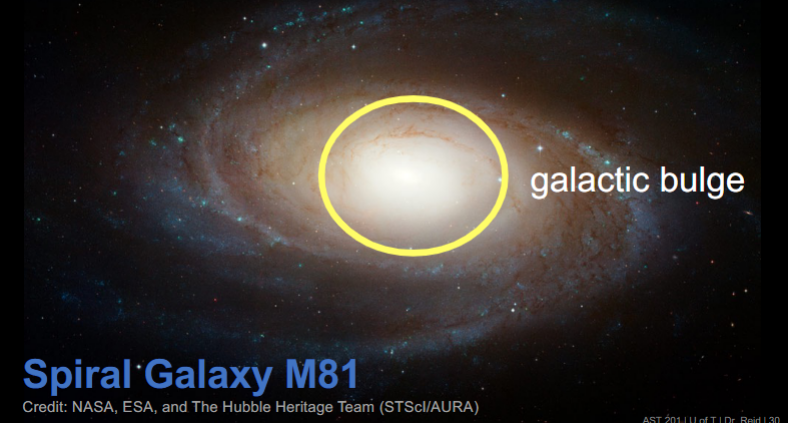
The galactic bulge
Contain older, redder stars
Not a lot of dust and gas
In most spiral galaxies, the bulge hosts a supermassive black hole
hard to see because less than 0.1% mass of galaxy
The galactic halo
Both the bulge and the halo is spherical
Contain old stars
Very few stars, cant see much colour
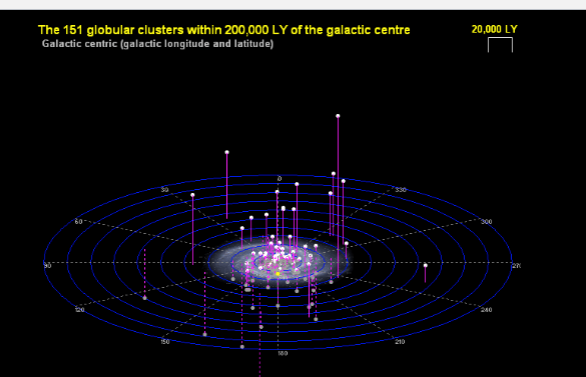
Contains Globular clusters
most large galaxies have globular clusters around them
.
eg:
E.g. omega centauri
Very densely packed
10 mil stars packed into a ball 150 light years across
May have its own central intermediate-mass black hole
Spins of the galaxy
Spin of the milky way causes everything to be flattened into a disk
Stars in halo, bulge, and clusters rotate in random orientations
Where do we find the most dark matter?
The halo of the galaxy is also where we find the majority of dark matter
The milky way is actually a glob of dark matter
Dark matter and scientific discoveries
In Newton's law of gravity, gravity falls with the inverse square of gravity
Prediction is in disagreement with what we observe (rubin & zwicky)
.
In light of discoveries like this, either:
Our model of reality is wrong
Our observations of reality is wrong
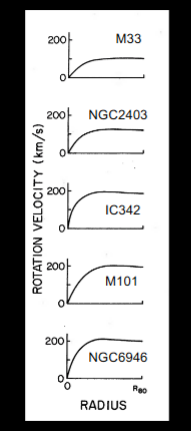
Explaining the rotation curve
The observations could be wrong
Our model of reality is wrong
Understanding of gravity wrong
Understanding of galaxies wrong
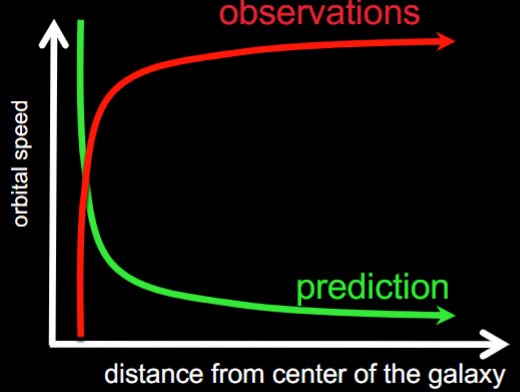
Observations were correct for rotation curve
Always the same result when repeated
.
The part of a galaxy that glows in visible light is only a small portion of what's truly there
Unseen parts cover much larger area
BUT: The flat rotation curve extends well past the visible or luminous part of each galaxy
Why would the most distant objects be moving at crazy speeds?
Our theory of gravity is right
Maybe our understanding of gravity is wrong?
Tried to explain using modified newtonian dynamics MOND
But they don't explain how gravity works for other observations
We are wrong about what a galaxy is
Before: assumed that the mass is concentrated in the centre
Instead of most of mass being in the centre, but actually spread out, well beyond what we can see
The speed only has to resist the pull of gravity of everything in its orbit circles
Objects have to resist the gravity of more and more mass when getting further away from the centre
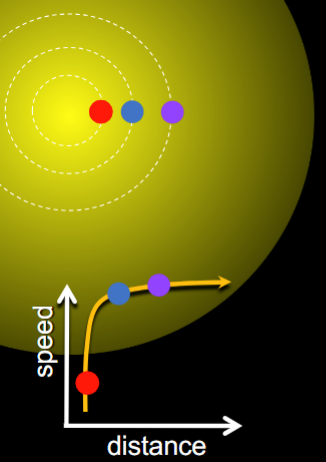
How much mass does the milky way have to have to reproduce this?
Much much bigger than what we observe added up
“Ordinary” or “baryonic” matter, made of protons and neutrons
To get the rotation curve, the amount of total mass is ten times what we can see
Non-baryonic matter
DARK matter
90% of the mass of the Milky Way is dark matter
Proof for dark matter enacting gravity
Gravitational lensing is significantly more than can be explained by the luminous mass of the lensing object
We don't know what dark matter is
Some NEW form of matter
Like neutrinos but does not interact with light but DOES produce a force of gravity
We don't know what dark matter is — Colliding galaxy cluters: the bullet cluster
We can use gravitational lensing to build a map of where most the mass is located
Dark matter passed through each other
doesn't interact with each other
The hot gas around does not match the distribution of dark matter
does interact with each other
Dark matter is COLLISIONLESS