W19 Lens Materials and Manufacture
 Call Kai
 Learn
Learn Practice Test
 Spaced Repetition
 Match
Match Flashcards
 Knowt Play
1/26

There's no tags or description
Looks like no tags are added yet.
Name | Mastery | Learn | Test | Matching | Spaced | Call with Kai |
|---|
No analytics yet
Send a link to your students to track their progress
27 Terms
How does glass exist?
Occurs naturally as fulgirites but has been manmade since 5000BC
What is quartz?
Known as sand, it occurs naturally and is almost pure silica- was historically used to make spectacle lenses
What is the structure of glass?
Amorphous structure- atoms are arranged in an irregular manner- glass is sometimes referred to as a supercool liquid
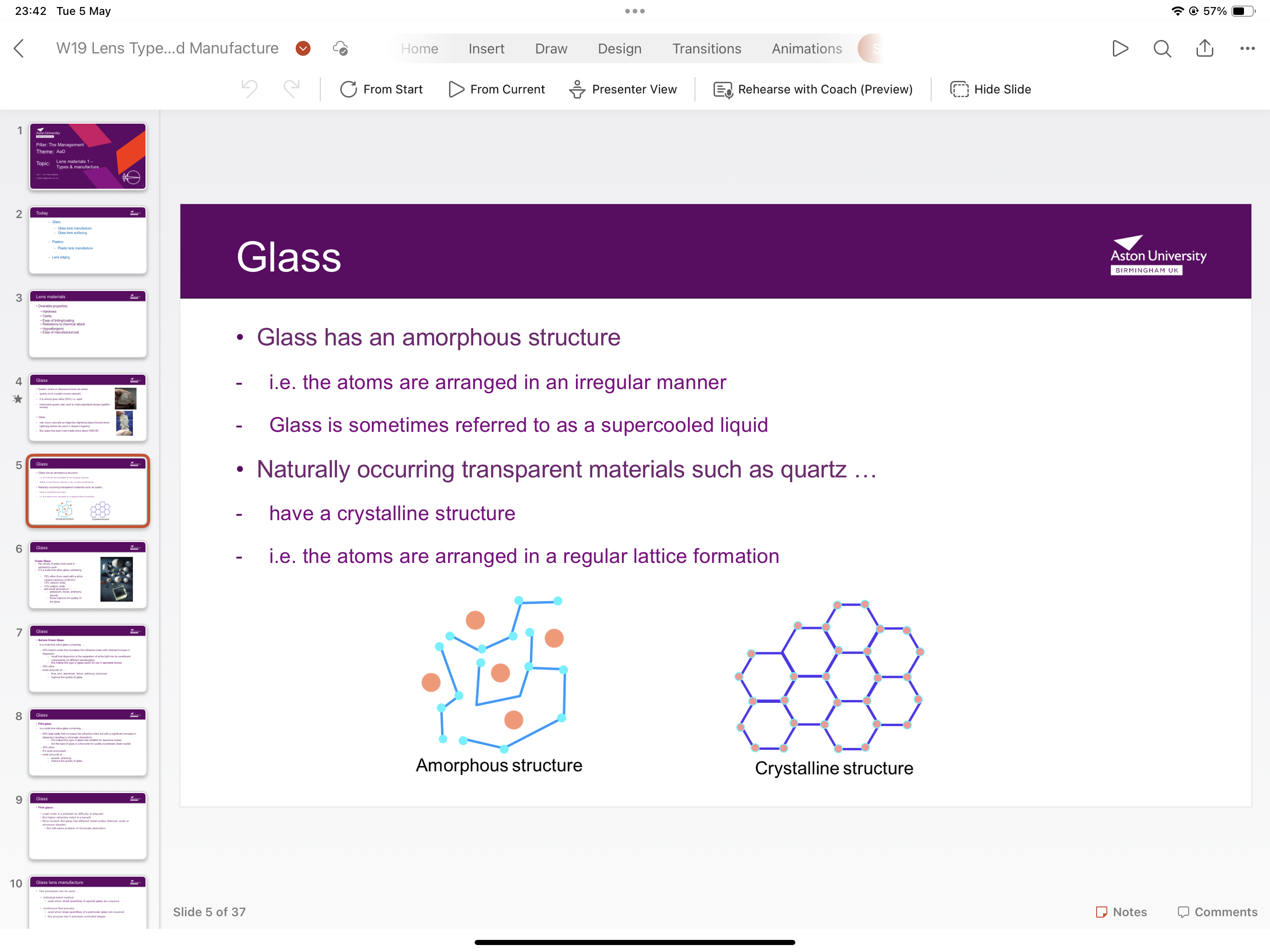
What is the structure of quartz?
Has a crystalline structure- regular lattice formation
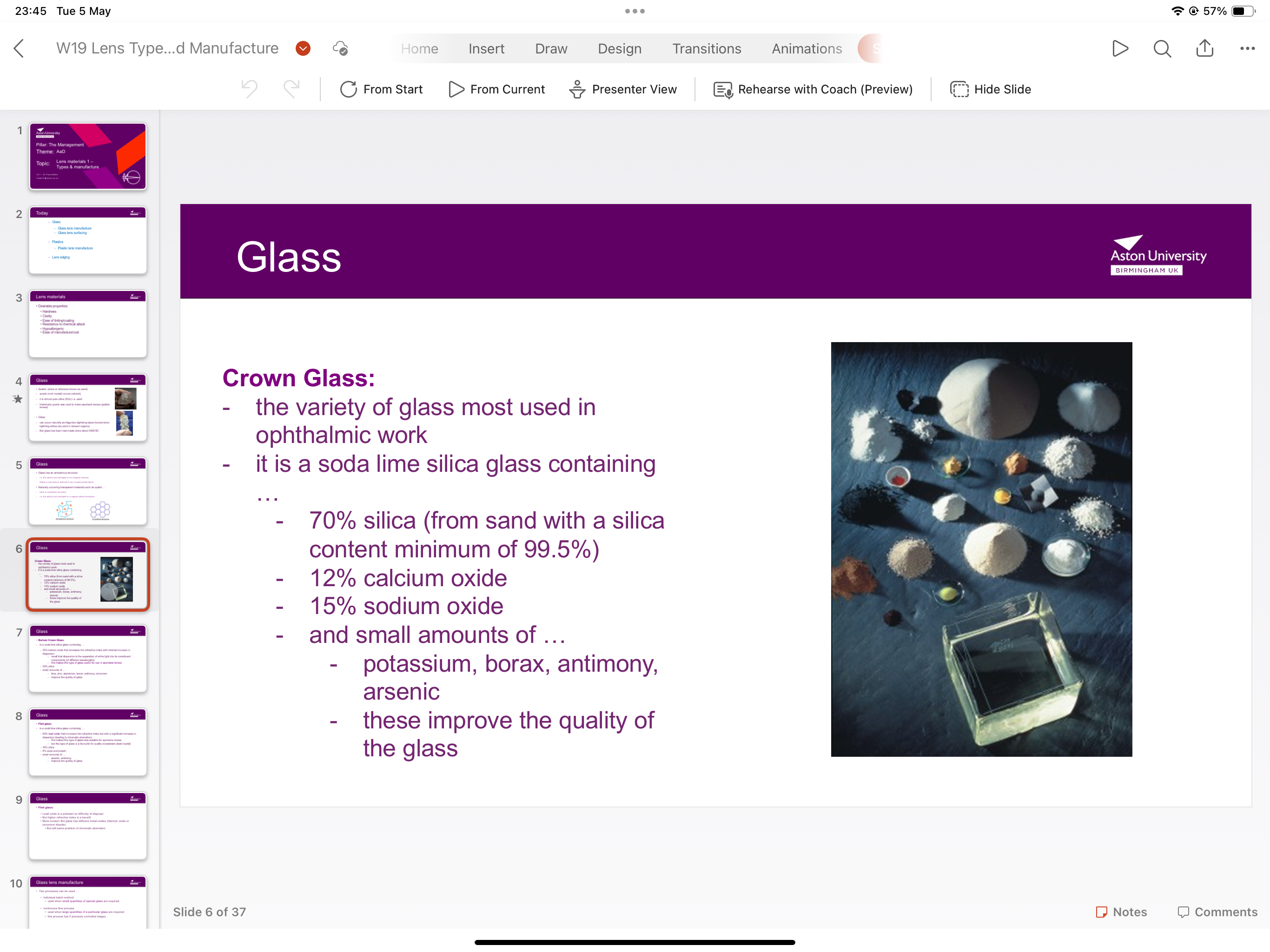
What are features of crown glass?
Variety of glass most used in ophthalmic work- soda lime silica glass containing small amounts of potassium, borax and arsenic which improve glass quality
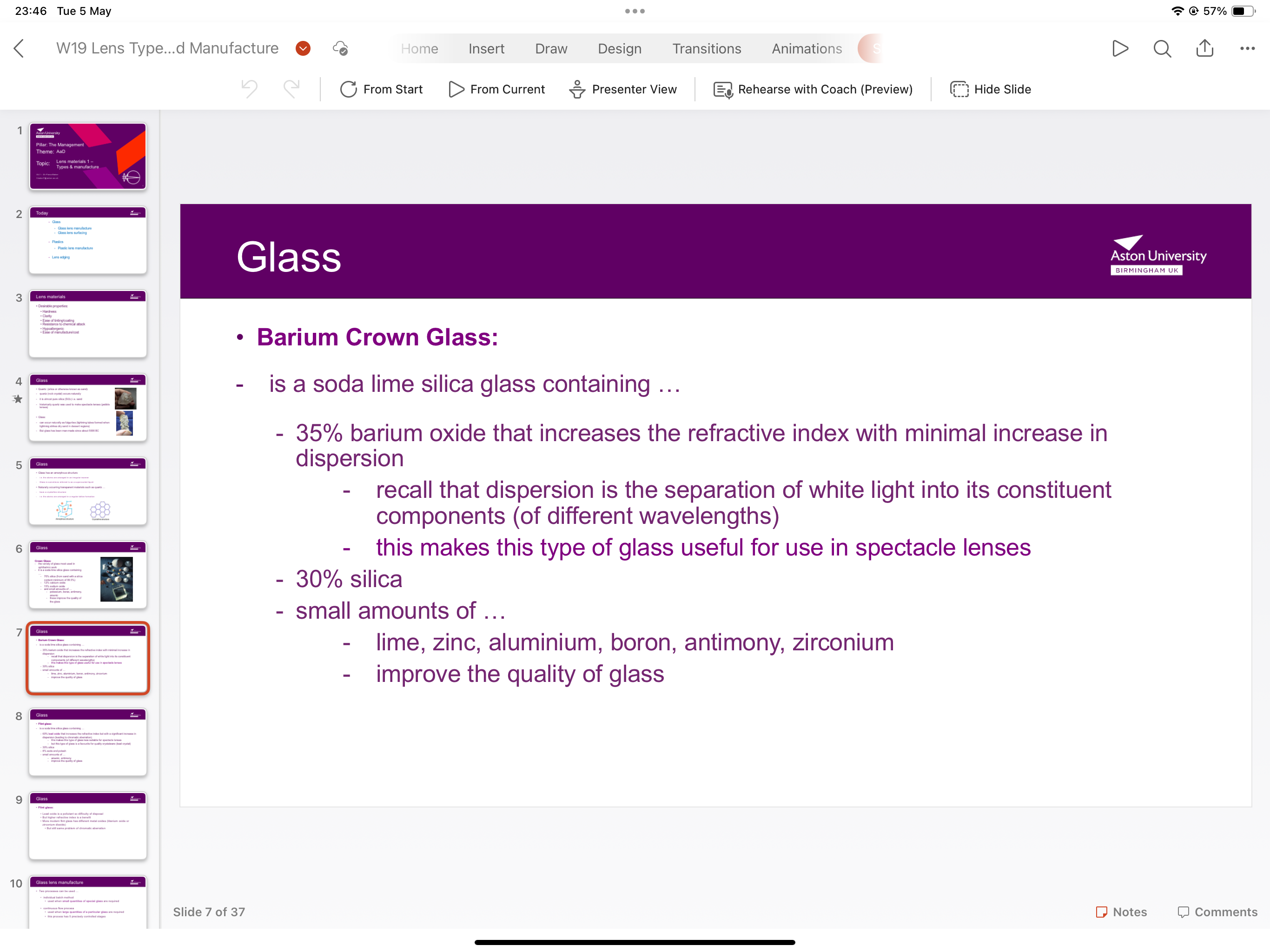
What are features of BARIUM crown glass?
Soda lime silica glass containing 35% barium oxide (increases RI with small increase in dispersion), 30% silica and small amounts of antimony, lime and zinc which improve glass quality
What are features of flint glass?
Soda lime silica glass containing 60% lead oxide, 30% silica and small amounts of arsenic and antimony to improve glass quality
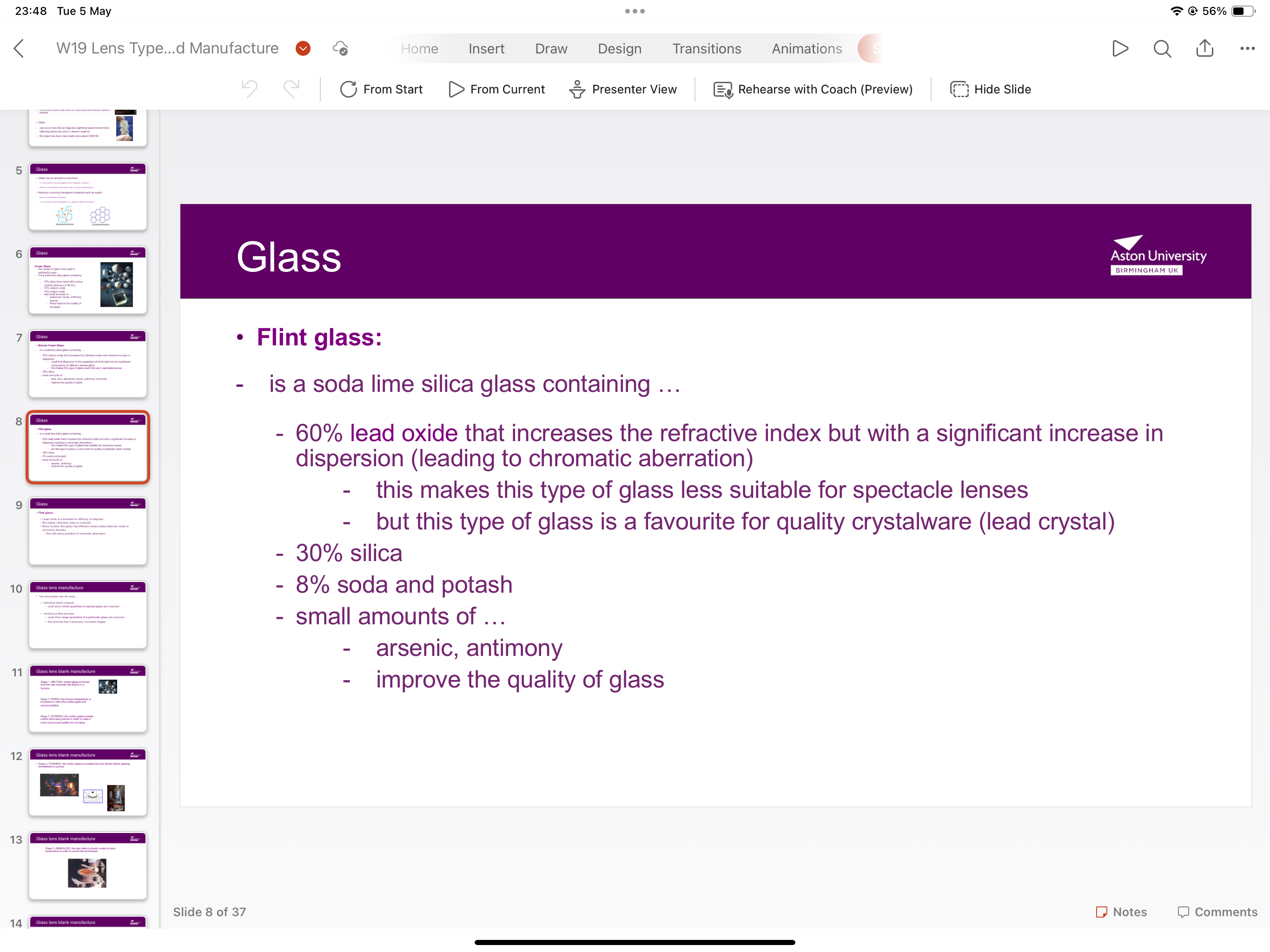
Why is flint glass less favourable?
Lead oxide increases the refractive index but with a significant increase in dispersion, leading to chromatic aberration- this glass is however a favourite for quality crystalware
Lead oxide is also a pollutant so it’s hard to dispose of
What are the 2 processes to manufacture glass lens?
Individual batch method (small quantities of special glass) and continuous flow process (large quantities)
What are the stages of glass lens blank manufacture?
Melting- molten glass formed from raw materials in furnace
Fining- increase temperature to remove bubbles
Stirring- increase viscosity, makes more suitable for moulding
Forming- moulding before pressing
Annealing- lens is cooled to room temperature
What is the structure of the lens blank?
Front and back curvature is not transparent, maximum possible lens power is determined by lens thickness
What is lens surfacing?
Conversion of lens blank into an uncut spectacle lens
What’s the benefit of glass compared to plastic?
Maintains form better
More scratch resistant
Less chromatic aberration
Higher refractive index materials
What are the cons of glass compared to plastic?
Danger when shatters
Brittle/poor impact resistance
What are features of CR39?
Most common plastic material, thermosetting plastic, RI 1.498
How are CR39 lens manufactured?
Liquid monomers poured into a mould- initiators are added to trigger polymerisation
Moulds subjected to thermal process after heating (curing), activating the initiator
Sealing lid removed, lens removed from dye
Further curing occurs to release internal strain in lens matrix
SEALING RINGS CANNOT BE RESUED BUT GLASS MOULDS CAN
What is polyaddition?
Production of a polymer from more than one monomer- production may take up to 48 hours to complete
What is polycarbonate?
Thermoplastic material made by injection moulding
How is polycarbonate manufactured?
Pellets of polycarbonate heated to 300 degrees, forming viscous liquid
Chilled water is passed around to solidify and cool the liquid
Takes 20 secs- polycarbonate is very soft so temporary scratch resistant coating is applied
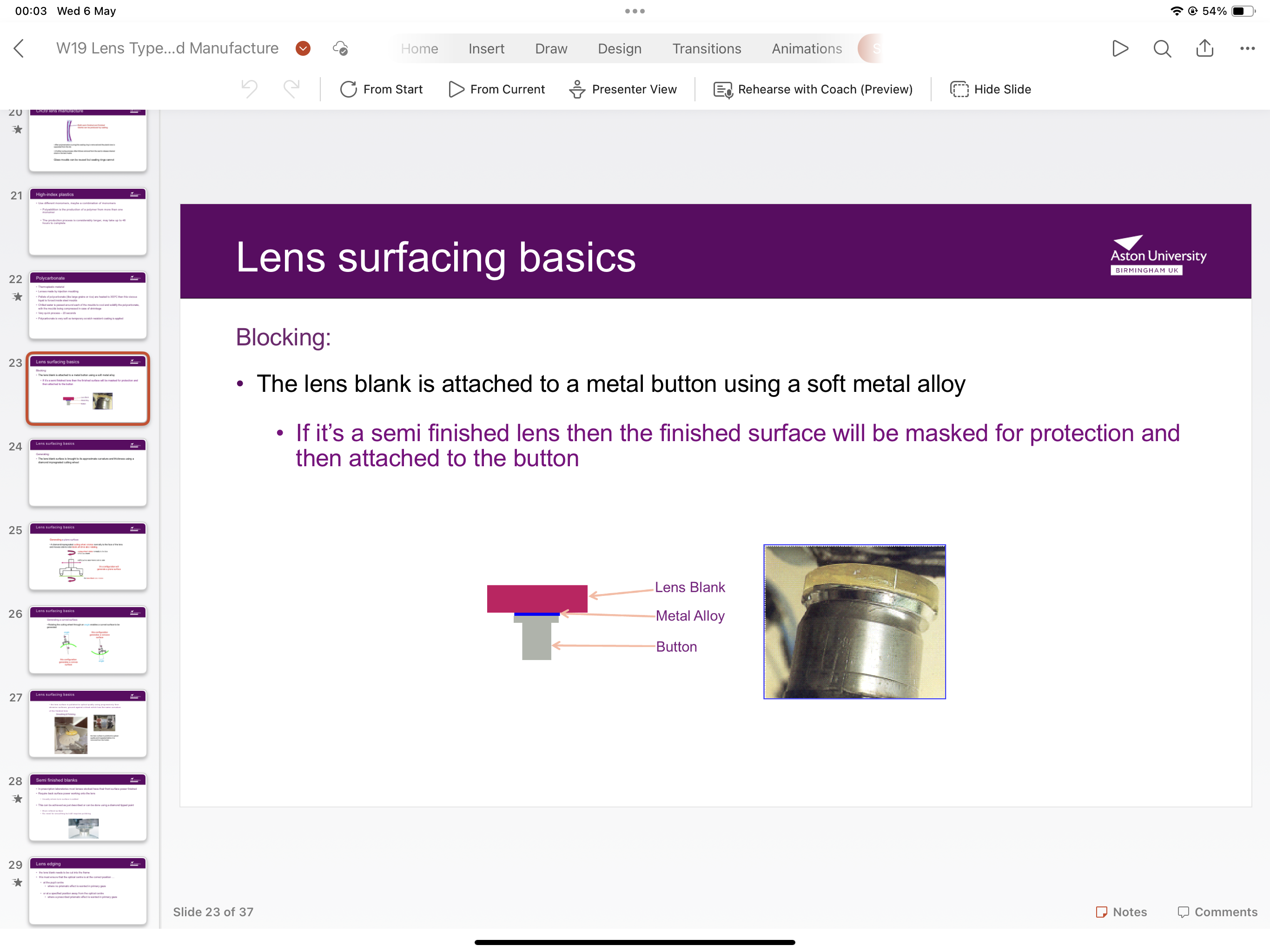
What’s the process of blocking in lens surfacing?
Lens blank is attached to a metal button using a soft metal alloy
What happens after blocking in lens surfacing?
Generating- lens blank surface bought to appropriate curvature and thickness using diamond impregnated cutting wheel
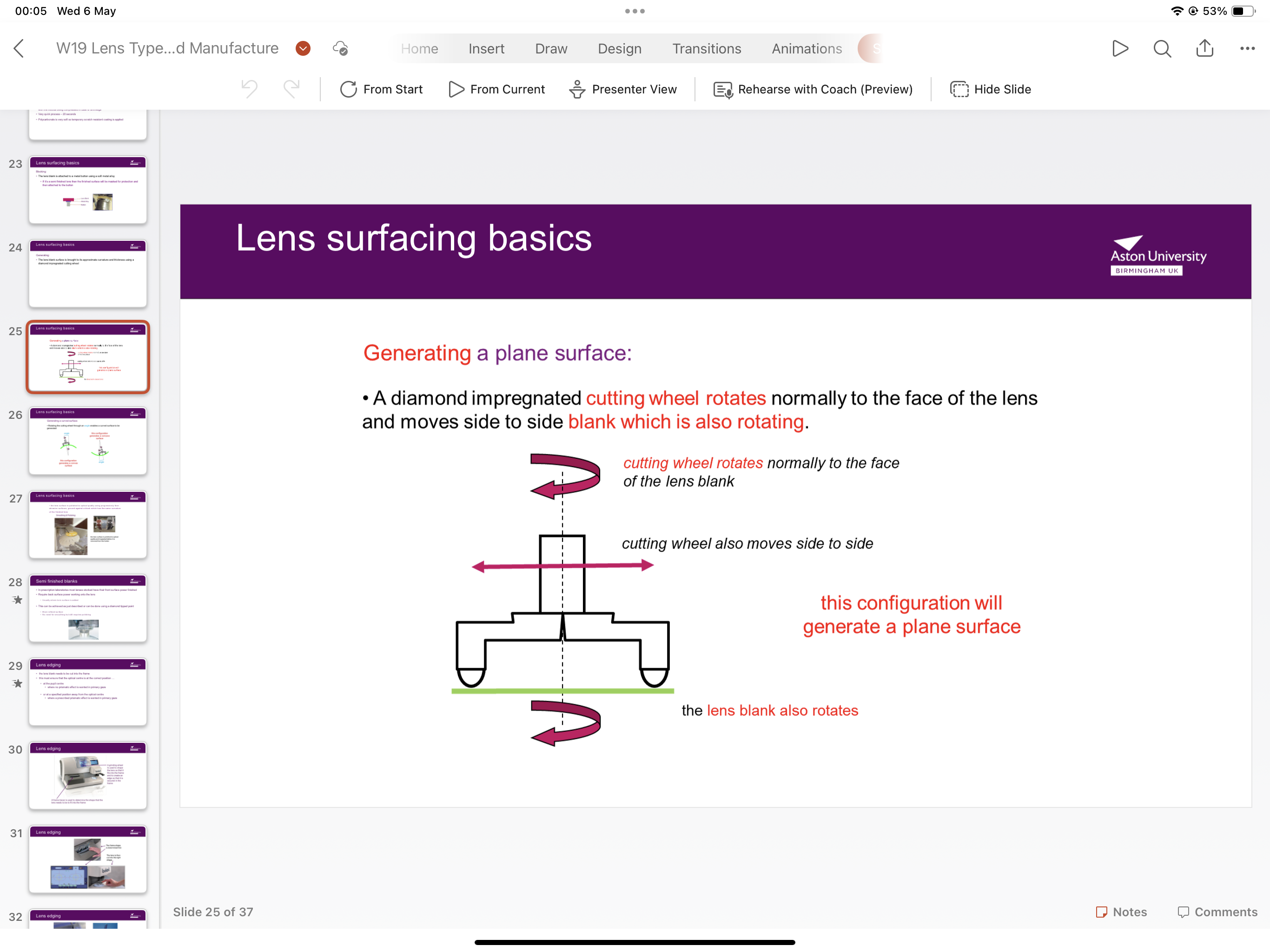
How do you generate a plane surface?
Diamond impregnated cutting wheel rotates normally to face of lens and moves side to side blank
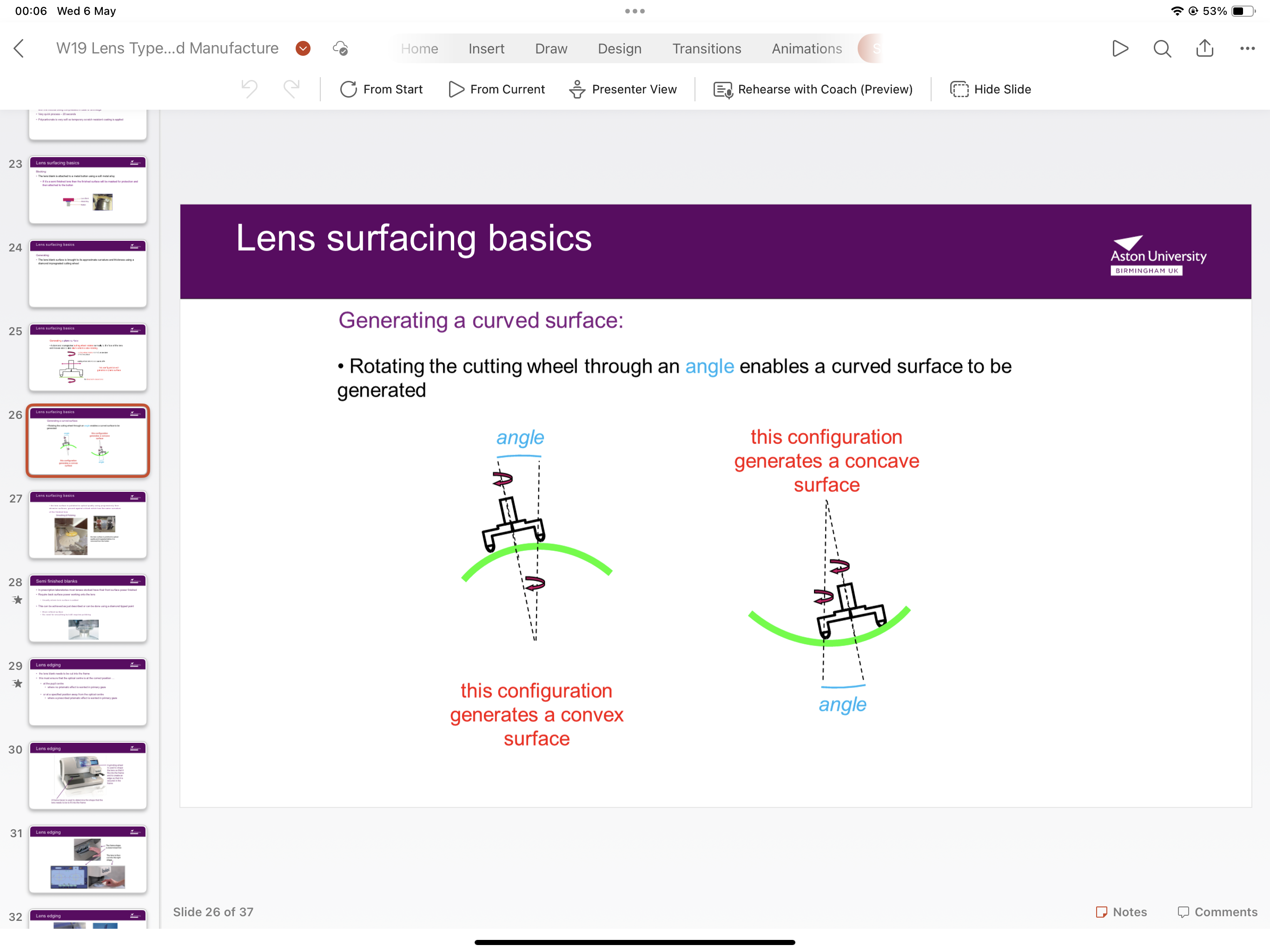
How do you generate a curved surface?
Rotate the cutting wheel through an angle enabling a curved surface to be generated
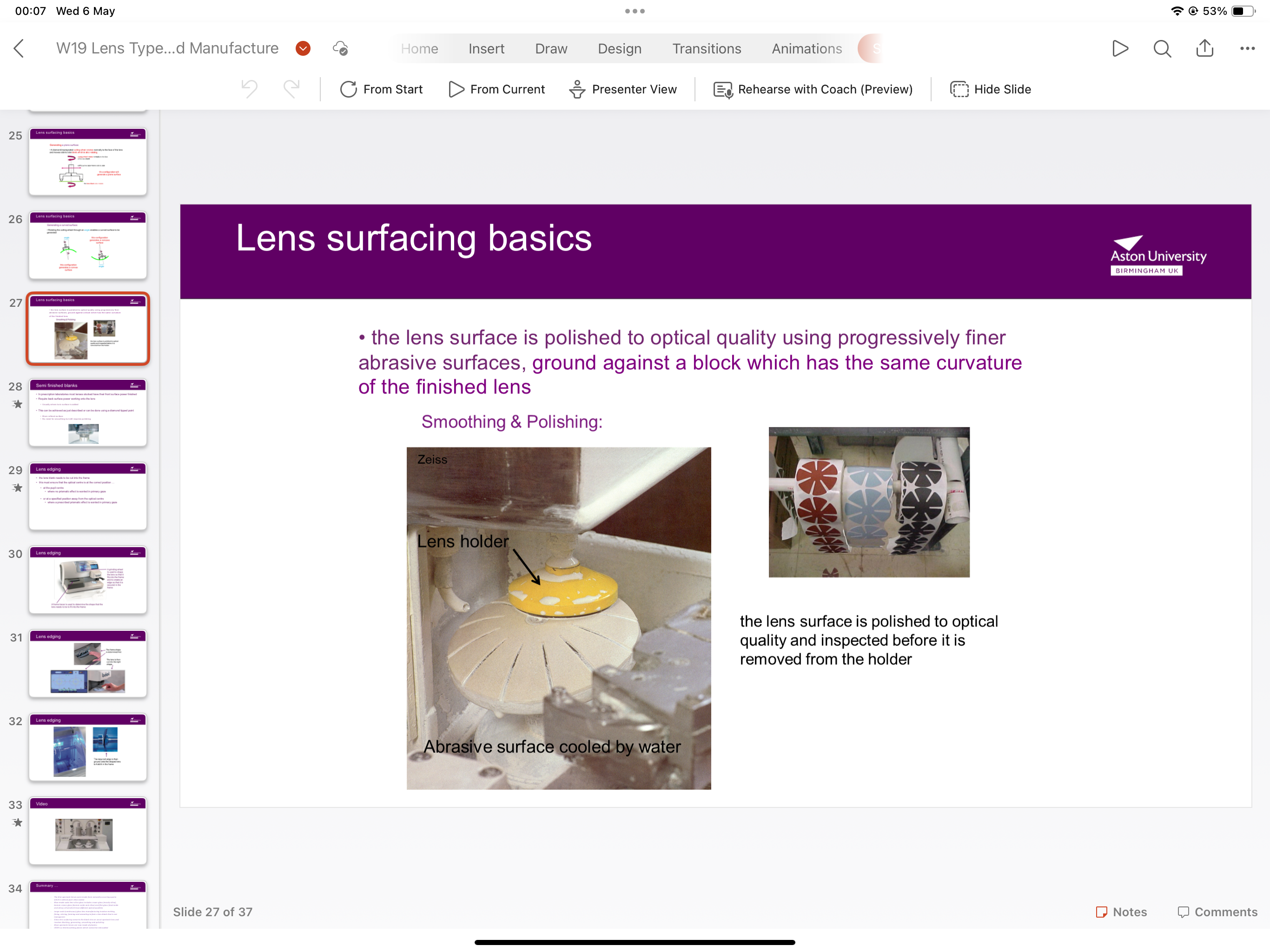
How are the lens smoothed and polished?
Using finer abrasive surfaces, they’re ground against a block which has the same curvature as the finished lens
Why are prescription laboratory lenses only having their front surface power finished?
Back surface power is altered when toric surface is added- achieved by using a diamond tipped point for a more refined surface (polishing is still required)
What is lens edging?
Lens blank must be cut into the frame- must ensure optical centre is at the correct position, at pupils centre (no prismatic effect) OR at a specified position where prismatic effect is wanted in the primary gaze
What is the process of lens edging?
Grinding wheel shapes the lens
Frame tracer determines the shape
Frame shape is determined first, then lens is cut
Required edge is grounded onto shape lens to hold it in place