BIO 141 Cell Structures, Microscopes, and Cell Respiration Lab Review
 Call Kai
 Learn
Learn Practice Test
 Spaced Repetition
 Match
Match Flashcards
 Knowt Play
1/18

There's no tags or description
Looks like no tags are added yet.
Name | Mastery | Learn | Test | Matching | Spaced | Call with Kai |
|---|
No analytics yet
Send a link to your students to track their progress
19 Terms
What is the proper way to carry a microscope?
Always carry the microscope with both hands, one supporting the base and the other grasping the upright arm.
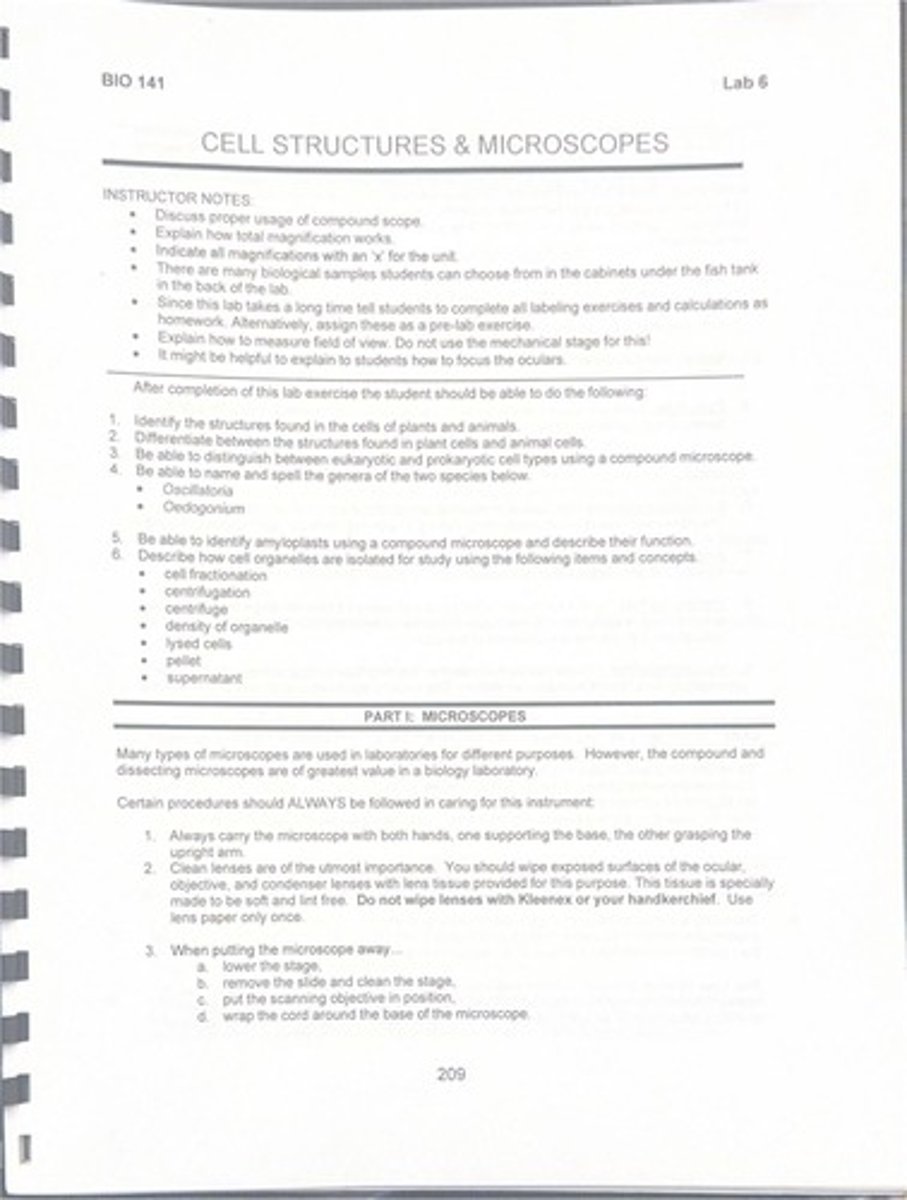
What should be used to clean microscope lenses?
Use lens tissue that is soft and lint-free; do not use Kleenex or handkerchiefs.
What is the first step when putting away a microscope?
Lower the stage.
What should be done with the slide before storing the microscope?
Remove the slide and clean the stage.
What is the function of amyloplasts?
Amyloplasts store starch in plant cells.
What are the two genera of species students should be able to name and spell?
Oscillatoria and Oedogonium.
What is the difference between eukaryotic and prokaryotic cells?
Eukaryotic cells have a nucleus and membrane-bound organelles, while prokaryotic cells do not.
What is cell fractionation?
A technique used to separate cellular components while preserving their individual functions.
What is the role of centrifugation in cell studies?
Centrifugation separates organelles based on their density.
What does the term 'supernatant' refer to?
The liquid that remains above the solid residue after centrifugation.
What is the significance of total magnification in microscopy?
Total magnification is calculated by multiplying the magnification of the ocular lens by the magnification of the objective lens.
What should students do to measure the field of view?
Measure without using the mechanical stage.
What is the importance of clean lenses in microscopy?
Clean lenses are crucial for clear visibility and accurate observations.
What is the maximum magnification typically used in a compound microscope?
The maximum magnification can vary but is often around 1000x.
What is the purpose of the ocular lens in a microscope?
The ocular lens magnifies the image further after it has been magnified by the objective lens.
What is the first step in preparing a microscope for use?
Ensure that the microscope is clean and properly set up.
What safety precautions should be taken when handling sodium hydroxide in the lab?
Wear safety goggles and gloves, and handle it carefully to avoid skin contact.
What is the purpose of labeling exercises in the lab?
Labeling exercises help students learn to identify and understand the structures of cells.
What is the main difference between compound and dissecting microscopes?
Compound microscopes are used for viewing small specimens at high magnification, while dissecting microscopes are used for larger, three-dimensional specimens at lower magnification.