(10) Power analysis and meta-analysis
 Call Kai
 Learn
Learn Practice Test
 Spaced Repetition
 Match
Match Flashcards
 Knowt Play
1/22

There's no tags or description
Looks like no tags are added yet.
Name | Mastery | Learn | Test | Matching | Spaced | Call with Kai |
|---|
No analytics yet
Send a link to your students to track their progress
23 Terms
What is effect size?
The size of the relationship between two variables
the extent to which one can predict the value of one variable given the value of the other variable
What do statistical tests tell us about results?
They indicate whether an effect is likely due to chance, not whether it is meaningful
Does effect size imply causation?
No, it reflects the strength of a relationship, not causality
Why can the Pearson correlation be used as an effect size?
It measures the strength of the relationship and is standardised across studies
we can derive it from other tests such as t-tets if its not reported
What is Cohen’s d?
A standardised measure of the difference between two means
How is effect size expressed in Cohen’s d?
In standard deviation units
What is a problem with relying only on significance testing?
Significant results may not be meaningful and depend heavily on sample size
e.g. a significantly large sample size will always produce a significant result
Why is the null hypothesis rarely true?
Because real-world differences almost always exist to some degree
What is a Type I error?
Finding a significant effect when none exists
false positive
What is a Type II error?
Failing to detect a real effect
false negative - most likely due to lack of statistical power
What is statistical power?
The probability of detecting a real effect when it exists
e.g. a study with a power of 0.8 has a 80% chance of finding a sig effect when there is one, also a 20% chance of not finding one
Why are low-powered studies problematic?
They are unlikely to detect real effects and increase Type II errors
What factors affect statistical power?
Effect size, sample size, and alpha level
the bigger the effecti size, the higher the likelyhood it is detected
the bigger the sample the greater the power
a more leinent alpha will increase the power
What is the recommended level of statistical power?
Around 0.80 (commonly accepted standard)
but power should definitely be above .5
Why is power analysis important in research planning?
To ensure studies have a reasonable chance of detecting effects
What are Cohen’s benchmarks for effect size?
0.2 = small, 0.5 = medium, 0.8 = large
How can researchers estimate effect size before a study?
Using pilot data, previous research, or meta-analysis
What is meta-analysis?
A method of combining effect sizes across studies to estimate an overall effect
average effect size
how is meta analysis conducted
define variables of intrest
plan database search
calculate effect size
combine effect size
compare effect sizes from different study types
Why convert correlations to z-scores in meta-analysis?
To avoid distortion when averaging effect sizes
How can statistical power be increased?
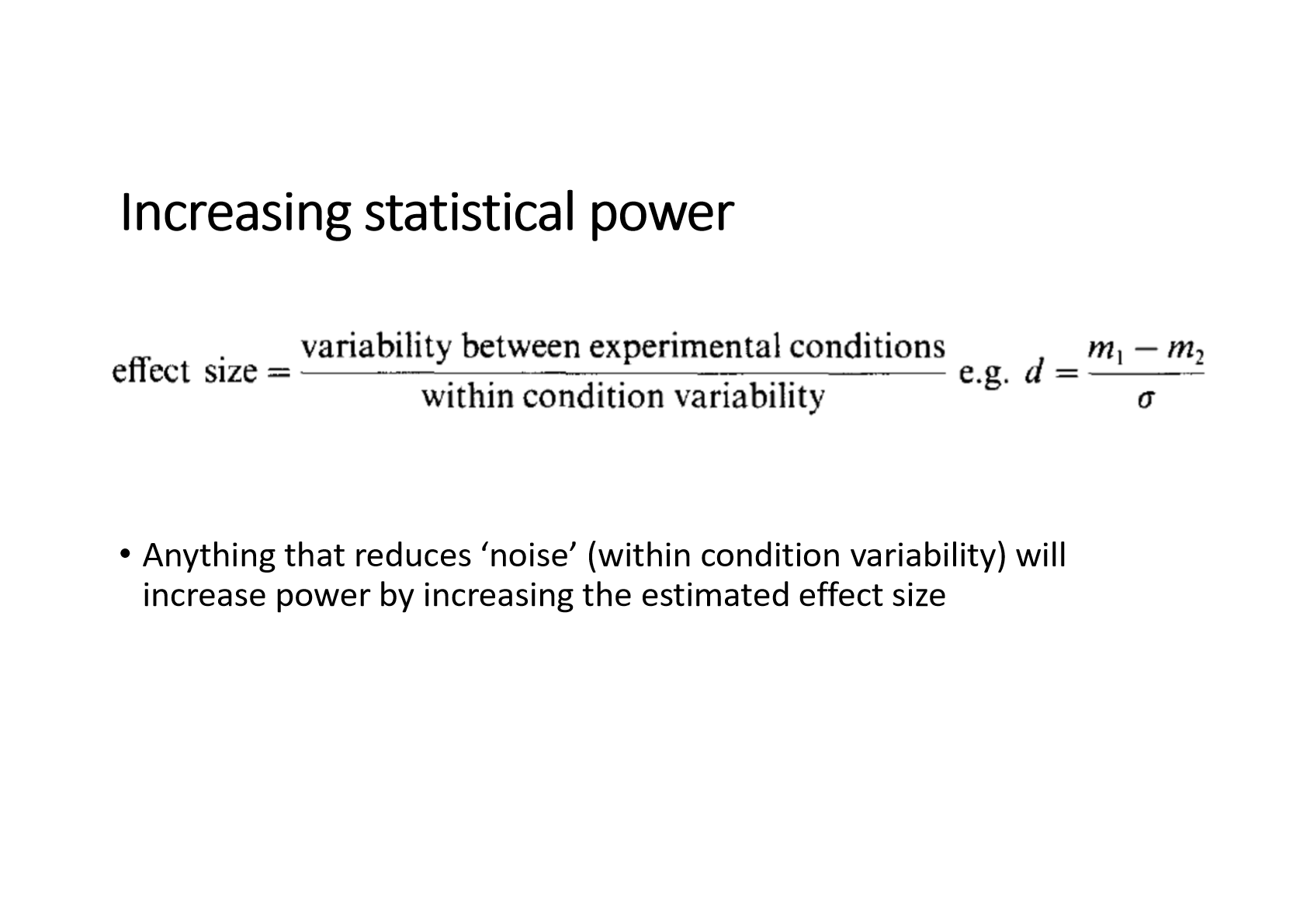
Increase sample size, relax alpha, reduce noise, standardise procedures, and use reliable measures and repeated measures design
how does reducing ‘noise’ increase effect size
it reduces within condition variability which increases the power by increasing the effect size
What is the role of falsification in scientific discovery?
Theories should be tested by trying to disprove them rather than confirm them