4: sag, lens form and lens thickness.
 Call Kai
 Learn
Learn Practice Test
 Spaced Repetition
 Match
Match Flashcards
 Knowt Play
1/55

There's no tags or description
Looks like no tags are added yet.
Name | Mastery | Learn | Test | Matching | Spaced | Call with Kai |
|---|
No analytics yet
Send a link to your students to track their progress
56 Terms
sign conventions for lens calculations
when measuring radius , if compass point is placed to the right its positive if left to the surface then its negative.
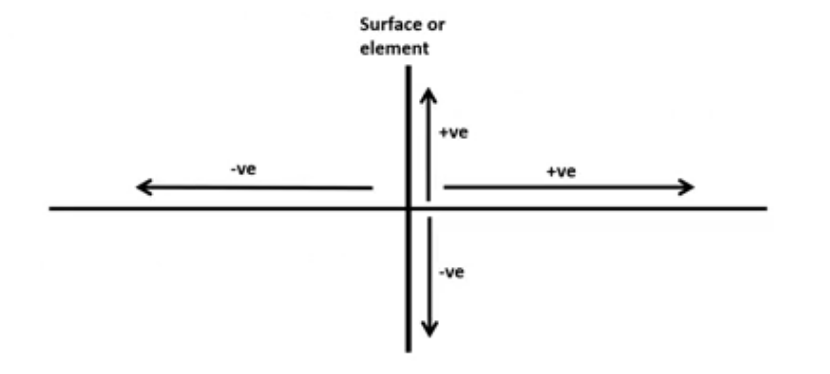
signs of angles
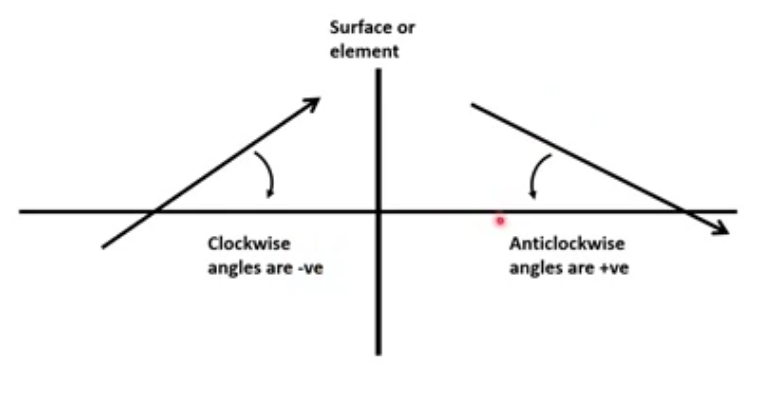
using sing angles for snells law
n normally air
n’ refractive index of material
angle of incidence is i
angle of refraction is i’
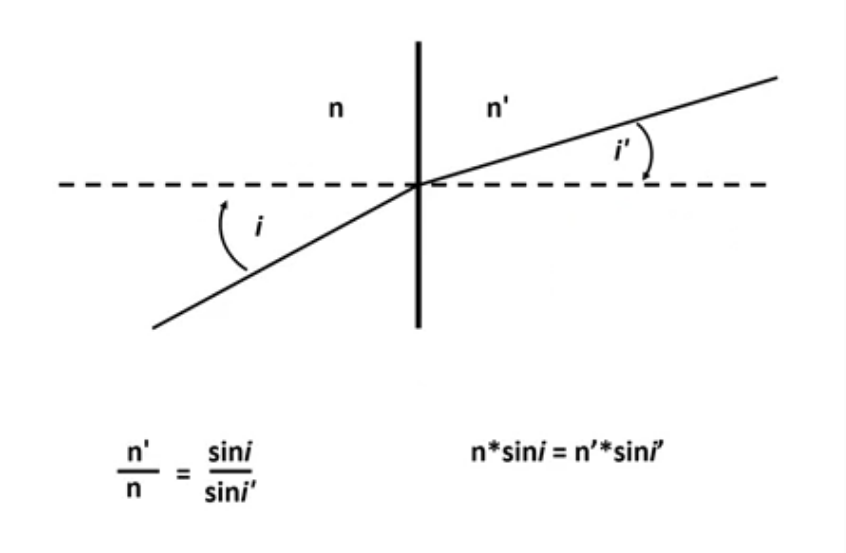
refractive index
refractive index of medium= velocity of light in vacuum/ velocity of light in medium
vacum is used in definition of asolute refractive index
air at standardised pressure 1 atm and temp 0 degrees is commonly used instead of velocity in vacuum.
velocity of light in vacuum= 299792458
refractive index of air - 1
so velocity of light in ait = 299702547 m/s
light travelling from left to right
radius of the front surface would have a positive sign and back surface of radius would have a negative surface
radius of front surface is on the right side so thats why it is positive
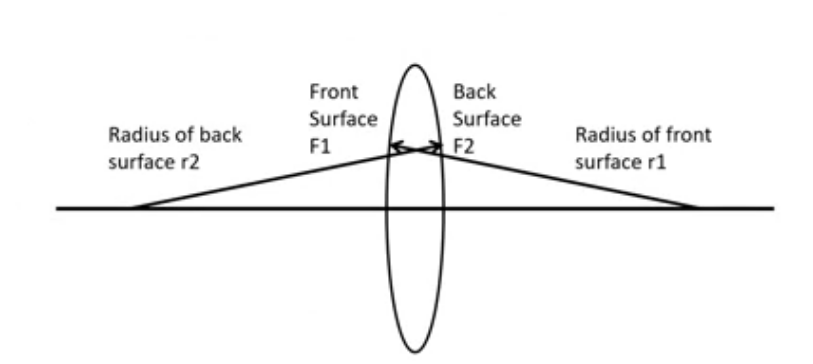
miniscus lens showing light travelling from left to right
both surfaces will have a positive sign as theyre to the right of surface
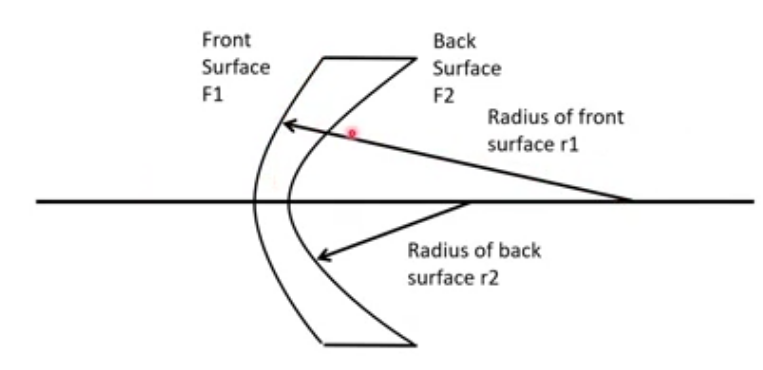
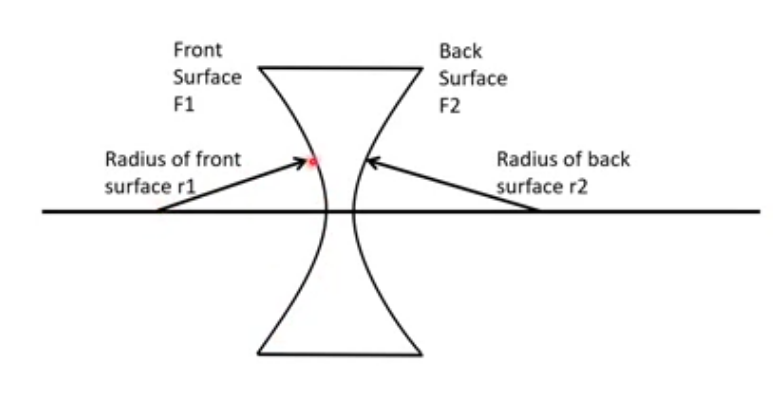
biconcave lens showing light moving from left to right
front surface the compass points to the left so f1 i snegative
back surface points to the right to the sign will be positive
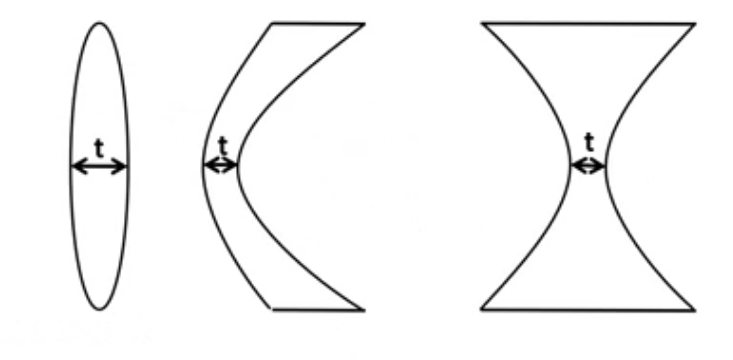
centre thickness, t
thickness of the lens in the centre
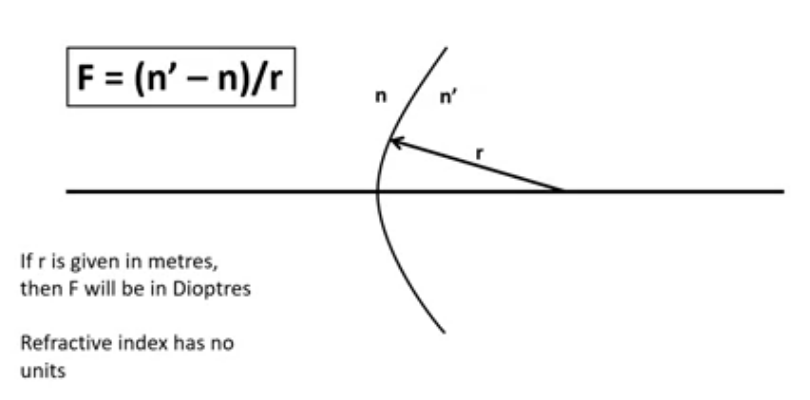
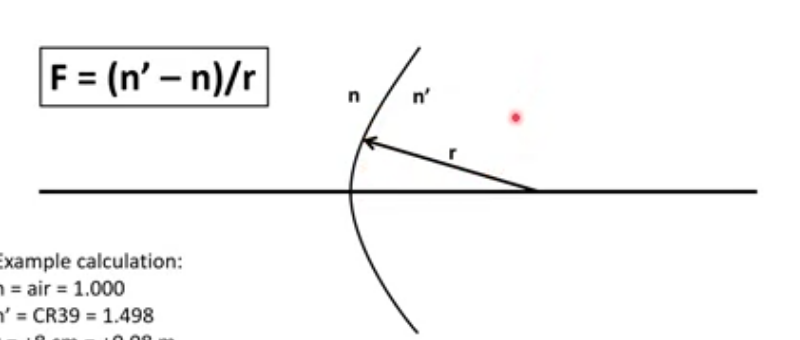
surface power (F) of a refracting surface made from a material of refractive index n’, in a medium of refractive index n is given by:
F= (n’ - n ) / r
if r is given in metres then F will be in dioptres
refractive index has no units
light going into lens, going through surface and its the new refractive index that youre moving into minus the refractive index the light has left from
surface power calculation
if it doesnt say, assume the lens is in air
n= air= 1.00
n’ = 1.498
r = +8cm
so
F= (1.498-1.00)/ 0.08
F= +6.23 D
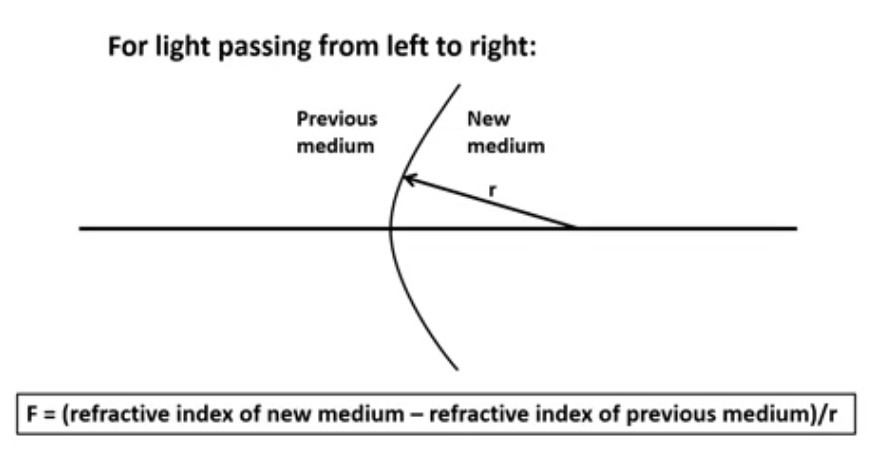
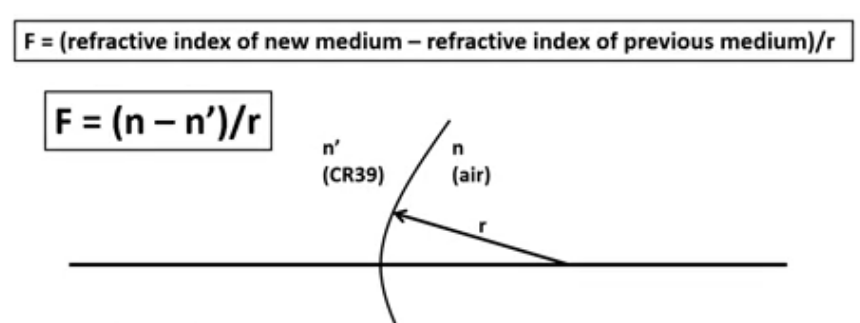
back surface of a lens in air
going to be F= (n-n’) / r
rear surface power, refractive index of air is th new refractive index the light is moving into
n= 1.00
n’= 1.498
r= +6cm
so F= (1.00-1.498) / 0.06
F= -8.30 D
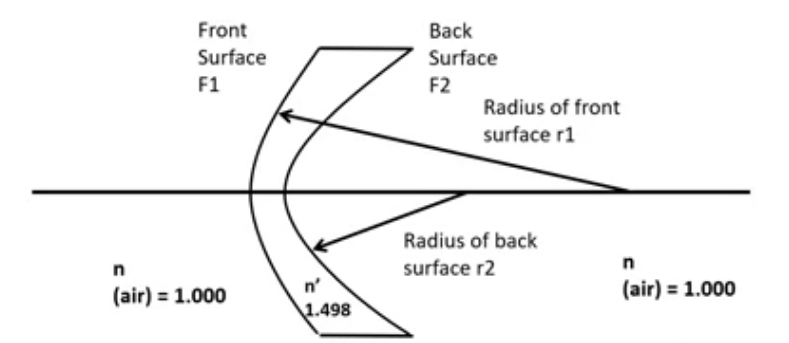
using both front and rear surface equation
front surface power f1
(n’-n) / r
radius = +8cm
F1= (1.498-1.00)/0.08 = +6.23 D
back surface power F2
(n-n’) / r
radius = +6cm
F2= (1.00-1.498) / 0.06
F2= -8.30 D
overall power of the lens=
thin lens equation = f = f1 + f2
overall lens= 6.23 + - 8.30 = -2.07 D
need to take into account the thickness of lens
lens measure- device for measuring surface power
clock with needle that moves around
measures sag, determines radius of curvature from sag across a known chord , and then displays surface power using an assumed refractive index
if put on flat surface- with 0 power the pins will be in direct allignment
if use cinvex surface- pin will be pushed further upwards
if use concave surface pin will be pushed down
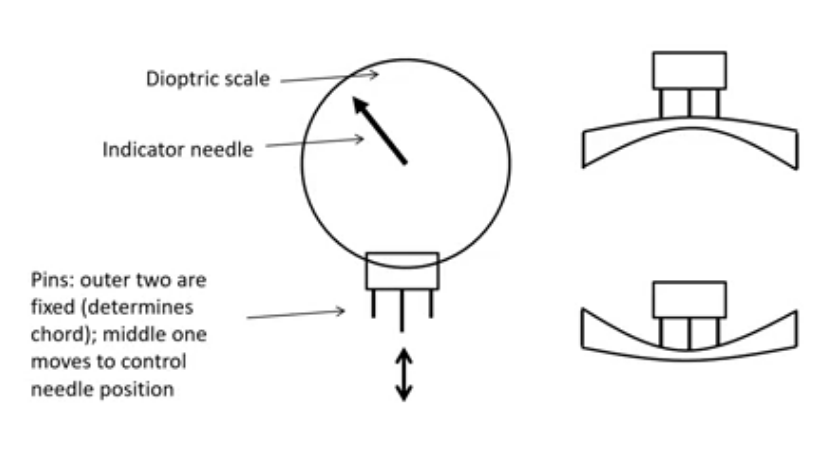
what is sag
refers to the height of a curved surface- like a lens or mirror
measured from the centre of the surface to the edge along line perpendicular to optical axis
sag formula
derived from a² + b² = c²
semi diameter is Y / a
r is radius / c is hypotenuese
b
s is- apex of curve to the line drawn
s is the edge thickness worked out from centre thickness
to find s need to find out b
r- b is going to be s
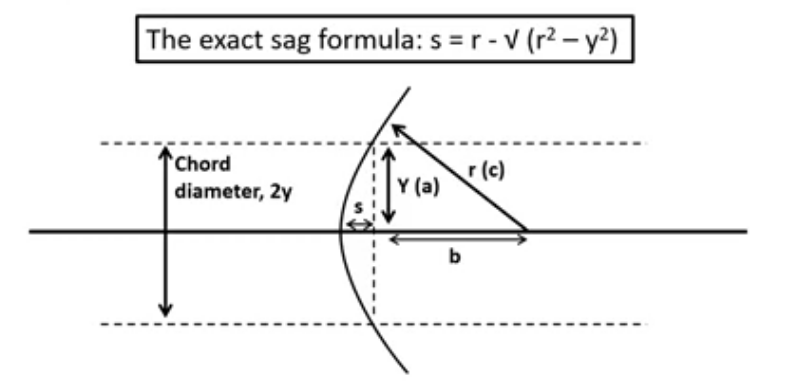
rearranging s y and r
a² + b² = c²
Y= a
r= c
r- b = s
to work out b : c² -a² then square root
( radius² - y² ) then square root this for b
then to work out s = radius - b
rearrange sag for r
r = (y² + s²) / 2s : spherical surface
so the spacing of the outer pins on the lens measure will give 2y. the length of the centre pin will give s
lens measure- underlying maths using opthalmic crown glass
sag told us the radius of the surface, but lens measures are designed to tell us the surface power
most lenses are calibrated for opthalmic crown glas with a refractive index of 1.523
F= (n-1) / r
so if n is 1.523, surface power, F, = 0.523 / r (where radius of surface in metres)
what is we are measuring a lens made from a material other than crown glass
true surface power , F true = F measured x ( n true -1 ) / 0.523
0.523 is the surface power
n true is the actual refractive index of the lens being measured
so actual refractive index of lens, n true= 1+ ( ( F true / F measures ) x 0.523 )
what is the actual surface power of a lens made from flint glass (n= 1.654) when the lens measure displays a surface power of + 6.00 D
true surface power , F true = F measured x ((n true - 1) / 0.523
F true= +6.00 x ((1.654 -1.00 ) / 0.523
F treuu = + 6.00 x (0.654/0.523)
F true= + 7.50 D
Where n true is actual refractive index of lens being measured
so actual refractive index of the lens , n true = 1+ (( F true / F measured) x 0.523)
lens is made from higher refractive material than air there is more surface power
true surface power= ( n true - 1 / n calibrated -1 ) measured surface power
if not stated what the refractive index calibrated, it is always going to be 1.523
so it would be x-1 / 1.523-1
what is the refractive index of a lens when a lens measure calibrated for crown glass ( n+ 1.523) displays a surface power of +6.00 D, but actual surface power is +7.50 D
actual refractive index of the lens , n true= 1 + ((F true / F measured) x 0.523 )
n true = 1+ 7.50 / 6.00 × 0.523
n true = 1.654
altenative formula from henson, optometric instrumentation
surface power = ((n-1) / ( n0 -1 )) x lens measure reading
where n = actual refractive index of les being measured
n0 is refractive index to which lens measure is calibrated
what is surface power if n = 1.523
n’ = refractive index of lens
n= refractive index of air = 1.00
radius- radius of curvature
surface power = 1.523 -1.00 / radius
0.523 / r is surface power
thick lens calculations: BVP
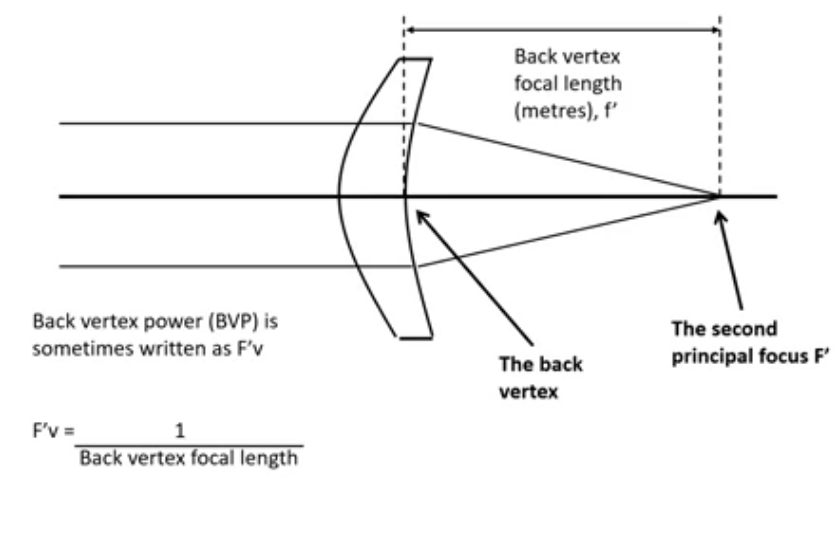
the power of the lens measured with respect to the back vertex ; the reciprocal of the back vertex focal length
example shows a positive lens
correcting myope with a plus lens but will be upside down
BVP= 1/ bacl vertex focal length in metres
second principal focus behind the lens
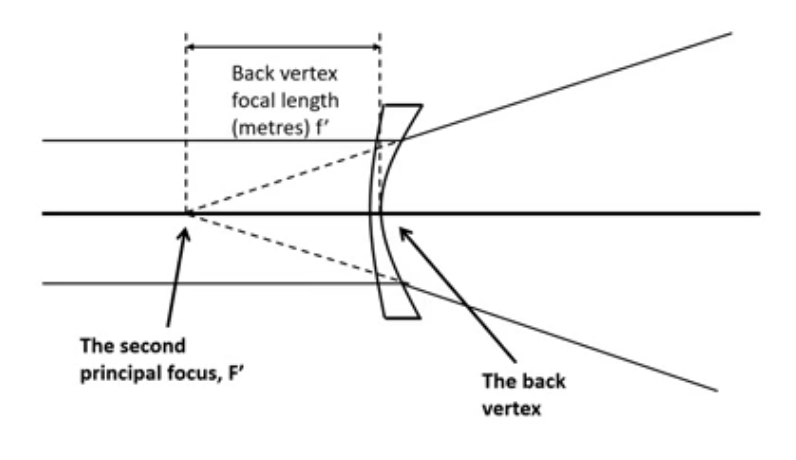
BVP with a negative lens
second principal focus is behind the lens
for a myopic person if you put the focus point coincident with far point then its corrected
shift the far point to infinity by placig concave lens in front of eye, so it diverges the rays making them appear to originate from the far point
FVP= 1/ front vertex focal length
thick lens calculation : back vertex power
F1= surface power of the front surface of the lens D
F2= surface power of the back surface of the lens D
t= centre thickness of the lens in meters
n’= refractive index of lens material
formula is reducing the front surface by placing F1 in the same plane as F2 , which turns it into the thin lens equation
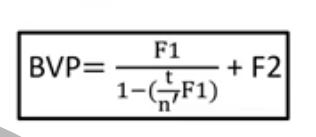
thin lens calc
power of the surface = F1 + F2
2 lenses F1= +5.00DS and F2 = +7.00DS are separated by 15cm. what is the equivalent power of this lens combination
Fequivalent= F1+F2 - d x F1 x F2
= ( 5+7) - 0.15 × 5 × 7
=
thick lens; front vertex power
F1= surface power of the front surface of the lens D
F2= surface power of the back surface of the lens
t= the centre thickness of the lens in metres
n’ = the refractie index of the lens material
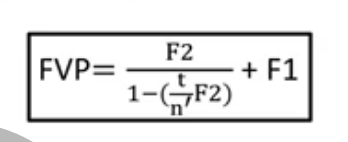
BVP calculation
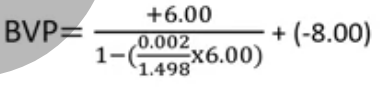
F1= +6.00 DS
F2= -8.00 DS
t= 2mm
BVP =-1.95 DS
if you give a lens more thickness it goes more plus
thin lens would be = + 6.00 + - 8.00 = -2.
thick is more plus than thin.
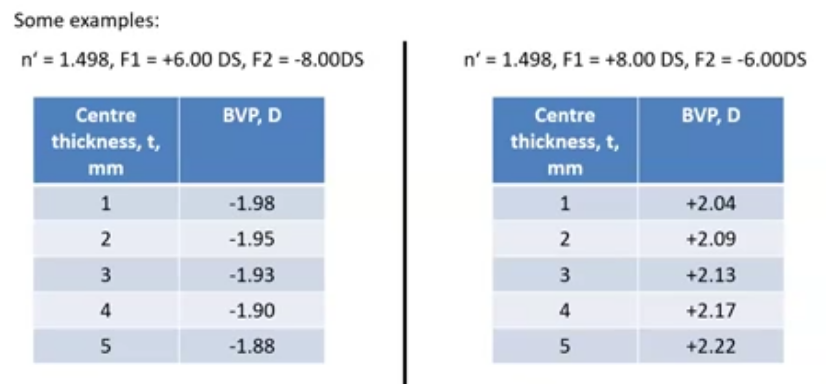
general effect of centre thickness, t, on BVP
increasing centre thickness will make the bvp more positive or less negative, if other parameters remain the same
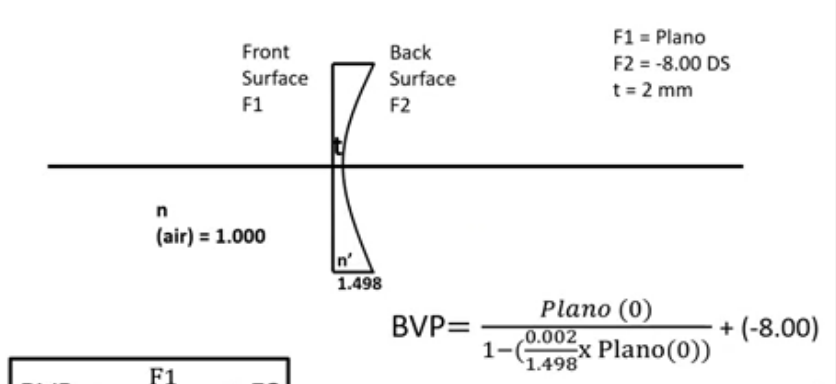
effect on t on BVP when one surface is plano- negative lens eg
F1= plano
F2= -8.00
t= 2mm
bvp will be the rear surface power
bvp = F2= -8.00 DS
effect of t on the bvp when one surface is plano - positive lens eg
F1= + 8.00 DS
F2= plano
t= 2, 4, and 6mm
positive lens with plano rear surface, theres no power at the back surface as f2 is 0 F1 is moved forwards so reduced surface changes as we go thicker
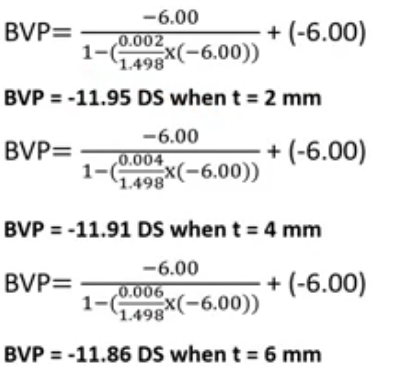
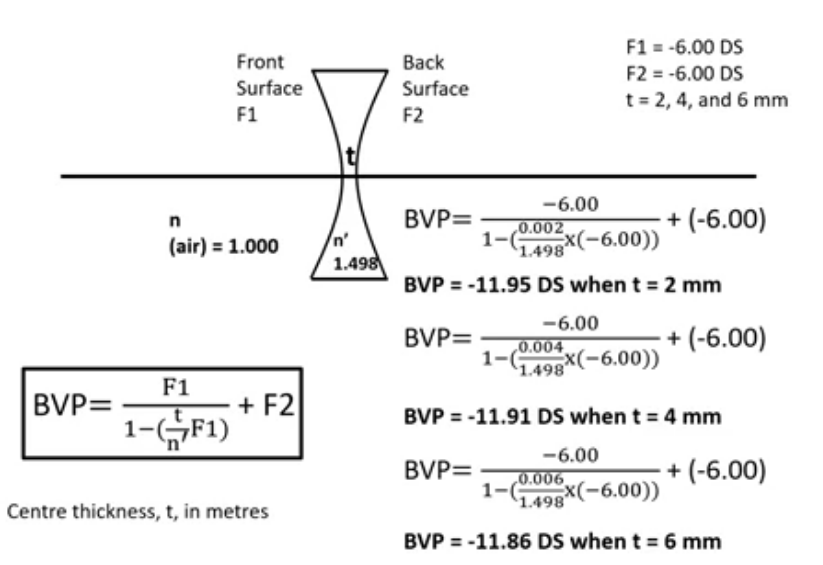
effect of t on back surface in biconcave lens form
F1 is negative in coconcave
as cntre thickness gets thicker, it gets more positive.
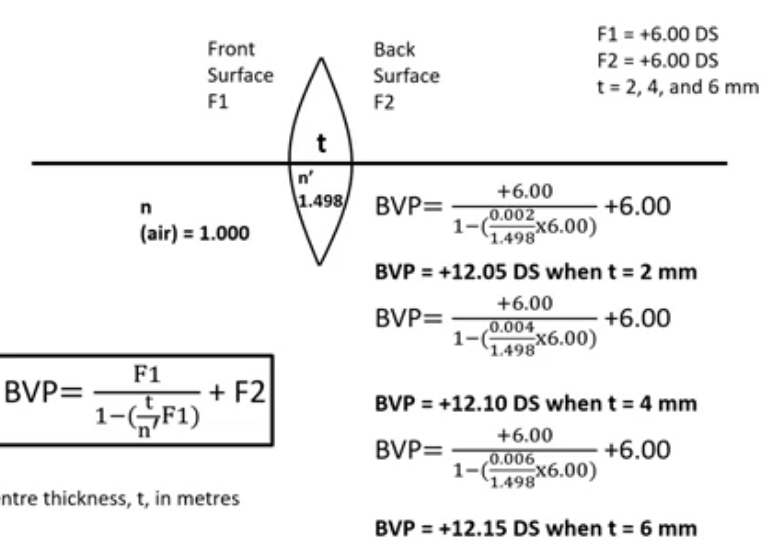
effect on t on the bvp in biconvex lens form
F2 is positive
lens form, sags and lens thickness- lecture week 4
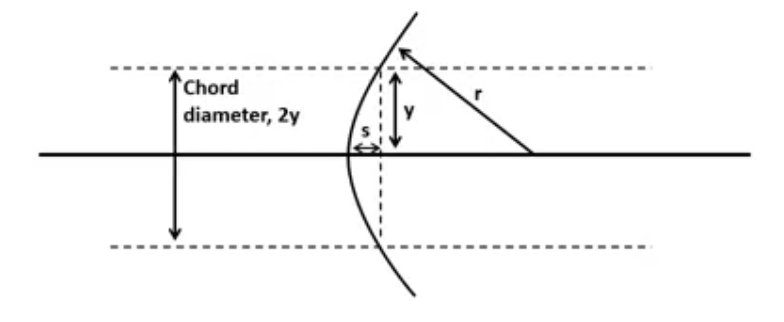
sag of spherical lens surface: definitions
r= radius of surface
y= semi diameter of the chord
s= sag of surface at the chord diameter 2y
as you increase y ( as spectacle lense increases) the sag gets bigger
in small lenses- small field of view
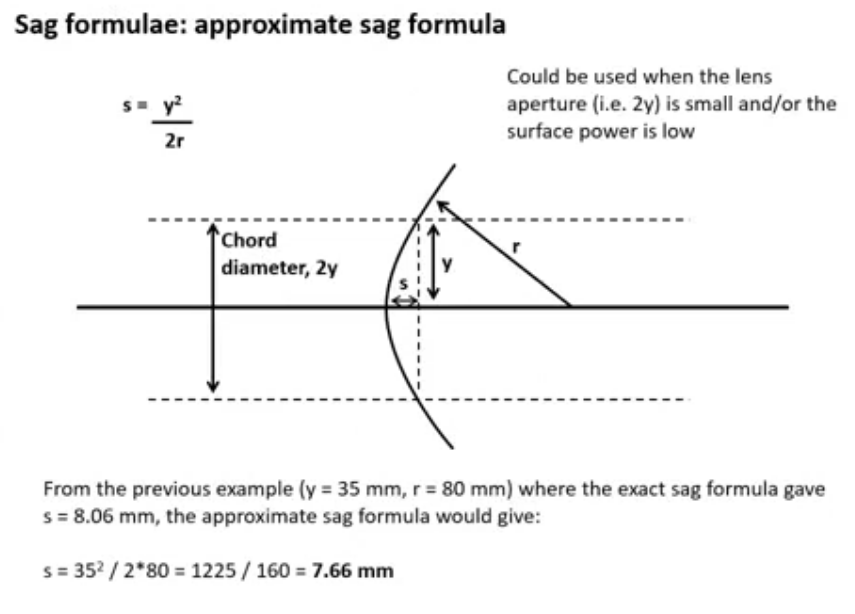
approx sag formula
error increases as surface power increases larger radius- flatter lens srface so error goes down
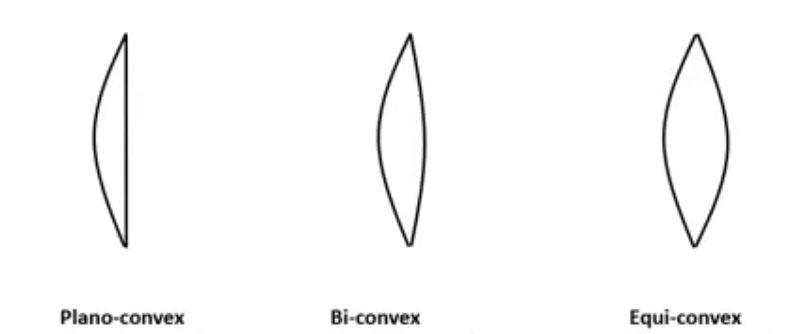
flat form conves lenses
plano- convex- one convex surface one plano surface
bi convex- two convex surfaces of differing radius
equi-convex- two convex surfaces of equal radius
flat form lenses seen in trial lenses, in refractor heads
flat form tend to be thinner and lighter, but not good for spectacles
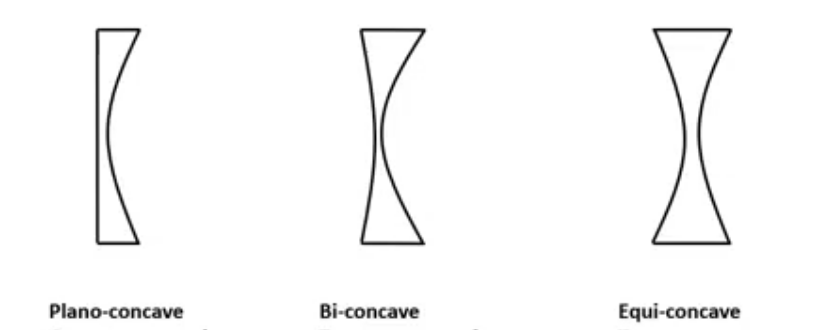
fllat from concave lenses- minus powered lens
plano concave- one concave surface, one plano surface
bi concave- two cncave surfaces of differing radius
equi concave- two concave surfaces of equal radius
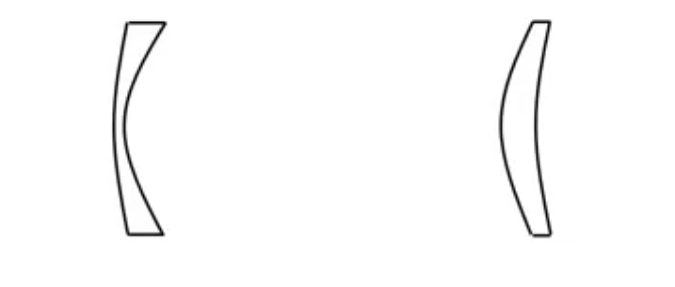
meniscus or curved form lenses
a lens that is not flat form is curved form
one surface is convex one surface is concave
the ralationship between the surface radii, lens thickness and refractive index determine the sign and power of the lens
LENS ON LEFT:
front surface is more positive so front is convex back is concave so negative power but more negative than front
likely that front is negative but more positive than the rear
LENS ON RIGHT:
front surface is positive, steeper curve so its more plus
rear surface is concave, lower minus power than front. Likely that front is positive, back is negative
myopes- rear surface negative
hyperopes- rear surface little bit minus or positive
relationship between sag, centre thickness and edge thickness of opthalmic lenses
for this plano concave lens:
S1= 0 as F1 is flat/plano
S2= sag of the back surface
tc= centre thickness
te= edge thickness
for this form of lens: tc + S2= te
if the surface powers, centre thickness and lens diameter are known then the edge thickness can be predicted
this can help practitioner to infrom the patient of the likely cosmetic appearance of the finished spectacles
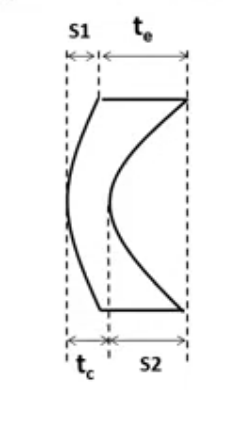
for a negative curved lens form
S1= sag of front surface
S2= Sag of back furface
tc= centre thickness
te= edge thickness
if surface powers, centre thickness and lens diameters are know, then edge can be predicted
minus powered lens as front surface flat and rear is curved
tc + S2= S1 +te
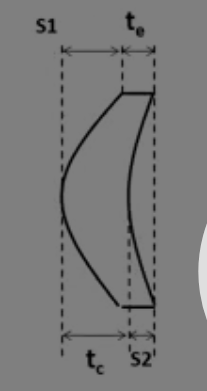
positive curved lens form
positive powered lens
front surface more powerful as its very curved compared to the lower powered rear surface
indicates that front surface is a high plus surface rear surface low minus lens. showing the lens is positive tc +S2 = S1 +te
calculating sag from surface power - working out edge thickness from surface power
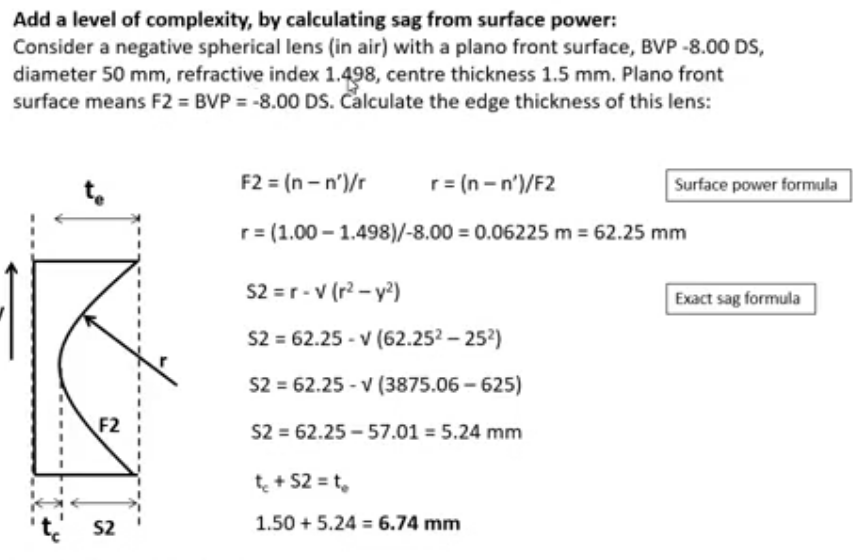
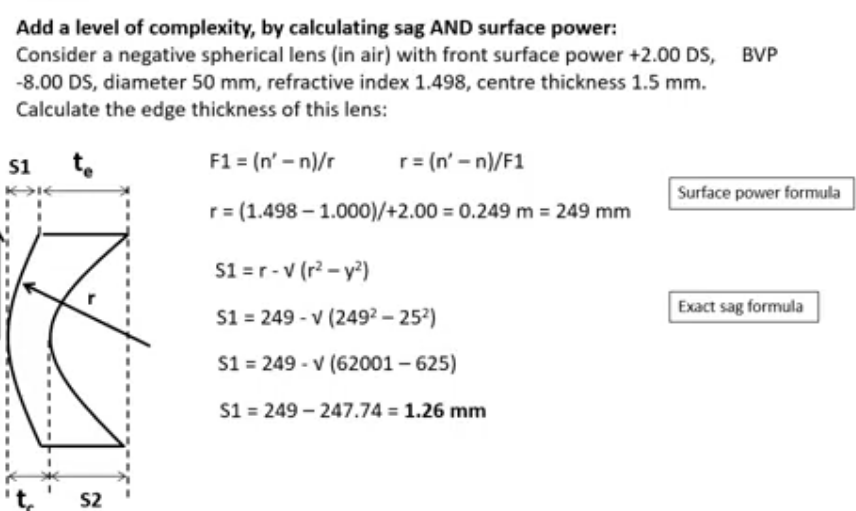
adding sag and surface power
curved surface so more needed
working out rear surface power
rear surface power needed to work out S2 if front surface is +2.00 and and overall is -8
so need the rear surface to be around -10
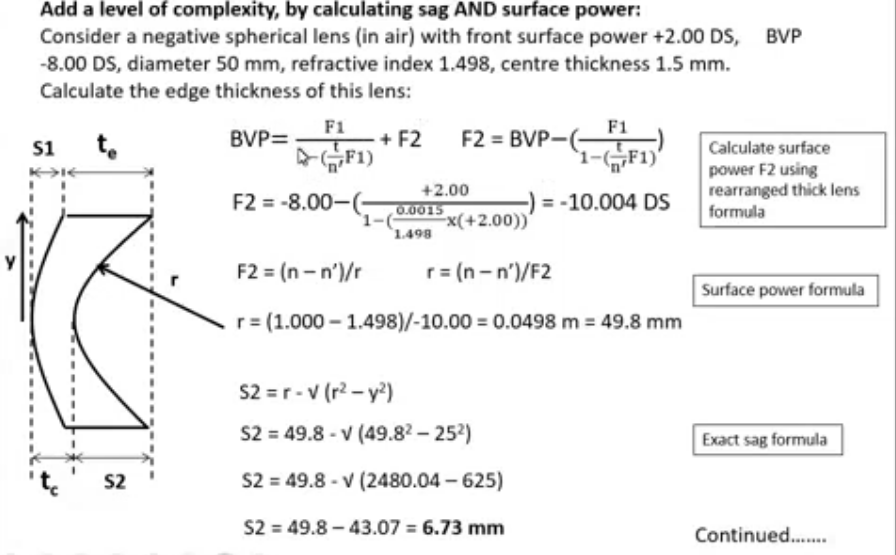
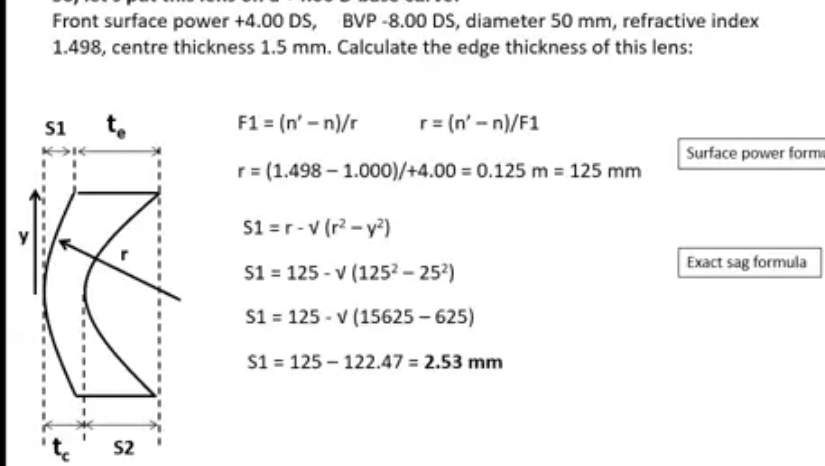
calculating edge thickness when base curve ( front surface of lens) and its effect on edge thickness
as the base has changed to +4.00 more positive, more negative
sag is going to be bigger, radius smaller
power is needed in the rear surface
means edge surface is going to be thicker
a more positive base curve increases sag of both surfaces and increases edge thickness
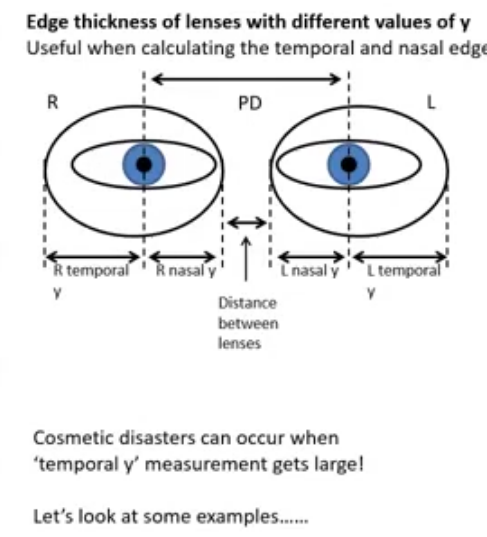
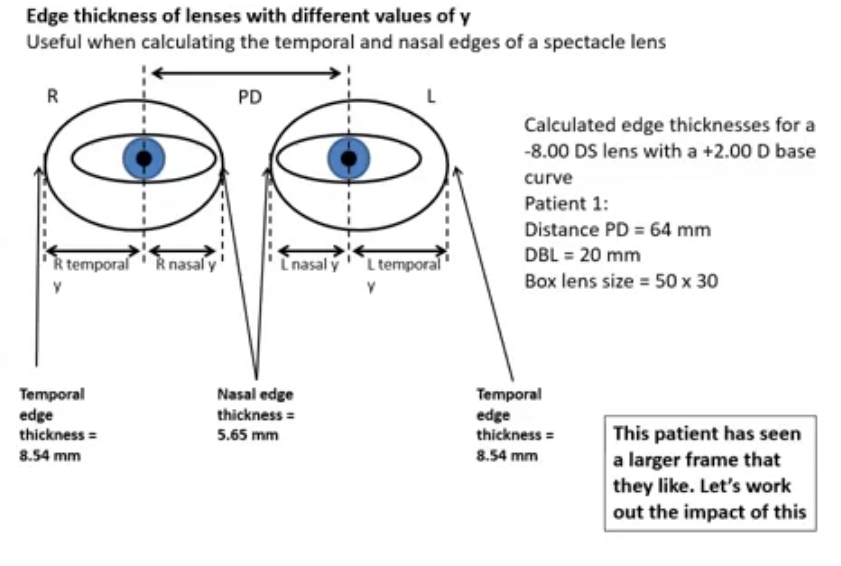
edge thickness of lenses with different values of y
useful when calculating the temporal and nasal edges of spectacle lens
for each eye, temporal y and nasal y = horizontal lens size
distance between the centres of the two lenses is usually larger than the patients PD
temporal y is usually greater than nasal y
if frame was made smaller, tempral y value reduces as thickness reduces
if made bigger, value increases
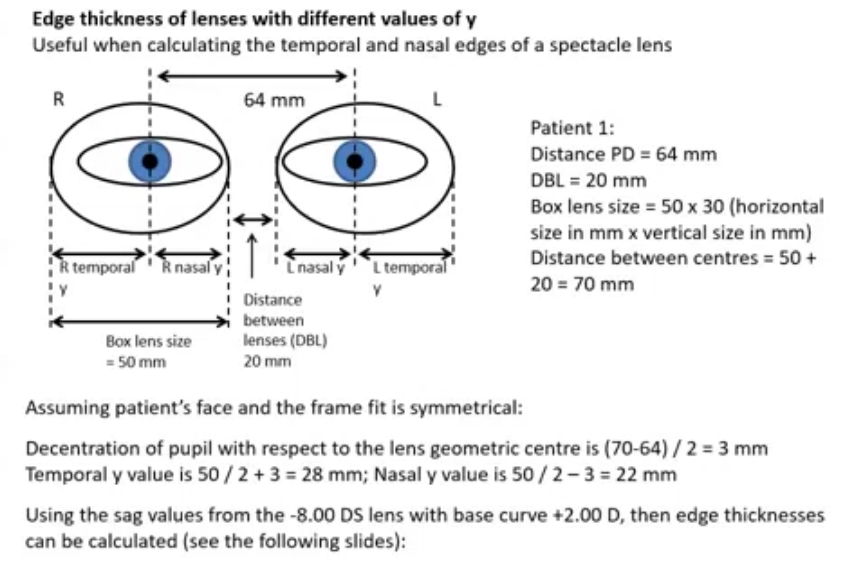
box lens size
measured from temporal y to nasal y
will see in the case of box lens size being 50 : see 50 20 135
50 is horizontal box lens
20 is the distance between lenses
135 is total length of the side
whats decetration of pupil
pupil isnt centere correctly, so the geometric centre of the pupil no longer represents the true optical centre of vision
impact of patient wearing a larger frame
larger box lens size
so larger temporal edge thickness
patient would not want thick lenses so important to pick th right frame
keeping lenses thin for a myope
consider a high refractive indes lens material
go for smallest frame possible, but keep field of view in ming, keeps pupils in middle, which keeps thickness even
small eye size- minimises thickness
avoid lens shapes with points a long way from required optical centre
try match distance between geometric centres with patients PD
choose a frame where the BVP can be as small as possible
choose frame where the rims and side configuration can hide some of the edge thickness
edge the lenses so that the bevel is at the front of the lens- this prevents a thick lens edge protruding form the front of the frame
keeping lenses thin for a hypermetrope
consider a high refractive index lens material
choose the finished lens blank size with care. many workshops will carry a stock of finished single vision lenses ; 65 m diameter for plus powers and 70 mm diameter for minus powers
glazing a 65mm lens of high plus power into a small frame can produce bad results - make eyes look small
should use smaller blank size