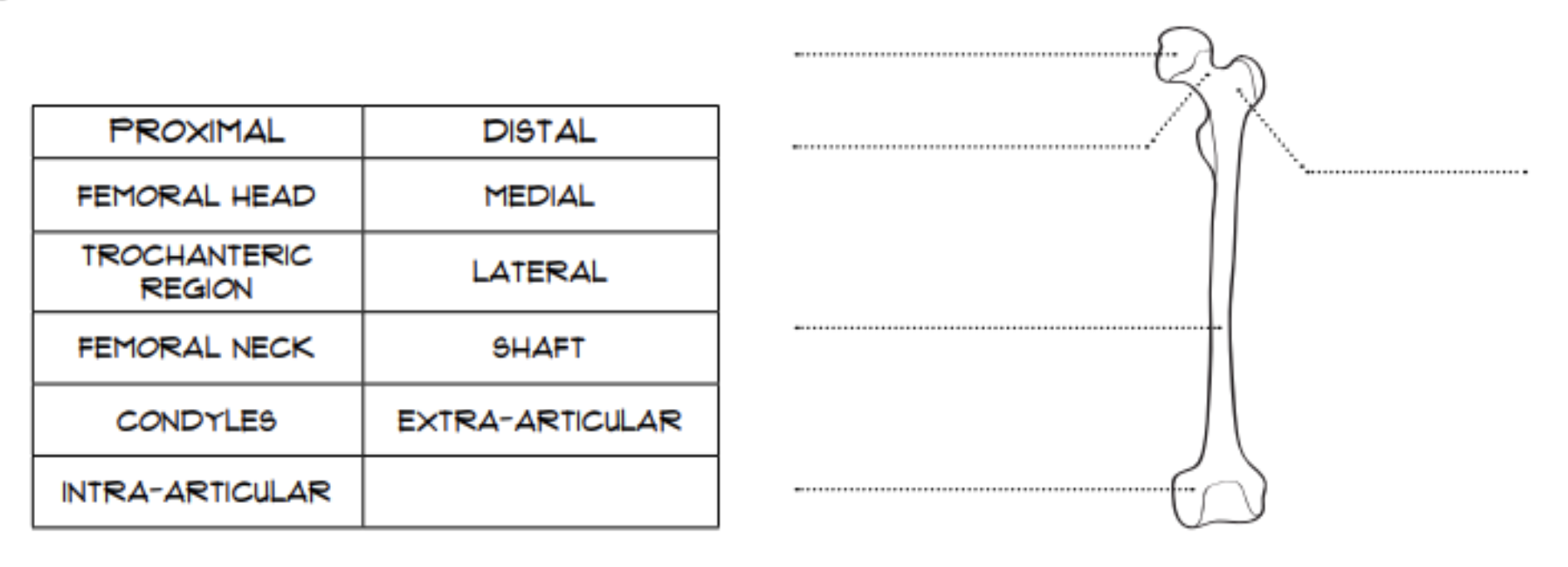
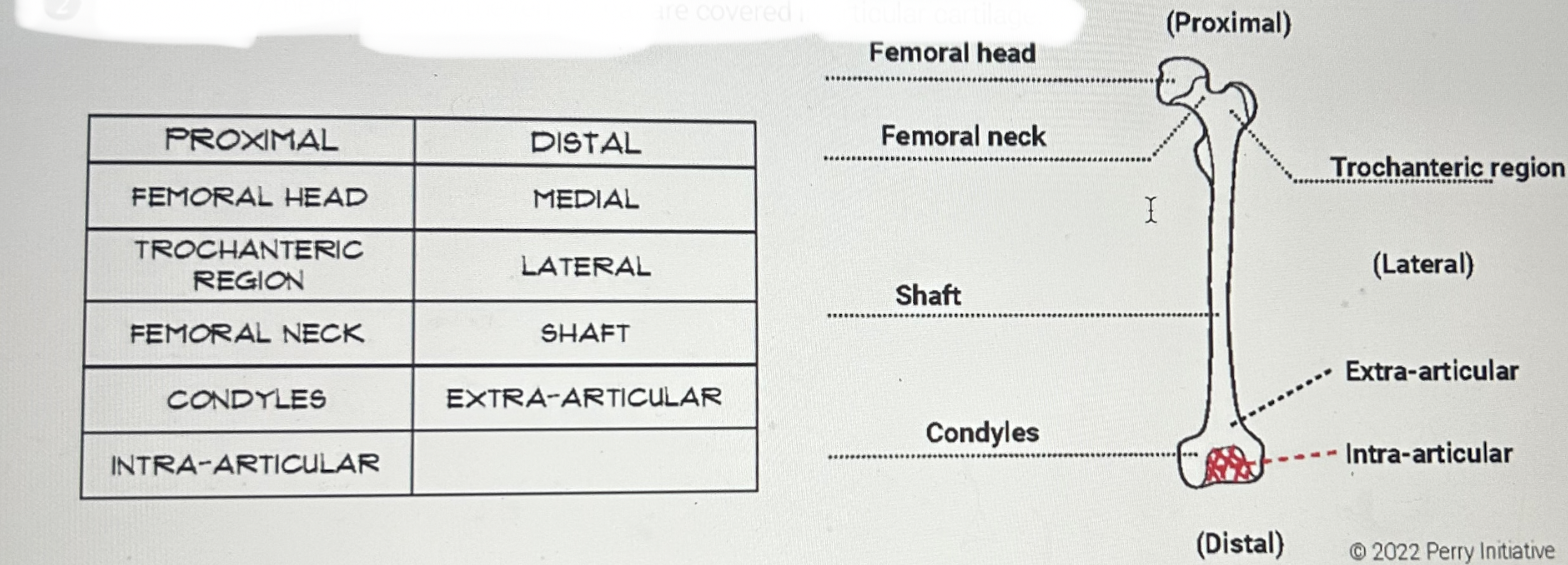
3) Bones
 Call Kai
 Learn
Learn Practice Test
 Spaced Repetition
 Match
Match Flashcards
 Knowt Play
1/13

There's no tags or description
Looks like no tags are added yet.
Name | Mastery | Learn | Test | Matching | Spaced | Call with Kai |
|---|
No analytics yet
Send a link to your students to track their progress
14 Terms
Compact bone: location, function, made by what?
location: outside of spongy bone—-surrounded by periosteum
made w/ osteons
function: provide weight-bearing support
Spongy bone: location, function, made by what?
location: inside compact bone
contains bone marrow
function: provides flexibility
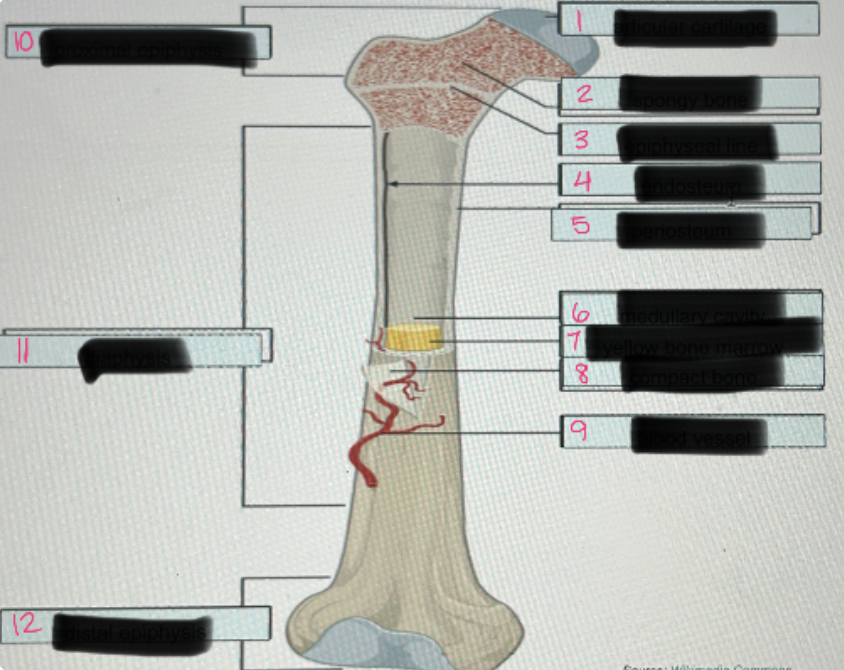
label:
yellow bone marrow
proximal epiphysis
spongy bone
compact bone
epiphyseal line
diaphysis
distal epiphysis
endosteum
articular cartilage
blood vessel
periosteum
medullary cavity
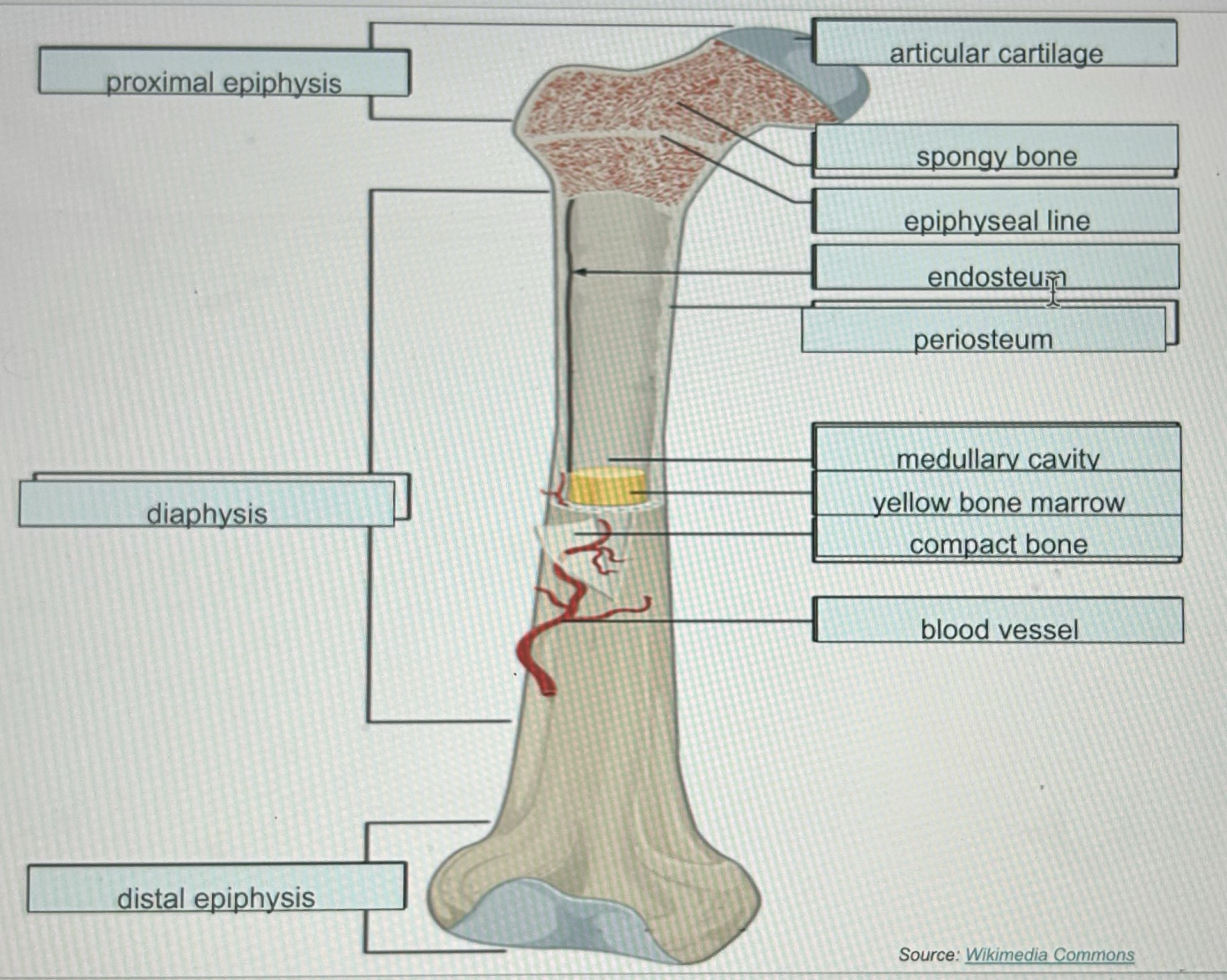
4 types of bone fractures (1 extra) & how does it look like?
Transverse = broken directing across (straight line)
Oblique = straight line broken at an angle
comminuted = broken into tiny pieces (most severe)
Spiral = diagonal fracture that wraps around & through the bone’s axis
Greenstick = partial, incomplete break where the bone bends and cracks on one side only
How are the bone fractures broken?
Transverse = strong force applied perpendicular
Oblique = sharp angled blow to the bone
comminuted = high-energy, high-impact trauma, severe force
Spiral = twisting force
Greenstick = bone bends and cracks
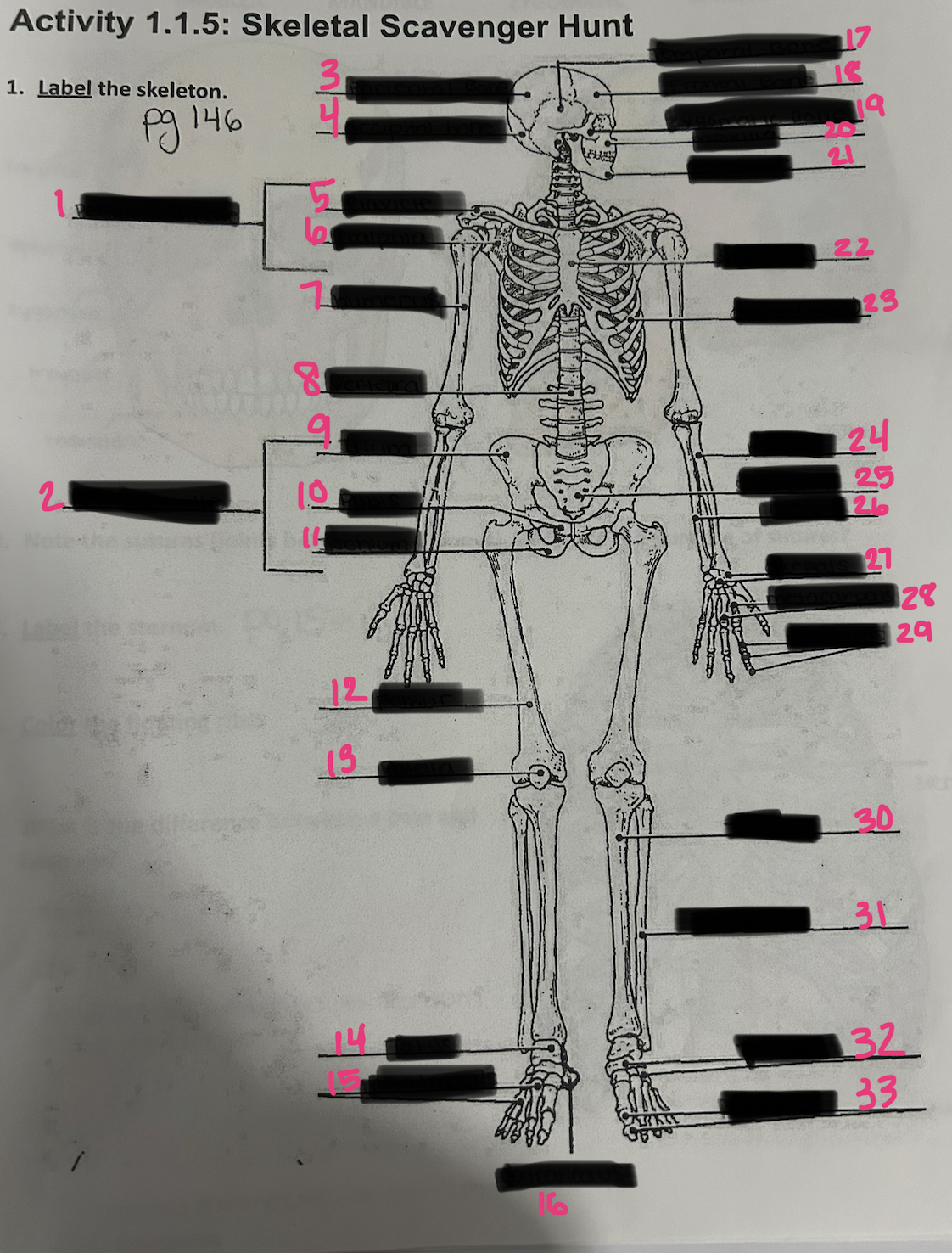
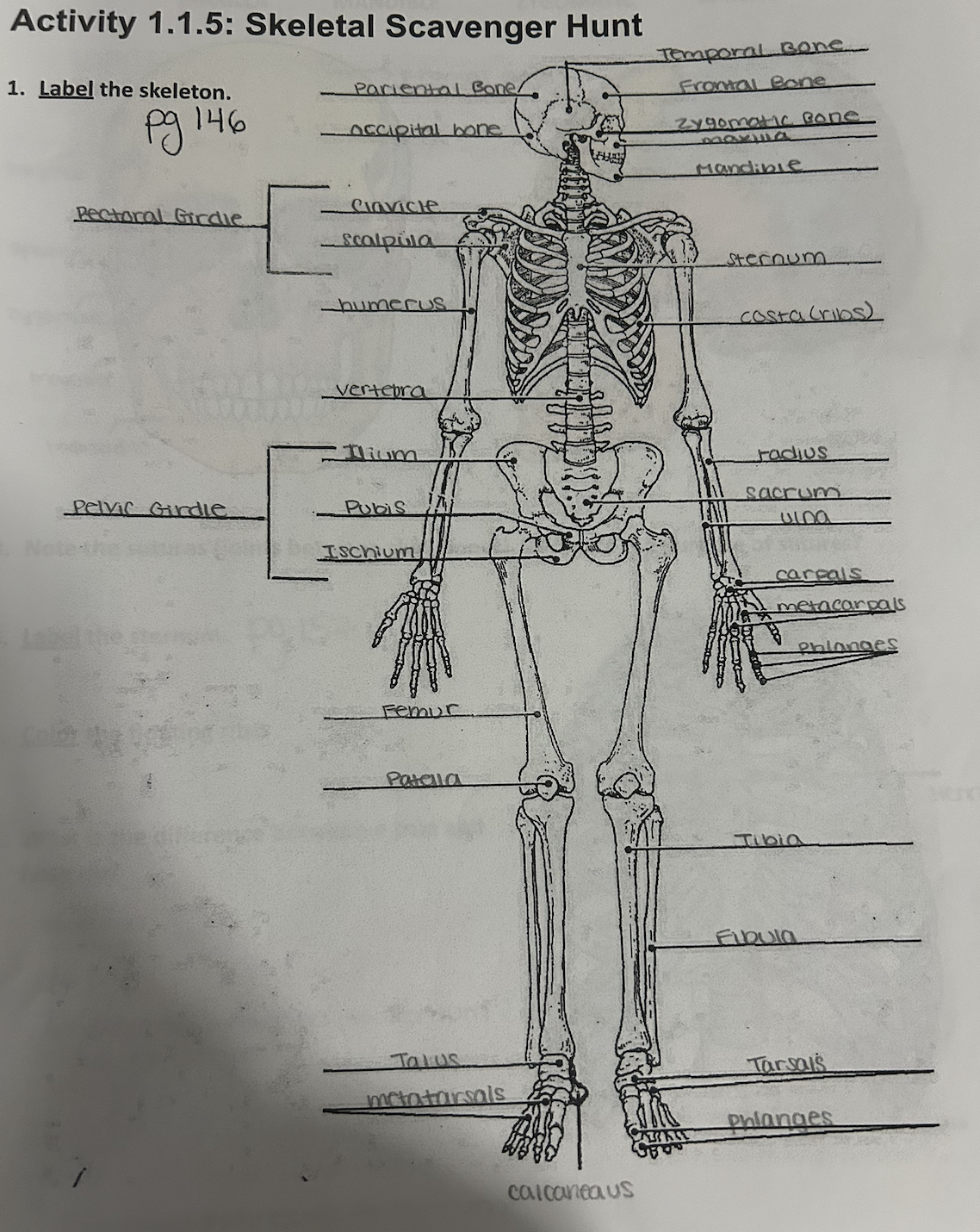
parietal bone
clavicle
temporal bone
zygomatic bone
occipital bone
scapula
frontal bone
maxilla
pectoral girdle
pelvic girdle
mandible
humerus
Ilium
sternum
radius
vertebra
pubis
costa
sacrum
Ischium
patella
ulna
metacarpals
femur
talus
carpals
phalanges (2 places)
metatarsals
tibia
fibula
tarsals
calcaneus
Osteoclasts vs Osteoblasts?
Osteoblasts = bone-forming cells
Osteoclasts = reabsorbs bone
Main steps of bone reformation?
1. Inflammation:formation of a hematoma at the break——(mass of clotted blood)
2. formation of a fibrocartilaginous (soft) callus——(fibers tie ends of bone together)
3. formation of a bony (hard) callus——(osteoblasts convert fibers to bone)
4. remodeling and addition of compact bone—-(osteoclasts re-absorb bone)
4 types of bones?
Long, short, irregular, flat
Flat bones (description & examples)
layer of spongy bone between 2 thin layers of compact bone
marrow, no marrow cavity
EX) Frontal, Parietal, Occipital
Long bones (description & examples)
shaft, 2 ends, & longer than it is wide
thick outside layer w/ marrow-filled cavity
ends of bone = spongy bone
EX) Humerus, Femur, Radius
Irregular bones (description & examples)
thin layers of spongy bone, surrounded by compact bone
EX) Vertebrae, Sacrum, Maxilla
Short bones (description & examples)
Roughly cubic in shape
mostly spongy bone
outside surface = thin layer of compact bone
EX) Carpals, Tarsals