Chromatography
 Call Kai
 Learn
Learn Practice Test
 Spaced Repetition
 Match
Match Flashcards
 Knowt Play
1/21

Earn XP
Description and Tags
Name | Mastery | Learn | Test | Matching | Spaced | Call with Kai |
|---|
No analytics yet
Send a link to your students to track their progress
22 Terms
What is chromatography?
An analytical technique that relies on different components of a sample having different affinities to the mobile and stationary phases.
What is the mobile phase?
The part that carries the soluble components of the mixture with it.
True or false? The more soluble the component in the mobile phase, the faster it moves.
True.
What is the stationary phase?
The part that holds back the components of the sample that are attracted to it.
True or false? The greater the affinity a component of the solute has for the stationary phase, the faster it moves.
False. THE GREATER THE AFFINITY A COMPONENT OF THE SOLUTE HAS FOR THE STATIONARY PHASE, THE SLOWER IT MOVES.
Talk me through the process of thin-layer chromatography (TLC).
1) Draw a pencil line 1 cm up from the bottom of the glass/metal/plastic sheet coated with silica gel or alumina.
2) Using a capillary tube, dot the sample on the pencil line and wait for it to dry.
3) Place some solvent in a developing chamber.
4) Place the glass/metal/plastic sheet coated in silica gel or alumina in the developing chamber, making sure the pencil line is not submerged in the solvent.
5) Wait until the solvent has moved roughly ¾ up the glass/metal/plastic sheet coated with silica gel or alumina, then remove it from the developing chamber.
6) Wait for the glass/metal/plastic sheet coated with silica gel or alumina to dry.
7) Analyse it by putting it under ultraviolet light OR by using a chemical stain to make everything visible.
(Same process as paper chromatography except paper is replaced).
Give four advantages of using TLC over paper chromatography.
TLC runs faster.
Smaller amounts of mixture can be separated in TLC.
The components of the mixture tend to spread out less.
The plates are more robust than paper.
What is the solvent front?
The distance moved by the solvent.
Rf = ?
Rf = distance moved by solute / solvent front
True or false? Rf values should always be less than 1.
True.
What is the stationary phase in column chromatography?
A powder or a resin.
Give two examples of powders that can be used in column chromatography.
Silica, aluminium oxide.
Describe what a chromatogram from column chromatography looks like.
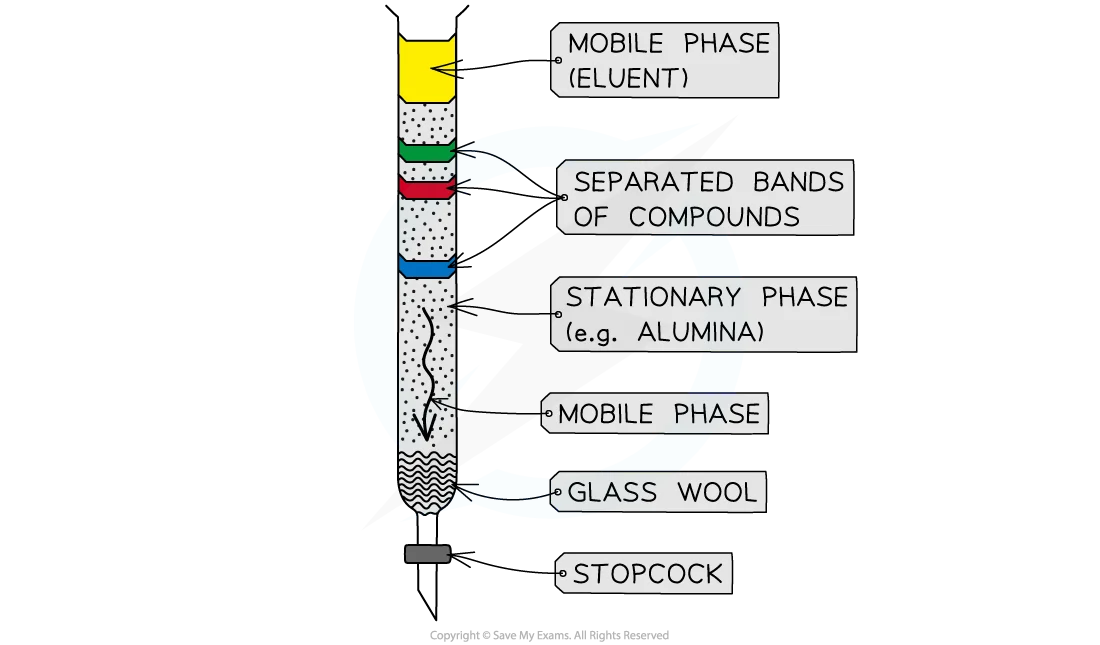
Talk me through how column chromatography works.
1) Pack glass wool into the bottom of the burette.
2) Fill up the rest of the burette with the stationary phase.
3) Add the eluent to the top of the burette, different components of the eluent will move through the stationary phase at different rates.
4) Collect each separated component in a flask (these can be further analysed if you want).
What does eluent mean in column chromatography?
The mixture that is going to be separated (column chromatography equivalent of solute).
Describe the different components of the setup for gas-liquid chromatography (GC).
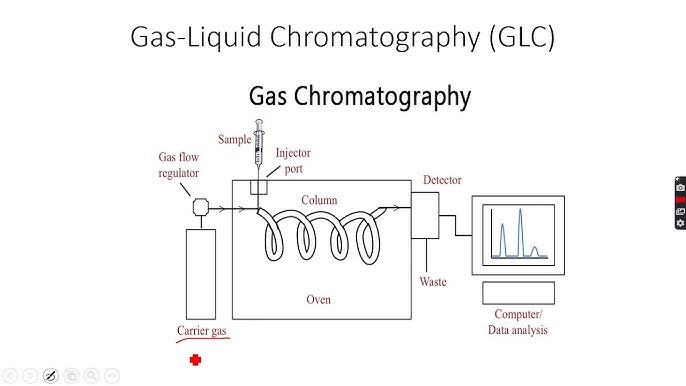
What is the stationary phase in gas-liquid chromatography?
A powder coated with oil.
What does the mobile phase tend to be in gas-liquid chromatography?
An unreactive gas.
Talk me through how gas-liquid chromatography works.
1) The sample is injected into the column (tube) containing the stationary phase.
2) The sample is carried along the column by the carrier gas, some components are more retained by the oil some are more carried by the gas. This happens at a high pressure/temperature.
3) A detector (automated and computer controlled) records a certain property of the component (e.g. mass spectrometer) when it leaves the column.
What does retention time mean in gas-liquid chromatography?
The time at which the component leaves the column containing the stationary phase.
Give one advantage of gas-liquid chromatography.
It can separate very minute traces of substances.
What is GCMS?
When components separated in gas-liquid chromatography (aka gas chromatography) are directly fed into a mass spectrometer to analyse them after it’s retention time has been noted.