AP PreCalc
 Call Kai
 Learn
Learn Practice Test
 Spaced Repetition
 Match
Match Flashcards
 Knowt Play
1/49

There's no tags or description
Looks like no tags are added yet.
Name | Mastery | Learn | Test | Matching | Spaced | Call with Kai |
|---|
No analytics yet
Send a link to your students to track their progress
50 Terms
Describe symmetry for even and odd functions
Even- symmetry to the y-axis
Odd- symmetry to the origin
Y-intercepts when domain is all real numbers
Input x=0 and solve
y=f(x-h)+k
-h is horizontal right, k is vertical up
Composite functions
f(g(x)), solve g(x) then f(x)
y-coordinate at x=5
Input x=5 and solve for y
X-intercepts when domain is all real numbers
Input y=0 and solve for x
Domain of a function
Exclude inputs that cause 0 in denominator or negative radicands
BOBO, BOTN, EATS D/C
Defines horizontal asymptotes
BOBO (Big on Bottom) =0
BOTN (Big on Top) =None
EATS D/C (Exponents are the same) =Divide Coefficients
When does a rational function have a hole
Hole if you cancel a factor from numerator and denominator
Relationship between function’s degree and the # of zeroes
Tells the maximum number of zeros (complex/ both real and imaginary)
Relationship between domains & ranges of inverse functions
Domain of f = Range of f-1
Range of f = Domain of f-1
Logarithmic to Exponential
log2x=2
22=x
Change of base formula for log
log312=log12/log3
(If no base is shown, it is base 10)
Unit circle (degrees and radians)
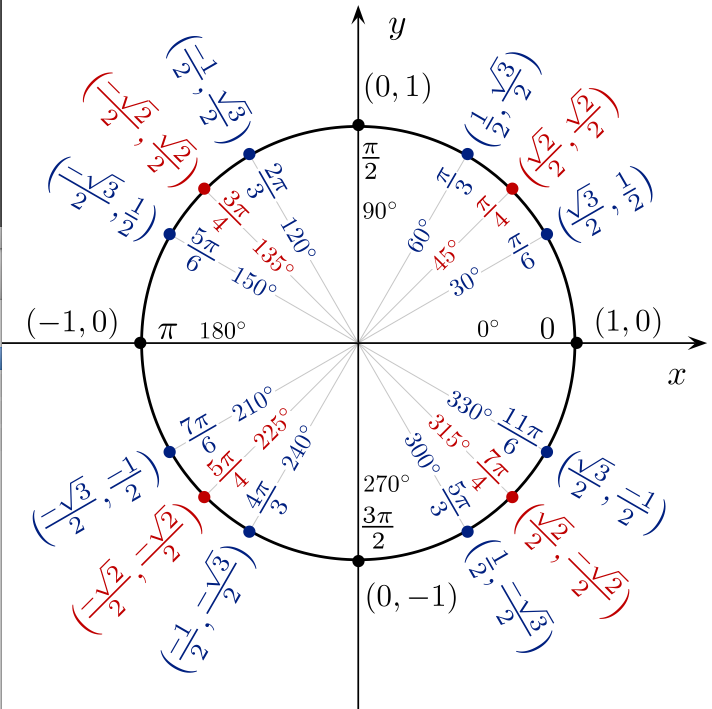
Which trig functions are even and which are odd
Even: cos, sec
Odd: sin, csc, tan, cot
With SOH CAH TOA, sin and tan are 1 and 3, cos is 2 (even), same with inverses
Number of x-ints in sin and cos graph
Sin and cos have infinitely many intercepts
Relationship between sin and cos graphs
cos is a phase-shifted sin graph, left pi/2 radians
Amplitude and period of y=asin(b(x-c))+d
amplitude: absolute value of a
period: 2pi/absolute value of b
Vertical asymptotes of y=tanx, y=cotx, y=secx, and y=cscx
Find where the function is undefined and when the denominator =0
(tanx)(cosx)
(sinx)
Sum and difference formulas for sin and cos
sin(u±v)= sinu cosv ± cosu sinv
cos(u±v)= cosu cosv ∓ sinu sinv
Forms of cos(2u)
cos2u-sin2u
2cos2u-1
1-2sin2u
Which shape has interior angles with a sum of 360
Quadrilaterals
How can a triangle be solved (methods)
Law of sines
Law of cosines
Methods to finding triangle area
A=1/2bh
A=1/2absinC
Number of polar descriptions for a point
Infinitely many ways
Number of rectangular descriptions for a point
One way
Values of r and ∅ in polar pairs
r: directed distance from origin
∅: directed angle from polar axis
Polar graphs passing through the pole
Limacons with inner loops
Roses
Polar to rectangular / rectangular to polar form
x=rcos∅
y=rsin∅
r2=x2+y2
tan∅=y/x
Identifying coterminal angles
add or subtract multiples of 360 degrees or 2pi
Techniques for evaluating limits
direct substitution
factoring and canceling
rationalizing the numerator/denominator (conjugating)
Domain of a log function
Set the argument >0 and solve
Marine motto
Semper fidelis
always faithful
Solutions of a linear system
One, none, or infinitely many solutions
three indeterminate forms
0/0
∞/∞
0∞
Solving an absolute value equation
Isolate the express and set the argument to ± the constant
|x-3|=5 turns into x-3= ±5
Two uses of the horizontal line test
Determines if function is one-to-one
Checks if inverse is a function
Relationships of exponential and log limits
They mirror across line y=x
Vertical asymptotes convert to horizontal asymptotes
3 rules of logs
Product rule: log(uv)=log u + log v
Quotient rule: log (u/v)=log u - log v
Power rule: log (un)= n log u
Term for successive differences in arithmetic sequences
common difference
like 3,7,11,15 all have a difference of 4
Calculating AROC
(y2-y1)/(x2-x1)
Requirements for continuity at x=b
f(b) is defined
lim as x approaches b of f(x) exists
lim as x approaches b of f(x) = f(b)
Define a limit
the behavior of a function as we approach a certain input value
How are end behaviors determined
Check if the leading coefficient is negative or positive
Check if the highest exponent is odd or even
Limits at infinity and horizontal aymptotes
the lim as x approaches ± ∞ of f(x)=L, and the horizontal asymptote is y=L
Finding horizontal asymptotes of rational functions
Compare degrees of top and bottom
Use the bobo, botn, eats d/c rules
Writing the limit equation
lim as x approaches 3 of x²=9
Write two limit expressions (one left-hand limit and one right-hand limit)
Left: lim as x approaches c- of f(x)
Right: lim as x approached c+ of f(x)
Why do some limits not exist
Left and right limits do not match
The function goes infinitely
The function grows without bound (±∞)