Psychology exam 1
 Call Kai
 Learn
Learn Practice Test
 Spaced Repetition
 Match
Match Flashcards
 Knowt Play
1/52

Earn XP
Description and Tags
LO 1
Name | Mastery | Learn | Test | Matching | Spaced | Call with Kai |
|---|
No analytics yet
Send a link to your students to track their progress
53 Terms
Neurons
Exhibit tremendous diversity in shapes and sizes reflecting their differing processing functions
Glial cells
affect neuronal processes by providing neurons with raw materials, chemical signals, and specialized structural components
Astrocytes
A star-shaped glial cell with numerous processes (extensions) that run in all direction
Oligodendrocytes
forms myelin in the central nervous system.
Schwann cells
forms myelin in the peripheral nervous system.
Microglia
Extremely small motile glial cells that remove cellular debris from injured or dead cells.
Golgi
Stains the full extent of neurons; small percent of neurons
Nissl
Stains the cell bodies of neurons; estimates relative densities of cell bodies
Dendrites
An extension of the cell body that receives information from other neurons.
Cell body/soma
The region of a neuron that is defined by the presence of the cell nucleus
Axon
A single extension from the cell body that carries action potentials from the cell body toward the axon terminals.
Axon hillock
The cone-shaped area on the cell body from which the axon originates.
Axon terminals
End part of a neuron that releases neurotransmitters to send signals to another cell
Synapse
The cellular location at which information is transmitted from a neuron to another cell.
Synaptic vesicles
A small, spherical structure that contains molecules of neurotransmitter.
Presynaptic
the “transmitting” side of a synapse
Postsynaptic
the region of a synapse that receives and responds to neurotransmitters
Neurotransmitter
Signaling chemicals released by one neuron that cross the synapse and affect another neuron, allowing neurons to communicate
Receptors
A specialized protein, embedded in the cell membrane, that selectively senses and reacts to molecules of a corresponding neurotransmitter
Myelin
fatty insulation around an axon, formed by glial cells
Central
Processes information and control responses (Contains spinal cord and brain cord)
peripheral
All nerves outside the brain and spinal cord
Autonomic
A part of the peripheral nervous system that provides the main neural connections to the internal organs
Somatic
The somatic nervous system controls movement and carries sensory information between the body and brain
Sympathetic
The part of the autonomic nervous system that acts as the fight-or-flight system, generally preparing the body for action
Parasympathetic
The part of the autonomic nervous system that generally prepares the body to relax and recuperate.
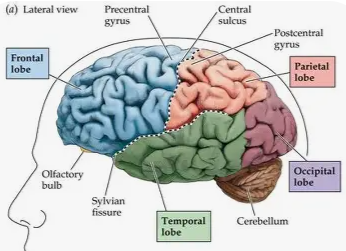
Cerebral cortex
Outer layer of the brain responsible for thinking, memory, senses, and voluntary movement
Gyri
A ridged or raised portion of the cortical surface.
Sulci
A crevice or valley of the cortical surface.
Gyrus
A raised ridge or fold on the surface of the brain
Sulcus
A groove or indentation between the folds of the brain
Frontal Lobe
anterior portion of the cerebral cortex (Thinking, decision making, and movement)
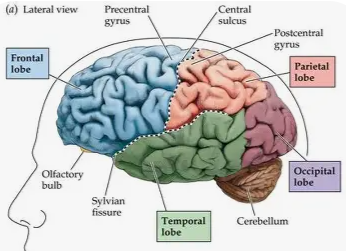
Parietal
The large region of cortex lying between the frontal and occipital lobes in each cerebral hemisphere (Touch and sensory processing)
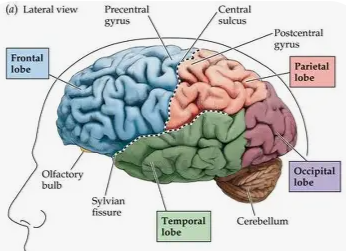
Temporal
The large lateral region of cortex in each cerebral hemisphere (Hearing, memory, language)
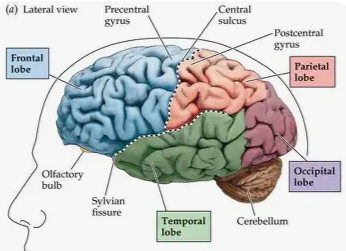
Occipital lobe
large region of cortex that covers much of the posterior part of each cerebral hemisphere.
Corpus callosum
The main band of axons that connects the two cerebral hemispheres
Dorsal
toward the back of the body or the top of the brain
Ventral
toward the belly or front of the body, or the bottom of the brain
Rostral
toward the front/nose of the brain or body
caudal
toward the back/tail of the brain or body
White matter: myelinated axons
A light-colored layer of tissue, consisting mostly of myelin-sheathed axons, that lies underneath the gray matter of the cortex
Gray Matter: Cell bodies and dendrites
Areas of the brain that are dominated by cell bodies and are devoid of myelin
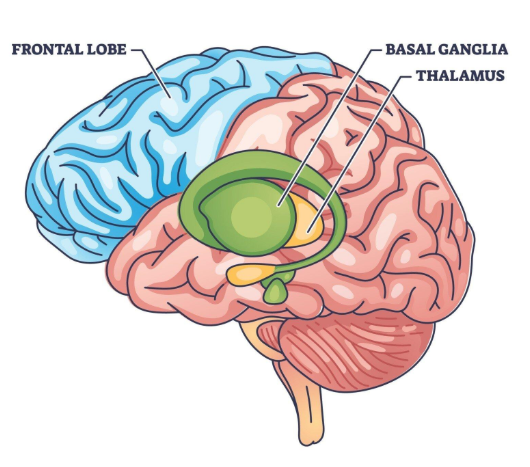
Basal ganglia
The basal ganglia are deep brain structures involved in movement and skill learning
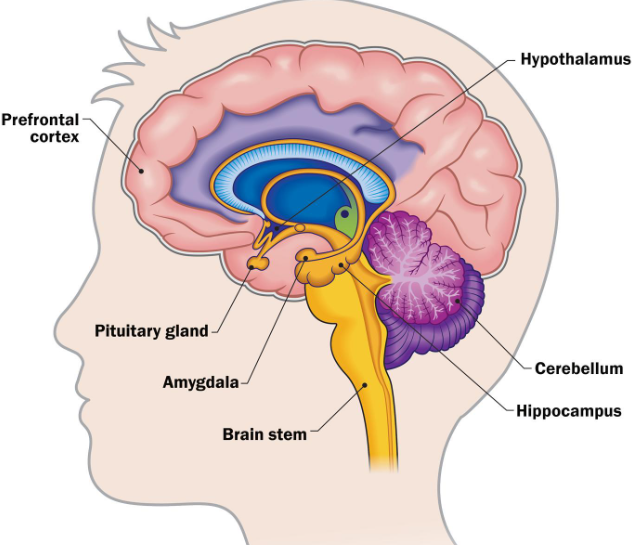
Amygdala
A group of nuclei in the medial anterior part of the temporal lobe
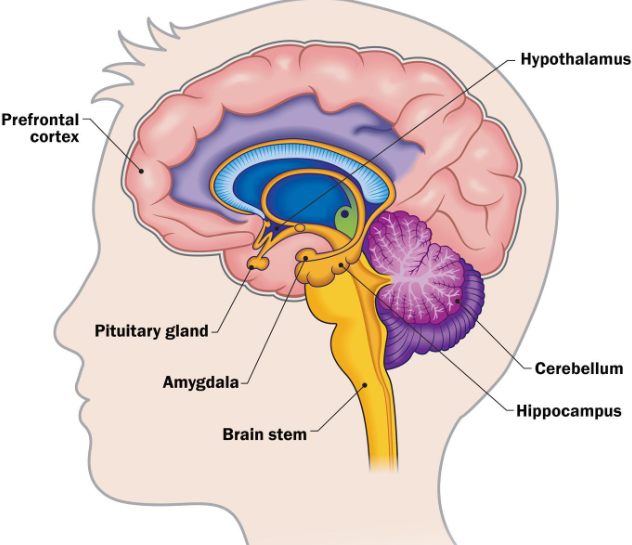
Hippocampus
A group of nuclei in the medial anterior part of the temporal lobe.
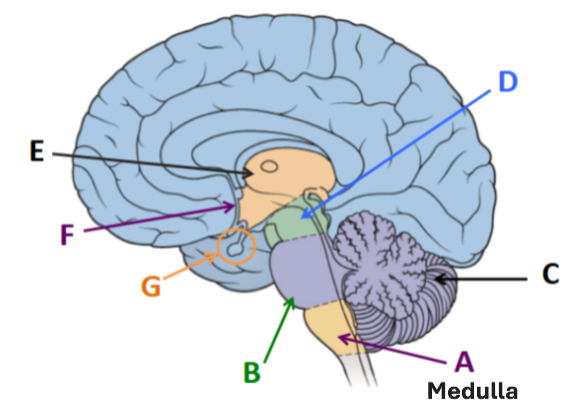
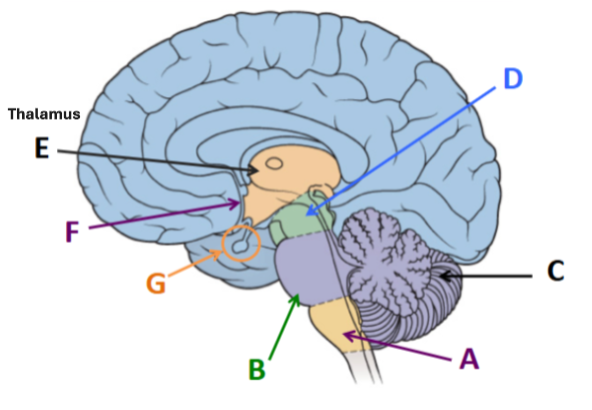
Thalamus
Paired structures to either side of the third ventricle (at the top of the brainstem) that direct the flow of sensory information to and from the cortex.
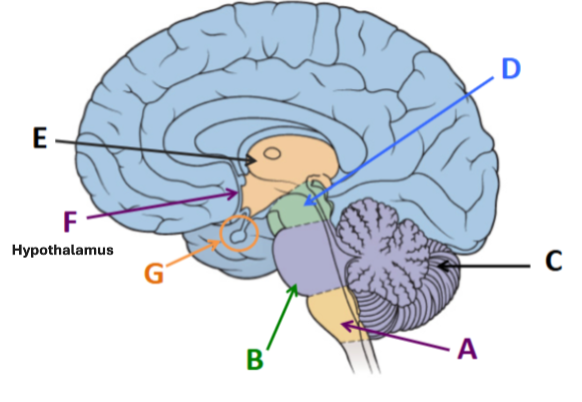
Hypothalamus
Part of the diencephalon, lying ventral to the thalamus
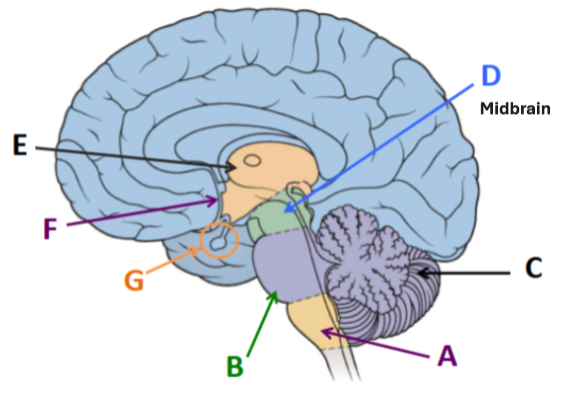
Midbrain
The middle division of the brain
Substantia nigra
a brain structure that helps control movement by producing dopamine.
Parkinson’s Disease
a disorder caused by loss of dopamine-producing cells, leading to tremors and movement problems.
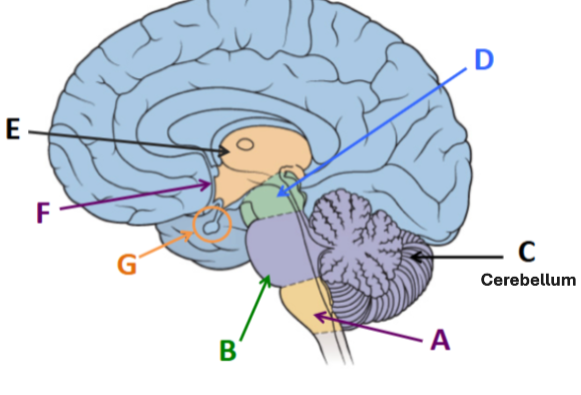
Cerebellum
A structure located at the back of the brain, dorsal to the pons, that is involved in the central regulation of movement and in some forms of learning.
Pons
The portion of the brainstem that connects the midbrain to the medulla.
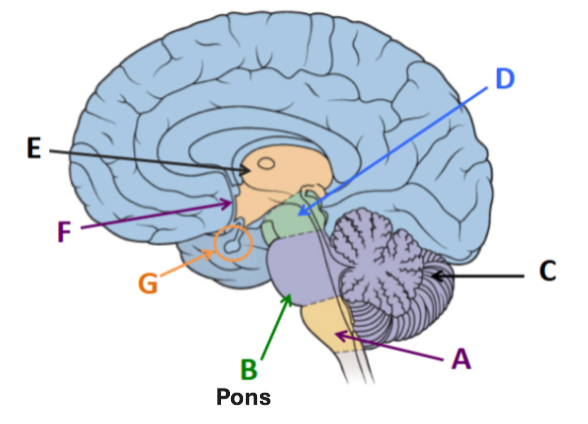
Medulla
The posterior part of the hindbrain, continuous with the spinal cord