Chapter 5, Emergency care: Medical Terminology
 Call Kai
 Learn
Learn Practice Test
 Spaced Repetition
 Match
Match Flashcards
 Knowt Play
1/20

There's no tags or description
Looks like no tags are added yet.
Name | Mastery | Learn | Test | Matching | Spaced | Call with Kai |
|---|
No analytics yet
Send a link to your students to track their progress
21 Terms
The Component of Medical Terms
Compounds are made up of two or more words
Smallpox
Words made from parts: roots
Therm meaning heat
Roots with combining form
Therm/o + meter = thermometer
Prefixes: Dyspnea, tachy-pnea
Suffixes: Arthritis, hemophiliac
World component example: Cardio (heart) logy (study of) Ist (someone who specializes in
Abbreviations and Acronyms
Acronym: Abbreviation made up of initials that can be pronounced as a word
CPAP (SEE-pap)
Constant positive airway pressure
Dissenting a Compound Word- Cholecystitis
CholeysitisChol/e meaning bile
Cyst meaning closed sac
It is meaning inflammation
Assembled = bile-sac-inflammation
Cholecystitis=inflammation of the gallbladder (which stores biles)1. Biological Fluid
A bitter, greenish-yellow fluid produced by the liver and stored in the gallbladder. It is released into the small intestine to aid in the digestion and absorption of fats. [1, 2]
When and When Not to use Medical Terms
Do not use when speaking to patients or family members
Occasionally complex terms used in messages can cause confusion even among trained healthcare professionals
If there is potential for ambiguity, it is better to use simple terms
The language of Anatomy and Physiology
Anatomy: Study of body structure
Physiology: Study of body function
Anatomical Terms
Directional Terms:
Facing forward
Hands at sides
Palms facing forward
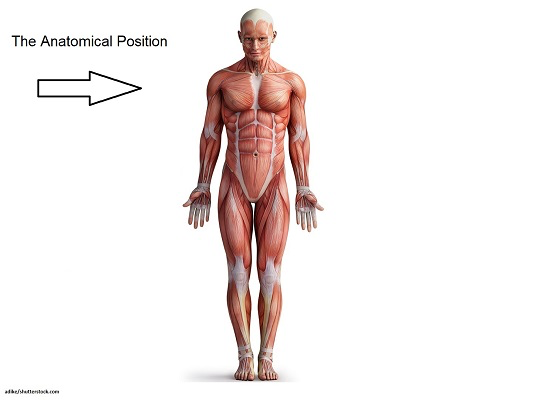
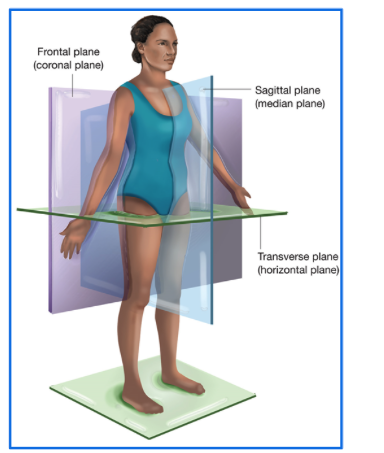
Divide body into planes
Midline
Medial is closer to the midline.
Lateral is farther from the midline.
Midline: An imaginary vertical line drawn straight down the middle of your body, separating your left and right sides.
Medial: Closer to that middle line. For example, your nose is medial to your eyes.
Lateral: Further away from the middle line. For example, your ears are lateral to your nose.
directional term (continuing)
Bilateral
“Both sides”
Unilateral
One side
Midaxillary line
Unilateral: Means affecting or occurring on one side of the body only. For example, a unilateral headache affects only the left or right side of your head. [1, 2, 3]
Bilateral: Means affecting or occurring on both sides of the body (or involving both paired organs). For example, bilateral knee pain means both of your knees hurt. [1, 2, 3]
Midaxillary line: An imaginary vertical line drawn straight down the side of the torso, starting exactly from the middle of your armpit. It serves as a spatial reference point for medical professionals used in physical assessments, listening to the lungs, or placing medical devices like ECG Leads. [1, 2, 3]
Directional terms
Anterior (ventral)
Front
Posterior (dorsal)
Back
Superior
Vertical, above
Inferior
Vertical, below
Anterior / Ventral: Refers to the front of the body. (e.g., Your kneecap is on the anterior side of your leg).
Posterior / Dorsal: Refers to the back of the body. (e.g., Your shoulder blades are on the posterior side).
Superior: Means above or closer to the head. (e.g., Your eyes are superior to your mouth).
Inferior: Means below or closer to the feet. (e.g., Your pelvis is inferior to your abdomen)
What is the Torso
The torso (also called the trunk) is the central core of the human body. It excludes the head, neck, and limbs. [1, 2, 3, 4]
What it Includes
Chest (Thorax): Houses the heart and lungs.
Abdomen & Pelvis: Contains the digestive and reproductive organs.
Back: Provides structural support and protects the spinal cord. [1, 2, 3, 4, 5]
Directional Terms (continuous)
Proximal
Closer to torso
Distal
Farther from torso
Palmar
Refers to the palm of the hand
Plantar
Refers to the sole of the foot
Proximal: A part of a limb or body part that is closer to where it attaches to the main trunk of the body.
Example: Your shoulder is proximal to your hand. [1, 2, 3, 4]
Distal: A part of a limb or body part that is farther away from where it attaches to the torso.
Example: Your toes are distal to your knee. [1, 2]
Palmar: Refers to the front or palm side of the hand.
Example: A blister on the inside of your hand is on the palmar surface. [1, 2]
Plantar: Refers specifically to the bottom or sole of the foot.
Example: The arch of your foot is on the plantar surface. [1, 2]
Body regions and anatomical position
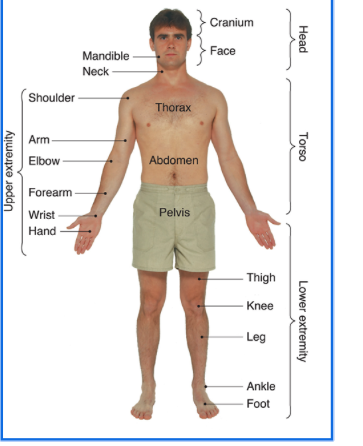
Directional Terms
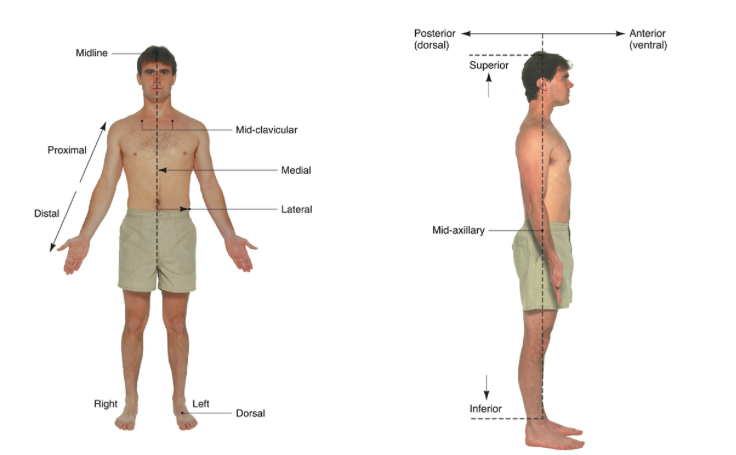
Directional Terms
Midclavicular line
Divides chest into regions
Since there are two clavicles, there are two mid-clavicular lines.
Clavicle and Midclavicular line
A clavicle is your collarbone—the small, curved bone running horizontally across the top of your chest, connecting your shoulder to your breastbone. A midclavicular line is an imaginary vertical line running straight down your body starting exactly from the midpoint of that collarbone. [1, 2, 3]
The Clavicle (Collarbone)
What it is: A palpable, long, slightly S-shaped bone located at the base of the neck.
Function: It acts as a strut to keep your shoulder blades in place, allowing your arms a wide range of motion. It also protects important nerves and blood vessels traveling from your neck to your arm.
Feel it: You can easily feel the clavicle just under the skin on the upper chest. [1, 2, 3, 4, 5]
The Midclavicular Line (MCL)
What it is: An imaginary reference line that starts at the exact middle of the clavicle and runs vertically down the front of your torso. [1]
Function in Medicine: Doctors and healthcare professionals use the MCL as a standard landmark to accurately map out and describe the positions of internal organs. [1, 2]
Common Uses:
Listening to the Heart: It helps locate the "apex beat" (the point of maximum impact for the heart) so a doctor knows exactly where to place a stethoscope.
Assessing the Liver: It is used to measure liver size and detect if the liver is enlarged.
Abdominal mapping: It divides the abdomen into nine distinct regions.
Emergency procedures: It is a key reference point for performing safe needle decompression of a collapsed lung (pneumothorax)
![<p><span>A </span><strong>clavicle</strong> is your collarbone—the small, curved bone running horizontally across the top of your chest, connecting your shoulder to your breastbone. <mark>A </mark><strong><mark>midclavicular line</mark></strong><mark> is an imaginary vertical line running straight down your body starting exactly from the midpoint of that collarbone</mark>. [1, 2, 3]</p><p>The Clavicle (Collarbone)</p><ul><li><p><span><strong>What it is:</strong> A palpable, long, slightly S-shaped bone located at the base of the neck.</span></p></li><li><p><span><strong>Function:</strong> It acts as a strut to keep your shoulder blades in place, allowing your arms a wide range of motion. It also protects important nerves and blood vessels traveling from your neck to your arm.</span></p></li><li><p><span><strong>Feel it:</strong> You can easily feel the clavicle just under the skin on the upper chest.</span> [1, 2, 3, 4, 5]</p></li></ul><p>The Midclavicular Line (MCL)</p><ul><li><p><span><strong>What it is:</strong> An imaginary reference line that starts at the exact middle of the clavicle and runs vertically down the front of your torso.</span> [1]</p></li><li><p><span><strong>Function in Medicine:</strong> Doctors and healthcare professionals use the MCL as a standard landmark to accurately map out and describe the positions of internal organs.</span> [1, 2]</p></li><li><p><span><strong>Common Uses:</strong></span></p><ul><li><p><span><strong>Listening to the Heart:</strong> It helps locate the "apex beat" (the point of maximum impact for the heart) so a doctor knows exactly where to place a stethoscope.</span></p></li><li><p><span><strong>Assessing the Liver:</strong> It is used to measure liver size and detect if the liver is enlarged.</span></p></li><li><p><span><strong>Abdominal mapping:</strong> It divides the abdomen into nine distinct regions.</span></p></li><li><p><span><strong>Emergency procedures:</strong> It is a key reference point for performing safe needle decompression of a collapsed lung (pneumothorax)</span><br><br></p></li></ul></li></ul><p></p>](https://assets.knowt.com/user-attachments/93fc5c05-7b01-4d33-a608-65541fdd91ac.png)
Planes of the Body
Directional Terms (abdominal Quadrants )
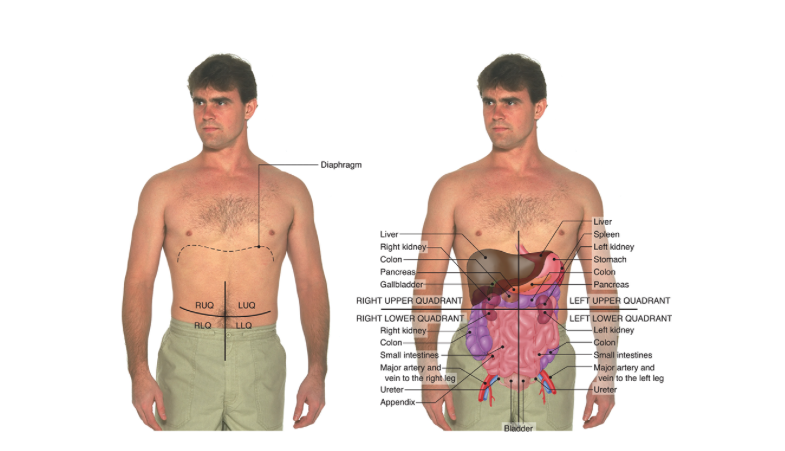
Horizontal and vertical lines through navel
Right upper quadrant (R U Q)
Left upper quadrant (L U Q)
Right lower quadrant (R L Q)
Left lower quadrant (L L Q)
This text describes the four abdominal quadrants, a standardized mapping system used by healthcare professionals to pinpoint and communicate the location of abdominal pain, organs, or clinical findings. [1, 2]When clinicians evaluate your abdomen, they imagine a crosshair intersecting directly over the umbilicus (navel/belly button) to divide the belly into four specific zones. [1, 2]
Understanding "Right" and "Left"
In medical terminology, "Right" and "Left" always refer to the patient's right and left sides, not the person looking at the body. For example, the Right Upper Quadrant is on your own right side. [1, 2, 3]
Breakdown of the 4 Quadrants
Each quadrant houses specific vital organs, which helps doctors quickly identify what might be causing symptoms: [1, 2, 3]
Right Upper Quadrant (RUQ): This zone contains the liver, gallbladder, right kidney, and parts of the small and large intestines. Clinicians check this area if they suspect issues like gallstones. [1, 2, 3]
Left Upper Quadrant (LUQ): This zone holds the stomach, spleen, pancreas, left kidney, and parts of the intestines. Pain here can sometimes indicate gastric reflux or spleen issues. [1, 2, 3]
Right Lower Quadrant (RLQ): This zone houses the appendix, cecum, the right ureter, and right reproductive organs (like the right ovary in females). Sharp pain in this quadrant is a classic warning sign for appendicitis. [1, 2, 3, 4]
Left Lower Quadrant (LLQ): This zone contains the sigmoid colon, the left ureter, and left reproductive organs (like the left ovary in females). It is a frequent site for pain related to diverticulitis or intestinal cramps. [1, 2, 3, 4, 5]
Abdominal Quadrants
Positional Terms
Supine
Patient lying on back
Prone
Patient lying on abdomen
Recovery (lateral recumbent)
Patient lying on side
Preferred for any unconscious nontrauma patient
Positional Terms
Fowler
Patient seated straight up
Semi-Fowler
Leaning back in a semi-sitting position
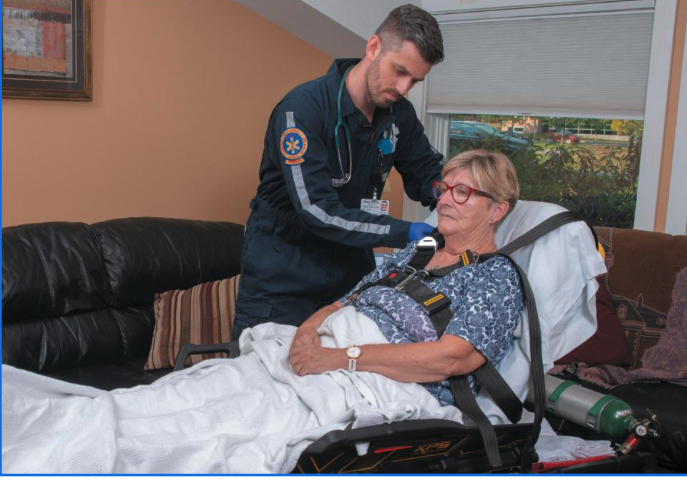
Semi-Fowler position